• Our new ticketing site is now live! Using either this or the original site (both powered by TrainSplit) helps support the running of the forum with every ticket purchase! Find out more and ask any questions/give us feedback in this thread!

Has the COVID Crisis changed our attitude to risk?

Status
Not open for further replies.

DB

Guest
Joined
18 Nov 2009
Messages
5,036
The UK, for instance (more specifically mainland GB), which is probably vaguely comparable to NZ being a smallish but reasonably sized island nation

The population density of the UK (England particularly, plus the central belt of Scotland and South Wales) is much higher than New Zealand.

New Zealand's largest uran area, Auckland, is smaller than the conurbations of Birmingham / Manchester / Glasgow, and of course massively smaller than London - and it has no other cities of over a million people. In practice this will mean that a virus like this, which spreads most easily in crowded conditions, will be much harder to eradicate here.
 
Sponsor Post - registered members do not see these adverts; click here to register, or click here to log in
R

RailUK Forums

yorkie

Forum Staff
Staff Member
Administrator
Joined
6 Jun 2005
Messages
78,548
Location
Yorkshire
The problem with this all is that other than a vaccine or effective treatment there isn't an exit strategy that doesn't involve lots of people dying and health services being overwhelmed.

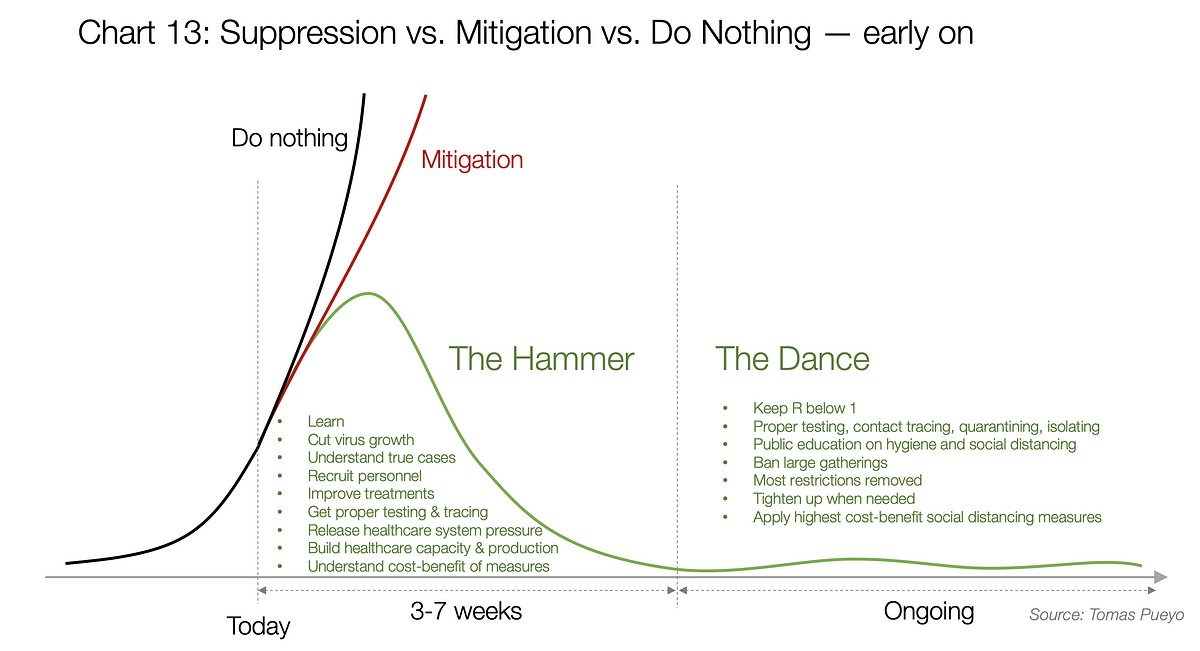
It is clear to me that we are following this:

...and I'm not sure of any other sensible way out, really.
That's quite an old article now, so I'd be interested to something more recent. It also makes some claims I find difficult to believe, such as that the virus has already mutated in a form that won't be covered by immunity.

Fundamentally it says the aim is to "control this virus until we have a vaccine" which means it's not aiming at irradiation the virus nor does it offer an exit strategy other than "buying time" for a vaccine to become available.

To be honest, that's not really any different to what Sweden are doing; it just becomes a question of how much you control it.

If you try to eliminate almost all risk of transmission, you keep cases very low but you drag it out for such a long time that your only exit strategy remains a vaccine.

If you take a more proportionate approach where the overall risks of other things are considered, you accept you are going to get more infections, but at a controlled rate, and you have the backup strategy that if a vaccine does not become available soon then you at least have a chance of reaching a reasonable level of immunity across the population that you can at least go back to normality in a reasonable time frame.

So I think we are in agreement that the debate isn't about what strategy to take as such but how to apply that strategy and to what extent we mitigate different risks?

It can be eradicated...
WHO say otherwise:
"We have all got to learn to live with this virus, to do our business with this virus in our presence, to have social relations with this virus in our presence and not to be continuously having to be in lockdown because of the widespread infections that can occur," Mr Nabarro added.
And this is exactly the problem, isn't it? There's no guarantee that a vaccine will ever be successfully developed (or if it is, when), and the current restrictions simply cannot carry on indefinitely without causing more problems than the virus would - and apart from anything else, people are increasingly ignoring them and that's only going to happen more. China might be able to impose draconian measures to try to stop this, but it won't work in the west as people simply won't stand for it....
I agree; I've posted my thoughts on this in the following thread:
https://www.railforums.co.uk/thread...eople-are-behaving.205822/page-5#post-4641882
I actually can't see any workable alternative to the herd immunity strategy...
The only two exit strategies are 1) eradication (impossible); or 2) herd immunity, which is also what @Bletchleyite is ultimately proposing.

It's likely that a vaccine will ultimately be developed which will go a long way to reaching herd immunity, but the question in the mean time is how much do we disrupt our lives to reduce the 'risk' of the virus, and therefore increase risk in other areas (including risk of unrest, deprivation etc).
No, it isn't present on your island, it is not eradicated. In order to guarantee it never returns, you will have to stay completely isolated, i.e. no movement on or off it, until the virus in declared extinct globally. For reference only 2 viruses have been completely wiped out of the eco-system, Smallpox & Rinderpest. So you may be stuck for some time.....
They can't stay isolated forever; it will be interesting to see what happens...
The population density of the UK (England particularly, plus the central belt of Scotland and South Wales) is much higher than New Zealand.

New Zealand's largest uran area, Auckland, is smaller than the conurbations of Birmingham / Manchester / Glasgow, and of course massively smaller than London - and it has no other cities of over a million people. In practice this will mean that a virus like this, which spreads most easily in crowded conditions, will be much harder to eradicate here.
Indeed it's not a valid comparison.
 
Last edited:

Bletchleyite

Veteran Member
Joined
20 Oct 2014
Messages
113,832
Location
"Marston Vale mafia"
So I think we are in agreement that the debate isn't about what strategy to take as such but how to apply that strategy and to what extent we mitigate different risks?

To some extent, yes. I think my take on the latest relaxations is not that we shouldn't have done it, but that it should have been a little different (i.e. lower risk) - a "Great British Outdoor Summer" with pubs/restaurants not able to open for indoors custom, but for mass road closures etc to allow them to operate wholly outside if they don't have a beer garden, same with restaurants and even potentially things like hairdressers which could potentially switch to e.g. providing a mobile service in peoples' gardens/on their balconies.
 

Huntergreed

Established Member
Associate Staff
Events Co-ordinator
Joined
16 Jan 2016
Messages
3,178
Location
Dumfries
To some extent, yes. I think my take on the latest relaxations is not that we shouldn't have done it, but that it should have been a little different (i.e. lower risk) - a "Great British Outdoor Summer" with pubs/restaurants not able to open for indoors custom, but for mass road closures etc to allow them to operate wholly outside if they don't have a beer garden, same with restaurants and even potentially things like hairdressers which could potentially switch to e.g. providing a mobile service in peoples' gardens/on their balconies.
I would argue, with unpredictable weather, that this would be a massive risk to take and could potentially be economically unviable
 

Bantamzen

Established Member
Joined
4 Dec 2013
Messages
10,510
Location
Cheshire
That of course is more of an issue for the IoM than it is for New Zealand. The UK, for instance (more specifically mainland GB), which is probably vaguely comparable to NZ being a smallish but reasonably sized island nation, could survive without international travel of people for a considerable time - if there was a war in Europe we'd have to - and goods can still be moved without people.

Yes we could cope, in the same way that we could cope without the internet, or talking walks in the Lakes, or travelling for anything other than essential journeys. But that coping would still come with a price, you would have fill the economic hole left by it. Something New Zealand & the IoM are going to have to consider now.

The IoM is a bit small for that. I think in NZ they have got that right - I'd rather be able to lift all restrictions domestically but lose the ability to leave the country for say 2 years - the former affects me every single day, the latter maybe a couple of times a year.

As I say, New Zealand is going to have to figure out how the heck they are going to reopen before any vaccine (which won't happen this year) or total viral extinction (very, very unlikely, ever). They were effective in removing it from their islands, but now they have a whole new problem.

This does suggest we should have locked down earlier (say from 16th March) and probably a bit longer (maybe another 3 week period). I won't agree with stricter, as I think the ability to take exercise has been very important and somewhat of a public health coup given that our down-curve is basically the same shape as Italy. Though I did think £60 penalties rather than say £1000 were a bit weak.

I suspect the fines were set at a realistic level, i.e. that people might just pay up. Fines of £1000 or more would likely go unpaid, leading to all the extra work chasing them, going through courts etc, something that the country needs like a hole in the head.

To some extent, yes. I think my take on the latest relaxations is not that we shouldn't have done it, but that it should have been a little different (i.e. lower risk) - a "Great British Outdoor Summer" with pubs/restaurants not able to open for indoors custom, but for mass road closures etc to allow them to operate wholly outside if they don't have a beer garden, same with restaurants and even potentially things like hairdressers which could potentially switch to e.g. providing a mobile service in peoples' gardens/on their balconies.
I would argue, with unpredictable weather, that this would be a massive risk to take and could potentially be economically unviable

Indeed. @Bletchleyite might think its just a case of "putting yer big coat on" & sucking it up. But looking out of my window this morning and seeing the rain tip down, I'm pretty certain I'd be giving outdoor eateries, pubs and hairdressers (had to laugh at that one!) a wide berth. And I'm someone who happily will walk over the moors in pretty much any weather.
 

Bletchleyite

Veteran Member
Joined
20 Oct 2014
Messages
113,832
Location
"Marston Vale mafia"
I suspect the fines were set at a realistic level, i.e. that people might just pay up. Fines of £1000 or more would likely go unpaid, leading to all the extra work chasing them, going through courts etc, something that the country needs like a hole in the head.

True. Prison was an interesting option, though I don't think I'd do it as prison, rather I'd requisition hotels and call it quarantine. If you breach lockdown, you pose a risk of transmission and thus must be isolated in a Government facility for 14 days. Quite easy to sell.

Indeed. @Bletchleyite might think its just a case of "putting yer big coat on" & sucking it up.

It pretty much is - look at how many people you see sitting outside pubs in the dead of winter just so they can have a cigarette?
 

Bantamzen

Established Member
Joined
4 Dec 2013
Messages
10,510
Location
Cheshire
It pretty much is - look at how many people you see sitting outside pubs in the dead of winter just so they can have a cigarette?

That's due to an addiction, and many give up for exactly this reason. Few people would happily sit in a howling gale and driving rain to have a meal or even a pint.
 

DB

Guest
Joined
18 Nov 2009
Messages
5,036
True. Prison was an interesting option, though I don't think I'd do it as prison, rather I'd requisition hotels and call it quarantine. If you breach lockdown, you pose a risk of transmission and thus must be isolated in a Government facility for 14 days. Quite easy to sell.

Do you really think they could have done something like that on a national scale without a significant backlash? Because I'm afraid I don't.
 

Tetchytyke

Veteran Member
Joined
12 Sep 2013
Messages
17,653
Location
Isle of Man
So I think we are in agreement that the debate isn't about what strategy to take as such but how to apply that strategy and to what extent we mitigate different risks?

Definitely. I do think "whack-a-mole" is the correct strategy. I don't think we should sit cooped up at home until the virus is eradicated for good. But I think England are rushing things, and I think Scotland and Wales are right to be a bit slower and a bit more circumspect. I think the rules in pubs, for instance, are so detailed quite simply because re-opening is being rushed. I think taking it slower would, ultimately, speed up leaving restrictions behind.

I'd rather be able to lift all restrictions domestically but lose the ability to leave the country for say 2 years

Goods still come here, the boat still runs, helped by the fact trailers always usually travel here without a tractor unit coming with them. People who need to come and go can do so, with government permission (although two Jersey care home executives, who came in with permission and went out for a meal and pints despite being told not to, has rather undermined trust!). There's no shortage of anything, everything I need is in Tesco.

And we don't have any social distancing laws. No wearing masks on buses, no having to book a table in a pub, the schools are back without bubbles and rules.

This is the bind we're in now. We have freedom nobody else in the British Isles has. Re-opening the border puts that at risk. I'm in no rush for the border to re-open, as being able to go to the shops without queuing, and being able to pop out for a pint, is worth more than being able to go on holiday. Especially as holidays are going to be miserable right now due to Covid rules elsewhere!

No, it isn't present on your island, it is not eradicated.

We had it, now we don't. That's the very definition of eradication.

I'm not saying what works on a small island with 80,000 people can necessarily be scaled up to a huge island with 60m people. But the virus can be eradicated with a strong lockdown.

Do you really think they could have done something like that on a national scale without a significant backlash?

Yes, I do. They did here!

I think prison for lockdown breaches would have been a popular move, actually.
 

yorkie

Forum Staff
Staff Member
Administrator
Joined
6 Jun 2005
Messages
78,548
Location
Yorkshire
We had it, now we don't. That's the very definition of eradication.
That's odd; I thought it meant to do away with completely, ie. that it would never return.

Anyway no point arguing about semantics; clearly there is no way the Isle of Man can avoid getting any more cases indefinitely and I don't think anyone can deny that!
 

DB

Guest
Joined
18 Nov 2009
Messages
5,036
Yes, I do. They did here!

I think prison for lockdown breaches would have been a popular move, actually.

But as you've just said, it's a small island. It has no large cities, where it would be largely impossible to enforce.

As for being 'popular', it would only have been popular with the extreme locktivists who think that everyone should stay at home indefinitely.
 

Bantamzen

Established Member
Joined
4 Dec 2013
Messages
10,510
Location
Cheshire
We had it, now we don't. That's the very definition of eradication.

I'm not saying what works on a small island with 80,000 people can necessarily be scaled up to a huge island with 60m people. But the virus can be eradicated with a strong lockdown.

It would need a lockdown of around 7 billion people to eradicate it. Good luck with that one!
 

Tetchytyke

Veteran Member
Joined
12 Sep 2013
Messages
17,653
Location
Isle of Man
clearly there is no way the Isle of Man can avoid getting any more cases indefinitely and I don't think anyone can deny that!

There is a way we can avoid it: we can keep the border shut. Whether that remains an option depends on whether the negative consequences of keeping it shut outweigh the negative consequences of reopening it. The longer it goes on, the more the cons of keeping it shut outweigh the pros, of course.

As for eradication, the only way Covid will come back here is if it is imported here. That's the crux of the matter. It boils down to whether the consequences of it potentially being imported outweigh the consequences of keeping the doors shut.

As for being 'popular', it would only have been popular with the extreme locktivists who think that everyone should stay at home indefinitely.

I genuinely think it would have had wider appeal with people who have played by the rules (even if they didn't like them) and are very angry at those who didn't. Look at the rage at the photos of packed beaches with litter and faeces strewn everywhere.

I'm no locktivist but I'm glad to see a few people who've just sinply taken the pee here (mainly those who were let in on compassionate grounds and then broke the rules) get slammed in Jurby to learn that the rules apply to them too.

It would need a lockdown of around 7 billion people to eradicate it. Good luck with that one!

An immediate ban on air travel back in March would have saved a lot of heartache. That horse has bolted, of course it has. But the fact remains that countries that imposed tough border and travel controls have come out of the mess relatively unscathed and those that didn't- the UK, the US, Brazil- haven't.

Germany managed to impose strict border controls, and look how it's worked for them. You're telling me a relatively small island like the UK couldn't have?

The problem facing countries that took a tougher line is how to deal with countries that didn't. Germany, notably, won't let people from Sweden or the US in without a two-week quarantine even when rules are loosened this week.
 
Last edited:

Tetchytyke

Veteran Member
Joined
12 Sep 2013
Messages
17,653
Location
Isle of Man
I've said this on another thread and seems to fit here too.

It's either safe to reopen or it isn't. These half-baked measures don't do anyone any favours. If it's safe to re-open (and by September I'd hope it is) then do it. If not, then don't.

Halfway houses just prolong the misery, achieve little, and are a sign of weak and poor leadership.

Halfway houses are bad because either:
It isn't really safe to re-open but they're trying to push it through anyway, or;
It's perfectly safe but they're too scared to make the argument in case they look silly later.

And nobody has any real way of knowing which is true, so cannot assess the risk for themselves.

To answer the original issues about risk, this is where the real problem is. We don't get solid information, everything is conflicted because the government are weak, so we can't judge risk. This means everyone just has to guess for themselves. Anxious people will go anxious, and bullish people will go bullish, because there's nothing else to go on.
 

Bletchleyite

Veteran Member
Joined
20 Oct 2014
Messages
113,832
Location
"Marston Vale mafia"
It isn't really safe to re-open but they're trying to push it through anyway, or;
It's perfectly safe but they're too scared to make the argument in case they look silly later.

But that misses the third option of "it's adequately safe to reopen with certain restrictions but not fully".

"Adequately" is important, nothing is 100% safe, ever.
 

Tetchytyke

Veteran Member
Joined
12 Sep 2013
Messages
17,653
Location
Isle of Man
But that misses the third option of "it's adequately safe to reopen with certain restrictions but not fully".

Perhaps, though I tend to look at it a little more black and white. If you need a big stack of restrictions then chances are it isn't adequately safe. The guidance issued to pubs this week is 43 pages long; if that level of restriction is really needed, then it isn't adequately safe.

But, again, there's no coherent argument from government about their position and how they have reached it. I genuinely cannot tell if the restrictions in pubs and schools are needed or if, like taking your shoes off at the airport, it's all just theatre.

I think that the truth is they're pushing it through too early AND the restrictions are political theatre which will achieve bugger all, which is the worst of all worlds. Obviously my opinion is clouded by the fact I think (from experience living in London!) that Johnson is about as much use as a chocolate teapot. But God only knows because the Bumbler in Chief is incapable of making a coherent argument for why they're doing what they are doing.
 

Huntergreed

Established Member
Associate Staff
Events Co-ordinator
Joined
16 Jan 2016
Messages
3,178
Location
Dumfries
There are many factors which have led to us being in the problematic situation with which we are now facing. These are mainly:

A poor portrayal of the correct level of risk from government and media sources (we've never been told what actually is the risk of dying from this coronavirus, in fact I would almost argue it's been portrayed in a way that convinces people that if they catch it they will, without a doubt, be lying within a mortuary fridge within a week or two, which is completely over the top). Not only do I think this, but we actually have documented evidence from a SAGE meeting that actually states that they feel the public are not adequately scared of the virus and that we need to use more fear mongering in order to try and increased lockdown compliance.

The culture and society we live in is one of 'blame', where, if every possible risk is not mitigated by a organisation for their customers, then this can be legally challenged and the organisation is 'blamed' for any incidents that take place there, whether this was preventable or not. This is what is happening now to a larger scale with the government. If cases start to rise, people will 'blame' the government for easing the lockdown too soon, so they have no choice but to implement over the top restrictions in a bid to appear 'safe' and prevent any media or public blaming them for any rise in cases. We need to change this attitude as, unless we do, it's going to make easing lockdown and the inevitable rise in transmission which accompanies it virtually impossible.

All sensible perception of risk has gone out the window, and I include the government in this. An 'increase in cases' actually means nothing unless the cases are significantly putting a person's life or quality of life at risk. I appreciate that for many the virus is not 'pleasant' but it is not, iny my opinion, justified to commence local lockdowns to prevent people from 'having a cough'. If we, where transmission is shown to be higher, properly lockdown care homes and strongly advise the vulnerable to fully shield, I see no reason why the rest of society should come to a halt and the economy with it in order to prevent what is essentially a bad version of the 'common cold' from spreading around an area until herd immunity is reached on a local level (and this would actually speed up our exit from lockdown).

Let me pose a question to everyone who is advocating that the current level of restrictions is sensible: what is your definition of 'safe'?

Is it when transmission is impossible? (unless we completely eliminate the virus, it's impossible to reopen the economy if this is what you want)

Is it when you are not at risk of dying? (unless you are in a vulnerable group (which I think should be more heavily protected for now), you will almost certainly not die from the novel coronavirus.)

Is it when cases start to increase instead of decrease? (Again, unless we eliminate the virus, in order to prevent further severe economic damage, this is, eventually, going to happen, but it doesn't mean the risk of dying has significantly increased unless you are particularly 'vulnerable')

 

Tetchytyke

Veteran Member
Joined
12 Sep 2013
Messages
17,653
Location
Isle of Man
If we, where transmission is shown to be higher, properly lockdown care homes and strongly advise the vulnerable to fully shield, I see no reason why the rest of society should come to a halt and the economy with it in order to prevent what is essentially a bad version of the 'common cold'

It isn't a "bad version of the common cold" though. In mild cases it is similar to flu which, if you've ever had flu, will know is nothing like the cold. In major cases it is a particularly aggressive pneumonia requiring intensive ventilation. Ventilation is a particularly unpleasant and invasive treatment. Those who survive more severe forms of the illness are showing signs of significant bronchial and lung damage.

And this is part of the issue. It isn't "just a cough". For some people it is. Some people get no symptoms at all. But not everyone. I said before I know five people who've had it; four got it mildly but each of them were still bed-bound for several days before recovering fully, the fifth has now been ill with it for about three months- only relatively mildly, but enough to struggle to work.

This variety of outcome makes it even harder to manage the risk. Certain people are more at risk of getting Bad Covid than others, but even then there's not always consistency. Yorkie has a relative of 93 who got it and was asymptomatic but equally young children and teenagers have died of it.

You also talk of locking down care homes. But they do not exist in a vacuum. Staff have to interact with the wider world. Residents will require hospital treatment and could return with Covid; that has been a particular issue for care homes receiving patients discharged from hospital. You can't lock up care staff- and their families- for ever either.

Dismissing it as a cough does show a lack of appreciation of the illness.
 
Last edited:

Huntergreed

Established Member
Associate Staff
Events Co-ordinator
Joined
16 Jan 2016
Messages
3,178
Location
Dumfries
It isn't a "bad version of the common cold" though. In mild cases it is similar to flu which, if you've ever had flu, will know is nothing like the cold. In major cases it is a particularly aggressive pneumonia requiring intensive ventilation. Ventilation is a particularly unpleasant and invasive treatment. Those who survive more severe forms of the illness are showing signs of significant bronchial and lung damage.

And this is part of the issue. It isn't "just a cough". For some people it is. Some people get no symptoms at all. But not everyone. I said before I know five people who've had it; four got it mildly but each of them were still bed-bound for several days before recovering fully, the fifth has now been ill with it for about three months- only relatively mildly, but enough to struggle to work.

You also talk of locking down care homes. But they do not exist in a vacuum. Staff have to interact with the wider world. Residents will require hospital treatment and could return with Covid; that has been a particular issue for care homes receiving patients discharged from hospital. You can't lock up care staff- and their families- for ever either.

Dismissing it as a cough does show a lack of appreciation of the illness.
I can't say that this was the experience that myself, or any other members of my family, had when we had the virus. I would say it was, at worst, a rough cold for us, so I'm aware of what it can be like. I of course appreciate that this is, for some, a truly horrific virus and we must prevent those who are more susceptible to dying from this as much as we can, but as the economy gets damaged so significantly I do simply wonder if everything is still truly necessary at this stage.
 

bramling

Veteran Member
Joined
5 Mar 2012
Messages
20,455
Location
Hertfordshire / Teesdale
It isn't a "bad version of the common cold" though. In mild cases it is similar to flu which, if you've ever had flu, will know is nothing like the cold. In major cases it is a particularly aggressive pneumonia requiring intensive ventilation. Ventilation is a particularly unpleasant and invasive treatment. Those who survive more severe forms of the illness are showing signs of significant bronchial and lung damage.

And this is part of the issue. It isn't "just a cough". For some people it is. Some people get no symptoms at all. But not everyone. I said before I know five people who've had it; four got it mildly but each of them were still bed-bound for several days before recovering fully, the fifth has now been ill with it for about three months- only relatively mildly, but enough to struggle to work.

You also talk of locking down care homes. But they do not exist in a vacuum. Staff have to interact with the wider world. Residents will require hospital treatment and could return with Covid; that has been a particular issue for care homes receiving patients discharged from hospital. You can't lock up care staff- and their families- for ever either.

Dismissing it as a cough does show a lack of appreciation of the illness.

This is the problem, there *is* a genuine quandary. As you rightly say it isn’t just a case of sealing up care homes - this just isn’t viable for several reasons (although a lot more could have been done, like not dumping infected people out of hospitals for a start!). Likewise the point about long-term health scars is well made, and this seems to be an unknown at this point.

However likewise the prospect of hundreds of thousands of job losses, mental health issues, suicides, and deaths from other diseases not properly treated is unpalatable as well.

I’d say it’s hard to make a really proper assessment weighing up the relative risks as there are still too many unknowns. Another unknown is when a vaccine might appear and how effective it might be - it’s conspicuous that talk about vaccines has gone rather quiet recently.
 
Last edited:

Non Multi

Member
Joined
11 Dec 2017
Messages
1,192
Not sure if this warrants its own thread. Pollsters Ipsos MORI carried out a survey in late June of 1078 individuals. 59% feel 'not very/not at all comfortable' with the thought of using public transport, versus 25% being
'very/fairly comfortable'.

It's clearly going to take years to persuade many of those in the 59% to return to public transport.

Source: https://mobile.twitter.com/benatipsosmori/status/1278638844020166656
 

Bletchleyite

Veteran Member
Joined
20 Oct 2014
Messages
113,832
Location
"Marston Vale mafia"
I’d say it’s hard to make a really proper assessment weighing up the relative risks as there are still too many unknowns. Another unknown is when a vaccine might appear and how effective it might be - it’s conspicuous that talk about vaccines has gone rather quiet recently.

It hasn't. There have been news stories about several vaccines recently, e.g. the Oxford one, but realistically they won't be until early next year at best if successful.
 

Bantamzen

Established Member
Joined
4 Dec 2013
Messages
10,510
Location
Cheshire
Another unknown is when a vaccine might appear and how effective it might be - it’s conspicuous that talk about vaccines has gone rather quiet recently.

There are several human trials in various countries taking place at the moment. The reason why they are not being regularly talked about is that these trials won't be feeding the media frenzy with regular updates, as there won't be any for weeks or more likely months as each go through the testing & assessment. And that's not a bad thing, constant talk of vaccines leads to people hankering for a bit more lockdown in the hope that a vaccine might only be a few weeks away, when in reality even if the trials proved successful in such a timeframe (which it probably won't), it would still take a great deal of time to get it into mass production & distribution.
 

Tetchytyke

Veteran Member
Joined
12 Sep 2013
Messages
17,653
Location
Isle of Man
as the economy gets damaged so significantly I do simply wonder if everything is still truly necessary at this stage.

However likewise the prospect of hundreds of thousands of job losses, mental health issues, suicides, and deaths from other diseases not properly treated is unpalatable as well.

It's a real quandary, as you both say. I'm not sure of the answer either. Back in March/April I genuinely thought it an overreaction, and said as much here, but now with hindsight I'm not so sure it was. I was sceptical of Ferguson's modelling after his overblown predictions about SARS.

But the modelling from Imperial has turned out to be about right for deaths with lockdown imposed, so I'm inclined to believe the larger numbers too. Modelling showed a Swedish-style lockdown would have caused about 90,000-100,000 deaths, just over double what the UK has had.

And despite that Sweden are, according to the IMF, on course for an 8% annual drop in GDP, compared to about 10-11% in the Brexit-distorted UK. A lighter lockdown probably wouldn't have saved many jobs but would potentially have killed an additional 50,000 people. 50,000 deaths are only good for business if you're an undertaker.

The economy also doesn't operate in isolation.

I don't think lockdown is an open-ended solution, but I'm not convinced England is ready to be let loose.
 
Last edited:

DB

Guest
Joined
18 Nov 2009
Messages
5,036
Not sure if this warrants its own thread. Pollsters Ipsos MORI carried out a survey in late June of 1078 individuals. 59% feel 'not very/not at all comfortable' with the thought of using public transport, versus 25% being
'very/fairly comfortable'.

It's clearly going to take years to persuade many of those in the 59% to return to public transport.

Source: https://mobile.twitter.com/benatipsosmori/status/1278638844020166656

I wonder how many of those are not comfortable about using it because of the enforced muzzles and extremely hostile attitude of the transport companies? I certainly fall into that category (to the extent that I am actively avoiding all public transport) and I'm sure I am not alone in this. I would not be at all bothered about using it if the only consideration was the risk of catching the virus.
 

philosopher

Established Member
Joined
23 Sep 2015
Messages
1,513
The problem with the whack-a-mole strategy is that it sounds sensible in practice, but in reality I just do not see it working. Such a strategy involves individuals and businesses complying with the rules quite strictly. For example pubs will have to tell patrons off if they have a conversation with someone standing at the bar, individuals have to get tested if they have symptoms and isolated if told too, etc. This is not helped by a lot of the rules being unenforceable, for example indoors people are meant to stay 1 metre away from others and only meet with one other household. Such a rule can’t be policed. People will therefore bend or break the rules.

Looking at what has happened at other countries, even driving the number of cases to a very low level is not enough to prevent a resurgence and I suspect floating of the rules is the reason for this. Israel in mid may got cases down to 15 cases a day, pretty close to elimination, however they since have had a second wave with case numbers approaching that of their first wave. Something similar now seems to be happening in Melbourne.
 

MikeWM

Established Member
Joined
26 Mar 2010
Messages
4,965
Location
Ely
Except it wasn't. The headline figure was 510,00 deaths if the government did nothing at all, about 260,000 if they stuck with their "herd immunity" plan, and between 30,000 and 40,000 with a full lockdown.

Covid has killed 44,000 people in the UK, with pretty much a full lockdown, so actually the modelling was pretty much bang on the money.

I was talking about the Ferguson approach applied to Sweden in the Uppsala paper, which shows that this model doesn't come up with remotely the right answer for the mitigation-without-lockdown plan that Sweden has followed.

But for the UK, Ferguson didn't even model a full lockdown in the infamous March 16th Imperial paper. You can see that for yourself, here it is:
https://www.imperial.ac.uk/media/im...-College-COVID19-NPI-modelling-16-03-2020.pdf

One thing that is often overlooked *in this model* is that the more you suppress now, the worse 'second wave' you'll get. Ferguson may have issues with his modelling, but he doesn't pretend you can stop the virus entirely, just delay it. Look at figure 3.
Once interventions are relaxed (in the example in Figure 3, from September onwards), infections begin to rise, resulting in a predicted peak epidemic later in the year. The more successful a strategy is at temporary suppression, the larger the later epidemic is predicted to be in the absence of vaccination, due to lesser build-up of herd immunity.

In other words : if you think this model is accurate, you only have three choices : (a) bet on a vaccine becoming available quickly, (b) never stop suppression, or (c) at some point just accept the consequences.
 

Yew

Established Member
Joined
12 Mar 2011
Messages
7,245
Location
UK
It isn't a "bad version of the common cold" though. In mild cases it is similar to flu which, if you've ever had flu, will know is nothing like the cold. In major cases it is a particularly aggressive pneumonia requiring intensive ventilation. Ventilation is a particularly unpleasant and invasive treatment. Those who survive more severe forms of the illness are showing signs of significant bronchial and lung damage.


Indeed, it's so severe that lots of people have symptoms so mild that they don't even notice that they've had it! Wait, something doesn't add up there!
 

MikeWM

Established Member
Joined
26 Mar 2010
Messages
4,965
Location
Ely
The problem with this all is that other than a vaccine or effective treatment there isn't an exit strategy that doesn't involve lots of people dying and health services being overwhelmed.

Sweden would disagree.

It is clear to me that we are following this:

...and I'm not sure of any other sensible way out, really.

There are a number of problems with that paper though. For example:

- It makes the 'hammer' look far more necessary than it was (see, yet again, Sweden).

- It assumes we can end the 'dance' by a vaccine or treatment, even though it equally says that we probably can't get to herd immunity 'naturally' because the virus keeps on mutating.

- And it makes the 'dance' look rather more attractive than it would actually be, by suggesting (in chart 15) that keeping R below 1 can allow most things people will want to do (even clubs, conferences and sports!)

And their conclusion is, to be polite, problematic:
On one side, countries can go the mitigation route: create a massive epidemic, overwhelm the healthcare system, drive the death of millions of people, and release new mutations of this virus in the wild.

On the other, countries can fight. They can lock down for a few weeks to buy us time, create an educated action plan, and control this virus until we have a vaccine.
 
Status
Not open for further replies.

Top