• Our new ticketing site is now live! Using either this or the original site (both powered by TrainSplit) helps support the running of the forum with every ticket purchase! Find out more and ask any questions/give us feedback in this thread!

1963 Southampton to Wembley Part 2

Status
Not open for further replies.
Sponsor Post - registered members do not see these adverts; click here to register, or click here to log in
R

RailUK Forums

Dr Hoo

Established Member
Joined
10 Nov 2015
Messages
5,699
Location
Hope Valley
As a former British Rail operations manager in the Southampton area (quite a few years after the time when the story is set) I have followed both the previous thread and this one with great interest. (I have also dabbled in writing historical fiction myself and know how hard it is to strike a realistic note whilst not bogging down the narrative with excessive detail.) It is most impressive how so much atmosphere has already been created. However, I would offer the following additional comments:

[Edited] The 10.13 p.m. train from Weymouth called at Dorchester South, Moreton, Wool, Wareham, Poole, Bournemouth Central, Christchurch, New Milton, Sway, Brockenhurst and Southampton Central (for a brief call around 12.30 a.m.) and arrived at Southampton Terminus at 12:44 a.m. in the Summer 1962 timetable that I am using.

Although you might not expect the station to be very busy at that time of night the 10.35 p.m. Waterloo-Weymouth arrived at 12:54, also reversing in the station before leaving at 1.16 a.m. So with two engine changes and the bullion van shunt there would have been at least five locomotives to move around and the signalman would have been working flat out. The station would be (relatively) busy with passengers arriving off the 10.35 p.m. from London, looking for taxis, waiting to be picked up and so forth. Many might have loads of luggage ready for lengthy sea voyages starting the next day after a night in a Southampton hotel. A security nightmare!

Southampton Terminus had six platforms, only one of which, Number 6, on the east side, adjacent to the line from the docks, had an engine release road. I would have though that this would be used for the 10.35 and the bullion train put in the westernmost Platform 1, adjacent to the end-on loading dock siding and the area most suited to 'van' traffic. On the other hand it was adjacent to a fan of sidings that would be difficult to 'sweep' for any intruders.

The shunt with the bullion van would probably have been brought in across Canute Road open crossing (where there was always a 'flagman', quite apart from any special police presence) and moved across the 'ladder' of slips and crossovers to stand on the Up Local line, just north of the long footbridge that crossed the tracks a little way north of the road bridge. It could then wait out of the way whilst the two main line trains arrived on the Down Local. The local lines at this point were parallel with the loco sidings, turntable, coal stage, etc. where the locomotive (Wadebridge) for the 1.10 a.m. would be being prepared, along with the locomotive to take forward the next leg of the Waterloo-Weymouth train. In the mind's eye there would be a moment when there could be four locomotives effectively 'lined up' across four tracks - main line arrival, bullion van shunt and two light locomotives ready for the two departures. A busy little scene.

As soon as the first train had arrived from Weymouth at 12.44 the signaller would want to clear the block back to Chapel Lane Crossing to allow the London arrival to follow and re-set the points into Platform 6. It would be possible to set up a parallel move with the bullion van shunt, forward from ground disc signal 11 onto the back of the Brockenhurst train. Knowing how both signalmen and drivers liked to 'show off' with parallel moves I can imagine both moves arriving under the road bridge side by side.

The bullion van would be buffered up to the Brockenhurst portion and the shunt locomotive released. This could be backed out onto the Down Local, which was now clear. The road could then be re-set for Wadebridge to come out of the loco sidings onto the train. This would have been followed by the locomotive for the Weymouth leg of the 10.35 across the entire layout. Knowing that the shunt locomotive driver was probably keen to get back for a break after a lot of hanging around during the late evening the signaller would probably have signalled it back across the lines towards Canute Road before offering the 1.10 departure to Chapel Lane. Only after both the 1.10 and 1.16 had departed would peace descend.

If a delayed departure of the 1.10 is a key part of the story it would not be difficult to imagine one! But by no stretch of the imagination could what happened in that half hour be considered as the 'dead of night'.

On a couple of more general points, given the apparent desire to include modern icons of the early 1960s (Commer van, Consul Cortina and radio) it is probably worth considering a diesel shunter rather than a USA tank engine for the bullion van move. Some diesels had already been introduced and would have been ideal for use at night when movements in the dock were at their quietest. The didn't need a fireman and were thus much cheaper to operate. A steam locomotive that had been in traffic all day would have had a pretty ropey fire, be low on water, etc. and generally less pleasant to wait around on. But I know that they were the classic Southampton shunter!

The 1.10 had run as a through train from [Edited] Weymouth, with reversal, for several years and would, I am sure, be formed with a brake van as the rear vehicle from Southampton Terminus. I can't imagine how the train could be otherwise re-marshalled in the time available. Having it at the 'concourse end' would also be handy for loading mail and parcels at that point.

The 1.10 was quite a slow train, with calls at Eastleigh, Winchester, Basingstoke, Farnborough, Woking, Weybridge and Surbiton en route to Waterloo. None of those stops would have been expected to be very busy, at least with passengers, but everyone on the train - driver, fireman, guard and security escorts would always be ready for the next event. This was hardly a 'long and lonely dash through the night'.

By the way there is a great eight-page article on operations in Southampton Docks in the February 1959 Trains Illustrated magazine and a Railway Roundabout TV programme video (for 1958, I believe) on YouTube, which features Southampton Docks in part.

But perhaps I have imagined this all wrong, in which case I will be happy to be corrected on any of the above points by people who were actually there at the time!
 
Last edited:

Taunton

Veteran Member
Joined
1 Aug 2013
Messages
12,314
Here's the Railway Roundabout film
One thing to bear in mind is the book is a novel for the fiction department, not a detailed historical account.
 

Dr Hoo

Established Member
Joined
10 Nov 2015
Messages
5,699
Location
Hope Valley
Thanks for finding and posting the link, Taunton. It is, perhaps, worth explaining that the well-informed commentary/voiceover with the footage was added many years later as the original scripts were lost and only silent film existed. It is not necessarily the same story as the original broadcast version was shot to tell.
 

30907

Veteran Member
Joined
30 Sep 2012
Messages
21,980
Location
Airedale
The 1.10 a.m. (no 24-hour clock then) departure from Southampton Terminus was through train only from Brockenhurst rather then Weymouth, so would be unlikely to convey any naval personnel from Portland. It is not obvious from the passenger timetables of the period where the stock for this train came from previously. The train ran non-stop to Southampton Central for a brief call around 12.30 a.m. and arrived at Southampton Terminus at 12:44 a.m. in the Summer 1962 timetable that I am using

Thanks for a brilliant account of the possible movements at Terminus.

I was mystified by the Brockenhurst reference, though, as the Mails were conveyed from Dorchester and the train started there until the mid 50s and thereafter from Weymouth - but apparently not in 1962?
I wonder if you looked at the beginning of the table, which shows only stops after midnight - whereas the page showing the last trains of the day shows the whole lot? I'm not at home so can't check but I think that's an explanation.
 

Dr Hoo

Established Member
Joined
10 Nov 2015
Messages
5,699
Location
Hope Valley
Aha! You are quite right. Neither BR Southern Region nor Bradshaw has a sensible column note (or arrival time at Brockenhurst) but this was indeed the tortuously slow 10.13 p.m. from Weymouth, so the Portland ratings and officers can now re-join the drama. I will correct my original post accordingly.

(Getting too carried away with re-creating the night shift in Southampton Terminus signalbox.:oops:)
 

Union St

Member
Joined
31 Jan 2020
Messages
97
Location
Washington DC
Oh! My goodness! I just got around to reading all this (excellent stuff), but I have to run out again (and I'm supposed to be retired!). Please give me a few hours to respond. But THANK YOU all.
 

70014IronDuke

Established Member
Joined
13 Jun 2015
Messages
4,089
... Gerry Fiennes, well regarded very senior railway manager of the period who wrote some classic books about the railway from a management point of view certainly calls them Spam Cans.

Hmm. Interesting point. But to be pedantic, I believe (at least at one point) he wrote about a Bulleid light pacific climbing Brentwood bank on a test run and referred to the "can" ate it up - meaning: the spam can "ate up the coal".
BICBW and ISTBC. :)
(Our American OP must be bemused by all this banter about slang names for steam engines last seen in normal service more than half a century ago :) )
 

Union St

Member
Joined
31 Jan 2020
Messages
97
Location
Washington DC
Hello Gents, thank you again for all your contributions. I feel a necessity to say something about my writing. This is only my second book. When I wrote the first (published last year), I became addicted to the enterprise and the essential supportive elements that go along with it; research, questioning, understanding, the overwhelming thirst to get it right. When this cannot be accomplished the writer is left with generalizing, bluffing and largely leaving the reader with the realization that the writer didn’t know how to convey what he was trying to say. Well, in my first book I DID know the subject well, but it still took me two years, because it became so expansive. I fully admit to being an amateur, but – as many others will know – there is enormous satisfaction in understanding something, especially when it really should be a complete unknown to me. That’s where I stand on writing. I am an avid reader too – don’t you find it so frustrating when a writer quite obviously hasn’t spent the time to get the facts right? Believe me, when I read now, I notice the odd spelling mistake, the odd piece of lackadaisical grammar, a sentence where the writer didn’t know, so just generalized or left the reader in doubt. That’s fine, perhaps they have a deadline to meet. I don’t, I’m an amateur, through and through. I’m retired, so I do this as a vocation, but I can assure you, once begun, this book will one day reach its conclusion, because the story is so good.

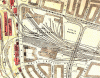
Dr. Hoo, I have found this map of Southampton Terminus, which helps to explain a good portion of all you have stated. You’ve identified the crucial problem, balancing realism with obsession which will not help the reader. The main reason I chose 1963 was because I like the era, there were no bloody 12 year old’s solving or committing the crime with a computer, no CCTV and it just happened to be a “good” period for train robberies (note the South Coast Raiders from earlier), although truth be told, it appears the robbery doesn’t happen on the train, but that’s another matter. BTW, I did buy and read “Great Train Robbery Confidential” – what can I say? I liked a lot of it, and I agreed with most of his analysis of Goody and Reynolds, AND the mis-identification of ‘The Ulsterman’, but I thought bringing Billy Hill and the Krays in wasn’t necessary and I’ve seen no one else trying to stretch the story in that direction. But, overall, good book. I was also chatting on the Police Community Forum and someone there was very helpful concerning the police in London and recommended this book (or was it someone on this site), which I read: The Great Train Robbery and the Met. Police Flying Squad. But, anyway, my book is not about that.

So, I ‘ve discovered the surprise that the train begins in Weymouth, which is not a problem. I’m also surprised (but not shocked) that there are a few maneuvers in S. Terminus, and also caught unawares that it stops so often. But just these last two sentences are easy to incorporate (and fill around) and add enormously to the authenticity – just imagine if you had read the book to see me blasély accounting of a fast train from the docks directly to Waterloo? It would ruin your enjoyment of a good read.

I’ve just found where I got the shunter references from: http://www.yorkshirefilmarchive.com/film/91-southampton-docks-southern-region-engines

I think your description to the busy little events at the time of all the shuffling around is enlightening, and I now understand the reason for the passenger coaches. I apologize to everyone concerning my thirty-minute delay at the Terminus – that was purely an unintended error because I was throwing stuff at the page. Again, my style of writing is that I currently have fourteen chapters on the go and I return to each one again and again (maybe ten times or more), until I can get it ready for an editor – then I have to change it again. Good job I’m not on a deadline! (Currently writing a chapter on a maritime character who lives in Sembawang, Singapore).

If anyone has the name of an appropriate diesel shunter, then I am happy to use it. I just didn’t see any in the movie.

Dr. Hoo, thank you for the magazine and YouTube tips – I will check them out. IronDuke, I love the banter! Now I know where 30907 got his name!

Again, thank you everyone for your contributions – I will come out of this with a more-rounded understanding of the UK rail systems of the past, and that cannot be a bad thing!
 

Attachments

  • southampton(1908)map.gif
    southampton(1908)map.gif
    242.4 KB · Views: 6

70014IronDuke

Established Member
Joined
13 Jun 2015
Messages
4,089
Union Street - the Southampton Docks' diesel shunters were not named - at least not officially, up to the end of the 60s. I'm not sure when they were withdrawn. Someone will soon come along and correct me, if wrong.
 

Dr Hoo

Established Member
Joined
10 Nov 2015
Messages
5,699
Location
Hope Valley
Union Street - the Southampton Docks' diesel shunters were not named - at least not officially, up to the end of the 60s. I'm not sure when they were withdrawn. Someone will soon come along and correct me, if wrong.
See Wikipedia article on British Rail Class 07.

14 locomotives were built for Southampton Docks (to replace the USAs). They did not have names. They were based at the old steam shed.
 

Dr Hoo

Established Member
Joined
10 Nov 2015
Messages
5,699
Location
Hope Valley
220px-BR_D2991_%2807007%29.jpg

Picture of D2991 from Wikipedia. The class were referred to as 'Rustons' (having been built by Ruston Hornsby). The builder's plate, visible on the 'nose' says "Ruston". The Class 07 TOPS designation only came after 1963. The locomotives were radio-equipped for their Southampton Dock work.
 

Dr Hoo

Established Member
Joined
10 Nov 2015
Messages
5,699
Location
Hope Valley
Sorry. Total Operations Processing System. First computerised management of rolling stock, bought by British Rail from your Southern Pacific. Every locomotive had to have a five-digit number in a specific 'class', e.g. 07. Not relevant in 1963.
 

randyrippley

Established Member
Joined
21 Feb 2016
Messages
5,382
Sorry. Total Operations Processing System. First computerised management of rolling stock, bought by British Rail from your Southern Pacific. Every locomotive had to have a five-digit number in a specific 'class', e.g. 07. Not relevant in 1963.

Just to clarify - in 1963 they weren't known as class 07. There was an earlier numerical classification system but that was very much for internal use and not really public knowledge so don't be tempted to use that.
Just call them Ruston & Hornsby shunters (or just Ruston for short). They were a special purchase for the docks because they could cope with tight radius curves. Also - just in case you're tempted in the story - they virtually never strayed from the docks and terminus. If they ran longer distances the transmissions would overheat
 

WesternLancer

Veteran Member
Joined
12 Apr 2019
Messages
15,311
Union Street - the Southampton Docks' diesel shunters were not named - at least not officially, up to the end of the 60s. I'm not sure when they were withdrawn. Someone will soon come along and correct me, if wrong.
I assumed he meant name as in type. So I guess 'a Ruston' would do the trick as suggested.
 

WesternLancer

Veteran Member
Joined
12 Apr 2019
Messages
15,311
Thanks for finding and posting the link, Taunton. It is, perhaps, worth explaining that the well-informed commentary/voiceover with the footage was added many years later as the original scripts were lost and only silent film existed. It is not necessarily the same story as the original broadcast version was shot to tell.
V interesting to watch Taunton's Railway Roundabout extract - and I noted the commentary after you had made your point - at least later on - refers to things being in the past (as it's not the orig commentary) - I assume / understand these were voiced live to broadcast when originally screened by the BBC and thus not recorded with the film at the time.

But presumably these were not juts done off the cuff - although maybe they were? the film makers were well known for their railway knowledge. Did they work to any scripts and have these survived?
 

Taunton

Veteran Member
Joined
1 Aug 2013
Messages
12,314
V interesting to watch Taunton's Railway Roundabout extract - and I noted the commentary after you had made your point - at least later on - refers to things being in the past (as it's not the orig commentary) - I assume / understand these were voiced live to broadcast when originally screened by the BBC and thus not recorded with the film at the time.

But presumably these were not juts done off the cuff - although maybe they were? the film makers were well known for their railway knowledge. Did they work to any scripts and have these survived?
For those of us who remember the original TV programmes (which we rushed home from school to see), the commentary done by John Adams and Pat Whitehouse sounded very familiar to this current one, even the measured tones of the voice. I have seen the production standard described elsewhere, the only recording was that of the film, John and Pat (who also apparently did much of the filming personally) sat in the studio each week, live (probably at BBC Birmingham, they both lived there), introduced the program, discussed things live to camera, etc. I'm sure there was a script but it was the days before teleprompters and they just did it like still happens with radio. It wasn't even recorded, which is how the film has survived but not the programmes. The same is true of many other broadcasts of the era.
 

WesternLancer

Veteran Member
Joined
12 Apr 2019
Messages
15,311
For those of us who remember the original TV programmes (which we rushed home from school to see), the commentary done by John Adams and Pat Whitehouse sounded very familiar to this current one, even the measured tones of the voice. I have seen the production standard described elsewhere, the only recording was that of the film, John and Pat (who also apparently did much of the filming personally) sat in the studio each week, live (probably at BBC Birmingham, they both lived there), introduced the program, discussed things live to camera, etc. I'm sure there was a script but it was the days before teleprompters and they just did it like still happens with radio. It wasn't even recorded, which is how the film has survived but not the programmes. The same is true of many other broadcasts of the era.
Thanks Taunton - yes I think they were well known film makers and sound recordists too (I have a feeling that the NRM holds some / all? of their archives). I guess they may have been able to do a voice over from notes maybe, so it would I guess be if the notes / scripts etc survived on paper and found their way into a film or other archive - maybe they didn't use notes, or they didn't survive.

Nice to hear that you felt the voiceover on that was pretty authentic, going on the basis of your personal memories of the broadcasts.
 

Union St

Member
Joined
31 Jan 2020
Messages
97
Location
Washington DC
Gents, one quick question, if I may: the driver & fireman both live in Battersea, near Nine Elms. If the Wadebridge is already parked in Southampton (waiting for the Upmail), might the same driver & fireman have come south in that loco earlier? Would that be like a days work, down and back?
 

randyrippley

Established Member
Joined
21 Feb 2016
Messages
5,382
Gents, one quick question, if I may: the driver & fireman both live in Battersea, near Nine Elms. If the Wadebridge is already parked in Southampton (waiting for the Upmail), might the same driver & fireman have come south in that loco earlier? Would that be like a days work, down and back?

"Wadebridge" NOT "the Wadebridge"
someone else will be better placed to answer your question though
 

30907

Veteran Member
Joined
30 Sep 2012
Messages
21,980
Location
Airedale
Gents, one quick question, if I may: the driver & fireman both live in Battersea, near Nine Elms. If the Wadebridge is already parked in Southampton (waiting for the Upmail), might the same driver & fireman have come south in that loco earlier? Would that be like a days work, down and back?
That would be about right for 8 hours, including light engine workings to and from Waterloo and a brief spell on shed at Eastleigh between trains.
However, supposing their outward working was the 9.30pm Bournemouth express, they would have worked it to Southampton Central - but express trains didn't change engines there, so it's just as likely they were relieved there and so had a different loco each way (Southern crews routinely switched locos like that); in that case Wadebridge might have been away from Nine Elms for the whole day.
 
Last edited:

Union St

Member
Joined
31 Jan 2020
Messages
97
Location
Washington DC
Right, so the two of them could have ridden down to the Southampton area (on whatever loco), then been ready to complete their eight hours by driving Wadebridge back to London?
 

30907

Veteran Member
Joined
30 Sep 2012
Messages
21,980
Location
Airedale
Right, so the two of them could have ridden down to the Southampton area (on whatever loco), then been ready to complete their eight hours by driving Wadebridge back to London?
Yes, one way or the other.
If they had taken the loco back to shed, they would have left Waterloo at 4.30 following the empty train and booked off about 5am.
If I'm right about the 9.30pm down, they'd have done a bit over 8 hours, but rostered overtime wasn't unusual.
Nice little earner one way and another, but I don't know enough about enginemen's workings - maybe someone else here does?
 

WesternLancer

Veteran Member
Joined
12 Apr 2019
Messages
15,311
Pat Whitehouse has an interesting Wikipedia page https://en.wikipedia.org/wiki/Patrick_Whitehouse

You may like to compare his WW2 RAF experiences with the whinging elsewhere on this board of those who find their first class freebies have been reduced ...
More seriously thanks for the link Taunton, very interesting and of course interesting to read how 'well connected' he was eg with Tom Rolt etc, whose books I have much enjoyed over the years - 1st having been introduced to them by my school metalwork engineering workshop teacher - tho not sure I have read the one authored jointly with Pat W however. I'm going to get hold of a copy of the DVD Railway Roundabout compilations to view. I am sure I will enjoy them very much.

Also interested to read that Pat W trained in the Empire Air Training scheme in Canada, which my uncle did too - and who later went to live in Canada after his RAF service - which then resulted in my own trips there and opportunities to enjoy and learn about north american trains, which takes me back to the OP and this thread I am following because I am very much enjoying Union St's efforts to fully appreciate and accurately reflect in his writing our own UK rail scene for this section of his book, an era before my time but one of much interest to me.
 
Status
Not open for further replies.

Top