
-
Our new ticketing site is now live! Using either this or the original site (both powered by TrainSplit) helps support the running of the forum with every ticket purchase! Find out more and ask any questions/give us feedback in this thread!
You are using an out of date browser. It may not display this or other websites correctly.
You should upgrade or use an alternative browser.
You should upgrade or use an alternative browser.
How Vulnerable are Trains to Drone Attack?
- Thread starter matacaster
- Start date
- Status
- Not open for further replies.

Sponsor Post - registered members do not see these adverts; click here to register, or click here to log in
R
RailUK Forums
choochoochoo
Established Member
- Joined
- 6 Aug 2013
- Messages
- 1,318
I'm guessing the signals in the section that's in final approach path wouldn't trip to danger, so trains in the firing line can escape.
The difference is that the most critical parts of a flight are take-off and landing and at Gatwick the railway line is directly in line with the end of the runway. A plane taking off towards the east stalling at the wrong moment could quite likely end up on the London to Brighton main line.How is this any different to planes flying over cities and towns, what they do every second on this planet ?

krus_aragon
Established Member
I think it's a combination of two things: Most air accidents happen at take-off or landing (i.e. at the end of the runway), and trains aren't able to stop within their line of sight (as trams do) or avoid an obstacle on the tracks. So if an aircraft ends up on the railway, you need a method of stopping trains from approaching the area.How is this any different to planes flying over cities and towns, what they do every second on this planet ?
edwin_m
Veteran Member
As far as I know there have never been any fatal accidents from trains colliding with aircraft. There have been many from trains colliding with road vehicles. I think there was one in the 50s or 60s where a jet fighter clipped the top of a steam engine, and back in the 20s a plane went through the boundary fence of Croydon airport and collided with a tram.
As far as I know there have never been any fatal accidents from trains colliding with aircraft. There have been many from trains colliding with road vehicles. I think there was one in the 50s or 60s where a jet fighter clipped the top of a steam engine, and back in the 20s a plane went through the boundary fence of Croydon airport and collided with a tram.
Indeed, and even if such an accident HAS occurred that we are not aware of, fatal accidents between air craft and trains are exceedingly rare.
As has already been said, means exist at Gatwick to stop trains in case of an aircraft in trouble.
I doubt that the trains could be stopped in time in case of a completely unexpected aviation emergency, but they certainly could be stopped before the landing of a plane known to be in difficulty.
There is undoubtedly the potential for a terrible accident at Gatwick with hundreds of lives lost, but the risk seems minute and not in my view worth elaborate precautions.
Remember that the most dangerous part of a rail or air journey is driving or walking or cycling to/from the station or airport.
randyrippley
Established Member
- Joined
- 21 Feb 2016
- Messages
- 5,382
technically a tunnel strong enough to resist impact wouldn't be a problem: Manchester already has a dual carriageway road tunnel under the west end of the runway

Charlie Smythe
Member
- Joined
- 18 Aug 2018
- Messages
- 704

DanDaDriver
Member
- Joined
- 5 May 2018
- Messages
- 338
The Kegworth disaster was pretty close to the MML, and there was that light aircraft that got tangled up in the wires on the WCML back in 2009 (?)

Peter Mugridge
Veteran Member
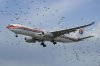
This pilot is not having a good time..jpg)
Those look like starlings which are very small and are probably considerably closer to the camera than the aircraft is - although I do agree a flock that size would be an alarming sight in the vicinity of a flightpath.
edwin_m
Veteran Member
The MML is about two miles from the end of the runway at Kegworth, and quite a bit lower as well.The Kegworth disaster was pretty close to the MML, and there was that light aircraft that got tangled up in the wires on the WCML back in 2009 (?)
I think it's a combination of two things: Most air accidents happen at take-off or landing (i.e. at the end of the runway), and trains aren't able to stop within their line of sight (as trams do) or avoid an obstacle on the tracks. So if an aircraft ends up on the railway, you need a method of stopping trains from approaching the area.
And what do you find after the end of the runway / before the beginning of the runway in the airports I’m talking about ? Buildings.
My point is that a plane crashing on a city makes much more material and human damage than on a railway line, as history has shown. I can recall a hell of a lot of urban airplane disasters, and no railway/airplane disaster having caused casualties.
Charlie Smythe
Member
- Joined
- 18 Aug 2018
- Messages
- 704
Those look like starlings which are very small and are probably considerably closer to the camera than the aircraft is - although I do agree a flock that size would be an alarming sight in the vicinity of a flightpath.
Obviously the flock of birds is a fair distance from the plane as there is know way the birds are that big but still. Its a cool photo of off wiki.
krus_aragon
Established Member
Accepted. The point I'm trying to make (and failing so far) is that once a plane hits a building then the disaster has already happened, but a plane hitting a railway line means that a second disaster may happen if a train then ploughs into the crash zone. There are some steps (emergency signalling) that can be taken to avoid that second disaster.And what do you find after the end of the runway / before the beginning of the runway in the airports I’m talking about ? Buildings.
My point is that a plane crashing on a city makes much more material and human damage than on a railway line, as history has shown. I can recall a hell of a lot of urban airplane disasters, and no railway/airplane disaster having caused casualties.
What steps should be taken to avoid a plane hitting a building or transport infrastructure in the first place is another (and one that I can't speak authoratively on).
edwin_m
Veteran Member
As I have already posted, there are already measures in place to replace signals to danger and I think to cut the power supply on electrified lines as well. Clearly there is some risk of a plane landing on top of a train or of a train approaching the site of a crash a few seconds after it has happened - but only if the plane gets into trouble unexpectedly so train movements haven't been stopped.Accepted. The point I'm trying to make (and failing so far) is that once a plane hits a building then the disaster has already happened, but a plane hitting a railway line means that a second disaster may happen if a train then ploughs into the crash zone. There are some steps (emergency signalling) that can be taken to avoid that second disaster.
What steps should be taken to avoid a plane hitting a building or transport infrastructure in the first place is another (and one that I can't speak authoratively on).
Here's the link to the accident I mentioned earlier: http://www.railwaysarchive.co.uk/eventsummary.php?eventID=9052
There is no category in the Railways Archive accident database for accidents caused by aircraft, so I can't easily check if there are any others. There is no HMRI report for this accident on the site, suggesting one probably wasn't produced.At about 17:05 as a train was passing Defford Airfield a Meteor jet aircraft coming into land hit the top of the locomotive, denting the cab roof and wiping off the aircraft undercarriage. This necessitated the aircraft making a belly/crash landing on the grass of the airfield. There were no injuries on the train or the aircraft other than the engine driver later needing treatment for shock.
- Status
- Not open for further replies.