• Our new ticketing site is now live! Using either this or the original site (both powered by TrainSplit) helps support the running of the forum with every ticket purchase! Find out more and ask any questions/give us feedback in this thread!

Route knowledge at junctions: I tip my hat to the train drivers

Status
Not open for further replies.

hexagon789

Veteran Member
Joined
2 Sep 2016
Messages
18,313
Location
Glasgow
So , with regards to the speed limit signs that have two different speeds on them ( one above the other) is the top speed the one you stuck to if you’re leaving The line at the upcoming junction ?

If you mean a sign which has just say 20 then a line and say 60 under the line, the top speed is for freight or loco-hauled and the bottom figure for passenger trains.
 
Sponsor Post - registered members do not see these adverts; click here to register, or click here to log in
R

RailUK Forums

ComUtoR

Established Member
Joined
13 Dec 2013
Messages
9,562
Location
UK
They have two separate discs and one will have an arrow pointing in the direction of the junction.
 

ComUtoR

Established Member
Joined
13 Dec 2013
Messages
9,562
Location
UK
You also have speeds for EMU/HST etc and you also need to remember that your unit has a maximum speed too; which may be less than linespeed.
 

Gooner18

Member
Joined
24 Oct 2018
Messages
634
Yes, that means the route to the left has a 40 restriction.

I see, and the signal before that junction would more than likely be a single yellow , making you slow down as you would be possible looking at a red next signal, rather than just leaving it green etc
 

ComUtoR

Established Member
Joined
13 Dec 2013
Messages
9,562
Location
UK
It can still be green. The speed itself alone does not change the signal sequence. It depends on the approach speed, turn out speed, number of junctions and other factors.
 

hexagon789

Veteran Member
Joined
2 Sep 2016
Messages
18,313
Location
Glasgow
I see, and the signal before that junction would more than likely be a single yellow , making you slow down as you would be possible looking at a red next signal, rather than just leaving it green etc

Not necessarily, depends on the linespeed on the normal route and other factors. I believe that a difference of 10 mph is permitted without any signalled warning for instance.
 

Gooner18

Member
Joined
24 Oct 2018
Messages
634
So, if for example linespeed was 40MPH and the turn out speed ( which I presume is the max speed for the junction if you was turning off the main line ) was 35MPH the light would stay green if there are no other issues to factor in, however, if there was say a reduced speed to 20MPH either due to the turn out speed or maybe the limit of the line you’re joining then the signal sequence would change
 

_toommm_

Established Member
Joined
8 Jul 2017
Messages
6,297
Location
South West London
So, if for example linespeed was 40MPH and the turn out speed ( which I presume is the max speed for the junction if you was turning off the main line ) was 35MPH the light would stay green if there are no other issues to factor in, however, if there was say a reduced speed to 20MPH either due to the turn out speed or maybe the limit of the line you’re joining then the signal sequence would change

The signal would normally go down to yellow, then the signal protecting the junction would flash yellow if you were diverging off.
 

Tomnick

Established Member
Joined
10 Jun 2005
Messages
5,933
The signal would normally go down to yellow, then the signal protecting the junction would flash yellow if you were diverging off.
No, you’re getting confused.

If there’s a flashing yellow sequence, it’s the one in rear of the junction signal that flashes yellow (with the junction signal steady yellow + junction indicator).

Otherwise, the junction signal will normally be held at danger until the train is close enough for the junction indicator to be clearly seen when it clears.
 

TRAX

Established Member
Joined
2 Dec 2015
Messages
1,834
Location
France
I’m not sure if this really fits the topic but I’ve seen it mentioned a few times and I don’t want to bother anyone with a new topic.
Could anyone explain to me what the main differences are between route signalling and speed signalling ?
 

hexagon789

Veteran Member
Joined
2 Sep 2016
Messages
18,313
Location
Glasgow
I’m not sure if this really fits the topic but I’ve seen it mentioned a few times and I don’t want to bother anyone with a new topic.
Could anyone explain to me what the main differences are between route signalling and speed signalling ?

Route signalling - the signal aspects show which route is set but not the speed it is to be taken at, drivers are expected ro know the relevant speed as part of their route knowledge.

Speed signalling - the signal aspects tell you what speed to proceed at and in most cases won't even tell you that a diverging route is set.

France has a hybrid system, signals both tell a driver a diverging route is set and the speed it is to be taken at.
 

TRAX

Established Member
Joined
2 Dec 2015
Messages
1,834
Location
France
I see, thank you. GB has route signalling is that right ?
 

hexagon789

Veteran Member
Joined
2 Sep 2016
Messages
18,313
Location
Glasgow
I see, thank you. GB has route signalling is that right ?

With currently very few exceptions, yes. HS1 is in-cab signalling for example - TVM430 - which is used on most French high-speed lines.

Most of the world uses speed signalling. Ireland, being based on British practice, uses route signalling but has a few quirks of its own - no flashing aspects for instance.
 

PudseyBearHST

Member
Joined
28 Sep 2015
Messages
1,120
Location
South West
Ahhh yeh I did indeed mean those ones.

And with EPS speeds on the West Coast, these would apply to tilting trains. If there is a differential speed limit, such as 95/100 aceoss Weaver Jn, the top one would apply to Class 221 and the bottom would apply to Class 390 (assuming tilt is authorised, if not then they are running under PS speeds which would be 85).
 

PudseyBearHST

Member
Joined
28 Sep 2015
Messages
1,120
Location
South West
So, if for example linespeed was 40MPH and the turn out speed ( which I presume is the max speed for the junction if you was turning off the main line ) was 35MPH the light would stay green if there are no other issues to factor in, however, if there was say a reduced speed to 20MPH either due to the turn out speed or maybe the limit of the line you’re joining then the signal sequence would change

Not necessarily. At Colwich Jn, you can run greens all the way despite the fact speed comes down from 125 EPS to 45 if going straight on to Manchester or 65 if going across to Stafford. But you get a warning board with AWS and you get two PRIs which show what the route is set for.
 

Gooner18

Member
Joined
24 Oct 2018
Messages
634
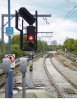
So with regards to this signal , if the row of lights above the signal and point towards the left are all on this wound indicate you’re going to the left at the next junction, if none are on you’re going ahead ? Looking at the picture it’s also possible to go to the right, how would this be indicated?
 

Attachments

  • 27EA424B-BFE9-4819-9D1F-780DEECDE67D.jpeg
    27EA424B-BFE9-4819-9D1F-780DEECDE67D.jpeg
    554.2 KB · Views: 39

PudseyBearHST

Member
Joined
28 Sep 2015
Messages
1,120
Location
South West
So with regards to this signal , if the row of lights above the signal and point towards the left are all on this wound indicate you’re going to the left at the next junction, if none are on you’re going ahead ? Looking at the picture it’s also possible to go to the right, how would this be indicated?

Correct. If you get the ‘feather’ (the white lights on top of the signal), you are going across to the ‘left.’
I don’t know the area but as a guess, you would get the position lights (the two white lights at 45 degree below the signal) if you were going to the ‘right’ ?
 
Last edited:

driver9000

Established Member
Joined
13 Jan 2008
Messages
4,563
Correct. If you get the ‘feather’ (the white lights on top of the signal), you are going across to the ‘left.’
I don’t know the area but as a guess, you would get the position lights (the two white lights at 45 degree below the signal) if you were going to the ‘right’ ?

I don't now where that signal is but there does appear to be a shunt through the cross over to the right. Looks to be another ground signal for a train to drop in behind.
 

Val3ntine

Member
Joined
29 Apr 2015
Messages
404
Location
London
So with regards to this signal , if the row of lights above the signal and point towards the left are all on this wound indicate you’re going to the left at the next junction, if none are on you’re going ahead ? Looking at the picture it’s also possible to go to the right, how would this be indicated?

It’s possible that the move to the right is a shunt move or a move into a siding/depot/reception road, therefore the move is to be made at extreme caution and at a certain set speed (usually 5mph but varies to local agreements). This move would be signalled by that little black box showing two white lights.
 

sw1ller

Established Member
Joined
4 Jan 2013
Messages
1,567
With regards to feathers, I wouldn’t get too hung up on left and right... this can be confusing. Its routes 0,1,2,3,4,5,6. There are times when a “left” can mean straight on and a “straight on” can mean right. It’s down to route knowledge at each junction that you know you’re going the right way. Take Ordsall Lane, as I come round the corner into Manchester, I want a 4 or 5 even though to me, it still feels like I’m going “straight on”

Then there’s things like Warrington. If I’ve got a green on the up fast, I know I’ve been wrong routes so I wouldn’t proceed. It’s all about your route knowledge. What makes sense at one location, won’t make any sense somewhere else.
 

The Planner

Veteran Member
Joined
15 Apr 2008
Messages
19,700
But a loco hauled passenger train can travel at the higher speed which applies to passenger trains, parcels trains and light locos.
Was going to say, the top speed is for freight, bottom for anything else, not sure where the loco hauled bit has come from?
 
Status
Not open for further replies.

Top