• Our new ticketing site is now live! Using either this or the original site (both powered by TrainSplit) helps support the running of the forum with every ticket purchase! Find out more and ask any questions/give us feedback in this thread!

Study to investigate re-opening Gobowen to Welshpool line

Status
Not open for further replies.

Llanigraham

On Moderation
Joined
23 Mar 2013
Messages
6,490
Location
Powys
Well heavy rail manges 1:30 on a certain private railway, and the Lickey is 1:37, but I'm not sure what a PPM would manage.

If the purse deep anything is possible, but here...........................I doubt it.
 
Sponsor Post - registered members do not see these adverts; click here to register, or click here to log in
R

RailUK Forums

Railwaysceptic

Established Member
Joined
6 Nov 2017
Messages
1,738
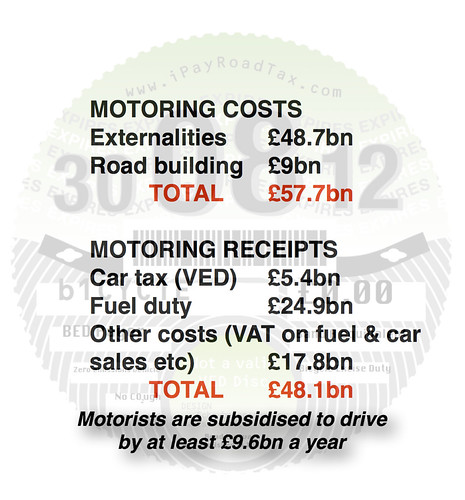
Road users get to pollute the air, cause noise pollution and nuisance to other people to a far greater extent than rail users without having to pay for it (before you say, fuel duties an road tax, there have been quite a few estimates that suggest revenue from fuel duties etc. does not cover anything like the full cost of the 'collateral damage' that cars cause). There are also things like the cost of policing roads, pressure on the health service because of the lack of exercise associated with driving everywhere and so on.

I don't doubt that rail receives a considerable operating subsidy, but to get the full picture you probably need to take into account these kinds of 'hidden subsidies' to motorists that don't register on the DfT budget.
These "estimates" that motorists do not pay their way never seem to withstand thorough analysis. Motorists do not pay only road tax and excise duty on fuel. They also pay 20% VAT on their cars, servicing, accessories etc plus 9% impost on their car insurance.
 

Xenophon PCDGS

Veteran Member
Joined
17 Apr 2011
Messages
35,478
Location
A typical commuter-belt part of north-west England
Transport problems need modern solutions and clearer, wide-ranging thinking - not a knee-jerk response from the Ernest Marples road-building manual.

Looking at the current RMT way of achieving this in the area of the Arriva Rail North franchise with its iconic Pacer fleet, it will obviously entail only running trains on certain days of the week to cut down on diesel atmospheric pollution as demonstrated recently the RMT by not wishing to involve itself in rail transportation on:-
Tuesday, 19th June
Thursday, 21st June
Saturday, 23rd June
 

yorksrob

Veteran Member
Joined
6 Aug 2009
Messages
44,419
Location
Yorks
That's why I quoted approx traffic figures for roads funded by Highways England - the same coverage as their budget.

But you stated that rail accounts for "10% of surface travel" which suggests to me all surface travel, including local journeys. Obviously any disparity between what DfT proportionally spends on road versus rail will look a lot more severe unless one considers that the majority of local roads are paid for by Councils.

Trying to make a comparison between what the DfT spends on different modes of transport versus the whole of surface transport doesn't seem very meaningful to me as a greater proportion of non-rail journeys will include a vastly greater proportion of very short trips accommodated on the local road network.
 

Gareth Marston

Established Member
Joined
26 Jun 2010
Messages
6,231
Location
Newtown Montgomeryshire
These "estimates" that motorists do not pay their way never seem to withstand thorough analysis. Motorists do not pay only road tax and excise duty on fuel. They also pay 20% VAT on their cars, servicing, accessories etc plus 9% impost on their car insurance.

So The Institute for Fiscal Studies and the RAC Foundation in 2012 got it wrong then did they?

https://www.racfoundation.org/asset.../fuel for thought - ifs observation piece.pdf
“Road use generates costs which are borne by wider society instead of the motorist.”

That's right Railwaysceptic even that champion of motoring the RAC Foundation concedes the negative externalitys point.

Further more folk that have calculated these things have already taken into account things like VAT on Car sales. This ones from an NGO producing a report for the cabinet office in 2009 http://www.sd-commission.org.uk/data/files/publications/fairness_car_dependant.pdf

6343088181_b59eb33362.jpg
 

A0

On Moderation
Joined
19 Jan 2008
Messages
7,751
If the St Pancras - Corby trains were somehow extended to Peterborough, a convenient interchange with expresses heading north should be possible. It's likely with HS2 taking more of the longer distance demand, remaining trains on the ECML will likely make a few more stops at major interchanges like Peterborough, but we're getting a long way from Oswestry and the Welsh Borderlands!

No demand to do that. The long-standing National Express coach from Corby to Scotland has now been withdrawn I believe.

The 'immigration' from Scotland to Corby happened in the 1930s - you're 3 or more generations on from that now. It's more likely that the current Corby population would want a fast train to Luton Airport Parkway than a direct train or better link to Scotland.....
 

Western Lord

Member
Joined
17 Mar 2014
Messages
1,065
All this talk about Oswestry's decline made me seek out my AA Road Book of England and Wales, published in 1966. The population of Oswestry then was 12,000, it is now 17,000. Some decline! Of course some may argue that the increase in population is greater justification for rail reinstatement, but to talk of a decline since losing its (not very useful) rail service is clearly misleading.
 

30907

Veteran Member
Joined
30 Sep 2012
Messages
21,990
Location
Airedale
Well heavy rail manges 1:30 on a certain private railway, and the Lickey is 1:37, but I'm not sure what a PPM would manage.

If the purse deep anything is possible, but here...........................I doubt it.

A road overbridge, as part of the dualling, would be perfectly feasible though.
 

Llanigraham

On Moderation
Joined
23 Mar 2013
Messages
6,490
Location
Powys
A road overbridge, as part of the dualling, would be perfectly feasible though.

And I'll repeat my last line "If the purse is deep anything is possible, but here? I doubt it"
 
Last edited by a moderator:

Matt P

Member
Joined
15 Jun 2018
Messages
153
For the sake of throwing something else out there... MUCH more expensive, and still probably a poor business case compared to numerous other potential rail improvements across the UK. But... If you really wanted to put Oswestry back on the rail network, perhaps in the long run this would be a more sensible way of doing it?

View attachment 49371

I had suggested something not unlike that myself in an earlier post. Id perhaps go further and straighten the route out north of Oswestry by realigning the route to stay to the west of and run parallel to the Oswestry and Gobowen by-passes to re-join the existing Shrewsbury to Chester line approximately where the A5 currently crosses the railway line on a bridge on the outskirts of Gobowen. The line would need to be built to 90mph standards and other sections of the Shrewsbury to Chester line upgraded for 90mph running to compensate for the slightly more tortuous route and the speed penalties that going through the centre of Oswestry would impose compared to the existing route. However we're probably talking about, 10 miles or so of new route across not particularly difficult country to build across. I know it is an idea well into the realms of fantasy, but it would correct a serious 19th century error and potentially make Oswestry far more sustainable in terms of transport and accessibility.
 

ruthtom010

Member
Joined
28 Apr 2012
Messages
15
So The Institute for Fiscal Studies and the RAC Foundation in 2012 got it wrong then did they?

https://www.racfoundation.org/assets/rac_foundation/content/downloadables/fuel for thought - ifs observation piece.pdf


That's right Railwaysceptic even that champion of motoring the RAC Foundation concedes the negative externalitys point.

Further more folk that have calculated these things have already taken into account things like VAT on Car sales. This ones from an NGO producing a report for the cabinet office in 2009 http://www.sd-commission.org.uk/data/files/publications/fairness_car_dependant.pdf
IIRC (haven't checked) the SD externalities include congestion costs imposed on other road users of around 10 billion - they are a true cost, but not really a subsidy in the sense of a transfer from non-road users. If you knock that off, motoring about pays its full costs. But even if you don't, the "subsidy" per journey is much lower than rail.
 

MarkyT

Established Member
Joined
20 May 2012
Messages
7,612
Location
Torbay
No demand to do that. The long-standing National Express coach from Corby to Scotland has now been withdrawn I believe.

The 'immigration' from Scotland to Corby happened in the 1930s - you're 3 or more generations on from that now. It's more likely that the current Corby population would want a fast train to Luton Airport Parkway than a direct train or better link to Scotland.....

I did'nt suggest direct trains from Corby to Scotland, rather a local link to Stamford and Peterborough where longer distance connections would be available.
 

HSTEd

Veteran Member
Joined
14 Jul 2011
Messages
20,373
I wonder for things like this, if anyone has done any studies on the cost of light rail on rural alignments as compared to conventional heavy rail systems.

Even with overhead wiring the power demand density would be low enough for relatively lareg substation spacings and cheap-ish substations, and the ability to go on and off roads as required, and being able to climb crazy gradients, could potentially reduce costs.
 

Matt P

Member
Joined
15 Jun 2018
Messages
153
I wonder for things like this, if anyone has done any studies on the cost of light rail on rural alignments as compared to conventional heavy rail systems.

Even with overhead wiring the power demand density would be low enough for relatively lareg substation spacings and cheap-ish substations, and the ability to go on and off roads as required, and being able to climb crazy gradients, could potentially reduce costs.

You could probably run light rail between Oswestry to Gobowen without necessarily wiring the whole route. A section of Seville's tram network runs without wires through the city centre. However at tram stops there is a sector of overhead power (looks more that an inverted conductor rail than conventional overhead wiring). The trams run on battery power on this city centre section. When they stop their pantograph is raised to charge from the overhead power then lowered again before moving off. Perhaps something similar would work on a 2.5 mile branch - overhead charge points provided at Gobowen and Oswestry and perhaps another at Park Hall.

How would a light shuttle impact upon bridging/tunnelling costs/feasibility under the A5 compared to something suitable for heavy rail?
 

MarkyT

Established Member
Joined
20 May 2012
Messages
7,612
Location
Torbay
How would a light shuttle impact upon bridging/tunnelling costs/feasibility under the A5 compared to something suitable for heavy rail?

Assuming dualling of the A5 through the area, an overbridge for the improved road to cross the railway could also assist with levels for obtaining a grade separation at the B5069 intersection. The rail alignment could thus remain largely unchanged and compatibility for heavy rail operation could allow a small shuttle vehicle to share track with CHR steam trains if it was also desired to run those from Gobowen. Separate platforms for the shuttle, signalling and trap point arrangements could ensure heavy and light rail could never access the shared single line section at the same time to ensure safety, thus the light vehicle need not fully meet heavy rail crash resistance.
 

MarkyT

Established Member
Joined
20 May 2012
Messages
7,612
Location
Torbay
The shuttle might be an ideal application for a 2 car battery D-train, with fast charging at one or both ends.
 

AndrewE

Established Member
Joined
9 Nov 2015
Messages
7,365
Id take it a step further and go driverless. It is surely an ideal route.
Ideal route it may be, but do you really want an extra 5 to 10 years' delay for development - after you thought you had got the scheme off the ground? Why this obsession with eliminating any human presence?
 

Gareth Marston

Established Member
Joined
26 Jun 2010
Messages
6,231
Location
Newtown Montgomeryshire
IIRC (haven't checked) the SD externalities include congestion costs imposed on other road users of around 10 billion - they are a true cost, but not really a subsidy in the sense of a transfer from non-road users. If you knock that off, motoring about pays its full costs. But even if you don't, the "subsidy" per journey is much lower than rail.

Most of the current rail subsidy is a consequence of the inherent inefficiency of the artificial fragmentation of the UK rail industry imposed on it by politicians whereas the road industry's problem with its externalities are a natural consequence of the mode.
 

ruthtom010

Member
Joined
28 Apr 2012
Messages
15
Most of the current rail subsidy is a consequence of the inherent inefficiency of the artificial fragmentation of the UK rail industry imposed on it by politicians whereas the road industry's problem with its externalities are a natural consequence of the mode.
I believe (can be checked from EU stats) that rail subsidy per journey in UK is less than in most other countries. In other words, farepayers in UK pay a higher share of total costs. You may be right though that those total costs are higher in UK....presumably someone has looked into this. Roads externalities are real and large, I agree. But non-external costs per journey seem much higher for rail.
 

yorksrob

Veteran Member
Joined
6 Aug 2009
Messages
44,419
Location
Yorks
I believe (can be checked from EU stats) that rail subsidy per journey in UK is less than in most other countries. In other words, farepayers in UK pay a higher share of total costs. You may be right though that those total costs are higher in UK....presumably someone has looked into this. Roads externalities are real and large, I agree. But non-external costs per journey seem much higher for rail.

This has certainly been the case historically. Whether its desireable is debatable.
 

HSTEd

Veteran Member
Joined
14 Jul 2011
Messages
20,373
The increasing containerisation of freight into containers and articulated lorry trailers (and most large delivery vans could be replaced with compact artics with 8m trailers, probably), we could concieve of a freight network that allows trailers to be moved cheaply and rapidly from one end of the country to the other.

Supermarkets and Amazon and the like could pack delivery runs at a single point and have them shipped rapidly to be turned over to the delivery driver - so the payloads would only be handled once from the central depot to the destination. (As the packages would all be packed in the correct order).
 

Gareth Marston

Established Member
Joined
26 Jun 2010
Messages
6,231
Location
Newtown Montgomeryshire
I believe (can be checked from EU stats) that rail subsidy per journey in UK is less than in most other countries. In other words, farepayers in UK pay a higher share of total costs. You may be right though that those total costs are higher in UK....presumably someone has looked into this. Roads externalities are real and large, I agree. But non-external costs per journey seem much higher for rail.

"Per journey " it's not comparing apples with apples though as 75% of all car journeys are under 5 miles in length whilst rail ones are much longer distance.
 

Lucan

Established Member
Joined
21 Feb 2018
Messages
1,262
Location
Wales
... 75% of all car journeys are under 5 miles in length ...
Which is brought home when you make a long journey on an old-style A-road. For example I sometimes drive up the A5 to the Holyhead area, through Snowdonia. Through the towns or big villages : Betws-y-Coed, Bethesda, and Llangollen, the traffic is busy, even with traffic jams. Yet on the country parts between the traffic is very light, or even absent for miles on end. Clearly there are a lot of people making car journeys just within those places, and as they are scarcely a mile from one end to the other, there must be a lot of people making car journeys of only about a mile at most and probably much less. Of course they are discouraged from walking because of unpleasantness and danger of the heavy traffic.
 

Lucan

Established Member
Joined
21 Feb 2018
Messages
1,262
Location
Wales
These "estimates" that motorists do not pay their way never seem to withstand thorough analysis. Motorists do not pay only road tax and excise duty on fuel. They also pay 20% VAT on their cars, servicing, accessories etc plus 9% impost on their car insurance.
Rather than generalising, I think we should consider how some road users (and non driving council tax payers) are subsidising other road users. The OAP using their old Jaguar only 2000 miles per year is massively subsidising in VED the travelling rep clocking up 25,000 miles and the HGV with 75,000 miles. My wife drives a small car only ~1000 miles per year, almost all of which are on a rural B road to our shopping town and back, without passing a single traffic light to maintain, or ever seeing a policeman to employ, or passing a road sign that she has any need for. While I am not saying she should pay nothing (as a nephew of ours does with a large new car - don't ask me why), she is certainly subsidising others with VED and insurance premiums. She has never made an insurance claim in her life yet insurance companies complain they are in poverty, so someone somewhere is enjoying her money.

My view is that the HGV industry and high mileage driving generally, is riding on the back of millions of low mileage car owners who "cannot do without their car no matter how expensive and illogical it is for them to own one".

If they really wanted to tax/penalise either road usage or CO2 emissions, they would put almost all of that tax/penalty on fuel, and add a premium if you did not have a garage or driveway to park off the road.

As for myself, I drive a large car a smallish mileage and pay about 10x the VED per mile as a typical big HGV artic does. Yet we are told that it would cost £billions to repair the nation's road potholes, and that the overwhelming cause of road damage is HGVs (proportional 3rd or 4th power of the axle load or something). Will the HGV owners be paying that? Yes, when pigs fly.

 

Gareth Marston

Established Member
Joined
26 Jun 2010
Messages
6,231
Location
Newtown Montgomeryshire
Rather than generalising, I think we should consider how some road users (and non driving council tax payers) are subsidising other road users. The OAP using their old Jaguar only 2000 miles per year is massively subsidising in VED the travelling rep clocking up 25,000 miles and the HGV with 75,000 miles. My wife drives a small car only ~1000 miles per year, almost all of which are on a rural B road to our shopping town and back, without passing a single traffic light to maintain, or ever seeing a policeman to employ, or passing a road sign that she has any need for. While I am not saying she should pay nothing (as a nephew of ours does with a large new car - don't ask me why), she is certainly subsidising others with VED and insurance premiums. She has never made an insurance claim in her life yet insurance companies complain they are in poverty, so someone somewhere is enjoying her money.

My view is that the HGV industry and high mileage driving generally, is riding on the back of millions of low mileage car owners who "cannot do without their car no matter how expensive and illogical it is for them to own one".

If they really wanted to tax/penalise either road usage or CO2 emissions, they would put almost all of that tax/penalty on fuel, and add a premium if you did not have a garage or driveway to park off the road.

As for myself, I drive a large car a smallish mileage and pay about 10x the VED per mile as a typical big HGV artic does. Yet we are told that it would cost £billions to repair the nation's road potholes, and that the overwhelming cause of road damage is HGVs (proportional 3rd or 4th power of the axle load or something). Will the HGV owners be paying that? Yes, when pigs fly.

Not a million miles from the RAC Foundation report arguing for road pricing as a way of the heavy user paying their true costs and other road users paying less.

For the record we have one vehicle ( an SUV) 3 of us at home including 18 year old daughter going to uni this year and one remaining grandparent in family lives close by who doesn't drive. I walk/get lift to work 50/50. We live at top of quite a steep hill and do have a town bus that comes by once an hour from 9 to 4. The uphill walk back and sharing a vehicle between 4 probably sees us use the one car more than average but it's one vehicle and we do make use of bus and taxi as well.
 

ruthtom010

Member
Joined
28 Apr 2012
Messages
15
"Per journey " it's not comparing apples with apples though as 75% of all car journeys are under 5 miles in length whilst rail ones are much longer distance.


Not sure I get your logic here. It is about proportions, not absolute amounts. So if the % subsidy for road use is (say) 0-20%, depending on whether you treat congestion as subsidy to road users (I think this range is broadly in line with the SD report you quoted), and the % subsidy for rail is (say) 40%, then these percentages will apply whether you express things per journey or per mile travelled. I think it follows that rail is clearly more heavily subsidised than road, even after taking account of externalities.

My 40% guesstimate for rail comes from the linked and very interesting European Commission report. (I agree with what you say in later post - there is a very strong argument for road pricing, but this should mainly be to replace road taxes, rather than in addition. Can't see any politicians being brave on this, though!)

https://ec.europa.eu/transport/site...ce-quality-rail-pax-services-final-report.pdf
 

Gareth Marston

Established Member
Joined
26 Jun 2010
Messages
6,231
Location
Newtown Montgomeryshire
Not sure I get your logic here. It is about proportions, not absolute amounts. So if the % subsidy for road use is (say) 0-20%, depending on whether you treat congestion as subsidy to road users (I think this range is broadly in line with the SD report you quoted), and the % subsidy for rail is (say) 40%, then these percentages will apply whether you express things per journey or per mile travelled. I think it follows that rail is clearly more heavily subsidised than road, even after taking account of externalities.

My 40% guesstimate for rail comes from the linked and very interesting European Commission report. (I agree with what you say in later post - there is a very strong argument for road pricing, but this should mainly be to replace road taxes, rather than in addition. Can't see any politicians being brave on this, though!)

https://ec.europa.eu/transport/site...ce-quality-rail-pax-services-final-report.pdf

That 40% would be an EU average though? As I said before the current level of UK rail subsidy is mainly a direct consequence of the structural inefficiency of the imposed fragmentation of the UK rail sector by Government - If we had kept BR's cost base the railway in the UK would now be very close to subsidy free. Which is hugely ironic given that the Treasury's privatisation was suppose to deliver just that but actually made things worse!

Whilst there is a lot of overlap in rail/private vehicle markets a lot of use of both modes is in journeys where the two don't compete. i.e commuting to central London, taking the children to school less than a mile from your home etc. One can argue that given how much of the UK's GDP central London generates then allowing the people of the South East to access central London by rail around about an hour from there home is supporting the economy and there in fact no subsidy overall one can even argue there are positive externalitys arising from it. Whereas allowing HGV's who don't pay their true costs to charge around the (relatively) depressed North East of England with its lower GDP is actually a drain on the nation.
 
Status
Not open for further replies.

Top