• Our new ticketing site is now live! Using either this or the original site (both powered by TrainSplit) helps support the running of the forum with every ticket purchase! Find out more and ask any questions/give us feedback in this thread!

Trivia: Temporally anomalous station names.

Status
Not open for further replies.

swt_passenger

Veteran Member
Joined
7 Apr 2010
Messages
34,312
Except Newcastle Central, which is in fact the Central station for Newcastle (to distinguish it from Newcastle Manors I suppose). The Great Central went nowhere near Newcastle.

The idea described in the 150th anniversary book about the station and the High Level bridge is that the political proponents of "Central Station" in Newcastle wanted a combined station rather than the two or three separate ones that would have probably come into use if previous plans had continued.

ISTM that they were using Central to signify 'joint', or 'not separate'; and had probably seen how having a group of back to back terminating routes wasn't a good idea in the long term.
 
Sponsor Post - registered members do not see these adverts; click here to register, or click here to log in
R

RailUK Forums

LewFinnis

Member
Joined
22 Aug 2013
Messages
107
There is no longer a Priory at Dover Priory.

The Priory remains are adjacent to the station, in the grounds of Dover College, and probably little different to the state they were in when it was so named!
 
Last edited by a moderator:

tellytype

Member
Joined
25 Feb 2016
Messages
131
Surrey Quays - It's not in Surrey....and the Surrey Docks closed long ago.

Canada Water - Nowhere near Canada!

Dover Priory - but someone already beat me to that.

Folkestone Harbour - I guess it's on the harbour, but you can't actually get on a boat to anywhere from here :)
 

Cherry_Picker

Established Member
Joined
18 Apr 2011
Messages
2,825
Location
Birmingham
Bath Spa has always struck me as in itself, a bit of a repetitively-redundant name. If in one of our nearby Continental nations, one feels that the station would have had to be called Les-Bains-Les-Bains, or Bad Bad. (In Germany there is the real Baden-Baden, I suppose.)

Bath sits on the banks of the River Avon which is also repetitively redundant as Avon means 'river' in the old Celtic languages which were once spoken on these shores.
 

RSimons

Member
Joined
15 Dec 2016
Messages
62
Location
Alberta
. . . The same goes for Shippea Hill, although I suppose that any rise of more than a couple of feet in the Fens counts as a hill.

Years ago, I was told that potatoes shipped from the fens to London had a poor reputation. The railway company was persuaded to change the name from Shippea to Shippea Hill and, as everyone knows there are no hills in the fens, the market value of the potatoes promptly increased!
 

Calthrop

Established Member
Joined
6 Dec 2015
Messages
3,689
Bath sits on the banks of the River Avon which is also repetitively redundant as Avon means 'river' in the old Celtic languages which were once spoken on these shores.

That being so, "Avon" is, not very surprisingly, a favourite river name in the more southerly / westerly parts of England: the Bath / Bristol Avon, is one of several of that name.

(In northern England, that role for river names would seem to be taken over by "Derwent" -- most usually reckoned derived from the Brythonic / early Welsh word derw = oak, referencing oak-woods near the river. There are Derwents in Derbyshire; Cumbria; Durham / Northumberland; and Yorkshire, the last giving its name to the Derwent Valley Light Railway.)
 

61653 HTAFC

Veteran Member
Joined
18 Dec 2012
Messages
19,373
Location
Yorkshire
That being so, "Avon" is, not very surprisingly, a favourite river name in the more southerly / westerly parts of England: the Bath / Bristol Avon, is one of several of that name.

(In northern England, that role for river names would seem to be taken over by "Derwent" -- most usually reckoned derived from the Brythonic / early Welsh word derw = oak, referencing oak-woods near the river. There are Derwents in Derbyshire; Cumbria; Durham / Northumberland; and Yorkshire, the last giving its name to the Derwent Valley Light Railway.)

River Avon is literally "River River", Sahara Desert is Desert Desert, and Pendle Hill is Hill Hill Hill.
 

PermitToTravel

Established Member
Joined
21 Dec 2011
Messages
3,042
Location
Groningen
Is still a junction with the westbound NLL, even though the eastbound link was lifted when the station originally closed in the 80s.

TfL reckon the A10/A104 crossroads overhead is called Dalston Junction. Perhaps it could be said that for the few decades while the line via Hoxton was disused, the name transferred to the road junction and surrounds
 

bastien

Member
Joined
14 Aug 2016
Messages
427
River Avon is literally "River River", Sahara Desert is Desert Desert, and Pendle Hill is Hill Hill Hill.

...and 'frome' - which is among other things the river in Bristol that dives underground near Ikea and emerges by the Watershed - means 'fair river'...
 

lejog

Established Member
Joined
27 Feb 2015
Messages
1,323
There is a New Street but it isn't 'new'. And the station isn't in it (although not exactly far away)

The main entrance is off Smallbrook Queensway. Officially it is Queens Drive, but you would probably not recognise it. 50 years ago Queens Drive was the road between the LNWR and Midland parts of the station. Now it's basically just the station forecourt.

Also since the latest rebuilding there's not really an entrance onto New Street any more. The ramp is still there leading down from the GrandCentral shopping centre to New Street (so indirect). But you can exit directly to any of Stephenson St/Navigation Street, Hill Street/Station Street or Smallbrook Queensway all on the same level.

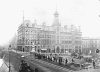
Before the 60s the entrance to New St Station was a bit closer to New St - you can see it on the right of this photo where the hansom cabs are. Good to see Birmingham was a building site even in Victorian times! The magnificent Exchange Building was demolished to make way for that ramp and shops.
 

Attachments

  • new st.jpg
    new st.jpg
    71.6 KB · Views: 23

lejog

Established Member
Joined
27 Feb 2015
Messages
1,323
Thanks very much. In that case I will offer Royal Oak, unless someone can prove it's still there. In fairness, any number of suburban locations that were once woods or forests could qualify.

I'd guess that Royal Oak station (London Underground) was originally named after a nearby pub.

The Royal Oak was indeed a pub, now called the Porchester, on Bishops Bridge Road, a few minutes from the station. So correct but wrong reason!
 
Last edited:

lejog

Established Member
Joined
27 Feb 2015
Messages
1,323
Strawberry Hill -- whatever there may have been when the line was built, there's no sign of any hill there these days.

The same goes for Shippea Hill, although I suppose that any rise of more than a couple of feet in the Fens counts as a hill.

Shippea Hill Farm is very much still there, just to the north of the tracks, as you approach from Ely. The hill reaches the giddy height of 5m above sea level, when the line and surounding area is around sea level, so its easy to spot if you know where to look.
 

edwin_m

Veteran Member
Joined
21 Apr 2013
Messages
28,756
Location
Nottingham
(In northern England, that role for river names would seem to be taken over by "Derwent" -- most usually reckoned derived from the Brythonic / early Welsh word derw = oak, referencing oak-woods near the river. There are Derwents in Derbyshire; Cumbria; Durham / Northumberland; and Yorkshire, the last giving its name to the Derwent Valley Light Railway.)

If you take a train from Leeds to Preston, you head up the Calder Valley, pass the watershed and follow another Calder that flows in the opposite direction down through Burnley.
 

lejog

Established Member
Joined
27 Feb 2015
Messages
1,323
(In northern England, that role for river names would seem to be taken over by "Derwent" -- most usually reckoned derived from the Brythonic / early Welsh word derw = oak, referencing oak-woods near the river. There are Derwents in Derbyshire; Cumbria; Durham / Northumberland; and Yorkshire, the last giving its name to the Derwent Valley Light Railway.)

Getting way off topic, but there are 10 River Calders in Northern England and Scotland (see Wiki).

If you take a train from Leeds to Preston, you head up the Calder Valley, pass the watershed and follow another Calder that flows in the opposite direction down through Burnley.

Including these two.
 
Last edited:

Calthrop

Established Member
Joined
6 Dec 2015
Messages
3,689
If you take a train from Leeds to Preston, you head up the Calder Valley, pass the watershed and follow another Calder that flows in the opposite direction down through Burnley.

Getting way off topic, but there are 10 River Calders in Northern England and Scotland (see Wiki).

Including these two.

I don't feel there's a need to worry about "off topic": this stuff is fun !

Further south: the Isle of Wight has essentially three watercourses which are reckoned to qualify as proper rivers: the Medina, in the middle of the island (the name coming from Old English signifying "the middle one"); and two which are both called Yar -- one, the island's longest, flowing eastward to Bembridge Harbour and the sea; the other at the western end of the island, reaching the sea at Yarmouth -- very short, and more of it is "estuary", than actual "river". People on the mainland do regard the inhabitants of Wight as a bit peculiar -- and vice versa.
 

glbotu

Member
Joined
8 Apr 2012
Messages
644
Location
Oxford
The Royal Oak was indeed a pub, now called the Porchester, on Bishops Bridge Road, a few minutes from the station. So correct but wrong reason!

So, that's not the pub it was named after. The original Royal Oak was on the corner of the Harrow Road and Lord Hill's Bridge, before someone put a stonking great motorway there, demolishing all the old two-up-two-downs that used to occupy the area. I believe the owners of the pub used their compulsory purchase order (or whatever it was called back in the '60s) money to buy the pub which is now called the Porchester. The old terraces were of course council property, so everyone there got moved into the brand new Warwick and Brindley Estates nearby, which were less vertically challenged than the Victorian terraces they replaced.
 

Old Yard Dog

Established Member
Joined
21 Aug 2011
Messages
1,825
There is no such place as New Pudsey and the station is no longer New, even if Monty Python think it is the centre of the universe

https://www.youtube.com/watch?v=qxDJMn-534Y

New Pudsey was in essence a relocation of Stanningley (for Farsley) station, which closed shortly afterwards, offering better parking for Bradford, Leeds and London passengers. Pudsey Lowtown and Pudsey Greenside on the eponymous loop had closed a few earlier.
 
Last edited:
Status
Not open for further replies.

Top