• Our new ticketing site is now live! Using either this or the original site (both powered by TrainSplit) helps support the running of the forum with every ticket purchase! Find out more and ask any questions/give us feedback in this thread!

Power Station Coal To End in 2025

Status
Not open for further replies.

LNW-GW Joint

Veteran Member
Joined
22 Feb 2011
Messages
21,947
Location
Mold, Clwyd
The details from the government are awaited, but the headline is that all coal-fired power stations will close by 2025.
The writing has been on the wall for some time, but until recently the rail traffic to feed the power stations has seemed buoyant and resilient.
Now it has suddenly fallen to lower levels, with a stream of power station closures implemented or imminent: Longannet, Ironbridge, Ferrybridge, Eggborough, Kingsnorth, Tilbury etc.
Now we have the prospect of all the others closing within 10 years - that's Aberthaw, Lynemouth, Cottam, West Burton, Ratcliffe on Soar, Rugeley, Fiddlers Ferry and the mighty Drax. Have I missed any?

This will be a hammer blow to the freight TOCs.
It's not clear yet whether there is a future for burning biomass in the remaining power stations.
The only talk so far is of building new gas plant to replace the coal, which would not involve rail.
Rail freight will need to find replacement markets if it is not to contract significantly over the next decade.
Maybe some of the power station sites themselves could become freight villages, retaining rail traffic, but otherwise the future looks bleak.
 
Last edited:
Sponsor Post - registered members do not see these adverts; click here to register, or click here to log in
R

RailUK Forums

Joined
18 May 2012
Messages
421
Well - keeping off the politics of the whole thing, I suppose the rail effects will be:

1. Freeing up of freight routes;
2. Freeing up of locomotives;
3. Redundancy of coal wagons;
4. Redundancy of drivers (dependent on alternative freight work);
5. Mothballing of dedicated freight routes; &
6. Closure of loading facilities at eastern sea ports.
 

tbtc

Veteran Member
Joined
16 Dec 2008
Messages
18,062
Location
Reston City Centre
On a line like the S&C that sees significant coal volumes (which limits the number of passenger services and restricts the speeds that they can operate at), how long would it take between the colliery/ power station closing down and the freight paths expiring so that passenger services could use them?

There's obviously a number of routes where freight restricts the number of passenger services (the North London Line probably being the most pressing example, though this isn't because of coal)...

...there are also some lines where there's only a little freight, but it's enough to knock out attempts at an improved clockface passenger timetable...

...but I've never seen an explanation of how quickly paths allocated to FOCs would become up for grabs for TOCs to bid for.

Does anyone know?
 

northwichcat

Veteran Member
Joined
23 Jan 2009
Messages
32,692
Location
Northwich
Rail freight will need to find replacement markets if it is not to contract significantly over the next decade.

Has rail freight not been increasing recently? It seems to have been in Cheshire, partly helped by a lack of landfill space in Greater Manchester, meaning non-recyclable rubbish from GM is being transported to Runcorn to be incinerated.
 

Top Shed

Member
Joined
10 Nov 2015
Messages
20
Indeed it is real food for thought Coal and biomass does account for a real chunk of freight operations.

As for 2025 if th government does not u turn on its carbon tax it will be way sooner.
They pay £30 per tonne and £40 per tonne carbon tax now. Indeed they may have to give the Power Station owners concessions to remain standby stations as we are now down to -5% capacity from March. If we have an event from overseas supplies or on one of our Nuclear stations the lights are off!

I have worked at all the aformentioned stations and spent 10 years Managing a team of staff keeping Kingsnorth going so I know whats around the corner.
As for the environment Associates of mine are currently involved in the construction of 185 coal fired stations with no modern emmision controls, China has commisioned 250 within the last 10 years again with electrostatic precipitation only.
The Russians are removing that much gas huge sinkholes are a daily occurance in Siberia.

As world leaders we were going to develope install and operate Carbon Capture for coal/multifuel fired boilers but the Politicians chickened out at the last minute.
This had the potential to increase trainload freight especially if some collected carbon was sent overland by rail tankers.

Also if you think that Bomass and multifuel boilers are environmentally freindly then think again it is worse but masked under the banner of renewable energy.

I know lets let China build some reactors with Chinese engineers and labour utilising cheap Chinese steel hey we could also use asbestos again like in the new NZ supplied diesel locos????
The sad fact is what the government says on job losses on coal fired is tosh completely.
Thousands of contractors are in the process of going to call centres etc. Skilled welders platers, boiler makers, fitters, riggers are going on the dole with many they will move on to other work activities taking their skills with them.
This is happening now not 2025 indeed the company I work for has just cleared sites for good for the first time in 25 years we could even be wrapping up very soon.

2025 try 2015.................................Given the information I have I should have moved out of "Blighty" with my family years ago...................I blame my addiction with British Railways!
 

LNW-GW Joint

Veteran Member
Joined
22 Feb 2011
Messages
21,947
Location
Mold, Clwyd
Has rail freight not been increasing recently? It seems to have been in Cheshire, partly helped by a lack of landfill space in Greater Manchester, meaning non-recyclable rubbish from GM is being transported to Runcorn to be incinerated.

The impression I get is that non-coal freight is rising modestly, but not at the rate to replace the coal traffic.
We are talking about something like hourly paths on the WCML between Hunterston and the English power stations, and similar from the east coast ports to the Aire/Trent Valley.
The limestone and gypsum flows linked to coal burning will also stop.
The new biomass flow from Liverpool to Drax may only have a short life.

Intermodal traffic is poised to grow but keeps on missing the big flows like supermarkets, who are still only playing with rail.
New rail-connected freight terminals lie idle all over the place.
 

The Planner

Veteran Member
Joined
15 Apr 2008
Messages
19,744
...but I've never seen an explanation of how quickly paths allocated to FOCs would become up for grabs for TOCs to bid for.

Does anyone know?

It doesnt take that long, when Daw Mill colliery closed the paths didnt last long after, certainly no more than 6 months.
--- old post above --- --- new post below ---
One can hope that one of the reasons that they aren't much used is a lack of suitable paths.

We have done this one before as I suspect you know, timetabling is done as part of any apraisal of a new terminal.
 

LNW-GW Joint

Veteran Member
Joined
22 Feb 2011
Messages
21,947
Location
Mold, Clwyd
Update on the announcement: https://www.gov.uk/government/speeches/amber-rudds-speech-on-a-new-direction-for-uk-energy-policy
It's announcing a consultation, not yet a decision, and was a speech at the Institution of Civil Engineers, not to parliament:
I am pleased to announce that we will be launching a consultation in the spring on when to close all unabated coal-fired power stations.
Our consultation will set out proposals to close coal by 2025 - and restrict its use from 2023

"Unabated" apparently means burning coal without carbon capture of the emissions.
But nowhere in the strategy does it mention investment in carbon capture!
 

najaB

Veteran Member
Joined
28 Aug 2011
Messages
33,734
Location
Scotland
We have done this one before as I suspect you know, timetabling is done as part of any apraisal of a new terminal.
I know timetabling is done at the application stage, but I'm thinking that they may have taken 'a path' in order to get the application through, but it isn't necessarily an optimal one. As the number of coal trains reduces some better paths may become possible.
 

Dr Hoo

Established Member
Joined
10 Nov 2015
Messages
5,714
Location
Hope Valley
On a line like the S&C that sees significant coal volumes (which limits the number of passenger services and restricts the speeds that they can operate at), how long would it take between the colliery/ power station closing down and the freight paths expiring so that passenger services could use them?

There's obviously a number of routes where freight restricts the number of passenger services (the North London Line probably being the most pressing example, though this isn't because of coal)...

...there are also some lines where there's only a little freight, but it's enough to knock out attempts at an improved clockface passenger timetable...

...but I've never seen an explanation of how quickly paths allocated to FOCs would become up for grabs for TOCs to bid for.

Does anyone know?

Changes to track access rights are covered by Part J of the Network Code.
See http://www.networkrail.co.uk/browse...ocument by part/the network code - part j.pdf (this runs to 60 pages).
In terms of explaining what should happen when traffic patterns change the most useful clause is probably:
“2.1 Obligation of Part J Access Beneficiaries to surrender Access
Rights

2.1.1 Without prejudice to the rest of this Part J, a Part J Access
Beneficiary shall voluntarily and in good faith surrender those
Access Rights or part or parts of such Access Rights in respect
of which it has no current or foreseeable reasonable on-going
commercial need...”
 

ainsworth74

Forum Staff
Staff Member
Global Moderator
Joined
16 Nov 2009
Messages
31,129
Location
Redcar
I've split the posts discussing the environmental or power generation implications of this into a separate thread in General Discussion. This can be found here. Can we therefore leave this thread clear for discussion about the potential impacts on rail freight and the FOCs.

Thanks! :)
 

61653 HTAFC

Veteran Member
Joined
18 Dec 2012
Messages
19,373
Location
Yorkshire
Whatever the pros and cons of biomass burning, it's perhaps worth mentioning that more biomass pellets need to be burned in order to generate as much electricity as the equivalent volume of coal, so theoretically could mean more freight by rail if power stations were converted on a 1:1 basis. Of course not all plants are being converted though.

I'm now imagining a Heath-Robinson type arrangement to transport wind to where the turbines are! :lol:
 

The Planner

Veteran Member
Joined
15 Apr 2008
Messages
19,744
I know timetabling is done at the application stage, but I'm thinking that they may have taken 'a path' in order to get the application through, but it isn't necessarily an optimal one. As the number of coal trains reduces some better paths may become possible.

A path is a path, sub optimal or not, if it is either that or nothing then it will still get used in the apraisal, it isnt given to anyone until a bid is made for it. If a coal path is removed then we will look at the overall picture again which still wouldnt always benefit or provide a FOC with something better.
 

najaB

Veteran Member
Joined
28 Aug 2011
Messages
33,734
Location
Scotland
A path is a path, sub optimal or not, if it is either that or nothing then it will still get used in the apraisal, it isnt given to anyone until a bid is made for it. If a coal path is removed then we will look at the overall picture again which still wouldnt always benefit or provide a FOC with something better.
I understand what you're saying. What I'm hoping (more than anything) is that there may be sites (e.g. supermarket distribution centres) which may only have been able to fit a single daily service into the timetable when they were built but in reality have found that with the single path it was cheaper to continue road haulage, but a second daily path would tip the balance back in favour of rail as they can "in and out" in a single day, rather than subsequent days.
 

WatcherZero

Established Member
Joined
25 Feb 2010
Messages
10,272
Conservative energy strategy:
Step 1 Say we need to close coal power stations
Step 2 cut green energy funding and dither when no private finance steps in.
Step 3 ?
Step 4 energy!
 

ainsworth74

Forum Staff
Staff Member
Global Moderator
Joined
16 Nov 2009
Messages
31,129
Location
Redcar
Conservative energy strategy:
Step 1 Say we need to close coal power stations
Step 2 cut green energy funding and dither when no private finance steps in.
Step 3 ?
Step 4 energy!

As opposed to Labour's energy strategy from their years in power:

Step 1 ?
Step 2 ?
Step 3 ?
Step 4 energy!

:lol:
 

RichmondCommu

Established Member
Joined
23 Feb 2010
Messages
6,906
Location
Richmond, London
With freight traffic clearly in decline I wonder whether all of the current FOC's will survive. If the steel plant at Scunthorpe closes within the next 10 years (it's future is looking increasingly bleak) the only freight originating from Immingham will be what ever comes from the refineries. Given how much freight passes through Barnetby at the moment that's a pretty sobering thought.
 

sprinterguy

Veteran Member
Joined
4 Mar 2010
Messages
11,579
Location
Macclesfield
As an enthusiast who grew up in the north east of England, the disappearance of merry go round coal trains from the railways is almost unthinkable, given how familiar and frequent a sight were they.

It is apparent that the volume of power station coal traffic has been slowly dwindling for several years now, but the effect that such a wholesale loss of power station coal traffic will have on the freight operators is likely to be drastic. It is interesting to note that, over the years in the north east, it has been possible to plot the evolution of railborne coal traffic from short distance flows from local collieries to low output, local power stations, changing to longer hauls from local collieries to the large centralised generating stations in far off Yorkshire, and then to shipments of imported coal from ports to the large power stations. And now the next evolutionary change may either be to an increased volume of biomass traffic (already evident, but for how long?), or to virtually no power station traffic at all!
 

northwichcat

Veteran Member
Joined
23 Jan 2009
Messages
32,692
Location
Northwich
As opposed to Labour's energy strategy from their years in power:

Step 1 ?
Step 2 ?
Step 3 ?
Step 4 energy!

:lol:

New Labour's energy plan was powered by hot air from Tony Blair and Alastair Campbell. The Conservative's energy plan is powered by hot air from Cameron, Osborne, Johnson, May, Gove, Duncan-Smith et al.
 

HowardGWR

Established Member
Joined
30 Jan 2013
Messages
4,981
New Labour's energy plan was powered by hot air from Tony Blair and Alastair Campbell. The Conservative's energy plan is powered by hot air from Cameron, Osborne, Johnson, May, Gove, Duncan-Smith et al.
I'm surprised no one had a go at the Lib Dems. It was their ministry during the coalition.

I don't understand the political and train spotter slants expressed by some here. Would we wish to go on burning coal just to keep the freight companies in business and provide photo opportunities for rail fans? Surely we should be aiming for an energy policy that doesn't involve emissions of greenhouse gases from transport of fuel, let alone those of the fuel, whatsoever?
 

sprinterguy

Veteran Member
Joined
4 Mar 2010
Messages
11,579
Location
Macclesfield
I don't understand the political and train spotter slants expressed by some here. Would we wish to go on burning coal just to keep the freight companies in business and provide photo opportunities for rail fans? Surely we should be aiming for an energy policy that doesn't involve emissions of greenhouse gases from transport of fuel, let alone those of the fuel, whatsoever?
I was considering purely from a rail perspective and putting the environmental considerations to one side. There's a separate thread for those.
 

WatcherZero

Established Member
Joined
25 Feb 2010
Messages
10,272
As opposed to Labour's energy strategy from their years in power:

Step 1 ?
Step 2 ?
Step 3 ?
Step 4 energy!

:lol:

A sixfold increase in green energy production under their energy policy from 2000 to 2014 when the policy was changed, to 24,500 MW or 19.1% of the UK energy mix, twice our international climate change target.
 

Nym

Established Member
Joined
2 Mar 2007
Messages
9,800
Location
Somewhere, not in London
I love how she went on about 'Secure' energy this morning on BBC breakfast, and that secure means gas, neglecting the inherently 'unsecure' nature of the UK's gas supply at the moment, Russian gas?

Unlike of course the mountain of coal we can stockpile anywhere, import from friendly euro nations, or mine out of our very own ground. Not to mention biomass conversion / blending...
 

najaB

Veteran Member
Joined
28 Aug 2011
Messages
33,734
Location
Scotland
I love how she went on about 'Secure' energy this morning on BBC breakfast, and that secure means gas, neglecting the inherently 'unsecure' nature of the UK's gas supply at the moment, Russian gas?
Of course, there is the billions of cubic feet of unconventional gas found over large areas of the UK.
 

ainsworth74

Forum Staff
Staff Member
Global Moderator
Joined
16 Nov 2009
Messages
31,129
Location
Redcar
I love how she went on about 'Secure' energy this morning on BBC breakfast, and that secure means gas, neglecting the inherently 'unsecure' nature of the UK's gas supply at the moment, Russian gas?.

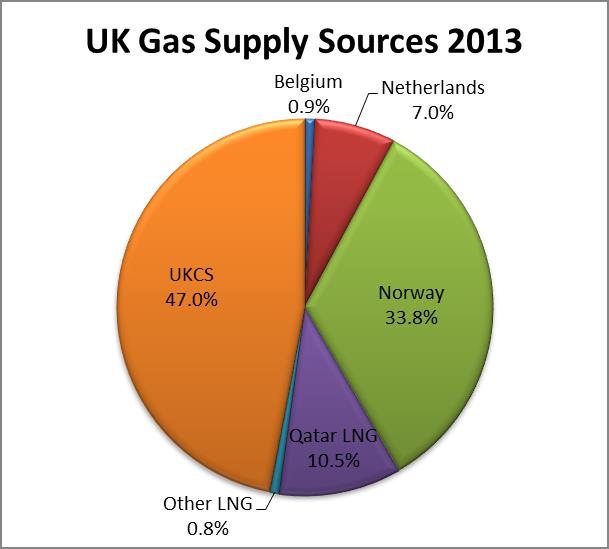
We don't actually rely that much on gas from the continent:

UK_gas_supply_sources_2013.jpg


Source
 

Nym

Established Member
Joined
2 Mar 2007
Messages
9,800
Location
Somewhere, not in London
It doesn't get away from the 'all your eggs in one basket' syndrome of relying "Only on Gas" for your baseline supply.

You ideally need a good mix of nuclear, coal, OCGT, CCGT, on line renewables and off line renewables...

Since the first four types of plant operate very differently to each other in terms of ramping and capacity.
 
Last edited:
Status
Not open for further replies.

Top