• Our new ticketing site is now live! Using either this or the original site (both powered by TrainSplit) helps support the running of the forum with every ticket purchase! Find out more and ask any questions/give us feedback in this thread!

Why are bus ticket prices not made available online?

Status
Not open for further replies.

bb21

Emeritus Moderator
Joined
4 Feb 2010
Messages
24,465
The issue with transfer fares in this country can be attributed largely to the widespread use of staged fares. They are reasonably easy to implement with flat fares or zonal fares which are the norm on the continent (so there is no particular reason why London cannot adopt such a fare structure on technical grounds).

With staged fares, should network-wide transfer fares be made available, you are then in the territory of having to define fares for all possible combinations, which can be a mammoth task for a big network.

For London, I can only assume that the pricing model will have to be altered, and with transfer fares not really a "thing" in this country, the appetite for change is not that great. I am aware of sporadic calls for this facility to be made available, but apart from that, not really much else.

I don't think the structure is stupid. It's not really a stupid principle to pay again when boarding another bus. This is also a widely-adopted principle in many countries. It is just a different one, one that differs from common practice on the European continent.

What I do think is important is for bus companies to be more transparent about single fares. Many companies already do these days, but more can still be done.
 
Sponsor Post - registered members do not see these adverts; click here to register, or click here to log in
R

RailUK Forums

W-on-Sea

Established Member
Joined
18 Dec 2009
Messages
1,449
Stagecoach Oxfordshire have all their fare tables on the Stagecoach website, but they are neither particularly user-friendly nor easy to find.

Quite a few of the Go-Ahead companies make their fares available on their websites, but how comprehensive the information available is varies from company to company.

I think the "confused tourist" thing is rather a red herring: when I go abroad and travel by bus, it's not usually that hard to establish what you have to do - and some things (such as, eg in Italy, it often being required to buy tickets in advance of getting on a bus, perhaps from a kiosk, perhaps from a newsagent/tobacco shop) are potentially wildly more inconvenient that anything one is likely to run into in many parts of the UK.
 

Bletchleyite

Veteran Member
Joined
20 Oct 2014
Messages
113,736
Location
"Marston Vale mafia"
To be fair, Germany has its inconsistencies - imagine, say, not being allowed to use an All Line Rover for journeys internal to some PTEs even if on mainline rail?
--- old post above --- --- new post below ---
I think the "confused tourist" thing is rather a red herring: when I go abroad and travel by bus, it's not usually that hard to establish what you have to do - and some things (such as, eg in Italy, it often being required to buy tickets in advance of getting on a bus, perhaps from a kiosk, perhaps from a newsagent/tobacco shop) are potentially wildly more inconvenient that anything one is likely to run into in many parts of the UK.

True, once you've worked out (outside London) that you just get on and ask the driver it's probably one of the easiest ones to deal with in the world.

(Of course, in Germany and the Netherlands bus tickets can be sold by the driver, so we aren't the only ones)
 

sng7

Member
Joined
22 Oct 2013
Messages
175
Location
Edinburgh
Is Lothian buses (Edinburgh) an exception then as they have on flat fare for the whole network which is clearly advertised at most (if not nearly all) stops clearly on the website and very prominently in a bright yellow banner on the front of pretty much every bus.
 

richw

Veteran Member
Joined
10 Jun 2010
Messages
11,528
Location
Liskeard
Is Lothian buses (Edinburgh) an exception then as they have on flat fare for the whole network which is clearly advertised at most (if not nearly all) stops clearly on the website and very prominently in a bright yellow banner on the front of pretty much every bus.

Although a small operation Royal Buses in St Ives Cornwall has a flat £1 single fare. They only operate various short routes calling at holiday parks, car parks, and the town centre. Always full when I've used them.
 

Bletchleyite

Veteran Member
Joined
20 Oct 2014
Messages
113,736
Location
"Marston Vale mafia"
Is Lothian buses (Edinburgh) an exception then as they have on flat fare for the whole network which is clearly advertised at most (if not nearly all) stops clearly on the website and very prominently in a bright yellow banner on the front of pretty much every bus.

Yes, they are an exception to the rule in many ways.
 

MCR247

Established Member
Joined
7 Nov 2008
Messages
10,292
Is Lothian buses (Edinburgh) an exception then as they have on flat fare for the whole network which is clearly advertised at most (if not nearly all) stops clearly on the website and very prominently in a bright yellow banner on the front of pretty much every bus.

Nottingham City Transport copied them and now have '£3.50 all day ticket' on the front of most buses that allow it
 

radamfi

Established Member
Joined
29 Oct 2009
Messages
9,267
The issue with transfer fares in this country can be attributed largely to the widespread use of staged fares. They are reasonably easy to implement with flat fares or zonal fares which are the norm on the continent (so there is no particular reason why London cannot adopt such a fare structure on technical grounds).

With staged fares, should network-wide transfer fares be made available, you are then in the territory of having to define fares for all possible combinations, which can be a mammoth task for a big network.

Staged fares weren't so bad back in the days of conductors. The fare paid was quite proportional to the distance travelled, and so paying two fares when changing buses wasn't that much of a problem and fares were often low in any case. Certainly you can argue that paying proportionally to distance is fairer. The use of conductors meant that ticket issuing didn't delay the bus.

Now we don't have conductors, and single fares are less proportional to the distance. In a particular town, you often only have a few possible fares to help minimise delays when issuing tickets. Some places have flat fare and others have near flat fare. For example, National Express West Midlands only has two fares for most services, £1.90 and £2.20. Metrobus charge £2.30 in Crawley (£2 with the app or a Southern Key Card), with short trips being £1.50. Where you have a flat or near flat fare system, the fairness advantage of staged fares no longer applies.

So changing buses now comes with a hefty price penalty. This is partly mitigated by the use of day tickets. For example, a National Express West Midlands Daysaver is £4.20, less than the price of two singles. But this is only good if you are travelling back by bus the same day and not good if you get a lift back, or are coming back another day.

Some places have increased single fares so high that a day ticket is often the same price or only slightly more than a single. For example, you can't go very far with First in Greater Manchester for £3 and for, say, 5 miles or more you are looking at nearer £4 or a FirstDay for £4.20.

Places interested in promoting integrated transport and maximising ridership realise that you have to accept that not all trips can be carried out on a direct service. They co-ordinate routes and timetables and make interchange as easy as possible. Charging extra to interchange would undermine that. So that is why most such places have flat fare or zonal fares with free interchange as through staged fares are too difficult to implement across a whole network. However, the Dutch have the best of both worlds thanks to their smartcard system, with per km pricing (i.e. taking advantage of the fairness aspect of staged fares) yet no interchange penalty when interchange occurs within 35 minutes.
 

Bletchleyite

Veteran Member
Joined
20 Oct 2014
Messages
113,736
Location
"Marston Vale mafia"
However, the Dutch have the best of both worlds thanks to their smartcard system, with per km pricing (i.e. taking advantage of the fairness aspect of staged fares) yet no interchange penalty when interchange occurs within 35 minutes.

To clarify this, there's a starting fee plus a kilometric rate, and you don't pay the starting fee again if you change buses. (Or something like that).

I'm not a fan of that system because you pay for the distance travelled on the individual bus rather than the distance travelled from start to destination in the system, even if the network means that's an inconvenient, longer journey e.g. into town and back out. It's also a bit complicated in that it's hard to know what you'll pay before doing it. I thought the old zonal system was better in both regards.
 

radamfi

Established Member
Joined
29 Oct 2009
Messages
9,267
To clarify this, there's a starting fee plus a kilometric rate, and you don't pay the starting fee again if you change buses. (Or something like that).

I'm not a fan of that system because you pay for the distance travelled on the individual bus rather than the distance travelled from start to destination in the system, even if the network means that's an inconvenient, longer journey e.g. into town and back out. It's also a bit complicated in that it's hard to know what you'll pay before doing it. I thought the old zonal system was better in both regards.

Yes, you have a nationwide standard boarding fee, currently 0.88 euros, plus the distance x rate, where the rate varies by operator. If you change buses/tram/metros within 35 minutes after alighting then you don't pay the 0.88 again. Certainly there are winners and losers compared to the old zonal system. In general, shorter distance travellers pay less and longer distance travellers pay more. The fare from A to B can be different from the fare from B to A depending on the location of bus stops and the design of the road network/tram lines.

A drawback from the zonal system was that you had to have a nationwide fare system. The only tool available to introduce some variance was to make zones smaller in certain areas.

A major reason for the Dutch implementation is to avoid having to split revenue across operators.
 

infobleep

On Moderation
Joined
27 Feb 2011
Messages
13,453
When I was in Glasgow I was surprised when I am not given any change on the First bus. Turns out they did this because money was going missing. Something like that I believe.

Other First bus routes elsewhere gave change at the time.

But what annoyed me the most was the fact this was not advertised to passengers clearly. Had it been, I'd have made sure I had the right change.

It was like they didn't want you to o ow so that can make extra money our of you.
 

radamfi

Established Member
Joined
29 Oct 2009
Messages
9,267
When I was in Glasgow I was surprised when I am not given any change on the First bus. Turns out they did this because money was going missing. Something like that I believe.

Exact fare is common across central Scotland. Aside from cutting driver fraud, it also improves boarding times compared to paying the driver. But it is better to accommodate off-bus ticket sales for single fares, which is easy when you have a zonal or flat-fare system and much harder when using a staged system, although Greater Manchester and West Yorkshire tried it in the 80s with their Clippercard/Saverstrip systems. The problem in Greater Manchester in particular was that you needed to have a separate card for each fare level. For example you had separate Clippercards for 12p/23p/35p single fares (or something like that), so you had to carry multiple cards. In West Yorkshire fares were a multiple of 5p and so you could just cancel the 5p card as many times as needed to reach the fare.

What is really crazy is that exact fare is used on long distance routes, or at least used to be, say from Edinburgh to Bathgate, where the fare is several pounds.
 

LexyBoy

Established Member
Joined
23 Jan 2009
Messages
4,478
Location
North of the rivers
Exact fare helps speed boarding when it's a nice round number, not so much if it's £1.75 or somesuch; and definitely doesn't help if passengers don't know the fare before boarding!

In Reading we are lucky to have a public bus company with a sensible (and advertised!) flat fare policy, although fares have gone up steeply recently. Like Nottingham and Edinburgh, it's exact change only except on the Newbury route which has staged fares.

The lack of advertised fares is symptomatic of the disregard for customers that bus companies have in general. Round here, Arriva can't be bothered to post timetables or even show their bus number on the stops, let alone publish prices (which are higher than even the Anytime rail fares, perhaps why). Bring the lot of them under state control I say. The government knows voters wouldn't put up with such a "service" on the railways yet for non-London buses it's fine!

I am currently in Penzance but I have no clue whatsoever the bus fare to the station is. Saying it is at least 2 quid means it's a proper ripoff. For my departure date I've got a Plusbus with Railcard discount for £1.30. Should've gotten one for today as well instead of walking.

The only fare I was able to find is the Ride Cornwall combined bus and train day ticket for £10, with a saving of £1.70 with a Railcard, but that cannot be sold on a bus.

You can buy Ride Cornwall tickets on the bus, don't know about Railcards though.

As a general rule, buses are a rip-off for single/returns, especially outwith larger towns. Multi-journey tickets are usually much better value.
 

bb21

Emeritus Moderator
Joined
4 Feb 2010
Messages
24,465
Flat fare is difficult to implement in this country, especially in rural areas, given how high fare levels are overall. I was amazed when I went to Nice a few years back and discovered that a flat fare of €1 applied to any journey except Airport specials, including a transfer within 74 minutes. Can you imagine this happening in this country? Short to medium distance journeys would be unaffordable if so. Even award-winning operations like Brighton & Hove, who were keen supporters of flat fares in the urban areas, had to re-introduce a central zone fare because the price was ridiculous for a short hop of a few stops.

Who said any of the authorities in this country are really interested in integrated transport? Successive governments only paid lip service to it, and that is not about to change given the commercial nature of the bus industry. Just look around you for interavailable day tickets across different operators in the same area. Plenty of pathetic examples with only a few local authorities looking like they put any effort into it. Nexus has somewhat of an integrated transfer-fare system, and just look at the premium these fares command, with all participating operators wanting their share of the pie.

There is a very big cultural difference between the UK and the continental countries. In this country (with the possible exception of TfL) we are not interested in providing a true public service with the government selling off anything it can. Commercial operations, by definition, will want to extract as much from the passengers as they can.
 

Mojo

Forum Staff
Staff Member
Administrator
Joined
7 Aug 2005
Messages
21,191
Location
0035
West Midlands by National Express have a simple fare structure of £1.90 for up to two fare stages, and £2.20 for three or more. Fare stages in the West Midlands are a lot smaller than what you tend to find elsewhere, though.

First in Bristol have recently simplified their fares too. You can travel 3 stops for £1, up to 3 Miles for £1.50, 3-6 Miles for £2.50 and over 6 Miles for £3.50. This is only within the city zone. These are still based on fare stages, but you can find the fare you are due by using their mobile phone App.
 

radamfi

Established Member
Joined
29 Oct 2009
Messages
9,267
Flat fare is more difficult but surely any town that only has a few fares (which is now a lot of towns) can implement a zonal fare system with minimum difficulty? Yes some people who cross the boundary for a short distance will pay more, but you then have a fare system that is compatible with any kind of fare collection system.

Zonal/flat fares doesn't necessarily mean cheap, even outside the UK. Fares in Germany tend to be somewhat higher than in France or Italy. For example in Düsseldorf a single is 2.60 euros (including interchange), although cheaper if you get a pack of 4. They even "cheat", like a number of other German cities, with having a "Kurzstrecke" (short hop) ticket for 1.60. In some cities the bus/tram stop tells you which stops you are allowed to go with a Kurzstrecke from that point, or sometimes there is a rule such as a maximum of 4 stops. But even that is available off bus and in a pack of 4.

West Midlands by National Express have a simple fare structure of £1.90 for up to two fare stages, and £2.20 for three or more. Fare stages in the West Midlands are a lot smaller than what you tend to find elsewhere, though.

Given the small difference between £1.90 and £2.20, why not just equalise at say £2.10?
 

bb21

Emeritus Moderator
Joined
4 Feb 2010
Messages
24,465
Flat fare is more difficult but surely any town that only has a few fares (which is now a lot of towns) can implement a zonal fare system with minimum difficulty? Yes some people who cross the boundary for a short distance will pay more, but you then have a fare system that is compatible with any kind of fare collection system.

Yes, it would be easier to implement in those cases, but as I mentioned before, I think culturally we are not a country used to this line of thinking, and I suspect that the pricing models probably rely quite heavily on people making 2 or more journeys paying for the day ticket, which are mostly quite reasonable these days compared to single fares.

The appetite for change probably isn't there, as nice as it would be to have it.

Given the small difference between £1.90 and £2.20, why not just equalise at say £2.10?

Fares like £1.90 in an exact-fare system is stupid imo. How many people have 90p change exactly?

I remember an article in Buses a few years back when they did a feature on Newport Buses. At the time they had a 95p flat fare with an exact-fare policy. Needless to say most people just paid £1.
 

Mojo

Forum Staff
Staff Member
Administrator
Joined
7 Aug 2005
Messages
21,191
Location
0035
To be honest I don't see the point in having cheap fares for really short journeys. I'd have thought that it increases the possibility of fraudulent travel; most of those that need to take the bus for short distances will have a free pass; and for everyone else they could improve their health by walking :smile:
 

crehld

Established Member
Joined
1 Nov 2014
Messages
1,994
Location
Norfolk
Fares like £1.90 in an exact-fare system is stupid imo. How many people have 90p change exactly?

I remember an article in Buses a few years back when they did a feature on Newport Buses. At the time they had a 95p flat fare with an exact-fare policy. Needless to say most people just paid £1.

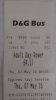
You think that's a stupid fare? How about this one (attached). Fortunately I pay with a PAYG ITSO Cheshire travel card so exact change is never an issue!
 

Attachments

  • IMAG0200.jpg
    IMAG0200.jpg
    25.9 KB · Views: 83

LexyBoy

Established Member
Joined
23 Jan 2009
Messages
4,478
Location
North of the rivers
Fares like £1.90 in an exact-fare system is stupid imo. How many people have 90p change exactly?

£1.90 in Reading too. I'm sure it won't be long before it goes up to £2.

There's also a "short hop" ticket in some areas, which was introduced with much fanfare and plastered all over buses and stops at £1. About 6 months later they all had to have little ".20" stickers plonked awkwardly on them...
--- old post above --- --- new post below ---
most of those that need to take the bus for short distances will have a free pass; and for everyone else they could improve their health by walking :smile:

You'd think so, yet I'm always seeing young, able bodied people waiting for the bus to town from Caversham. Makes me laugh when they're waiting 15 minutes for a bus!
 

tbtc

Veteran Member
Joined
16 Dec 2008
Messages
18,060
Location
Reston City Centre
A lot of brands/ industries only started putting their prices online when they started selling online – e.g. you expect to find the price of a bottle of Pepsi on the ASDA website since you can order it online, but you don’t expect your local pub to show the price of Pepsi on its website (there’s obviously no way I can buy it that way), which begs the question of what actual benefit it’d be to bus companies to have information available this way.

It’s one thing with National Express/ Megabus, where you can order tickets online – they have an incentive to make those prices are clearly available – but most normal people are only using buses for a single/ return into the nearest town centre (which is a regular journey, where the price won’t normally change more than once a year, so most passengers won’t need to check) or a handful of journeys in their urban area (e.g. changing in town to get a different service to a hospital/ shopping centre), in which case there’s generally a “day ticket” that is generally well advertised on websites.

Then you get into disincentives to provide this kind of information. If a single into town from my local stop is £2, but the bus company draws my attention to the fact that I could get a £1.50 ticket if I walked a couple of stops nearer at the start of my journey, then the bus company is only going to lose revenue. This is one big difference between buses and trains – the distance between train stations means that on most journeys the passenger isn’t going to walk between stations to save money – but with bus stops every hundred metres I am more likely to do so.

For every curious enthusiast who wants all information at their fingertips, there’ll be a lot more regular passengers who’d start paying less. If you were a bus company, would you be putting a lot of effort into shouting about this information?

I’m more interested in bus companies providing route maps (which clearly show the city centre stops) – showing me routes on Google Maps/ spider diagrams from various busy suburban areas... that kind of thing would be my priority.

(or, there’s the cynical answer to the OP’s question - such a significant number of bus passengers nowadays are pensioners on “free” passes, to whom things like fares are an irrelevance!)

Probably because most bus users either have no other option or benefit from concessionary fares, so they aren't as price sensitive as rail users.

Good point re concessionary fares – are they an incentive to keep the “normal” adult fares artificially high (when it comes to claiming reimbursements off councils)?

It costs more here where I am for a 16 mile round trip return ticket by bus than a 130 mile round trip return by rail.

I wouldn't want to advertise that if I was the bus company either,

What’s your example?

Are you comparing a commercial bus fare with an equivalent rail fare (i.e. not bought in advance, not restricted to a certain service, not heavily subsidised by a PTE)?

Because they don't want you to know just how much they are Ripping you off by.

Stagecoach in Lancaster:- Lancaster - Morecambe (approx 4 miles) and return by services 2,2A,3,4 cost £4.90 (abt 61p per a mile)

Stagecoach in Manchester:- Horwich - Stockport (approx 28 miles) and return by service 125 to Bolton, then service 22 to Stockport cost £4.10 (abt 15p per a mile)

First in Manchester:- Horwich - Huddersfield (approx 39 miles) and return by service 575 to Bolton, then service 36,37 to Manchester, then 184 to Huddersfield cost £4.20 (11p per a mile)

So a relatively short journey in Morecambe (far from the urban density of big cities) costs more (per mile) than the equivalent price per mile of a long distance journey from one end of a “rover” area in a large urban conurbation to the other?

That’s hardly surprising, and hardly unique to buses – the same could be said of other modes of transport.

The “price per mile” of a taxi journey to my local primary school will be significantly more than the “price per mile” of a taxi journey all the way to the city centre. Try going one stop on the London Underground and see if you find the fare a bargain!

I've always found it rather ironic that bus companies urge you to have the exact money for the fare but finding out that fare in the first place is usually impossible!

Then there are those that don't give change at all, which makes it even more necessary to know how much you're going to pay ahead of time.

The number of buses with fare adverts on the outside of the bus seems significantly higher nowadays, compared to any time I can remember.

Whilst I can understand bus companies not having websites twenty years ago, there was never any reason not to advertise fares on the outside of vehicles – something that is now becoming standard practice, thankfully.

(yes, it’s generally adverts for “day tickets”/ “weekly tickets”, but the advertising seems much better than I can recall it ever being)

It would help if bus companies simplified single fares

Nobody is going to argue against “simple fares”, but they do bring some problems. The main one is the large jump between zones – e.g. in the Cornish example you find that going one extra stop costs an extra quid.

They tried “simple” fares in Leeds a couple of years ago, but with mixed results. I don’t think any other big city has tried to replicate it since the Leeds move (ignoring the Edinburgh/ London examples, who had “simple” fares long before the Leeds experiment)? Does the Leeds experience (and lack of other cities subsequently doing it) suggest it isn’t worth trying?

Simple is good if it means your regular fare is rounded down to £1.50 – less good if you see it raised to £2.50. But you can’t realistically expect there to be a simpler set up without any significant losers. You also need some fairly obvious boundaries to avoid confusion (okay in London with the old “seventy pence if your journey is entirely outside Zone 1, a quid if it involves Zone 1” – but harder to educate people on elsewhere).

A flat fare like in Edinburgh is brilliant, but it does cost £1.50 for a half mile journey back from the local shops (people regularly drive such distances, so whilst I know people want to say something like “able bodied people shouldn’t use buses for such short distances, they should always walk or have a bike handy”, if we are serious about weaning people off cars then we should have some kind of incentive to make the bus attractive for short journeys as well as long ones).

One fare works okay in Edinburgh because of the “inside out” nature of the city (for historic reasons, a lot of wealthier areas are fairly close to the centre with cheaper houses on the outskirts – the opposite of many UK cities) so you have people travelling to “richer inner city” areas like Morningside/ Stockbridge paying the same fare as people travelling to “poorer outer suburbs” like Muirhouse/ Wester Hailes – in many cases, both can afford it.

But with flat fares in most UK cities, you risk pricing out journeys to inner cities, which are generally low income passengers who may not be able to pay a couple of quid to travel a mile home (but a couple of quid would be a bargain for a generally richer demographic travelling five miles to the leafier outer suburbs).

Fares transparency has always been an issue in the bus industry. This is a historical issue. I am sure we had discussions on this topic before. Arms length companies tended to be better at this in the past with most NBC company fares a closely guarded secret.

To be fair the situation has much improved compared to before with many more operators now making their fares available online, either through publishing the fare tables or in a more user friendly way like TrentBarton.

I wonder how many drivers still carry a copy of the fare table around with them for inspection by the passenger.

Fair points.

It is not confusing for Brits and Irish, but most other tourists will be familiar with single fares covering a whole single journey, not just part of one.

We need to change, to avoid confusing foreign tourists?

Staged fares weren't so bad back in the days of conductors. The fare paid was quite proportional to the distance travelled, and so paying two fares when changing buses wasn't that much of a problem and fares were often low in any case

As long as I’ve been buying bus tickets, there’s always been a cost for “boarding” (i.e. a mile long journey has never been as low as just half the cost of a two mile journey)

changing buses now comes with a hefty price penalty

Such “through” tickets are available in Sheffield, though I’ve never used one. Generally, if I need to change buses to get somewhere not on my local route, then I’m also coming back, so requiring at least four journeys, which means I’d buy a day ticket (at less than a pound per leg of the journey).

In most UK cities, the price of a day ticket is around the price of two singles from the suburbs to the city centre, so it seems simpler for bus companies to offer a day ticket instead of hundreds of potential journey combinations/ returns. Since there’s little realistic chance of going back to days of conductors, I think that expecting a driver to be able to know/ issue hundreds of “cross city” fares (and returns) is probably too much of an imposition.

the Dutch have the best of both

You have a habit of saying “In Europe they do things brilliantly...” then almost exclusively quoting examples that are Dutch (or Swiss).

Whilst public transport works well in a high density country like the Netherlands (and cycling is obviously a lot more attractive in such flat areas), it’s interesting that comparisons are seldom made with bigger countries like France/ Italy/ Spain, which seem better benchmarks for the UK.

 

radamfi

Established Member
Joined
29 Oct 2009
Messages
9,267
You have a habit of saying “In Europe they do things brilliantly...” then almost exclusively quoting examples that are Dutch (or Swiss).

Whilst public transport works well in a high density country like the Netherlands (and cycling is obviously a lot more attractive in such flat areas), it’s interesting that comparisons are seldom made with bigger countries like France/ Italy/ Spain, which seem better benchmarks for the UK.

I quote Dutch and Swiss because they are widely acknowledged as being the best or among the best and I regularly visit those places. If we are talking about national railways then I can see country size being an issue but not really if we are talking about local transport. Population density is more relevant and the Netherlands has a similar population density to England (about 400 per square kilometre). Western Germany and Belgium are also pretty high density. However, towns throughout Europe (including the UK) are generally compact, compared to say the US or Australia.

The dominance of cycling in the Netherlands means that buses are hardly used outside the major cities. That makes the standard of Dutch buses all the more impressive. People in the UK don't want to admit it, but mass cycling does impact on bus patronage. If the UK had similar cycle usage as the Netherlands, commercial bus operation would be virtually impossible.

The importance of density is somewhat overstated. In the past I did think very high density was essential, but not after reading

http://www.amazon.co.uk/Transport-Suburbia-Beyond-Automobile-Age/dp/1844077403
 
Last edited:

Bletchleyite

Veteran Member
Joined
20 Oct 2014
Messages
113,736
Location
"Marston Vale mafia"
A lot of brands/ industries only started putting their prices online when they started selling online – e.g. you expect to find the price of a bottle of Pepsi on the ASDA website since you can order it online, but you don’t expect your local pub to show the price of Pepsi on its website (there’s obviously no way I can buy it that way), which begs the question of what actual benefit it’d be to bus companies to have information available this way.

If the fares were well-known, people would be more likely to have the money ready, thus reducing change giving requirements and the time needed to conduct the transaction.

Then you get into disincentives to provide this kind of information. If a single into town from my local stop is £2, but the bus company draws my attention to the fact that I could get a £1.50 ticket if I walked a couple of stops nearer at the start of my journey, then the bus company is only going to lose revenue. This is one big difference between buses and trains – the distance between train stations means that on most journeys the passenger isn’t going to walk between stations to save money – but with bus stops every hundred metres I am more likely to do so.

Most regulars can work that out if they can be bothered. Under the old MK system that affected my local route, and I did indeed save 20p each way by way of a short walk.

For every curious enthusiast who wants all information at their fingertips, there’ll be a lot more regular passengers who’d start paying less. If you were a bus company, would you be putting a lot of effort into shouting about this information?

I can't see why they'd care, as if they started losing money surely they would just do what they always do and stick the fares up a bit? In most cases there is no competition, and where there is they are generally *very* quick to shout about the fares.

I’m more interested in bus companies providing route maps (which clearly show the city centre stops) – showing me routes on Google Maps/ spider diagrams from various busy suburban areas... that kind of thing would be my priority.

Maps also good!

(or, there’s the cynical answer to the OP’s question - such a significant number of bus passengers nowadays are pensioners on “free” passes, to whom things like fares are an irrelevance!)

Or often where reimbursement is based on single fares these are inflated to increase reimbursement, leading to the situation where very few people buy them and they become an irrelevance.

Good point re concessionary fares – are they an incentive to keep the “normal” adult fares artificially high (when it comes to claiming reimbursements off councils)?

Yes :)

Nobody is going to argue against “simple fares”, but they do bring some problems. The main one is the large jump between zones – e.g. in the Cornish example you find that going one extra stop costs an extra quid.

True, hence my suggestion of having slightly more zones (the key is to make them understandable - delimiting them at key geographic features) and making the lowest fare a 2-zone one. That way few are penalised.

Simple is good if it means your regular fare is rounded down to £1.50 – less good if you see it raised to £2.50. But you can’t realistically expect there to be a simpler set up without any significant losers. You also need some fairly obvious boundaries to avoid confusion (okay in London with the old “seventy pence if your journey is entirely outside Zone 1, a quid if it involves Zone 1” – but harder to educate people on elsewhere).

In traditional cities there are often obvious ring roads that can be used.

A flat fare like in Edinburgh is brilliant, but it does cost £1.50 for a half mile journey back from the local shops (people regularly drive such distances, so whilst I know people want to say something like “able bodied people shouldn’t use buses for such short distances, they should always walk or have a bike handy”, if we are serious about weaning people off cars then we should have some kind of incentive to make the bus attractive for short journeys as well as long ones).

Notably the German systems often have a "Kurzstreckenkarte" for that purpose - not much over EUR1, valid for a certain number of stops without change of vehicle. They don't sell many, but they do have a purpose.

Such “through” tickets are available in Sheffield, though I’ve never used one. Generally, if I need to change buses to get somewhere not on my local route, then I’m also coming back, so requiring at least four journeys, which means I’d buy a day ticket (at less than a pound per leg of the journey).

There are exceptions in some places where the outside location is for a transport connection, particularly if that is a connection often used by those of limited means. Milton Keynes Coachway is a good example - you need two fares to reach that, which makes a taxi almost as cheap (so bus companies are throwing away business). Mostly you're right that the day ticket solves the issue.

I think that expecting a driver to be able to know/ issue hundreds of “cross city” fares (and returns) is probably too much of an imposition.

You could use an approach like MK, where any cross-city journey is at the higher of 3 levels of fares (plus the city centre single). Just allow a connection if you buy that one.

Whilst public transport works well in a high density country like the Netherlands (and cycling is obviously a lot more attractive in such flat areas), it’s interesting that comparisons are seldom made with bigger countries like France/ Italy/ Spain, which seem better benchmarks for the UK.

I don't really agree - France is a much lower-density country than the UK. Germany is I think a better comparison except for intercity rail where it doesn't have one big centre - but our cities have more in common with German or Dutch[1] ones than French ones I'd say, except for that London is more like Paris perhaps. And France has a good reputation for public transport while often getting it spectacularly wrong (i.e. their rail system).

[1] I think in terms of other Europeans we actually have the most in common culturally with the Germans and the Dutch, particularly the latter.
 

me123

Established Member
Joined
9 Jul 2007
Messages
8,510
I have to say that bus fares are really difficult to use and frequently discourage me from traveling. For all the moaning there is about rail fares, I have to say that bus fares are considerably worse on just about every level.

My local bus company (First Aberdeen) has a zonal system, where you pay depending on the zones you travel through. Seems fair enough, until you try to find where the zones are. That's right, they don't tell you. Then think about ticket options. To most people, a return to a destination would be a reasonable request. Again, most bus companies don't do return tickets, you have to buy two singles or a day ticket. Then if you need to change buses - well, sorry, but that's two separate journeys. You can't make a transfer. Then exact change machines. It seems that they deliberately price fares at £1.90, £2.35 and the like in the knowledge that people generally won't be able to pay the exact fare and therefore must pay more. The fares are already, frankly, extortionate here in Aberdeen anyway.

I think the bus companies need greater regulation. Transparency in their fare structures, simplification and commonality across the UK, mandating introduction of contactless technology and adoption of contactless payment technology (as on London buses) would be a huge step forward to encourage people onto buses. The system in London is much more attractive to users than I've seen anywhere else in the UK.
 

Bletchleyite

Veteran Member
Joined
20 Oct 2014
Messages
113,736
Location
"Marston Vale mafia"
I do think bus companies need to look at contactless debit card payments - if anything else it would, especially if they provided an Oyster-like option for those with no card, mean that cash could be taken off the bus - a massive benefit in terms of driver safety and a massive speed-up of boarding, and the cost of cashing up reduced.

Even if it were just used to pay for a traditional paper ticket with nothing else changing, there would be a significant benefit.
 

crehld

Established Member
Joined
1 Nov 2014
Messages
1,994
Location
Norfolk
I do think bus companies need to look at contactless debit card payments - if anything else it would, especially if they provided an Oyster-like option for those with no card, mean that cash could be taken off the bus - a massive benefit in terms of driver safety and a massive speed-up of boarding, and the cost of cashing up reduced.

Even if it were just used to pay for a traditional paper ticket with nothing else changing, there would be a significant benefit.

Already being done in Cheshire: http://www.cheshireeast.gov.uk/public_transport/bus/cheshire_travelcard.aspx
 

northwichcat

Veteran Member
Joined
23 Jan 2009
Messages
32,692
Location
Northwich
(yes, it’s generally adverts for “day tickets”/ “weekly tickets”, but the advertising seems much better than I can recall it ever being)

The thing that's never clear with that is what's the maximum distance you can go where two singles are cheaper than the day ticket.

Sometimes shorter fares are advertised particularly where there is a lot of competition. For instance, in another thread Catch 22 Buses were mentioned who advertise a "£1 to Town fare" http://www.catch22bus.co.uk/1-to-town-offer/
 

radamfi

Established Member
Joined
29 Oct 2009
Messages
9,267
I don't really agree - France is a much lower-density country than the UK. Germany is I think a better comparison except for intercity rail where it doesn't have one big centre - but our cities have more in common with German or Dutch[1] ones than French ones I'd say, except for that London is more like Paris perhaps. And France has a good reputation for public transport while often getting it spectacularly wrong (i.e. their rail system).

[1] I think in terms of other Europeans we actually have the most in common culturally with the Germans and the Dutch, particularly the latter.

There is a clear cultural divide in Europe between the Germanic north and Romantic south. Fiscal prudence is more adhered to in the north which is probably reflected in the higher fares. There is a greater tendency towards good organisation in the north which I would guess should lead to improved public transport.

I don't rate France too highly and prefer transport in other countries. City transport in France is largely on the typical European model with integrated fares and buses feeding into metros and trams. But departure times are not at set minutes past each hour. The UK is more like the European standard in that regard. Rural buses in France are also largely non-existent.
 
Status
Not open for further replies.

Top