• Our new ticketing site is now live! Using either this or the original site (both powered by TrainSplit) helps support the running of the forum with every ticket purchase! Find out more and ask any questions/give us feedback in this thread!

Manchester - Liverpool Electrification

Status
Not open for further replies.
Sponsor Post - registered members do not see these adverts; click here to register, or click here to log in
R

RailUK Forums

LDECRexile

Established Member
Joined
30 Jan 2014
Messages
2,149
Location
Southport, UK
I went to Manchester Victoria today, calling at Huyton, St Helens Jct and Earlestown en route.

As I was out and about on Monday and Wednesday I was pleasantly surprised by the progress since:

1. Single wire up through St Helens Junction
2. More portals up at Earlestown
3. More masts up Roby Jct-Huyton Jct
4. Lots of change at Man Vic
5. Sankey Viaduct scaffolding has reached parapet level on both sides
6. At least three scrapes at Rainhill station now have bases curing in formers.


1. One wire ("Return Wire"?) now runs along the South side of the tracks from immediately West of St Helens Jct station to the previous start of multiple wiring some distance to the East. Therefore there is now a continuous stretch from Rainhill Signalbox to just West of Sankey Viaduct with at least one wire up.

2. Two more portals have been erected between Sankey Viaduct and the Junction Lane bridge West of Earlestown station. Metalwork is lying on the long-disused S-to-W platform ready to be installed on bare bases in that area.

3. New masts to the North side between Roby Jct and Roby station, including some on the embankment side. New masts on the North side between Roby and Huyton. Mast between tracks immediately East of Huyton. Work has begun to expose the masts buried under Roby platform 2/3. I think one new mast North of tracks between Huyton Stn and Jct. More piles in sight South of tracks in Huyton Jct area. The lone bare base at Huyton Quarry, South side, now has a mast on it.

4.1 Most of the route between Ordsall Lane Jct and the West end of Victoria Station now has multiple wires. The trackwork is complex and wiring is to match, with some stretches having lots of wires, others less. Nevertheless, lots of knitting up there. 4.2 The way the station is to be wired is now clearer. Moving from West to East: 4.2.1 immediately (like 2 feet) West of the station buildings (ie the bridge) are a mast, a base and a scrape, in line abreast. 4.2.2 Next eastwards are substantial overbuildings onto which vertical tubes (like thick scaffolding) have been bolted, wires will be attached to these, they look like longer versions of what hangs under Rainhill Skew Bridge. 4.2.3 Next follows a fairly long stretch with largely architectural metalwork, like higgledy-piggledy scaffolding. This does not look fit or intended to carry a load such as OHLE. A mast is being erected on Platform 3 to deal with this. 4.2.4 Next eastwards is more overbuilding, being dealt with in the same way as 4.2.2, then 4.2.5 the station proper ends, the gap between this and the three masts immediately beyond the eastern ends of the platforms is being bridged by building masts on the three platform. 4.2.6 From Floor 9 of the car park scrapes for more of the flat bases like those used around Salford Central can be seen East of the road bridge at the foot of Miles Platting Bank. 4.3 The last mega-roof girder has been put in place.

5 and 6 need no amplification.

All very encouraging, I reckon.

Photos and spreadsheet this evening or tomorrow.

Nuffield Sedbergh for now.
 
Last edited:

PDG1949

Member
Joined
21 May 2014
Messages
323
Location
St. Helens, Merseyside
I must admit, that did amuse me too - grew up not a million miles from there. It's Laffak Rd, though, which I think escapes the forum censor. Problem solved :)

Still no evidence of activity at Carr Mill Viaduct just yet, save for some electrification related gubbins dropped at the side of the track.

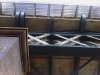
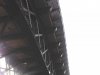
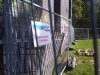
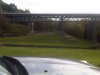
Did a detour on my way back up the 'Green from town at dinnertime to have a look at Carr Mill Viaduct. As you can see from the photos (1 & 2), there appears to be something happening. The sign on the side of the compound fence says 'Everlast Waterproofing Ltd - Men Working Overhead'. Photos 3 & 4 show the underside of the viaduct edges and indicate that it's an interesting engineering challenge for mast placement/anchorage when you consider that the grid structure must be the walkway either side of the tracks.

I'm not sure which correspondent it was, but yes, there were originally 4 tracks - up/down fast and up/down slow, the slow carrying mainly colliery/freight traffic to the numerous colliery spurs along the line. At the South end of the viaduct, just past the small Laffak Rd bridge was Carr Mill Junction, where the line split. One two track section carried on towards St. Helens Shaw Street (now St. Helens Central) as now, the other tracks formed a freight avoiding line which went around the East of the town eventually joining the St.H Shaw St to St. H. Junc and Widnes tracks at Sutton Oak and also serving a couple of collieries en route. From the northern side of the Carr Mill viaduct, the lines continued four-tracked to Garswood and beyond.
 

Attachments

  • CarrMill Via 04 - 17 Oct 2014.jpg
    CarrMill Via 04 - 17 Oct 2014.jpg
    155.7 KB · Views: 75
  • CarrMill Via 03 - 17 Oct 2014.jpg
    CarrMill Via 03 - 17 Oct 2014.jpg
    91.8 KB · Views: 64
  • CarrMill Via 02 - 17 Oct 2014.jpg
    CarrMill Via 02 - 17 Oct 2014.jpg
    237.8 KB · Views: 64
  • CarrMill Via 01 - 17 Oct 2014.jpg
    CarrMill Via 01 - 17 Oct 2014.jpg
    121.2 KB · Views: 64

LDECRexile

Established Member
Joined
30 Jan 2014
Messages
2,149
Location
Southport, UK
Did a detour on my way back up the 'Green from town at dinnertime to have a look at Carr Mill Viaduct. As you can see from the photos (1 & 2), there appears to be something happening. The sign on the side of the compound fence says 'Everlast Waterproofing Ltd - Men Working Overhead'. Photos 3 & 4 show the underside of the viaduct edges and indicate that it's an interesting engineering challenge for mast placement/anchorage when you consider that the grid structure must be the walkway either side of the tracks.

I'm not sure which correspondent it was, but yes, there were originally 4 tracks - up/down fast and up/down slow, the slow carrying mainly colliery/freight traffic to the numerous colliery spurs along the line. At the South end of the viaduct, just past the small Laffak Rd bridge was Carr Mill Junction, where the line split. One two track section carried on towards St. Helens Shaw Street (now St. Helens Central) as now, the other tracks formed a freight avoiding line which went around the East of the town eventually joining the St.H Shaw St to St. H. Junc and Widnes tracks at Sutton Oak and also serving a couple of collieries en route. From the northern side of the Carr Mill viaduct, the lines continued four-tracked to Garswood and beyond.

Aha! progress, the fencing wasn't there on Wednesday.

Very interesting to have clear local knowledge, not least, I suspect, from a fellow 1949-er!

Thank you.
 

snowball

Established Member
Joined
4 Mar 2013
Messages
8,144
Location
Leeds
"Nuff Sed". Very clever.

Some spectacular pictures there. I like the creatures of the forest. But I especially like the views east from Victoria, particularly the telephoto one, which is interesting to compare with the bird's eye view that you can get on Bing Maps.

I'm not sure of the current state of the works to rebuild Rochdale Road bridge. Last time I was there the old bridge was still there. Is the pale bridge in the picture Rochdale Road? Or is it the road beyond, Osborne Street, which was rebuilt first?

--- old post above --- --- new post below ---

Just in case anyone hasn't read WatcherZero's post in the Todmorden thread, he says this:

TfGM saying Liverpool-Airport electric service delayed into early 2015 but will commence as soon as work completed and before May timetable change.
 
Last edited:

LDECRexile

Established Member
Joined
30 Jan 2014
Messages
2,149
Location
Southport, UK
"Nuff Sed". Very clever.

Some spectacular pictures there. I like the creatures of the forest. But I especially like the views east from Victoria, particularly the telephoto one, which is interesting to compare with the bird's eye view that you can get on Bing Maps.

I'm not sure of the current state of the works to rebuild Rochdale Road bridge. Last time I was there the old bridge was still there. Is the pale bridge in the picture Rochdale Road? Or is it the road beyond, Osborne Street, which was rebuilt first?

Thank you for your kind comments and interest.

I'm not local, so I've found trying to answer your question fascinating. I've based my digging on Bing Maps, using this link:

http://www.bing.com/maps/#Y3A9NTMuN...zcz15cC5ZTjEwNjN4MjMwMTQ3MTkyfnBnLjF+cmFkLjgw

I was thoroughly thrown for a while by three things:

1. the conventional road map view has the advantage of giving street names but completely flummoxed me because I couldn't find the mass of "overbridges" for the likes of Dantzic St and Irk St. When I flipped to OS Map view the penny dropped, the road map is road-centred, so it doesn't care whether railways cross over or under. The OS Map view clearly shows that Dantzic St etc all pass under the railway.

2. the 20x telephoto severely compresses the impression of distance, so until the penny dropped I was looking on the map half way to Rochdale before I found where the tram tracks can be seen turning off to the right. The compression not only acts on the distance, but also on the impression of curvature. On the photo the bends in the running lines look like a train set, sharp and jerky, and the tram tracks appear to veer off right at about 30 degrees. On the map and on the ground the bends are gentle.

3. there appears to be a mass of bridges on the photo beyond the Class 142. The penny eventually dropped that some of them are portals with signals attached, notably the nearest and furthest from camera.

I therefore reckon:

a) the line of cars are parked along Bromley St
b) the tram tracks swing right approx at the end of Peary St, the two passing trams and the tops of the masts show the curve
c) the tram tracks then swing back left up and over the main railway lines beyond the gantry (or gantries) beyond the Class 142. The very tops of the tram electrification masts can be seen above the gantr(y/ies) and below the white bridge.
d) the white bridge is Rochdale Road
e) the "bridge" beyond the white bridge is another signal gantry.

Could all be cobblers, but thank you for stimulating a real fun half hour exploring Manchester's nether regions.
 

PDG1949

Member
Joined
21 May 2014
Messages
323
Location
St. Helens, Merseyside
Aha! progress, the fencing wasn't there on Wednesday.

Very interesting to have clear local knowledge, not least, I suspect, from a fellow 1949-er!

Thank you.

Thank you and yes - you're right, I am a '49er ! Glad you liked the little bit of 4 track history, although I guess it's not strictly on topic

And thank you for the latest update of your excellent progress chart (I wonder if NR's is as up-to-date haha !).

Let's hope the evidence of works at Carr Mill isn't just a waterproofing job.....
--- old post above --- --- new post below ---
Hi all,

I'm not sure if this site has surfaced before, but it gives quite a comprehensive list of electrification mast codes

http://www.railwaycodes.org.uk/electrification/mast_prefix.shtm

Still doesn't explain how Huyton to Wigan becomes 'HG' (now we can guess!) - apparently 'LW' was allocated but not used !

The main site - Railway Codes - is also very useful for other information

http://www.railwaycodes.org.uk/index.shtml
 
Last edited:

LDECRexile

Established Member
Joined
30 Jan 2014
Messages
2,149
Location
Southport, UK
I have to disqualify you for trying to sneak Eyemouth in twice and mis spelling Knowsley.
Barmouth is allowed: :D

I appeal against sentence.

Knowsley is where I got married in 1974, Noseley is in Leicestershire.

http://www.bing.com/maps/#Y3A9NTMuO...wJnE9Tm9zZWxleSUyQyUyMFVuaXRlZCUyMEtpbmdkb20=

Eyemouth twice is allowed within Mornington Crescent Rules when there is a V in the next month. Yarmouth, Barmouth, Exmouth, Falmouth, Sidmouth, Teignmouth and the like score only half points on grounds of failure to confuse.

Cockermouth might have scored double points or ensured disqualification on other grounds.

Aberdeen and Aberdyfi might have earned Celtic Bonus Points.

Hairmyles was, alas, just a typo (drat, drat and double drat.)
 
Last edited:

LDECRexile

Established Member
Joined
30 Jan 2014
Messages
2,149
Location
Southport, UK
I'm not sure if this site has surfaced before, but it gives quite a comprehensive list of electrification mast codes

http://www.railwaycodes.org.uk/electrification/mast_prefix.shtm

Still doesn't explain how Huyton to Wigan becomes 'HG' (now we can guess!) - apparently 'LW' was allocated but not used !

The main site - Railway Codes - is also very useful for other information

http://www.railwaycodes.org.uk/index.shtml

Yes, this fab site has surfaced before, but it can't do any harm to extol its virtues again.

I don't know how Huyton-Wigan became HG, but long experience of the ways organisations I've worked in dream up codes suggests an interplay of the following:

National precedent, eg going alphabetically round the lines radiating from London similarly to the way roads go numerically round, (A1 North, A2 South east, A3 South Westish, A4 West etc) This is fine until someone has the impertinence to build a road or electrify a line not originating in London.

National secondary precedent, eg lines branching off a line from London start with the code for the line they branch off and add a letter which may (or may not) be mnemonic. So G is the WCML out of London (alphabetic) and GL is Weaver Jct (off the line G) to Liverpool (L). This is fine unless there were also a line off the WCML to (say) Luton, in which case something like GN (G to LutoN) might be invented. It is also complicated by the inconvenient fact that many Weaver Jct to Lime St masts are coded L (see the database.)

Regional precedent, eg going round the lines radiating from a city outside London, such as Glasgow, so the WCML line south from Glasgow is G either on an alphabetic principle or a mnemonic one. This is fine until G (WCML from London) meets G (WCML from Glasgow) when mast numbers are discontinuous, if that matters. It might be less fine if there are several Gs dreamt up independently which could be confused, such as G (Glasgow), G (WCML) and G (Glossop.)

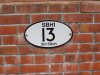
Silo coding, eg different eras (eg the three Gs mentioned above) and different departments (electrifiers, line engineers and database builders) have different working practices. Line engineers have had a universal, copper-bottomed, time-honoured "Engineers Line Code" (ELR) system operating since the 19th Century which uniquely identifies every line and every structure past and present. Just look at codes on bridges shown by printed signs or metal plates (eg Eccleston Park Bridge, see attached) or stencilled paint. Electrifiers or electrification designers or contract database builders have invented mast codes independent of the ELRs. In different eras we have Lime St-Hull being coded LH, with of course, the vast majority of it not being electrified. Our electrification scheme, however, has used LM for long infill sections such as Whiston-St Helens Jct even though LH was "allocated" to the route years ago.

Pick a letter, as long as it's unique, eg take the view that as long as a stretch of masts is clearly identified and each mast is uniquely identified it doesn't matter what letters are used.

Cherrypick rationales, eg Huyton to Wigan could be:

LHW LH to Wigan
LHG LH to G WCML
LMW LM to Wigan
LMG LM to G WCML
no, blow that, only two letter codes are permissible
HW Huyton to Wigan
HG Huyton to G WCML
or
HG Huyton to G the first gap in the alphabet noticed by the person doing the coding.

It seems obvious from the outside, afterwards, not being responsible for it or in the thick of it that piggybacking mast codes on ELRs would be a good idea. Well, it would be if the people designing electrification talked to the people maintaining bridges and tunnels. I'm sure they do talk to them, frequently and largely amicably, but that does not necessarily translate into having compatible software or systems. This departmental "not talking to" is not a criticism, but a fact of life.

ELRs have well over 100 years of solid provenance. This means that there is over 100 years of complexity, change and confusion in there. Using ELR codes, Huyton Jct to Wigan consists of all or parts of SBH1, SBH2, SBH3 and CGJ5 and, to add spice, the Huyton Junction datum point has moved 15 chains.

For an electrification designer to associate masts with ELRs would require him or her to have access to an exact, unmoving, ELR-based database into which s/he could input precise details of the location of a mast or other structure.

Probably more difficult in the real world would be the fact that ELR codes can be 3 or 4 characters (eg DSE and CGJ5) whereas an initial design spec for mast codes would be LL nn nn where LL are two letters. On such things empires tumble.

If I Ruled the World all codes would be meaningless, so masts 123456 and 234567 could be neighbours or 100 miles apart. They would, however, be guaranteed to be unique and identifiable by anyone with access to software saying where it stands, such as precise GPS data.
 

Attachments

  • 20140926EccelstonParkBridge.jpg
    20140926EccelstonParkBridge.jpg
    208.8 KB · Views: 28

childwallblues

Established Member
Joined
3 Jul 2014
Messages
3,832
Location
Liverpool, UK
Yes, this fab site has surfaced before, but it can't do any harm to extol its virtues again.

I don't know how Huyton-Wigan became HG, but long experience of the ways organisations I've worked in dream up codes suggests an interplay of the following:

National precedent, eg going alphabetically round the lines radiating from London similarly to the way roads go numerically round, (A1 North, A2 South east, A3 South Westish, A4 West etc) This is fine until someone has the impertinence to build a road or electrify a line not originating in London.

National secondary precedent, eg lines branching off a line from London start with the code for the line they branch off and add a letter which may (or may not) be mnemonic. So G is the WCML out of London (alphabetic) and GL is Weaver Jct (off the line G) to Liverpool (L). This is fine unless there were also a line off the WCML to (say) Luton, in which case something like GN (G to LutoN) might be invented. It is also complicated by the inconvenient fact that many Weaver Jct to Lime St masts are coded L (see the database.)

Regional precedent, eg going round the lines radiating from a city outside London, such as Glasgow, so the WCML line south from Glasgow is G either on an alphabetic principle or a mnemonic one. This is fine until G (WCML from London) meets G (WCML from Glasgow) when mast numbers are discontinuous, if that matters. It might be less fine if there are several Gs dreamt up independently which could be confused, such as G (Glasgow), G (WCML) and G (Glossop.)

Silo coding, eg different eras (eg the three Gs mentioned above) and different departments (electrifiers, line engineers and database builders) have different working practices. Line engineers have had a universal, copper-bottomed, time-honoured "Engineers Line Code" (ELR) system operating since the 19th Century which uniquely identifies every line and every structure past and present. Just look at codes on bridges shown by printed signs or metal plates (eg Eccleston Park Bridge, see attached) or stencilled paint. Electrifiers or electrification designers or contract database builders have invented mast codes independent of the ELRs. In different eras we have Lime St-Hull being coded LH, with of course, the vast majority of it not being electrified. Our electrification scheme, however, has used LM for long infill sections such as Whiston-St Helens Jct even though LH was "allocated" to the route years ago.

Pick a letter, as long as it's unique, eg take the view that as long as a stretch of masts is clearly identified and each mast is uniquely identified it doesn't matter what letters are used.

Cherrypick rationales, eg Huyton to Wigan could be:

LHW LH to Wigan
LHG LH to G WCML
LMW LM to Wigan
LMG LM to G WCML
no, blow that, only two letter codes are permissible
HW Huyton to Wigan
HG Huyton to G WCML
or
HG Huyton to G the first gap in the alphabet noticed by the person doing the coding.

It seems obvious from the outside, afterwards, not being responsible for it or in the thick of it that piggybacking mast codes on ELRs would be a good idea. Well, it would be if the people designing electrification talked to the people maintaining bridges and tunnels. I'm sure they do talk to them, frequently and largely amicably, but that does not necessarily translate into having compatible software or systems. This departmental "not talking to" is not a criticism, but a fact of life.

ELRs have well over 100 years of solid provenance. This means that there is over 100 years of complexity, change and confusion in there. Using ELR codes, Huyton Jct to Wigan consists of all or parts of SBH1, SBH2, SBH3 and CGJ5 and, to add spice, the Huyton Junction datum point has moved 15 chains.

For an electrification designer to associate masts with ELRs would require him or her to have access to an exact, unmoving, ELR-based database into which s/he could input precise details of the location of a mast or other structure.

Probably more difficult in the real world would be the fact that ELR codes can be 3 or 4 characters (eg DSE and CGJ5) whereas an initial design spec for mast codes would be LL nn nn where LL are two letters. On such things empires tumble.

If I Ruled the World all codes would be meaningless, so masts 123456 and 234567 could be neighbours or 100 miles apart. They would, however, be guaranteed to be unique and identifiable by anyone with access to software saying where it stands, such as precise GPS data.

HG could be Huyton - Garswood as there is already a HB and the line is already electrified at Springs Branch.
 

LNW-GW Joint

Veteran Member
Joined
22 Feb 2011
Messages
21,915
Location
Mold, Clwyd
Not a lot new to report today - still lots to do.
There was a large crane below Carr Mill viaduct on the north side - impossible to see what it was doing.
West of Roby there is a large concrete base going in on the embankment on the north side.
This looks similar to the specialist ones they installed over Chat Moss last year, and might be because of difficult ground conditions.

In passing, my TPE Newcastle flyer did the 31.5 miles from Victoria to Lime St in 30.25 minutes today. http://www.realtimetrains.co.uk/train/G33918/2014/10/20/advanced
This is the first time I have recorded better than a mile a minute between Manchester and Liverpool.
For once we were completely unchecked from Wavertree into P6 at Lime St.
There's still the 60mph restriction at Astley to come off, and a 75mph TSR at Newton le Willows which has been there for several months.
 

DJH1971

Established Member
Joined
10 Jun 2012
Messages
1,751
Location
St Helens, Merseyside
There was a large crane below Carr Mill viaduct on the north side - impossible to see what it was doing.

A good sign nontheless.

BTW, I got a response from NR regarding the delay to phase 2, which reads as follows:

'Thank you for your recent enquiry as noted below. In reply, I can confirm that at present we expect the work to electrify the line between Liverpool and Manchester to be completed slightly later than originally planned. But we are working closely with Northern Rail to ensure that there is little, if any, impact on passengers.

The delay has been caused by the unexpected ground conditions and technical issues with the wiring equipment that are now being resolved. In response, we are making every effort to ensure the work is completed as soon as possible and expect it to be completed by early 2015.

We will keep people informed as the work progresses.

I hope this helps.'
 

LNW-GW Joint

Veteran Member
Joined
22 Feb 2011
Messages
21,915
Location
Mold, Clwyd
A good sign nontheless.
BTW, I got a response from NR regarding the delay to phase 2, which reads as follows:

'Thank you for your recent enquiry as noted below. In reply, I can confirm that at present we expect the work to electrify the line between Liverpool and Manchester to be completed slightly later than originally planned. But we are working closely with Northern Rail to ensure that there is little, if any, impact on passengers.
The delay has been caused by the unexpected ground conditions and technical issues with the wiring equipment that are now being resolved. In response, we are making every effort to ensure the work is completed as soon as possible and expect it to be completed by early 2015.
We will keep people informed as the work progresses.
I hope this helps.'

That's identical to the quote in Rail last week.
You can never be quite sure what's going on underneath.
The pressure's on, for sure.
 

LDECRexile

Established Member
Joined
30 Jan 2014
Messages
2,149
Location
Southport, UK
Newcastle flyer

I like it!

Another nice steady flow of news today:

Carr Mill Viaduct: scaffolders in action
Earlestown: another portal erected off the eastern end of platforms 1&2, another mast over the W-S single line. An Orange Platoon were taking 10 metre deep soil samples from the site of one of the masts-to-be on Platform 1
Sankey Viaduct: Scaffolding complete on Column 7, both sides; team will return from Carr Mill tomorrow
Huyton Jct: possible evidence of excavation on bus station side of the fence opposite the eastern end of the trackside path. Can a local have a shufty?
Roby Jct-Roby: more masts up; masts between tracks have sprouted arms
Roby-Huyton: more masts up
Huyton Quarry: regret I erred last week when I reported that the lone bare base had had a mast plonked on - it hasn't
Rainhill: at least four of the scrapes have bases curing in formers.

I'll add photos later tonight.
 

DJH1971

Established Member
Joined
10 Jun 2012
Messages
1,751
Location
St Helens, Merseyside
I like it!

Another nice steady flow of news today:

Carr Mill Viaduct: scaffolders in action
Earlestown: another portal erected off the eastern end of platforms 1&2, another mast over the W-S single line. An Orange Platoon were taking 10 metre deep soil samples from the site of one of the masts-to-be on Platform 1
Sankey Viaduct: Scaffolding complete on Column 7, both sides; team will return from Carr Mill tomorrow
Huyton Jct: possible evidence of excavation on bus station side of the fence opposite the eastern end of the trackside path. Can a local have a shufty?
Roby Jct-Roby: more masts up; masts between tracks have sprouted arms
Roby-Huyton: more masts up
Huyton Quarry: regret I erred last week when I reported that the lone bare base had had a mast plonked on - it hasn't
Rainhill: at least four of the scrapes have bases curing in formers.

I'll add photos later tonight.

More nice progress here1 :D
 

59CosG95

Established Member
Joined
18 Aug 2013
Messages
6,856
Location
Beeston (Notts)

Class377/5

Established Member
Joined
19 Jun 2010
Messages
5,594
I clearly think they're embarrassed, but it would be better to come fully clean over this in my opinion.

Come clean and give another date? Last thing you want when you're running so late is give yourself another deadline. Currently plan is working in time for May, bit hopes of much sooner than that.
 

GRALISTAIR

Established Member
Joined
11 Apr 2012
Messages
10,492
Location
Preston Lancs
Come clean and give another date? Last thing you want when you're running so late is give yourself another deadline. Currently plan is working in time for May, bit hopes of much sooner than that.

I have a feeling somewhere about January-March for Wavertree to Earlestown.

Under promise and over deliver is my motto. I always remember under BR the ECML being well ahead of schedule and also Class 91 delivery. Even the MK4s were not too bad in the end.
 
Status
Not open for further replies.

Top