• Our new ticketing site is now live! Using either this or the original site (both powered by TrainSplit) helps support the running of the forum with every ticket purchase! Find out more and ask any questions/give us feedback in this thread!

Diesels Under the Wires

Status
Not open for further replies.

transmanche

Established Member
Joined
27 Feb 2011
Messages
6,021
I have sometimes wondered why it's not possible to procure a fleet of 125 mph-capable electric locos to haul diesel stock under the wires up to the point where the wires stop (eg Crewe for Holyhead, Edinburgh for Inverness/Aberdeen). There clearly is a reason why this is a bad idea, but could somebody explain it please?
Because the forthcoming Class 800 (Hitachi IEP/SET) will do that job for you - without all that messing about with locos...
 
Sponsor Post - registered members do not see these adverts; click here to register, or click here to log in
R

RailUK Forums

Tracky

Member
Joined
18 Jul 2011
Messages
483
I feel the government should be working to provide enough EMUs for services which run under wires and filling in gaps in the north before embarking on large scale fresh electrifications.

TPE should have had more than 40 coaches ordered for their west coast mainline services and northern deserve an order of electric units for chat moss and other routes. Wiring should be considered for the ECML branches, hull and Sunderland to release 180s and HST sets for the western.
 

swt_passenger

Veteran Member
Joined
7 Apr 2010
Messages
34,270
I don't use the ECML very often but why are we terminating services at Newark? Why not run them to Leeds, or even Doncaster?

They'd have no stock for the balancing return service - i.e. frequency could not be maintained. Running a two hourly service only one hour further from its origin would use a whole train per day, assuming the same turn round time at eventual end of route.

We did all the analysis of this for the XC Southampton extension a few months back. Extending the other 2 hourly service over a one hour 'distance' needed an extra train for a day...

--- old post above --- --- new post below ---

Wiring should be considered for the ECML branches, Hull and Sunderland to release 180s and HST sets for the western.

The GW won't need any extra 180s or HST's as it's being wired in faster timescales - it'll have so many of those trains to give away before Hull or Sunderland are electrified. (Ignoring the technical difficulties in wiring Sunderland at 25 kV of course...)
 
Last edited:

ic250

Member
Joined
3 Apr 2014
Messages
60
Why don't EC hire the NOL 373 sets from SNCF (as GNER did) when their lease expires, and run them to York as before?
 

johnnychips

Established Member
Joined
19 Nov 2011
Messages
3,826
Location
Leeds
Why don't EC hire the NOL 373 sets from SNCF (as GNER did) when their lease expires, and run them to York as before?

Because they kept sticking out of the end of platform 1 at Donny and delaying anything wanting to use platform 3 :mad: :D
 

transmanche

Established Member
Joined
27 Feb 2011
Messages
6,021
Why don't EC hire the NOL 373 sets from SNCF (as GNER did) when their lease expires, and run them to York as before?
Why bother, when the 800/801s are on their way?

Incidentally, who actually own the NoL sets?
 

infobleep

On Moderation
Joined
27 Feb 2011
Messages
13,451
Personally I prefer HSTs but only those with windows that you can actually pull down to look out of. Similarly I like the Gatwick Express because it has windows you can pull down. Not as many it must be said but they are there.

I like feeling the wind blowing in as you zoom all g and it helps to have no window when taking photos.

Sent from my Nexus 5 using Tapatalk
 

Beveridges

Established Member
Joined
8 Sep 2010
Messages
2,136
Location
BLACKPOOL
My proposal is, I think, quite simple. Set a date - say 2017 - after which if a TOC wants to run a service which is end-to-end under the wires (or beside the 3rd rail), and uses a diesel, an automatic £5000 fine is levied. Fair?

That would make the wires more of a problem to TOC's & FOC's than a solution.
 

RichmondCommu

Established Member
Joined
23 Feb 2010
Messages
6,906
Location
Richmond, London
Personally I prefer HSTs but only those with windows that you can actually pull down to look out of. Similarly I like the Gatwick Express because it has windows you can pull down. Not as many it must be said but they are there.

I like feeling the wind blowing in as you zoom all g and it helps to have no window when taking photos.

Sent from my Nexus 5 using Tapatalk

Good luck when you get your head knocked off. That reminds me of the Young Ones!
 

kermit

Member
Joined
2 May 2011
Messages
631
Quote:

My proposal is, I think, quite simple. Set a date - say 2017 - after which if a TOC wants to run a service which is end-to-end under the wires (or beside the 3rd rail), and uses a diesel, an automatic £5000 fine is levied. Fair?


That would make the wires more of a problem to TOC's & FOC's than a solution.

Which illustrates the perverse incentives that Privatisation creates. From the very beginning of electrification, there was a "greater good" element to it, dramatically reducing noise, smoke and impact on the environment, as well as technical advantages for the train operators. Now that we have these artificially created companies-under-contract, electrification, which is an unassailable "greater good" asset, can become a liability. Renationalise and get the whole thing running to a coherent strategy instead of a lawyer-friendly bunfight!
 

alex17595

Member
Joined
15 Mar 2013
Messages
1,159
Location
Burton on Trent
Quote:

My proposal is, I think, quite simple. Set a date - say 2017 - after which if a TOC wants to run a service which is end-to-end under the wires (or beside the 3rd rail), and uses a diesel, an automatic £5000 fine is levied. Fair?

It would not work very well for freight companys though (Apart from a 92(?) and 73 I can't think of any 3rd rail locos.)
 

Hadders

Veteran Member
Associate Staff
Senior Fares Advisor
Joined
27 Apr 2011
Messages
18,134
I agree I was disapointed booked a trip to York on Trainline.com, got an east coast HST going up and a Grand Central comming back, I wanted a ride on a MK4 set seemed a waste of all that money in the knitting

Never, ever use the trainline to book tickets. The same tickets are available on TOC's websites with no booking fees.
 

kermit

Member
Joined
2 May 2011
Messages
631
It would not work very well for freight companys though (Apart from a 92(?) and 73 I can't think of any 3rd rail locos.)

Freight trips that are end-to-end electrified (especially 3rd rail) are, I think, pretty rare. Very few freight journeys would be liable to be fined under this proposal, but if there's, say, a London-Glasgow intermodal under the wires all the way, and a diesel is used, ker-ching! Clearly exceptions must be allowed if the knitting has fallen down. Mind you, in Mr Twirly Moustache mode, I'm now imagining an unelectrified siding being laid beside an electrified freight yard to evade the fine - come to think of it, can an intermodal be safely unloaded under the wires? Which leads me back to the point that lawyer's arguments could be reduced dramatically by the simple expedient of renationalisation. Go!
 

LNW-GW Joint

Veteran Member
Joined
22 Feb 2011
Messages
21,915
Location
Mold, Clwyd
I have sometimes wondered why it's not possible to procure a fleet of 125 mph-capable electric locos to haul diesel stock under the wires up to the point where the wires stop (eg Crewe for Holyhead, Edinburgh for Inverness/Aberdeen). There clearly is a reason why this is a bad idea, but could somebody explain it please?

In the case of the WCML, there are no tilting locos available so the timetable wouldn't work (limited to 110mph like the Pretendolino set).
For the ECML (and GWML) the solution is the IEP, already on order.
 
Last edited:

Western Lord

Member
Joined
17 Mar 2014
Messages
1,059
In the case of the WCML, there are no tilting locos available so the timetable wouldn't work (limited to 110mph like the Pretendolino set).
For the ECML (and GWML) the solution is the IEP, already on order.

There would be absolutely no requirement for a locomotive to tilt. Tilt is for passenger comfort. The APT power cars did not tilt.
 

infobleep

On Moderation
Joined
27 Feb 2011
Messages
13,451
Good luck when you get your head knocked off. That reminds me of the Young Ones!

I'm not talking about putting the head right out of the window. Saying that I saw Michael Portello do just that the other day on his British railway journeys series. Not just slightly out either. Cameraman did the same thing too I imagine to film him, although it may have been possible to just put the camera out.

Sent from my Nexus 5 using Tapatalk
 

LNW-GW Joint

Veteran Member
Joined
22 Feb 2011
Messages
21,915
Location
Mold, Clwyd
There would be absolutely no requirement for a locomotive to tilt. Tilt is for passenger comfort. The APT power cars did not tilt.

Well, let's say there are no electric locos passed for more than 110mph on the WCML.
Would NR contemplate class 91s running at 125mph on the WCML, hauling tilting Voyagers?
Can't see it myself.
 

BantamMenace

Member
Joined
2 Dec 2013
Messages
573
Wouldn't the voyager need the engine running anyway to power the tilt mechanism? So you're still burning fuel albeit not as much
 

DownSouth

Established Member
Joined
10 Dec 2011
Messages
1,545
Quote:

My proposal is, I think, quite simple. Set a date - say 2017 - after which if a TOC wants to run a service which is end-to-end under the wires (or beside the 3rd rail), and uses a diesel, an automatic £5000 fine is levied. Fair?
In the unlikely event of it not being struck down as an unfair restraint of trade, the inevitable result would be one or more of the following three options:
1) certain services having trivial non-electrified segments added, with a resultant loss of flexibility in the event of a diesel set being out of action.
2) certain services simply being cut and the rolling stock leases prematurely ended under force majeure - leading to a scarcity of rolling stock and higher prices passed on to the fare-paying passengers.
3) no effect on operations with the costs simply passed on to the passengers (as an operating expense) or to the government (as reduced franchise payments or increased losses requiring extra subsidy) with the government picking up the rest of the bill for the additional bureaucrats required to oversee the scheme.

As for freight, it would be completely unenforceable due to no freight journey having a genuine end-to-end run under the wires. You can't load containers or bulk freight under the wires which leaves just vans, and they would rarely be loaded under the wires as that would require inefficient single-purpose yards.

In the case of the WCML, there are no tilting locos available so the timetable wouldn't work (limited to 110mph like the Pretendolino set).
Why would that matter for a locomotive when tilting is only for passenger comfort? Haulage of tilting passenger stock with non-tilting locomotives works just fine with the Bombardier-Talgo sets in Spain.

Talking about electric haulage of D(E)MUs is just silly though, diesel haulage of EMUs on non-electrified segments makes much more sense than either that or even bi-mode E/DE-MUs.

 

cjmillsnun

Established Member
Joined
13 Feb 2011
Messages
3,275
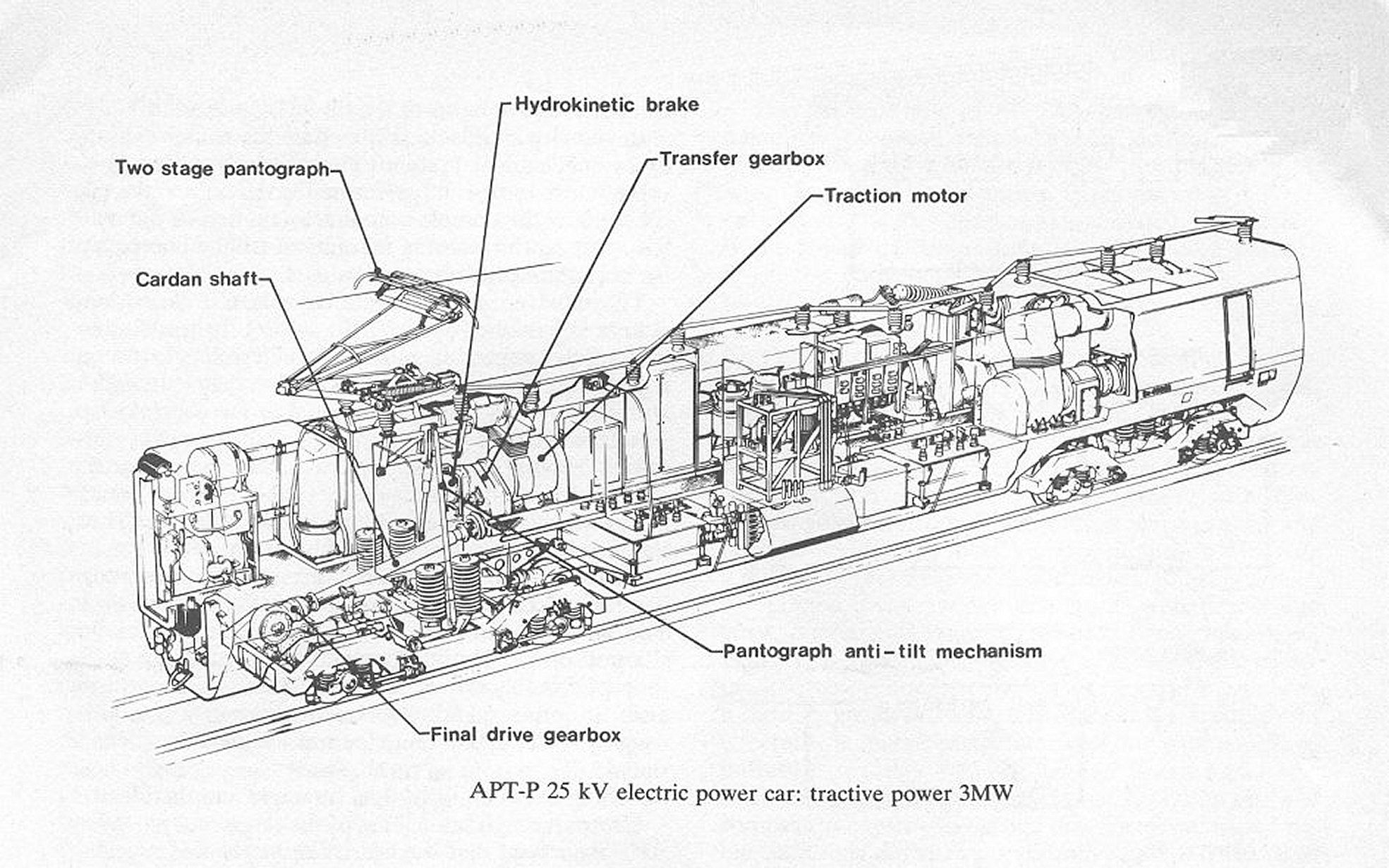
There would be absolutely no requirement for a locomotive to tilt. Tilt is for passenger comfort. The APT power cars did not tilt.

They did tilt. The pan was specially designed to allow the power cars to tilt whilst remaining square against the knitting.

ScR-Training_notes_power_car.jpg
 
Last edited:

DownSouth

Established Member
Joined
10 Dec 2011
Messages
1,545
Would NR contemplate class 91s running at 125mph on the WCML, hauling tilting Voyagers?
Can't see it myself.
Apart from having electric locos hauling diesel units in passenger service being a stupid idea at any speed, is there any good reason that it could not happen?

Wouldn't the voyager need the engine running anyway to power the tilt mechanism? So you're still burning fuel albeit not as much
A low-voltage connection from the loco should get the job done, it's not like it's a 25 kV connection that would be required.

But as I said before, electric haulage of a D(E)MU is just silly. Electric traction has a significant energy efficiency advantage, but you'd go close to wiping that out by having them haul around heavy DEMUs and supply power for tilting.
 
Last edited:

B&W

Member
Joined
12 Aug 2013
Messages
84
Even if coal-fired/gas power stations were of comparable efficiency to a diesel loco (they're not - they're better), then you're forgetting all that electricity produced by non-polluting sources, such as nuclear and renewables.

And another wiggling can of worms is when you start to factor in how much energy is used to construct and dispose of these 'non polluting' sources.

I also like the example of the biomass fire power stations/biofuel feted as 'green' and given taxpayers money by the likes of you and I. Fuel source grown faraway overseas by native trees being chopped down and burnt in the first place to plant the monoculture feed stock, this then transported to ports by diesel belching lorries, followed by ocean transport across several oceans by ships fueled on heavy oil high sulphur bunkers, then finally burnt to produce fuel or electricity.

Add in the CO2 produced to make all the transport, refineries and power stations and the overall balance makes burning home produced coal a very green source of power.

Brian
 

NotATrainspott

Established Member
Joined
2 Feb 2013
Messages
3,304
And another wiggling can of worms is when you start to factor in how much energy is used to construct and dispose of these 'non polluting' sources.

I also like the example of the biomass fire power stations/biofuel feted as 'green' and given taxpayers money by the likes of you and I. Fuel source grown faraway overseas by native trees being chopped down and burnt in the first place to plant the monoculture feed stock, this then transported to ports by diesel belching lorries, followed by ocean transport across several oceans by ships fueled on heavy oil high sulphur bunkers, then finally burnt to produce fuel or electricity.

Add in the CO2 produced to make all the transport, refineries and power stations and the overall balance makes burning home produced coal a very green source of power.

Brian

Being green is not just a matter of how much CO2 you produce...
 

transmanche

Established Member
Joined
27 Feb 2011
Messages
6,021
Being green is not just a matter of how much CO2 you produce...
A very good point.

(Even if ignoring the other pollutants released when burning coal and the fact that most coal is imported from the other side of the world as well.) Biomass (wood pellet) is a renewable resource; as in when you cut down a tree, you can plant another one. Coal is not renewable; as once you've dug it out, it's gone.
 

NotATrainspott

Established Member
Joined
2 Feb 2013
Messages
3,304
A very good point.

(Even if ignoring the other pollutants released when burning coal and the fact that most coal is imported from the other side of the world as well.) Biomass (wood pellet) is a renewable resource; as in when you cut down a tree, you can plant another one. Coal is not renewable; as once you've dug it out, it's gone.

Biomass (with recently-planted wood, not ancient) is also inherently carbon-neutral as every carbon atom in the organic material burned to produce a CO2 molecule came from a CO2 molecule in the air when the plant was alive. In effect it's just using the organic matter as a storage medium for solar energy from the sun through photosynthesis. As an additional bonus, as burning biomass is not anywhere near as polluting (soot etc) as coal it is possible to put the power stations far closer to homes and business so that they can then use the excess heat for district heating schemes.
 

30907

Veteran Member
Joined
30 Sep 2012
Messages
21,949
Location
Airedale
Apologies if anyone has already made the point, but the environmental cost of any train includes its raw materials and energy used in manufacture as well as its in-service energy consumption.

This means that replacing non-life expired diesels by new electrics may not be as environmentally friendly as it seems. (Having existing electric stock stand idle doesn't make environmental sense, of course.)
 

edwin_m

Veteran Member
Joined
21 Apr 2013
Messages
28,644
Location
Nottingham
Apologies if anyone has already made the point, but the environmental cost of any train includes its raw materials and energy used in manufacture as well as its in-service energy consumption.

This means that replacing non-life expired diesels by new electrics may not be as environmentally friendly as it seems. (Having existing electric stock stand idle doesn't make environmental sense, of course.)

Google finds this link:

http://www.environmental-protection...ty/air-pollution-and-transport/car-pollution/

It is estimated that of the CO2 emissions produced over a car’s lifespan 10% come from its manufacture and 5% from its disposal, with the remaining 85% coming from fuel use and servicing operations.

I can't immediately find a comparable figure for trains but I would guess at least 85% of their emissions also come from use and servicing, as trains are used more intensively and for a longer lifetime than the average car. If we believe this figure then it may be environmentally worthwhile to scrap an existing train prematurely if the replacement has significantly better emissions - even replacing a 225 set with something that has regenerative braking might be positive on balance. It doesn't of course say anything about the financial viability of doing this.
 
Last edited:

NotATrainspott

Established Member
Joined
2 Feb 2013
Messages
3,304
Whether something is environmentally friendly or not can also seem incredibly perverse on the surface. For example, because the act of farming itself is so carbon-intensive (as well as requiring a lack of forest and disrupting the natural ecosystem) if it is possible to do it somewhere else in the world only a few percentage points more efficiently these savings can then overcome the cost of shipping them across the world. It's like how the carbon cost of driving to a local farmer to pick up a small amount of produce can be larger than that of walking to a local supermarket where that produce has been shipped from the other side of the world. The actual carbon cost per portion of the imported item will be tiny as they are shipped in such enormous bulk quantity compared to what you would go and travel to buy yourself.

Going back to railways, it's most certainly a similar case when considering LDHS services. The power output and consumption of a Class 91 (4830kW) or 2x HST powercar set (2x1678kW) at 200km/h for hundreds of kilometres at a time will be enormous, especially when none of that energy is recuperated when the trains slow down. Over only a few years of intensive service (I'm not certain but I assume they are used at least 12 hours out of almost every day, most of which at high speed) the energy involved in their construction and later scrapping will not be very much in comparison to the amount they use in travel. With the energy efficiency of the IEPs, the amount of energy used in travel will be far less. In fact:

It is an essential requirement that IEP trains shall deliver improved energy efficiency, measured per seat km moved for the reference trains and designated routes on the East Coast Main Line (ECML) and Great Western Main Line (GWML), and taking account of auxiliary loads. The required improvement in energy efficiency over the reference trains (ref. TS277, section 2.3) shall be as follows:
Electric train (Intercity Service Type): Essential 31% Desirable 37%
Self-power train (Interurban Service Type): Essential 17% Desirable 33%
For the energy consumption calculation the IEP train interior shall be assumed to be configured for the Intercity service type for the Electric train and the Interurban service type for the Self-power train, both in the Fully Seated Condition.

IEP Train Technical Specifications - Section 3.8 Efficiency and Environment
 

B&W

Member
Joined
12 Aug 2013
Messages
84
Whether something is environmentally friendly or not can also seem incredibly perverse on the surface. For example, because the act of farming itself is so carbon-intensive (as well as requiring a lack of forest and disrupting the natural ecosystem) if it is possible to do it somewhere else in the world only a few percentage points more efficiently these savings can then overcome the cost of shipping them across the world. It's like how the carbon cost of driving to a local farmer to pick up a small amount of produce can be larger than that of walking to a local supermarket where that produce has been shipped from the other side of the world. The actual carbon cost per portion of the imported item will be tiny as they are shipped in such enormous bulk quantity compared to what you would go and travel to buy yourself.

Going back to railways, it's most certainly a similar case when considering LDHS services. The power output and consumption of a Class 91 (4830kW) or 2x HST powercar set (2x1678kW) at 200km/h for hundreds of kilometres at a time will be enormous, especially when none of that energy is recuperated when the trains slow down. Over only a few years of intensive service (I'm not certain but I assume they are used at least 12 hours out of almost every day, most of which at high speed) the energy involved in their construction and later scrapping will not be very much in comparison to the amount they use in travel. With the energy efficiency of the IEPs, the amount of energy used in travel will be far less. In fact:


IEP Train Technical Specifications - Section 3.8 Efficiency and Environment

So its better to farm wood and animals in far away out of sight out of mind places. I suppose that's good news for our local wildlife in the UK, but I am glad I am not an Orangutan or a big Cat trying to live in whats left if anything of my home in the burnt out jungles of Indonesia. I worked in Borneo in the 70s and looking at Google Earth most of the fantastically diverse places I knew and loved are now deserts of Palm Oil plantations so you and I can feel virtuous using our biofuels.

Regarding IEPs they might be better at the headline seat per km statistic, how much of that is achieved by squeezing the seat pitch to what appears to be less than airline standards?. The only draft layout I have seen indicated a pretty squashed and cramped shoe box internal layout with less seat pitch or wiggle room than a Suburban 4EPB or 308 emu of the 50s.

Anyway Network Rail will soon find ways of negating any energy savings. At Gatwick they have just commissioned the new platform 7 which means the all non stop trains to Brighton through out the day now brake from 90mph to 60mph down the gradient north of Horley as the points through platform 7 are speed limited and then the trains have to accelerate back to 90mph again up the gradient towards Three Bridges.
 
Status
Not open for further replies.

Top