Thanks everyone. See when you're tilting, are you trying to use shifted centre of gravity to balance out centrifugal force on the other side?
Shifted centre of gravity is correct, but there's no such thing as centrifugal force.
For any object to move in a curved path requires
centripetal force to pull it towards the centre of the curve. This force could be friction (cornering a car or a bike on a flat road), aerodynamic forces (e.g. a plane turning), a Normal Force (one object pushing against another, e.g. the outside rail of a flat curved track pushing a train inwards) or even gravity (holding you on the surface of the rotating earth instead of flying off into space on a straight line). Without something providing the centripetal force, an object cannot travel in a curved path and it will instead keep moving in a straight line according to Newton's first law (inertia).
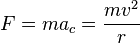
The centripetal force (F, in newtons) experienced by an object in a curved path at any instant is equal to the object's mass (m, kilograms) multiplied by the square of the object's velocity (v^2, v is in metres/second) divided by the radius of the curve at that moment (r, in metres) which looks like this:
Where the concept of tilting a vehicle comes in handy is for using something other than friction to provide the centripetal force instead of friction - we could use something else (e.g. a great big electromagnet, or rocket thrusters on the outside of a car/train) but gravity is far more convenient for working with land vehicles. When an object is resting on a tilted surface, gravity acts on it and pulls it towards the "inside" of the tilt.
What this allows is for the surface on which a vehicle travels to be tilted inwards, so that some (or even all) of the centripetal force is provided by gravity pulling the vehicle down the tilt towards the centre of the curve instead of friction. This is called a
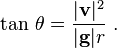
banking angle but is commonly referred to as camber on a road curve, and on a rail line as superelevation (the difference in height between the inside rail and outside rail, rather than as an angle) or commonly by the non-technical term of cant. Just by knowing the speed at which the cornering will take place and the radius of the curve, there's a simple formula to work out the "ideal" banking angle which would have the gravitational pull down the tilt providing exactly the right amount of centripetal force:
On an outdoor velodrome with progressive bankings, most people should be able to ride a bike fast enough that they can ride in a straight line around the turns with the bankings doing all the cornering work. If you're reasonably fit you should be able to ride faster than the ideal speed for the banking at the bottom and therefore need to counter-steer to lean the bike or move up towards the outside where the banking is higher.
Specifically talking about rail (and equivalents for road in brackets), you can't actually have the superelevation (camber) set at the "ideal" banking angle in 99% of cases because the majority of curves are used at a wide variety of speeds - the ideal banking angle for a slow freight train (Morris 1100) will be very different to the ideal banking angle for a fast passenger train (Ferrari 599). Setting it to the ideal angle for the passenger/Ferrari would have the freight train scraping along the inside rail and the Morris driver having to steer "up" towards the outside of the curve, while setting it to the ideal angle for the freight/Morris would have the passenger train pushing up against the outside rail and the Ferrari driver steering into the corner using the grip of the tyres to provide the centripetal force.
This is where the concept of
cant deficiency comes in, for resolving the compromise on a mixed traffic rail line. CD is the difference between the superelevation which would provide the ideal banking angle for the selected speed and the actual superelevation of the track - and is expressed in terms of height. When a train runs at a speed where the cant deficiency is greater than zero (i.e. a higher speed than the ideal speed for the banking angle) the banking angle is not sufficient to provide all the centripetal force and the remainder will be provided by the contact with the outer rail. Somewhere between 120-150mm is usually regarded as the top end of CD for a conventional (i.e. no tilting body) passenger train, if the CD is higher than that the amount of lateral force experienced by the passengers will be too high to be comfortable and they would be seen gripping their armrests and losing objects sideways off the table.
The principle behind providing a
tilting body train (e.g. a Pendolino, ICE-T, Acela, Hitachi's QR Tilt Train, or Talgo) is that it takes the same principle of using a banking angle to lessen the amount of centripetal force provided by friction and applies this to the friction between the seat and the passenger as well as to the rail/train interface. These trains can run at speeds set for a CD higher than that which would be comfortable on a conventional (up to 300mm in Europe) with the tilting body providing an "extra" banking angle to make up the difference between the track's superelevation and the higher banking angle which would be comfortable for passengers at that speed.
There is such a thing as too much tilt though. If a train is cornering with the banking angle of the passenger accommodation at exactly the ideal banking angle for the curve (whether just by the track's superelevation or a combination of that plus a tilting body) then there will be no lateral force and therefore no sensation of cornering - and passengers have a high chance of getting motion sickness if they get the visual sensation of cornering without the physical sensation. An infamous case of this was on the publicity runs for BR's APT project where the amount of tilt was so high this did become a problem - BR showed a great example of the traditional customer service ethic of a public railway (i.e. none at all) and publicly blamed it on the journalists being drunk, but then confirmed the journalists were actually correct by their subsequent actions (they reduced the amount that the APT bodies would tilt).
For some people who have become very accustomed to the cornering of a particular type of conventional train, the first time using a tilting body train could possibly see a minor degree of the same experience, but nowhere near as bad since that lesson was learned by BR. The same people may experience the same thing on even a new conventional train with different ride characteristics though.
The reason for this (I think) is that the axle weight is heavier on 390s and also 221s because of the additional tilt mechanism which you wouldn't find on say, 220s.
Axle load would be a small component of it, but the majority of the increased wear (mainly the outside rail) would be due to the speed being above the speed for which the track was optimised, and further above it than a conventional passenger train - remember that the centripetal force is proportional to the
square of the object's velocity. In the broader scheme of things though, a UK-spec Pendolino is still a lightweight train compared to the medium-weight "heavy" freight in Britain and genuine heavy freight elsewhere, and only 11 cars long as well.
It's easy to see why this is perceived as a price worth paying though - nowhere else makes such a huge song and dance is about the most minor of journey time improvements as Britain, and nowhere else would consider skipping a major interchange station to save a minute or two to be remotely acceptable as some were talking about on the Crossrail to Reading thread.
A tilting train puts more stress on the track than a non-tilting train of the same weight. But the track is able to cope with this - perhaps with an increase in rate of rail wear and need for more frequent rail grinding.
The increased wear would be primarily due to the increased speeds. Active tilt systems (i.e. not Talgo-style passive tilt) do transfer a little bit of weight to the inside rail which has a minor mitigating effect on the wear of the outside rail, which a conventional passenger train does not.
Ultimately there is a risk of overturning if the cant deficiency gets too great. However, like 455driver I have always understood that passenger comfort is the limiting factor on curving speeds.
Excessive wear and tear on mechanical components and the track would also kick in as limiting factors before the risk of overturning.
--- old post above --- --- new post below ---
Animals lean into a curve when running, and so do cyclists (pedal cyclists and motorcyclists). It's an intuitive response in order to maintain balance.
Yep, it's just a simple fact that comes from the physics of the situation - shoes and tyres are not equipped to pull you into a corner, they push you into it. Try to stay upright or leant the other way and you'll end up on the deck.
If you were to run up towards a vertical pole and grab onto it with one hand to swing yourself around it you wouldn't lean inwards though, there's simply no need to when something else other than friction is providing the centripetal force.
I used to know a man who drove a Land Rover with his alsation dog on the front passenger seat. I enjoyed watching them drive round the bend towards me, as both driver and dog would lean into the bend by the same angle and at the same time, and then both straighten up again simultaneously.
If you regularly use a proper car seat which hugs the body and keeps it in position, the instinct to lean disappears pretty quickly.