From your response it is obvious that I don't think I am making myself clear.
So I shall go back to be beginning. There are several gauges that have to be complied with before a vehicle can run on the railway. The first is the "static gauge" - which is the cross section of an infinitely short vehicle ie nothing can be larger than that. At the start of BR this was defined as the C1 loading gauge and allowed a maximum width of 9ft 3in at 4ft 0 1/2in above rail level. This 9ft 3in included an allowance for projections such as door handles.
This was then translated into two vehicle types with lengths of 63ft 6in and a bogie spacing of 46ft 6in and a shorter vehicle 57ft 0in. The latter was the go-anywhere vehicle and large numbers were built in various forms including both passenger and parcels vehicles, as it was recognised that the longer vehicle could not go everywhere on the system.
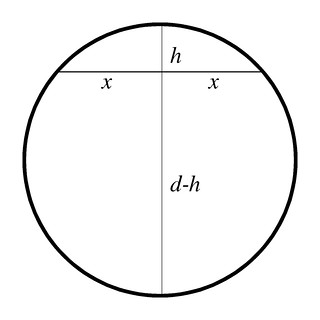
In the course of the development of the mark 3 vehicle it was realised that by recessing door handles, and with a slight tapering of the ends, the same width of 2.74 metres could be achieved in a longer vehicle, subject to route restrictions and this was the basis of Restriction C3. With a vehicle of this length the geometrical issues come into play, since what counts is the "swept volume" - the envelope through which the vehicle must be able to pass through. This is determined by the simple geometry of the circle, in which (
x) squared=
h(
d-h)
This means that the width of the vehicle must be reduced by an amount proportional to the square of the distance between the bogie centres. A similar adjustment must be made to the vehicle width outside the bogie centres. In the case of the mark 3, this reduction was 8 cm. Later on, mark 3 vehicles were built to the 20 metre length and to the full width of the static loading gauge ie 2.82 metres ie with a wider bodyshell than the mark 1.
If you obtain the formulae, put them on a spreadsheet and test out various lengths of vehicles and bogie spacings, you will find that each successive increment of length beyond 20 metres leads to a larger width reduction. A 21 metre vehicle needs to be just 2 cm narrower than the 20 metre vehicle, but a 23 metre vehicle loses 8 cm and a further 3 metres would lose more still - you can work that out for yourself. If you apply the formulae you will also discover that a longer vehicle of the same width as a mark 1 is theoretically possible with a longer overhang at each end.
One of the reasons why such vehicles were never built may be because of the stress it puts on the coupling and gangways - the mark 3 gangways are apparently subject to a lot of wear and tear due to the large relative movement between adjacent vehicles, with the bogie centres 3.5 metres in from the vehicle ends.
There are two further factors, however, that have to be taken into account. The first is that allowance has to be made for the movement of the vehicle on its suspension system. The second is that allowance has to be made for the movement of the track, which has a tendency to creep out of position, especially on curves. So tolerances have to be built in to accommodate this. Recent developments have made it possible to monitor this movement more accurately and so the allowance can be reduced somewhat. The same reduction in tolerances may also permit a wider static loading gauge.
IEP is in fact going to be 2.75 metres wide ie 1 cm more than mark 3. But the point is that, whichever way this issue is looked at, vehicle could be longer than 20 metres but nearly as wide and still have a go-anywhere capability. That surely is worth having since it would offer the possibility of system-wide standardisation.
It is obvious that I have not made myself clear, because you refer to the Oxford avoiding line designed for fast running. The tight Oxford turnoff I am talking about is the one through Didcot station. This is the sort of thing that is found when the matter is looked at in closer detail.
The picture you linked to of the Cotwold line was of track of a far larger radius than that which determines gauging restrictions. But unless you are working in the appropriate department of Network Rail, you do not have the information any more than I do, that is if it even exists at the moment. As for the works required at Victoria, the station approaches will have been relaid at least once since mark 3 stock was introduced and the accommodation works will have presumably been done then. And I have still never seen mark 3 stock, or photographs of mark 3 stock, on the eastern side of the station. Perhaps you know otherwise. If it would have been possible to operate 23 metre vehicles freely over the Southern lines, the ROSCOs would not have ordered over a thousand EMU vehicles to the 20 metre length for these routes. Assuming one day that the Southern routes were re-electrified on the 25kV system, how much additional infrastructure work would be needed to enable IEPs to run over these lines? Such a requirement is not beyond the bounds of possibility.