• Our new ticketing site is now live! Using either this or the original site (both powered by TrainSplit) helps support the running of the forum with every ticket purchase! Find out more and ask any questions/give us feedback in this thread!

British Rail Leeds to London - Inside story (1991)

Status
Not open for further replies.

TMLB UK

Member
Joined
10 May 2010
Messages
272
Location
UK
I'll put a link up when I'm home but I found this on YouTube last night and what a brilliant watch it is.


http://www.youtube.com/watch?v=cyyYeIuaNik&sns=em

[youtube]bRnMGQQFkME[/youtube]

Some excellent characters in it.

Some highlights for me...

2nd Driver gets on and gives camera man a right good dirty look, "what's all this then?" (With a lit cigarette hanging out his mouth)

Driver at Leeds gets into his blue bin bag prior to setting off!

So funny. Also being new to the railway I hear some frightening and very accurate predictions... "They will regret not investing more in the railway in 20 years"

Excellent video in sure you will enjoy it.
 
Last edited by a moderator:
Sponsor Post - registered members do not see these adverts; click here to register, or click here to log in
R

RailUK Forums

OuterDistant

Member
Joined
25 Oct 2010
Messages
609
Location
TOPS Area 43
Yes, yes! I've always wanted to see this again. Picking up that 2nd driver at Doncaster, and he's an old hand from steam days, complete with cloth cap and a fag. What a guy!
 

Alan1310

Member
Joined
21 Jan 2010
Messages
187
I have watched this loads of times and you have picked the best bits
One question though when did the 2 drivers over 110mph change
 

Goatboy

Established Member
Joined
23 Jun 2011
Messages
2,274
Interesting fare comparison.

1991:

First Anytime Return: £120
Anytime Return: £78
Saver Return £49
SuperSaver £39

2012:

First Anytime Return: £354 (+295%)
Anytime Return: £249 (+320%)
Offpeak Return (ie, Saver) £149 (+304%)
Super Offpeak (ie, SuperSaver) £94.10 (+241%)

Over the same period, the inflationary increase would have been circa 75%.

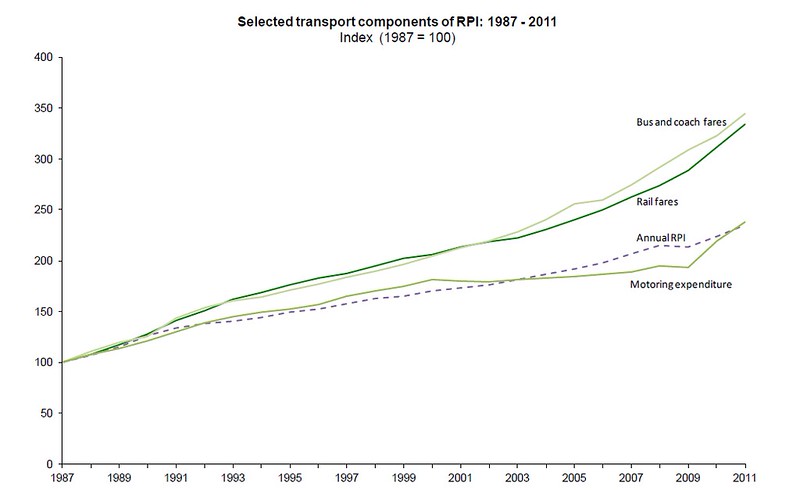
Astronomically crazy price hikes. In real terms, the fares on this route have more than DOUBLED or even TRIPLED!?. For the same journey from the same station taking the same time on the same rolling stock.

£249 for anytime return from Leeds is particularly hilarious. To make the same return journey in a 5 litre Mercedes S Class would cost £100 in fuel and say £40 to park in the city for the day. Something is wrong when it's considerably cheaper to take a top of the range Mercedes Benz on a journey than purchase a standard class rail ticket. Obviously that assumes you own such a car in the first place, but then all comparisons with road transport should be on the marginal cost of making that journey as most people already own a vehicle and have to pay for it anyway.
 
Last edited:

All Line Rover

Established Member
Joined
17 Feb 2011
Messages
5,270
Interesting fare comparison.

1991:

First Anytime Return: £120
Anytime Return: £78
Saver Return £49
SuperSaver £39

2012:

First Anytime Return: £354 (+295%)
Anytime Return: £249 (+320%)
Offpeak Return (ie, Saver) £149 (+304%)
Super Offpeak (ie, SuperSaver) £94.10 (+241%)

Over the same period, the inflationary increase would have been circa 75%.

Astronomically crazy price hikes. In real terms, the fares on this route have more than DOUBLED or even TRIPLED!?. For the same journey from the same station taking the same time on the same rolling stock.

£249 for anytime return from Leeds is particularly hilarious. To make the same return journey in a 5 litre Mercedes S Class would cost £100 in fuel and say £40 to park in the city for the day. Something is wrong when it's considerably cheaper to take a top of the range Mercedes Benz on a journey than purchase a standard class rail ticket. Obviously that assumes you own such a car in the first place, but then all comparisons with road transport should be on the marginal cost of making that journey as most people already own a vehicle and have to pay for it anyway.

Train fares are expensive nowadays and I would like them to come down slightly. But when you consider that the cost of diesel has increased from around 40ppl in 1991 to around 140ppl in 2012 (a 3.5x increase), the train fare increases don't look so bad.

If petrol cost only 40ppl back in 1991, and insurance costs were much lower, train fares obviously had to be significantly lower in order for the railways to be competitive.

A also noted that season tickets have increased by a lesser amount - the Wakefield to London First Class season mentioned in the programme has only increased by a little over 2x.
 

Goatboy

Established Member
Joined
23 Jun 2011
Messages
2,274
Once you've already bought a car, you've already taxed it and you've already insured it then the marginal cost of making a journey using it is the cost of the fuel and small per mile contribution to variable costs such as tyres and servicing. It is this marginal cost which rail should compete with. Sometimes it does and does it well but often it does not but in the Leeds example it seems to be hilarously out of touch. Most people do not drive 5 litre S Class Mercs and therefore the cost of driving to London and parking, from Leeds, is likely to be many times less than the cost of the Anytime rail fare with which driving competes. It's bonkers.

It's such a shame - rail should be getting cars off the road. Thats what its for now - reduce our dependancy on personal transport. To do this it needs to be cheaper than the marginal cost of using a car by enough of a margin to offset the relative lack of convenience (Though I accept that with the London example it can be argued the train is more convenient - though not twice as convenient!).

I like trains. I enjoy travelling by them and reading/posting about them but sometimes even I end up driving - alone - burning up petrol simply because it would cost more to use the train by enough of a margin to make it unjustifiable.

It's a shame.

I bang on about this a lot, I guess - but it's the number 1 issue that irks me on the railways today. I can tolerate delays. I can tolerate a coach somebody hasn't cleaned. I can tolerate 20 year old rolling stock. But crap value for money is my number 1 issue with rail in this country today.

Sometimes they get it so right - there are many journeys where you'd be mad to drive unless there are 2+ people. Just a shame we can't get this right elsewhere. This is where government should be intervening - especially if they are serious about cutting emissions and being 'green'.

Make public transport better value and you've won half the battle against the car. £250 for a walkup standard class return ticket from London to Leeds is just ridiculous.
 
Joined
21 Oct 2010
Messages
1,040
Location
Leeds
Yes but you cant work/prepare for a meeting/send emails etc while driving. Yes the peak time fares are huge but the trains are often full when arriving into London. The 0700 Leeds to KX had 398 in standard and 101 in First on Tuesday and this is a train which has no Peterbrough commuters. If demand outstrips supply then why would you lower the price.
If we are talking about lesuire travel than excellent advance tickets can be bought if booking weeks before, probably many more cheap tickets are available now than in 1991.
 
Last edited:

All Line Rover

Established Member
Joined
17 Feb 2011
Messages
5,270
Once you've already bought a car, you've already taxed it and you've already insured it then the marginal cost of making a journey using it is the cost of the fuel and small per mile contribution to variable costs such as tyres and servicing. It is this marginal cost which rail should compete with. Sometimes it does and does it well but often it does not but in the Leeds example it seems to be hilarously out of touch. Most people do not drive 5 litre S Class Mercs and therefore the cost of driving to London and parking, from Leeds, is likely to be many times less than the cost of the Anytime rail fare with which driving competes. It's bonkers.

It's such a shame - rail should be getting cars off the road. Thats what its for now - reduce our dependancy on personal transport. To do this it needs to be cheaper than the marginal cost of using a car by enough of a margin to offset the relative lack of convenience (Though I accept that with the London example it can be argued the train is more convenient - though not twice as convenient!).

I don't think it's a reasonble expectation that rail should compete with the variable costs of car travel. Rolling stock is incredibly expensive, the infrastructure costs a fortune to maintain and staff costs must be factored in also.

As YorkshireRider points out, rail has many advantages over car travel, especially when travelling to/from London (although this doesn't justify the ludicrous SOR fares).

I do agree with you that one of the aims of the railways should be a modal shift from car to rail travel, but the government doesn't support this philosophy.
 

Goatboy

Established Member
Joined
23 Jun 2011
Messages
2,274
I don't think it's a reasonble expectation that rail should compete with the variable costs of car travel. Rolling stock is incredibly expensive, the infrastructure costs a fortune to maintain and staff costs must be factored in also.

I think it is reasonable. The running costs of the railway are sort of irrelevent in this factor (Though you'll note that Intercity was not subsidised in 1991 yet delivered fares that are 3 times cheaper than they are now) because it should be part of the purpose of railways to provide a public service. Where there is a shortfall between revenue and cost it should be made up with public subsidy. The government spends enough money on 'green' issues - getting people onto public transport is pretty key to this and arguably would have a greater effect than ploughing piles of cash into other 'green' inititives.

Where it begins to be unreasonable to expect rail to compete with the car is where there are multiple people travelling. 2, 3 or 4 people will almost always be cheaper by car and thats a sad fact of life.

But a single person should be incentivised to swap car usage for rail usage by fares which offer better value, IMHO.

You can probably argue that peak time trains such as that in this example do offer tangiable benefits over car usage - you can work, you don't need to park and you probably don't need a car at your destination. In situations like this perhaps its fair to argue that rail shouldnt neccesarily undercut the marginal cost of car travel but the premium you pay for rail shouldn't be double the cost, as it is in this example at the very least!

Oddly it works in Devon and Cornwall. Buy a Devon and Cornwall Railcard and there is almost nowhere you can go in Devon or Cornwall by rail which isn't noticeably better value than driving. This is how the entire network should be, IMHO.

I'm aware this is heading offtopic, which is a shame as I think it's a fairly important and interesting debate :p
 

43167

Member
Joined
18 Jan 2010
Messages
1,021
Location
Keighley
I remember watching this about 20 years ago.

Would like to know what East Coast would do today if the all 91's were briefly withdrawn from service.
 

ainsworth74

Forum Staff
Staff Member
Global Moderator
Joined
16 Nov 2009
Messages
31,129
Location
Redcar
Would like to know what East Coast would do today if the all 91's were briefly withdrawn from service.

I'd imagine they'd focus HSTs on providing a core service between London - Leeds/Newcastle (with perhaps a few extensions to Edinburgh) along with plenty of buses and cross ticket acceptance on HT and GC for services to London and XC for services between York and Scotland (in the main but I'd imagine they'd try and just get all East Coast tickets accepted on all operates on a reasonable route). I also would imagine they'd try and hire in an EMT HST and probably look at spot hiring a rake of coaches (and the locomotives to operate them) or two from the likes of DBS.

It would be interesting certainly. I wonder if any TOCs that are very reliant on one type of train for their services (XC on 22xs, FGW on HSTs, VT on 390s, EMT on 222s) have any sort of back up plan for one of their fleets being grounded?
 

Manchester77

Established Member
Joined
4 Jun 2012
Messages
2,628
Location
Manchester
It would be interesting certainly. I wonder if any TOCs that are very reliant on one type of train for their services (XC on 22xs, FGW on HSTs, VT on 390s, EMT on 222s) have any sort of back up plan for one of their fleets being grounded?

Indeed
if XC lost their 22Xs for any period of time almost all services would be cancelled
Virgin I'd imagine would focus on running to Glasgow and Manchester via Birmingham using double 221s. They would probably have ATW run extra services in Wales and LM run extra services to Birmingham and Extend some to Manchester for extra capacity. TPE would perhaps run more North West to Scotland services.
If FGW lost their HSTs again XC would probably have to step in and help. Maybe they'd hire a XC HST set, an EMT set and perhaps an adelante off FHT/GC?

In any case if any TOC lost a whole fleet like that then there would be major disruption
 

tbtc

Veteran Member
Joined
16 Dec 2008
Messages
18,061
Location
Reston City Centre
If supply outstrips demand then why would you lower the price

Precisely.

Often its the same people complaining that trains are "overcrowded" who complain about them being too expensive (see threads about XC not offering bargain tickets for an example).

Maybe if demand started falling TOCs would have an incentive to cut their costs and offer more competitive fares, but they know that they can put their prices up above inflation and still see passenger numbers increase so they can afford some "inefficiencies".
 

HH

Established Member
Joined
31 Jul 2009
Messages
4,505
Location
Essex
Over the same period, the inflationary increase would have been circa 75%.
General inflation is in the region of 75-80% but apart from the price of power (whether electricity or diesel), there's also the massive increase in wages (especially driver's) and the extra cost of rolling stock, which was probably viewed in a different light back then. But prices weren't linked to costs back then, and they aren't now.

Under BR they were what they could get away with, and for fully non-regulated it's pretty much the same now. Nostalgia is all very well, but in 20 years time some will be looking back at today with just the same feelings. It's part of the human condition...
 
Joined
21 Oct 2010
Messages
1,040
Location
Leeds
Like the film by the way, the guard who signed the guys ticket so he wouldnt get arrested is still here another 21 years on
 

tbtc

Veteran Member
Joined
16 Dec 2008
Messages
18,061
Location
Reston City Centre
Yep that would be another one and they'd be totally stuffed (at least the others have some other stock)!

I wonder whether the chance of this has been the reason why some TOCs have gone for slightly split orders - e.g. Stagecoach buying 444s and 450s for SWT when they may have been tempted to stick to one type of train (with different seating)?
--- old post above --- --- new post below ---
in 20 years time some will be looking back at today with just the same feelings. It's part of the human condition...

True.

Look at 2012 - we have increasing passenger numbers (at a time when car driving seems to be going down), we have hundreds of miles of electrification to look forward to, we have staff on historically good wages (most drivers are in the 40% tax bracket with final salary pensions - most staff have a lot more job security than they had under BR), we've not had many deaths caused by train accidents in recent years, we've got a political consensus in favour of long term railway investment like HS2... we don't know how good we have it.
 

Goatboy

Established Member
Joined
23 Jun 2011
Messages
2,274
General inflation is in the region of 75-80% but apart from the price of power (whether electricity or diesel), there's also the massive increase in wages (especially driver's)

Drivers wages are 300% higher now than 20 years ago?

and the extra cost of rolling stock,

The film featured IC225's which are still used today and would be fully amortised were it not for the excellent situation we now have whereby TOC's must lease all the stock from banks ;)
--- old post above --- --- new post below ---
we have hundreds of miles of electrification to look forward to

Unless the reduction in running costs that electrified railways afford are passed on to the customers in terms of fare reductions then really there isn't much to look forward to in that respect. Infact it's likely the opposite will be the case - it'll be even more expensive because hey, shiney new electric trains now, somebody has to pay for those..

If you ask the average person what they think is wrong with rail travel almost nobody will say 'I'd like to pay more for my ticket in order to get electric trains' ;)
 
Last edited:

tbtc

Veteran Member
Joined
16 Dec 2008
Messages
18,061
Location
Reston City Centre
Drivers wages are 300% higher now than 20 years ago?

IIRC Virgin drivers were reportedly one pay rise off earning £60,000? Staff costs have gone up considerably (esp when you include pension costs - twenty years ago employers were taking "contribution holidays")

Unless the reduction in running costs that electrified railways afford are passed on to the customers in terms of fare reductions then really there isn't much to look forward to in that respect

Given that electrification is going to mean longer faster trains on many routes, frequency improvements on some routes and cascaded stock allowing improved services on other routes, I'd say there was something to look forward to, aye.
 

HH

Established Member
Joined
31 Jul 2009
Messages
4,505
Location
Essex
Drivers wages are 300% higher now than 20 years ago?
More I'd say. I recall them being around £12k before they were restructured. which was around 1995. :lol:

Taking tbtc's numbers for VRG drivers that's a five-fold increase...
 

Goatboy

Established Member
Joined
23 Jun 2011
Messages
2,274
More I'd say. I recall them being around £12k before they were restructured. which was around 1995. :lol:

I somehow doubt the average Class 91 trained driver was taking home £12k a year just prior to 1995.
 

HH

Established Member
Joined
31 Jul 2009
Messages
4,505
Location
Essex
I somehow doubt the average Class 91 trained driver was taking home £12k a year just prior to 1995.
The average VRG driver isn't taking home £60k now. Some are into 6 figures...
 

Bald Rick

Veteran Member
Joined
28 Sep 2010
Messages
35,965
I somehow doubt the average Class 91 trained driver was taking home £12k a year just prior to 1995.

Basic for a driver after restructuring (in 92, after the strikes from memory) was about 18k.


Back to the original point, my personal record for driving from the M1/M25 junction to central Leeds is 2h20 mins, and that was 10 years ago on a Sat night with no traffic, no speed cameras and a right foot that was a touch heavy. Urban London to central Leeds with no traffic today can be no less than 3 hours. Try it in the day and it's at least 4, perhaps 6. So I think it is reasonable to charge more than the marginal cost of motoring when you can save at least 2 hours - depending of course on your origin / destination points.
 
Last edited:

General Zod

Member
Joined
5 Jan 2008
Messages
590
Very amusing anecdote @ 11min 21 about the lady from Scarborough who was at the Leeds' exit barriers without a ticket. :D:D:D
Great characters throughout the documentary.
 

Metroland

Established Member
Joined
20 Jul 2005
Messages
3,212
Location
Midlands
The real shame of those rail stats is this:

Consider in 1988/9, the fares revenue was £1.8bn (about 3.4bn in today's money). The subsidy was around £446 million (less than £1bn now). This was in the days of so-called inefficient BR. Remember a lot of capital investment was going on - new sprinters, ECML electrification, new signalling, networker trains etc.

Wind the clock forward to 2012, fares revenue is £7.29 bn (over double what it was). Therefore you would expect the railway, even with no efficiencies, to be now subsidy free and in a position to replace the large amounts of sprinters bought 20 odd years ago! There is not only no investment plan in sight, the fares are making up only 65% of the cost!

In conclusion, some people have done very nicely out of rail privatisation, but it's not the farepayer or taxpayer!
--- old post above --- --- new post below ---
I somehow doubt the average Class 91 trained driver was taking home £12k a year just prior to 1995.

The basic rate of pay for a driver was 200ppw for a driver and the same for a grade E signalman (something like a medium-large psb) in 1992. Grade F signalmen were the highest paid front line ops staff, but there was only a few of those places (Noteably Reading, Birmingham New Street).

There was then various allowances on top, DOO, shift allowances, mileage, walking time (yes really!).

Lot of staff were on lower wages, grade B signalmen (a typical mechanical box) were on around £115pw per week with guards similar. Clerks were on about the same without allowances.

There were reports of ECML drivers and top grade signalmen (grade F) getting into pay rates around £20-25k with a lot of overtime from memory.
 
Last edited:

The Ham

Veteran Member
Joined
6 Jul 2012
Messages
12,046
Once you've already bought a car, you've already taxed it and you've already insured it then the marginal cost of making a journey using it is the cost of the fuel and small per mile contribution to variable costs such as tyres and servicing.

The thing is if you take the whole life costs of running a car, then often it works out cheaper to go by train. Now I know very few people are able not to have a car at all, but given the choice between going by train an buying & running a second car just to go to & from work train is likely to win on cost.
 
Status
Not open for further replies.

Top