• Our new ticketing site is now live! Using either this or the original site (both powered by TrainSplit) helps support the running of the forum with every ticket purchase! Find out more and ask any questions/give us feedback in this thread!

Why do UK bus operators not use basic measures used everywhere else to speed the service?

Status
Not open for further replies.

miklcct

Established Member
Joined
2 May 2021
Messages
5,017
Location
Cricklewood
You're talking about large towns and small cities here. I'm afraid that you're really quite mistaken. We could just subsidise the buses and increase the taxes on car use.
Thank you. I have nearly forgotten this. A "mileage tax" reported through MOT can be a good idea here.
 
Sponsor Post - registered members do not see these adverts; click here to register, or click here to log in
R

RailUK Forums

TheGrandWazoo

Veteran Member
Joined
18 Feb 2013
Messages
22,945
Location
Somerset with international travel (e.g. across th
Thank you. I have nearly forgotten this. A "mileage tax" reported through MOT can be a good idea here.
Arguably, that is what you would have through fuel duty; it's a tax for every litre of fuel consumed. It has not increase in the UK since 2010 and whilst Rishi Sunak sought to increase it by 2.8 ppl in the last budget, the opposition from Tory MPs and motoring groups saw it abandoned.

We are having Tory MPs creating noise about cutting the National Insurance rise that is supposed to fund the social care for the most vulnerable so the chances of a mileage tax.... dream on!
 

RT4038

Established Member
Joined
22 Feb 2014
Messages
5,456
@RT4038 is absolutely right. The argument for dual door vehicles in places outside London and Edinburgh was largely lost by the early 1970s. West Midlands was a early mover to single door vehicles from c.1970/1 and think Greater Manchester likewise from about 1973, though there were places that persisted despite being relatively small towns such as Ipswich or Hartlepool. A lot of the reasons may be lost in the mists of time and you have to look at how things were then. There was a clear aim to move to one person operated vehicles to reduce staff costs, not least in a period when passenger figures were already steeply declining and staff shortages were endemic. The 1960s had seen one-person-operated (OPO) vehicles and, initially in urban environments, these were often single deck, dual door vehicles such as Bristol RELLs, as well as less successful designs. Obviously, this did have benefits but in many instances, the reason behind it was an insistence (usually caused by trade unions) that double deckers would be either crew operated or that if they were to be OPO, then they would be single door.

The requirement for single door was also promoted because of driver shortages and the need for operational efficiencies so that capacities were increased (no loss of downstairs seats). Also, the additional cost of dual doors, both in purchase and ongoing, was a factor. Once that shift happened, it led to a fundamental casting of the dye so that it became the default way of doing it in the UK.

Similarly, the move to OPO and the demands of unions was reflected in how fares were handled. If drivers were now to replace conductors in fare taking, there was a view that they had enough on their plate. So as well as avoiding perceived safety issues with centre doors, there was also issue of fare handling etc. In some instances, that led to the use of fareboxes (that still persist in a number of areas), as well as other off-bus sales - monthly passes that could be bought at newsagents or travel shops, carnet strips etc.

However, the fact is that operators in the UK regulated and deregulated world have always had to cut their cloth (with perhaps a few instances in some PTEs in the 1970s/1980s) so they had to undertake the exercise of saying, if I do X, what is the cost and what is the benefit? And if it requires a significant investment, what is the payback period before I see that benefit. This is all standard stuff - it may explain why someone like Go Ahead with a predominantly urban bus portfolio outside London (Oxford, South Hampshire, Brighton and Hove, Tyne and Wear) could make the case for ITSO investment whereas Stagecoach couldn't - you'd have to ask them!

Until the entire bus system is changed - (I know franchising is often the term used but it's a misnomer) a move to 3rd party operation where operators are directly paid AND, most crucially, the financial and funding model is changed in both structure and in size, then you aren't going to have a European style operation etc. That's the truth of it. I might also add that there has to be a consequent change in how we view our relationship to the private car and to taxis/ubers.
I worked for one of the relatively small town operators on the early 80s, which was fully single-deck dual door vehicles (save for some legacy open-back DDs in the first year) of five different types. Being a municipal, and only operating in the dense urban area of the comparatively small town, meant that securing the necessary bus stop changes for a gradual roll out of OMO was relatively easy. The first route (about 10 years earlier, serving the most affluent area that the Department served) had been converted using Ultimate machines and giving change, but then Autofare and fareboxes were introduced for the busier routes, to get staff buy-in. @Bletchleyite would be proud of the speed of boarding/alighting with this system. The buses were well used and frequent, although fares/concessionary reimbursement [at full cost!] only covered about two thirds of costs.
There was an irritating background of middle door passenger alighting accidents (body shut in doors/bag or umbrella etc), some causing injury when falling to the ground. No deaths fortunately, although I suspect only one would have caused middle door operation to have ceased. These were mainly caused when standing passengers obscured the drivers inside mirror view, or driver error due to inattention particularly with the three or more different types of door operating mechanisms. Sorting that out would have given the then Chief Engineer apoplexy. Older passengers particularly did not like the steep steps at the middle door on some types, and would come to the front to alight. This was long before 'low floor' had been thought of!
The other operator in town (an NBC subsidiary) had no dual door vehicles. Staff who came from that Company tended to dislike dual door, compared to home trained staff.
Dual door vehicles usually had little resale value, and at Deregulation the resulting bus wars, with minibuses and other single deckers with only one door, eventually saw the demise of dual door operations.
 

Bletchleyite

Veteran Member
Joined
20 Oct 2014
Messages
113,450
Location
"Marston Vale mafia"
Thank you. I have nearly forgotten this. A "mileage tax" reported through MOT can be a good idea here.

I'd go with urban (and National Park) congestion charges and parking taxes. The use of cars in rural areas is generally not particularly harmful, and bus operation is generally uneconomic even with subsidy, so you might as well concentrate the taxation on where you really need to get people onto buses (and where it's viable to provide said buses).

Hitting people with taxation on driving when their nearest bus service is 5 miles from home and runs once a week is a bit raw. But if there's a bus stop at the end of their street with a bus into town every 10 minutes, it's fair game to do most things to prevent them driving there.

There's been some coverage of this point in the long-running thread about electric cars.
 

TheGrandWazoo

Veteran Member
Joined
18 Feb 2013
Messages
22,945
Location
Somerset with international travel (e.g. across th
I'd go with urban (and National Park) congestion charges and parking taxes. The use of cars in rural areas is generally not particularly harmful, and bus operation is generally uneconomic even with subsidy, so you might as well concentrate the taxation on where you really need to get people onto buses (and where it's viable to provide said buses).

Hitting people with taxation on driving when their nearest bus service is 5 miles from home and runs once a week is a bit raw.

There's been some coverage of this point in the long-running thread about electric cars.
Central government won't do it.

The problem is that local government is generally concerned with the usual local opposition to anything but what they did in Copenhagen is to do things by stealth. Remove 1% of on-street car spaces in city centres and also push up the price of parking to counteract the revenue loss. Not being able to park your car as easily, getting stung on cost and also using that space for traffic makes a lot more sense.
 

Deerfold

Veteran Member
Joined
26 Nov 2009
Messages
13,723
Location
Yorkshire
Then I'm sorry to say that, in those places, we can do nothing to reduce car ownership or car usage, because in such case, if the car is used frequent enough, it will be cheaper than the bus, leaving the few occasional users, who can't support a commercial bus service, using car clubs, taxis and minicabs as their main form of travel.
Can we not? Some operators have had success with higher quality buses and high frequencies - but none that I know of get an average of 50 passengers a bus and wouldn't by cutting fares to £1 - for example in Harrogate, some Sunday services have been sponsored to make them free to use. They've seen a substantial increase in use, but nothing like that.
Governments can influence this in many ways - bus companies used to get a large reduction on the tax of the fuel they bought, making it easier for them to offer competitive fares. They can make car ownership more expensive. They can provide dedicated lanes to enable those buses to have a speed advantage, even where they aren't particularly frequent.
However, even a village of a thousand people only can support a 16-seat minibus route at a reasonable fare (a 16 seat minibus route charging £1-£2 can be profitable if it has nearly full loading from morning to night, uses cheap mass-production vehicles with cheap maintenance, simple roster and minimal operation overhead; while a loading of 50 people on a regular double decker route in the day allows the route to be sustainable in quieter periods and offers a true dawn-to-midnight service). The caveat here though is that there can only be a single road out of the village (e.g. due to geographical constraint) which will pass through the nearest town, aggregating enough trips to support a minibus service. If the village in question has 4 roads heading to 4 different directions with 4 different towns serving different needs, unless there is enough demand to support long-distance bus services between the towns passing through the village, the village can't be feasibly served by public transport.
Maybe they can, but what's encouraging them to do that? Very few villages in the UK have only a single road out of the village. Have you looked at the geography of the UK?
My £1 argument really applies only if minicab services can be provided at the order of £4 for a 3-mile trip, where a bus won't be competitive if it charges £2 or more. As minicab fares are unregulated, minicab operation has a low barrier of entry, it is a representative of perfect competition and represents the true cost of offering personalised transport.
Does it? Does the true cost include (self-employed) drivers making less than minimum wage? Or Uber deliberately (and temporarily) undercutting other prices to take the competition out of the market?
 

Bletchleyite

Veteran Member
Joined
20 Oct 2014
Messages
113,450
Location
"Marston Vale mafia"
Central government won't do it.

The problem is that local government is generally concerned with the usual local opposition to anything but what they did in Copenhagen is to do things by stealth. Remove 1% of on-street car spaces in city centres and also push up the price of parking to counteract the revenue loss. Not being able to park your car as easily, getting stung on cost and also using that space for traffic makes a lot more sense.

I think they're more likely to do that (possibly plus motorway tolls other than on sections where they act as town/city bypasses) than to do "full" road pricing, which is hugely controversial, not least because it involves GPS trackers in cars. I know you're tracked by ANPR anyway, but psychologically it's massive.

What they certainly won't do is let the tax income from fuel duties just disappear, which if they don't do something else is the default as the switch to electric vehicles progresses. Also driving being cheaper damages the viability of public transport. But if you drive you have to park, and that's a way you can do it without much resistance (as people are used to paying to park).

I think this merits a thread in itself, I'll create one shortly.

Edit: here it is; https://www.railforums.co.uk/thread...ould-the-government-replace-fuel-duty.227500/
 
Last edited:

miklcct

Established Member
Joined
2 May 2021
Messages
5,017
Location
Cricklewood
Maybe they can, but what's encouraging them to do that? Very few villages in the UK have only a single road out of the village. Have you looked at the geography of the UK?
If there are only 10 people in a single hour heading in a particular direction from the village, no public transport will be viable. If there are 60 people doing so, a minibus service running every 15 minutes can be an attractive option.


Or Uber deliberately (and temporarily) undercutting other prices to take the competition out of the market?
This is the illegal practice of predatory pricing, and it's not sustainable since the barrier of entry to the market is low.
 

GusB

Established Member
Joined
9 Jul 2016
Messages
8,143
Location
Elginshire
Discussion of the costs of taxis or private hire isn't really anything to do with basic measures to speed up bus services. Please take that particular debate to the Other Transport section of the forum.
 

PeterC

Established Member
Joined
29 Sep 2014
Messages
4,780
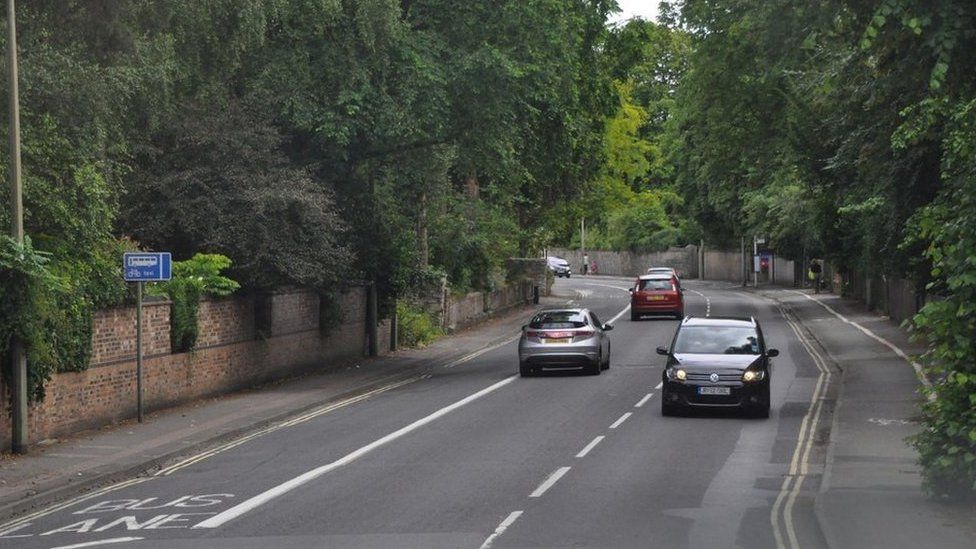
On the news today, Oxford are planning to remove bus priority on Woodstock Road and make the bus lane cycles only.
 
Joined
25 Jan 2021
Messages
281
Location
Bristol
On the news today, Oxford are planning to remove bus priority on Woodstock Road and make the bus lane cycles only.
A couple of links related to this:
- from the BBC https://www.bbc.com/news/uk-england-oxfordshire-60139080

Oxford Woodstock Road bus lanes to be axed in major revamp​

Published
23 hours ago

Woodstock Road
Image source, Lewis Clarke
Image caption,
The bus lanes on Woodstock Road will be merged with regular traffic to make more space for cyclists and pedestrians
A £12.5m project to replace bus lanes with cycle lanes will help make Oxford "a safer and more pleasant city", its roads boss has claimed.
Oxfordshire County Council aims to improve Woodstock Road's walking and cycling provision by merging the bus lane with regular traffic.
Tim Bearder said it would result in a "less polluted, safer, quieter, really beautiful environment".
But the Oxford Bus Company said the measures could lead to delays.
The proposals will see a revamp of the route between Wolvercote Roundabout and Green Templeton College in St Giles.
Phil Southall, managing director of the bus operator, said: "If the bus lanes go, cyclists have a continuous lane, and buses have to sit in the general traffic.

"If the council can come up with a plan to reduce the traffic then we are content with the proposals, but until they do we cannot accept buses being displaced from a dedicated bus lane because it would take too long."
Woodstock Road cycle lane design
Image source, Oxfordshire County Council
Image caption,
The route between Wolvercote Roundabout and Green Templeton College in St Giles is affected
Mr Bearder, who is the cabinet member for highway management, said new Automatic Number Plate Recognition cameras would favour public transport.
He said: "Everywhere will be accessible but you won't be able to rat run through and around the city.
"It will be a massive change to the way people travel around Oxford and will reduce traffic on these arterial routes."
The plans have been welcomed by cycling campaigners, who say it will increase safety.
Kathryn McNicoll, from cycling group Cyclox, said: "You're either sharing a pavement with pedestrians, or you're sharing the bus lane with a 30-tonne bus, and sometimes there's absolutely no cycle provision at all.

"It's not for the faint hearted and that's the trouble."
She said the new scheme "separates everyone... it separates pedestrians, it separates cyclists, and it separates most of the traffic".
A new public consultation will take place in the Summer, with the aim to begin construction at the end of the year.

- and what appears to be the consultation page: https://letstalk.oxfordshire.gov.uk/woodstock-road-improvements

Woodstock Road Corridor Improvements consultation​


Share on Facebook Share on Twitter Share on Linkedin Email this link


Consultation has concluded


Welcome to the Woodstock Road Corridor Improvements public consultation. This consultation runs from 12 noon on Thursday 28 October 2021 to 23:59 on Sunday 28 November 2021.
We have secured £12.5m for improvement work on Woodstock Road between Wolvercote Roundabout and Green Templeton College (St. Giles) in Oxford to improve walking and cycling facilities, and public transport for those who rely on this busy corridor for work and leisure.
We are proposing continuous, cycling and pedestrian routes, with segregated cycle lanes and wide footpaths to help improve bus journey times, improve air quality, and support delivery of planned housing growth in Oxford. A map and technical drawings of the proposal is available on the right side of the page.
Please scroll to the bottom of the page to fill in the feedback form.
New way of presenting designs
We understand that it is not always easy to read engineering drawings, so we are pleased to announce our new, online visualisation platform, Remix. This interactive map will allow you to view and comment on our proposals.
  • You will be able to access our proposals on an online-based map and by scrolling through the proposal, you can view the entire corridor. You can use it in the same way as you would use Google Maps.
  • You can zoom in and out to see the details and leave specific feedback by clicking on “Leave a Comment” situated on the top right-hand side of the map.
  • More detailed, technical drawings are also available on the sidebar to the right of the page.
Click here to view the Woodstock Road online proposals(External link)
Please note: overall scheme feedback should be left via the survey form provided on this page. Comments on the Remix plans should only be related to specific features or design element that are of concern or if supported. This will determine the hierarchy of most important features and those that need improvements. Alternative suggestions are welcomed.
Watch a video on how to navigate the online plans here.(External link)
Ask for the materials in a different format
Printed copies of the proposals, and the feedback form will also be available from the following locations:
  1. Oxfordshire County Council, County Hall, New Road, OX1 1ND
  2. Oxfordshire County Library, Queen Street, Westgate, Oxford OX1 1DJ
  3. Summertown Library, South Parade, Summertown, OX2 7JN
  4. Cutteslowe Community Centre, 31 Wren Road, Oxford, OX2 7SX
  5. Ferry Leisure Centre, 16 Ferry Pool Road, Summertown, Oxford OX2 7DT
 

philthetube

Established Member
Joined
5 Jan 2016
Messages
4,187
Then I'm sorry to say that, in those places, we can do nothing to reduce car ownership or car usage, because in such case, if the car is used frequent enough, it will be cheaper than the bus, leaving the few occasional users, who can't support a commercial bus service, using car clubs, taxis and minicabs as their main form of travel.

However, even a village of a thousand people only can support a 16-seat minibus route at a reasonable fare (a 16 seat minibus route charging £1-£2 can be profitable if it has nearly full loading from morning to night, uses cheap mass-production vehicles with cheap maintenance, simple roster and minimal operation overhead; while a loading of 50 people on a regular double decker route in the day allows the route to be sustainable in quieter periods and offers a true dawn-to-midnight service). The caveat here though is that there can only be a single road out of the village (e.g. due to geographical constraint) which will pass through the nearest town, aggregating enough trips to support a minibus service. If the village in question has 4 roads heading to 4 different directions with 4 different towns serving different needs, unless there is enough demand to support long-distance bus services between the towns passing through the village, the village can't be feasibly served by public transport.

My £1 argument really applies only if minicab services can be provided at the order of £4 for a 3-mile trip, where a bus won't be competitive if it charges £2 or more. As minicab fares are unregulated, minicab operation has a low barrier of entry, it is a representative of perfect competition and represents the true cost of offering personalised transport.
Imagine 12 as nearly full, the only way you can go higher is pre booking as if people cannot rely on the bus having seats they will not travel.

Outside work times if it rains, snows or is very windy your passenger numbers are going to be well down on that, and higher in good weather, school hols etc, but this will be the same on all routes operated so it is not practical to run extras as they would be needed all over the place. Then look at costs.

Drivers wages of approx £11 hourly, plus another 5.50 to cover costs of employing driver, hols, uniform, national insurance etc.
Diesel £6 a gallon, or soon will be.

You can probably reckon it costs £20 hourly just for the above then there is a long list of others including,

Traveling to route,
Management
Vehicle stabling, including depot maintenance
Vehicle depreciation
Vehicle maintenance and cleaning,
insurance
etc. Etc.

I don't think you have any concept of the costs involved, I would be surprised, and this is a guess, if you can put a bus out for less then £50 per hour.
 

GusB

Established Member
Joined
9 Jul 2016
Messages
8,143
Location
Elginshire
I think we're getting distracted from the original topic, which is basic measures to speed up the service. In-depth discussion about the costs of keeping a bus on the road is outwith the scope of this thread, but if anyone wishes to continue, feel free to start a new topic.
 

johncrossley

Established Member
Joined
30 Mar 2021
Messages
4,417
Location
London
I think we're getting distracted from the original topic, which is basic measures to speed up the service. In-depth discussion about the costs of keeping a bus on the road is outwith the scope of this thread, but if anyone wishes to continue, feel free to start a new topic.

As a light aside, Wiktionary shows "outwith" to be "now chiefly Scotland, Northern England". And when I type outwith in Chrome, it is underlined as a misspelling! :D


outwith

  1. (now chiefly Scotland, Northern England) Outside; beyond; outside of.
 

TheGrandWazoo

Veteran Member
Joined
18 Feb 2013
Messages
22,945
Location
Somerset with international travel (e.g. across th
As a light aside, Wiktionary shows "outwith" to be "now chiefly Scotland, Northern England". And when I type outwith in Chrome, it is underlined as a misspelling! :D

Well, @GusB is Scottish so it makes sense he'd use that word.

Perhaps there should be (or maybe there is) a thread on the general discussion forum - show people where you live with only one word/phrase of dialect :lol:
 

WAB

Established Member
Joined
27 Jun 2015
Messages
1,297
Location
Anglia
What no-one seems to have picked up on so far is the cumulative delay which excessive dwell times as a result of antiquated payment systems and single doors cause. One delay to a bus on a provincial high-frequency route and it starts picking up passengers for the next bus. Each additional passenger has a greater impact on the delay to the bus than if dwell times were kept down.
 

RT4038

Established Member
Joined
22 Feb 2014
Messages
5,456
What no-one seems to have picked up on so far is the cumulative delay which excessive dwell times as a result of antiquated payment systems and single doors cause. One delay to a bus on a provincial high-frequency route and it starts picking up passengers for the next bus. Each additional passenger has a greater impact on the delay to the bus than if dwell times were kept down.
I think you will find that this has been extensively discussed earlier in this thread, if you care to take a look.
 

WAB

Established Member
Joined
27 Jun 2015
Messages
1,297
Location
Anglia
I think you will find that this has been extensively discussed earlier in this thread, if you care to take a look.
I would be grateful if you could point me in the direction of the posts which discuss the effect of extended dwell times during late running.
 

RT4038

Established Member
Joined
22 Feb 2014
Messages
5,456
I would be grateful if you could point me in the direction of the posts which discuss the effect of extended dwell times during late running.
Most of this thread is about dual doors and the ticketing system. However, the specific point you make is quite valid.
 
Last edited:

daodao

Established Member
Joined
6 Feb 2016
Messages
3,601
Location
Dunham/Bowdon
What no-one seems to have picked up on so far is the cumulative delay which excessive dwell times as a result of antiquated payment systems and single doors cause. One delay to a bus on a provincial high-frequency route and it starts picking up passengers for the next bus. Each additional passenger has a greater impact on the delay to the bus than if dwell times were kept down.
It's true in London too, where buses typically arrive in 3's. Most provincial bus services are of lower frequency nowadays, even in cities, so bunching of buses is much less common. For example, the only routes where this is now likely to occur in Manchester are Stockport Road (route 192), Oxford/Wilmslow Roads and possible Rochdale Road. Bus services paralleling Metrolink routes run at a fraction of their former frequency.
 

Deerfold

Veteran Member
Joined
26 Nov 2009
Messages
13,723
Location
Yorkshire
It's true in London too, where buses typically arrive in 3's.
Whilst this happens, I don't think it's typical. London buses are controlled more rigorously than most and the contract system strongly encourages companies to stop this happening - there are contract penalties based on longer average waits for buses on a route and specifically for gaps of more than twice that timetabled.
 
Status
Not open for further replies.

Top