• Our new ticketing site is now live! Using either this or the original site (both powered by TrainSplit) helps support the running of the forum with every ticket purchase! Find out more and ask any questions/give us feedback in this thread!

Which lines do you think would benefit from 3rd rail electrification?

Status
Not open for further replies.

si404

Established Member
Joined
28 Dec 2012
Messages
1,267
In terms of Met/Chiltern shared lines, am I correct to say the 2 semi-fast Amersham services switch to LU metals at Moor Park
It's all LU metals between Harrow South and Mantles Wood junctions.

However, yes, they move across to the slow lines at the south junction of Watford Triangle, and then don't move across at Harrow, so are on the outside tracks that don't have platforms on through Northwick Park and Preston Road.
Also the transfer of Met fasts at Harrow North Jn is done on the flat?
Yes, the only grade separation there is the Uxbridge branch emerging in the middle of the Met formation. Carto Metro will help you here.
 
Sponsor Post - registered members do not see these adverts; click here to register, or click here to log in
R

RailUK Forums

MarkyT

Established Member
Joined
20 May 2012
Messages
7,574
Location
Torbay
IIRC, Lords has 3 tunnels under it, because that land wasn't coming back up again, ever. 2x2 track & 1x3 track, giving the 7. These tracks made it as far as a little way up Wellington Road, where the spare lines, used as headshunts, ended. The westernmost tunnel was probably just speculative and might be useful as headshunts for the goods yard regardless, the middle bore was intended for future express lines, and the three track bore was intended as the local lines and a headshunt for the old depot on the eastern side. Beyond the Wellington Road, only a single double track bore was built as far as where the GCR lines emerge to fly over the WCML at South Hampstead (though the abutments were built for 4 tracks), and the Hampstead tunnel on the other side to a little south from Canfield Place was also a single double track tunnel, but a short stub tunnel and second double track portal was built at Canfield place, where the GCR emerges just south of Finchley Road.

I presume that the GCR managed to built the Hampstead and St Johns Wood tunnels without demolishing everything above them, so there's no reason to assume you couldn't build another alongside the same way as easily as they built the existing ones. How disruptive those were to build I do not however know. Would be interesting to find out.

South of there the gaps have been closed up, so what was once multiple tunnels is now in effect a single tunnel from the WCML at South Hampstead to Lodge Road, just north of Marylebone.

I think the west tunnel was always intended as headshunts for the substantial goods depot whose throat is very close to the portals. The middle one was probably speculative in case widening to Finchley Road was ever required. I wonder if it was used for covered carriage storage to supplement the carriage shed on the east side. The east tunnel had three tracks two of which are the up and down lines still in use, and the third was a headshunt for the depot and carriage shed sidings. A siding alongside the mainline still goes partway into that tunnel today.

The unused Hampstead tunnel portal at Finchley Road extends no more than 100m to a blind end. A works yard extended into that tunnel during the line's construction, but no service tracks were ever laid. I believe this was constructed opportunistically using cut and cover techniques as far as it could parallel with the main tunnel, but beyond that, the main tunnel becomes a bored construction, so further speculative building of a second tunnel probably couldn't be justified, just like going further north than the cricket ground at the other end.
 

corfield

Member
Joined
17 Feb 2012
Messages
478
What is slighlty weird is that looking at the tunnels, they don’t appear to really go under Lords. Just catching the eastern end of the practice ground?
 

mr_jrt

Established Member
Joined
30 May 2011
Messages
1,574
Location
Brighton
From what I've read the reason it's called the Nursery end is that there used to be a horticultural nursery there where various unusual fruits were grown. I can't remember the exact order of events, I but I think the Cricket club bought the nursery for use as a practice ground, and not longer afterwards the GCR came along with a bill that enabled them to compulsorily purchase the entire cricket ground. The compromise that they came to to avoid legal wrangling that could delay things saw the GCR buying the remaining properties along the road and taking possession of the former nursery land, and then leasing it back to the cricket club who could then expand the full length of the road, but with the covenant that they could not go more than 18 inches deep, which is why all the trees down that end are apparently in pots, and they can't have a proper stand. There's an interesting Guardian article from years ago that describes how the club regret not buying the land back in 199(8?) when Railtrack disposed of the two two-track tunnels and the land above them.
 

MarkyT

Established Member
Joined
20 May 2012
Messages
7,574
Location
Torbay
What is slighlty weird is that looking at the tunnels, they don’t appear to really go under Lords. Just catching the eastern end of the practice ground?
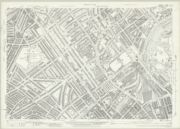
Here's a map link showing the situation in the 1930s
Today that's directly under the tent-like structure alongside Wellington Road. The Met tunnel seems to be directly under Wellington Road itself.
 

corfield

Member
Joined
17 Feb 2012
Messages
478
Really fascinating stuff - noting the subsequent fill in and buildings further up I assume the ground must raise a bit for their foundations. There is an obvious arc on Marlborough hill (which I guess confirms the ground rises!) with the tunnels presumably below the gardens.

Who did railtrack sell them to? What use can they have? You’d think MCC would have the pockets to buy them vs someone else for who they must be an odd asset?

The map is awesome - what a spread on the goods side. Makes you wonder why they didnt finish the main station as that looks small beer vs what was built. I’m assuming the streets around the unbuilt platforms are the original slum? housing.
 

corfield

Member
Joined
17 Feb 2012
Messages
478
Sorry I meant on the 1939 map - I think it must have been cleared by the council as those look very local authority like - 60/70s as you say. The map shows back to backs.

The 1939 map also suggests the Rossmore road bridge was built to cover all the potential platform ways judging by the spot heights which remain constant until it hits the side streets.

That is an unusual view - interesting!0
 

corfield

Member
Joined
17 Feb 2012
Messages
478
It’s some of those I’d knock down partially to get 2 more platforms in like 5&6. Granted goes partly through the school’s small yard. An option would be to go over the platforms with buildings.
 

Mikey C

Established Member
Joined
11 Feb 2013
Messages
8,262
From what I've read the reason it's called the Nursery end is that there used to be a horticultural nursery there where various unusual fruits were grown. I can't remember the exact order of events, I but I think the Cricket club bought the nursery for use as a practice ground, and not longer afterwards the GCR came along with a bill that enabled them to compulsorily purchase the entire cricket ground. The compromise that they came to to avoid legal wrangling that could delay things saw the GCR buying the remaining properties along the road and taking possession of the former nursery land, and then leasing it back to the cricket club who could then expand the full length of the road, but with the covenant that they could not go more than 18 inches deep, which is why all the trees down that end are apparently in pots, and they can't have a proper stand. There's an interesting Guardian article from years ago that describes how the club regret not buying the land back in 199(8?) when Railtrack disposed of the two two-track tunnels and the land above them.
The MCC did have a fairly recent plan to build flats at the edge of the Nursery Ground, next to Wellington Road,so I'm not sure how this would have impacted on the tunnels etc. The plan was eventually cancelled
 

mr_jrt

Established Member
Joined
30 May 2011
Messages
1,574
Location
Brighton
I recall reading in one source (so take it with a pinch or two of salt!) that the overall grand plan was to extend the widened lines all the way to Marylebone to take the GCR through traffic to the south coast (presumably via Snow Hill?) and still be able to serve the main Marylebone station, and this may be why so many tunnels were built. Given the proximity of Baker Street I have major doubts, but certainly wouldn't put it past Edward Watkin!
 

si404

Established Member
Joined
28 Dec 2012
Messages
1,267
South coast? I believe Watkins plan was a bit further south than that!
 

MarkyT

Established Member
Joined
20 May 2012
Messages
7,574
Location
Torbay
...The map shows back to backs. The 1939 map also suggests the Rossmore road bridge was built to cover all the potential platform ways judging by the spot heights which remain constant until it hits the side streets.
Yes, the housing looks fairly tightly packed, with some central courtyards. Agree about the bridge
Charles Booths Poverty maps, up to 1903, suggest this housing, shown centrally here just above Blandford Place, was 'fairly comfortable', 'mixed', and 'poor'. At least non of it was vicious, semi-criminal! Booth's notes refer to demolition having taken place already for the Great Central Railway.Maps can be viewed here: https://booth.lse.ac.uk/map/

booth.jpg
 

chiltern trev

Member
Joined
28 Mar 2011
Messages
517
Location
near Carlisle
Tetchytyke said:
the solution is to get some bigger trains for Chiltern and move the 2-car and 3-car 165/166s to the provinces where their size is better suited.

The Chiltern trains are sized according to passenger demand from Great Missenden, Wendover and Aylesbury which are Chiltern stations.

Amersham is TfL and so 'not a Chiltern problem'. Also ticket revenue goes off a small cliff at this point so revenue from Amersham into London is a lot less. Fares from High Wycombe and Beaconsfield are a lot higher than Amersham for a similar distance so a much better financial return to put rolling stock on the High Wycombe line.

TOC/franchising economics!
 
Last edited by a moderator:

si404

Established Member
Joined
28 Dec 2012
Messages
1,267
The Chiltern trains are sized according to passenger demand from Great Missenden, Wendover and Aylesbury which are Chiltern stations.
Which is why people will be standing from Great Missenden in 2023 (according to the West Midlands and Chiltern Route Study)...

Most off-peak trains are about half-full arriving at Amersham from Missenden and so Amersham-Rickmansworth passengers often have to sit next to those already on the train to get a seat. Missenden/Wendover/Aylesbury passengers would also be happier with a bit more space.

And it's much more problematic for Chiltern heading out of London in the evening (and I'm not even talking peak) - when you have some people standing at least as far as Rickmansworth, that's not good - and you can't make it that they are a south-of-Amersham passenger rather than a paying-a-lot-and-Chiltern-gets-the-money customer from north of Mantles Wood.

Obviously there's deploying scarce stock as best as they can, and that the Wycombe route generates revenue (though that tends to be short 2-cars trains too) that Amersham-and-south passengers don't. But I'm surprised that they can get away with it on the passenger satisfaction measures given how much other places gripe about short trains, having to stand for 'long' times (more than 10-15 minutes), etc.

When the franchise runs out in December next year, the new concession/franchise or the extension of the status quo is unlikely to not have a requirement to have longer stock.
 

Fincra5

Established Member
Joined
6 Jun 2009
Messages
2,636
Back to 3rd Rail ;)

On the SN Network, 2 routes that would do well are; Ore to Ashford Intl and Oxted to Uckfield.

To an extent Reigate to Reading (gap filling). A lot of work would need to be done to ensure adequate power supply however. Sussex Control are already nervous/ unsupportive of 769s using 3rd Rail between Redhill and Gatwick!

With regards to stock, 458s would be a decent candidate to replace 313s and 171s down on the Sussex Coast. (Reduced to 4 cars).

Then send 379s to GN (re-fitted) and bring back the 387s south of the river to SN, for Uckfield (etc).
 

Sad Sprinter

Established Member
Joined
5 Jun 2017
Messages
3,186
Location
Way on down South London town
I seem to recall reading in Modern Railways a few years ago (in an article about Gordon Pettitt, the SR General Manager), that detailed design work for the North Downs line third rail electrification had been done before privatisation.

Yes, one of the resident former managers over on London Recconections spoke about it once. I think he said they got as far as identifying locations for substations.

The Network SouthEast Story by Chris Green states the NDL was to be electrified by 1995 just before the GOBLIN.
 

The Ham

Veteran Member
Joined
6 Jul 2012
Messages
12,036
I suspect that probably any new third rail would be limited to infill schemes and then only where there's not a significant milage which could cope with being OHLE.

That may lead to some oddities such as Reading Gatwick having OHLE from near Guildford to Reigate.

It would certainly mean Basingstoke to Southampton via Salisbury as well as from Salisbury to Yeovil being OHLE. Especially when you consider that OHLE makes sense Salisbury - Bath and later on so does Yeovil - Exeter and the desire to convert Basingstoke - Southampton.

The latter would still enable a significant number of straight electric services to be run with either hourly or every two hours the Exeter services to London being run by bimodal trains. If every two hours the other service would be split at Yeovil - even if that wasn't too happen in day to day service it might be that it happens if there's an issue with providing a bimodal unit and it requires everyone to do trains at Yeovil so that the bimodal unit can turn around and run back to Exeter. As it would be a cross platform change you might need a few minutes, but that could be factored into the timetable either side of Yeovil, so that trains would be back on time by Basingstoke/Honiton.

As such it's likely to be the usual suspects which gain third rail.

Especially if the justification for adding more third rail is that the amount extra is limited because of safety concerns, in that if the extra is limited to a small percent of the total existing their rail network for a limited timeframe before conversions then being it back down to less than we have at present.

It's likely such a change would be over the following sort of timeframe:
- 2025 extra third rail starts being added
- 2040 peak third rail happens
- 2040 onwards a trail of third rail to OHLE conversation happens
- 2050 start of program of conversion of third rail and battery trains to OHLE

In doing so much of the existing network should be electric powered before much conversion happens (and mostly to help with meeting our net zero emissions for 2050), which should then quieten the complaints about there being a greater need for other lines to be wired up before third rail is replaced with OHLE.
 

DJ_K666

Member
Joined
5 May 2009
Messages
918
Location
Way too far north of 75A
Moderator note: Split from https://www.railforums.co.uk/thread...extension-of-3rd-rail-electrification.205175/

Hurst Green to Uckfield is a diesel island and should be 3rd rail or battery if that is suitable. Ashford to Hastings could be either 3rd rail or overhead whichever is easiest/cheapest
Basingstoke to Salisbury is outside the existing 3rd rail area and should be OHLE as that is the future with Basingstoke to Reading done at the same time
That would create a 25kV island in the middle of third rail terriotory, granted HS1 os OHLE however then you'd need dual voltage 377s/2s on the Hastings to Ashford line. Much better to infill the 3rd rail, re-double the line and have passive provision for the whole line to be converted to OHLE when the time comes
 

mr_jrt

Established Member
Joined
30 May 2011
Messages
1,574
Location
Brighton
Given the service is split at Hastings/Ore anyway, may as well do Ashford to Hastings as OHLE from the outset. You are then set for progressively heading west, and dual electrifying the Hastings area for that initial project might cross the line into worthwhile territory depending on how soon the Hastings mainline is likely to get converted...which given the tunnels, I suspect will be down near the bottom of the list. Follow up with Hastings to Eastbourne, then follow that with Seaford and Eastbourne to Lewes then finally down to Brighton and you've sorted out the east coastway.
 

Fincra5

Established Member
Joined
6 Jun 2009
Messages
2,636
Given the service is split at Hastings/Ore anyway, may as well do Ashford to Hastings as OHLE from the outset. You are then set for progressively heading west, and dual electrifying the Hastings area for that initial project might cross the line into worthwhile territory depending on how soon the Hastings mainline is likely to get converted...which given the tunnels, I suspect will be down near the bottom of the list. Follow up with Hastings to Eastbourne, then follow that with Seaford and Eastbourne to Lewes then finally down to Brighton and you've sorted out the east coastway.

Very blue-sky thinking there. Also, the current service runs from Eastbourne to Ashford Intl. Could be reconnected to Brighton if the Marsh is, rightly, electrified 3rd Rail.

No TOC would really want the headache of 20 or so miles of OHLE and having to ensure units are DV (not many spare on SN) or having them converted to DV units.
 

si404

Established Member
Joined
28 Dec 2012
Messages
1,267
Units needing to have the necessary pantographs and transformers to run on a currently diesel line that has been electrified with OHLE rather than the dominant third rail is little different than units needing to have the necessary diesel engine to run on them now.

But, should the flexibility be wanted, it's also a lot easier to fix existing electric units with the equipment to be dual voltage rather than to turn them into bimodes.

Obviously new electric stock would be needed to replace the diesel stock running currently on the line anyway and DV compatibility is a fairly negligible add on. So the issue is whether new flexibility of stock within Southern (that all stock can now run Marshlink/Uckfield rather than only bespoke stock) outweighs the extra substations and the like of third rail.
 
Last edited:
Status
Not open for further replies.

Top