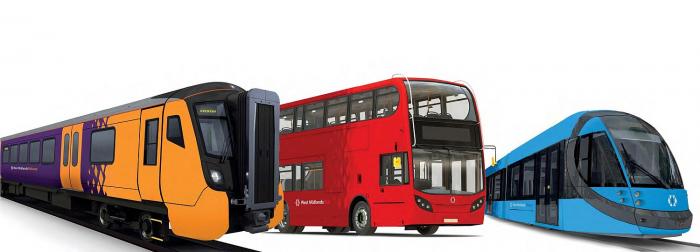
I suppose this publicity banner from the press announcement just about confirms it:

I do wonder why the West Midlands are going for distinct liveries for different transport modes. I suppose there is nothing inherently wrong with it, some other cities do it too (London, Madrid or Copenhagen as a few examples). And although it's not uncommon for trains and municipal transport to have separate identities, mostly due those being operated by different operators, in a lot of cities throughout Europe, trams and (municipal) buses do have the same branding. I quite like Manchester's unified branding across buses, trams (and in future trains) and there are a few cities that pull off a common brand across all municipal transport modes really well, such as Berlin, Stockholm and Vienna. Those cities all coincidentally have some of the best public transport provision in Europe. Some cities are also actively moving towards a more unified livery which even includes regional trains, for instance Paris with it's Ilê de France branding.
Personally, I think if pulled off right, a mostly unified livery, such as in the case of Paris or Vienna can look very cool. Distinct liveries can also work, if the different modes all have a strong identity. In Copenhagen s-tog, movia buses and the metro all have a strong visual identity, whilst also being collected under one umbrella branding DOT (din offentlig transport) which is then for the Greater Copenhagen region. West Midlands appears to be taking a leaf out of that book, also somewhat akin to London, though I await to see how exactly they intend to integrate the different modes in future. For urban transport, more integration rather than less generally seems like a good idea.
This development seems to be following in the footsteps of the 2018 announcement regarding the creation of the new West Midlands Transport identity. More evolution than revolution, the, though concerning public transport policy, that's not at all a bad thing.


 api.flickr.com