• Our new ticketing site is now live! Using either this or the original site (both powered by TrainSplit) helps support the running of the forum with every ticket purchase! Find out more and ask any questions/give us feedback in this thread!

Weatherproofing the railway

Status
Not open for further replies.

edwin_m

Veteran Member
Joined
21 Apr 2013
Messages
28,624
Location
Nottingham

Just reported that 2023 was second only to 2022 in average temperature in the UK.

Last year was the UK's second warmest on record, according to provisional data from the Met Office.
This puts it just behind 2022, which recorded an average temperature of only 0.06C higher.
For both Wales and Northern Ireland, 2023 was their hottest year on record.
The national weather service said climate change has made the high temperatures "significantly more likely".
 
Sponsor Post - registered members do not see these adverts; click here to register, or click here to log in
R

RailUK Forums

greyman42

Established Member
Joined
14 Aug 2017
Messages
5,367

AndrewE

Established Member
Joined
9 Nov 2015
Messages
7,325
Average temperatures should not cause any problems to the rail network.
Only exceptionally hot days will, of which there are very few.
and? Of course the average is tolerable - by definition.
The point is that the data tell us (and most people can recognise) that we are seeing ever more frequent extremes of temperature - and rainfall - and the rail network, roads and most of the rest of our infrastructure just isn't built to withstand them.
 

AndrewE

Established Member
Joined
9 Nov 2015
Messages
7,325
Extremes of temperature are not at all frequent.
Really? My memory must be playing up. I would say the in the last few years we have had more extremes of cold and heat than in most of the preceding decades I have lived through. Met office data will show the real position one way or the other.

(anyway, the real point is that just one a year is enough to paralyse our railway for a few days and further undermine its utility for the general UK population. We really need our public transport and other utilities to work 24/7, 365 days a year, unless conditions are so extreme that it's immediately obvious to the public why that's impossible.)
 

Class 317

Member
Joined
7 Jul 2020
Messages
556
Location
Cotswolds
Extremes of temperature are not at all frequent.
They are more frequent than you assume.
going back before the 1990's a temperature of 36 degrees or so was considered extreme.
20 years later it's seen as something of a more normal summer high.

The railway really needs to be planning for temperatures of around 40 to become normal and this is likely within the lifespan of most of the new and replacement infrastructure going in now.

Same with the frequency of storms increasing as the average temperature continues to rise adding more energy into them so the average wind speeds and rain will increase. Again this is likely to occur within the lifetime of the new and replacement infrastructure going in today.

To tackle flooding changes will probably need to be more widespread will a general change to land use, farming practices and reforestation, wetlands creation or other mature based solutions to reduce the volume of water that runs of.

Starting now on ensuring renewals, earthwork repairs, OHLE renewals and resignalling is carried out in a resilient way for future conditions is going to be cheaper than a crash programme of sorts in the future.

A case could be made for premptive upgrades on vulnerable sections of key routes on the main lines.
 

jon0844

Veteran Member
Joined
1 Feb 2009
Messages
30,871
Location
UK
You know pretty much none of that is going to happen.

Our Government is never going to invest in preventative measures like this, and companies will lobby to avoid having to do such things as it impacts on their profits. And there will be plenty of supporters of big business to tell us that there's nothing to worry about anyway as climate change is fake, net zero is a con etc etc.

I am not sure a change of Government will make any difference either? It's not like Labour would suddenly have money to spend on such things, essential as they are. It would be slated as a waste of taxpayer money from the off.
 

Class 317

Member
Joined
7 Jul 2020
Messages
556
Location
Cotswolds
At some point the cost of repairing inadequate infrastructure will put way the extra cost of making it resilient as it's replaced.

Don't forget that most rail infrastructure and other critical infrastructure is replaced every 30 years or so except the earthworks so we are not talking about doing it all at once or separately from renewals or upgrades.

The extra cost of adding resilience is likely to be dry small in most projects. Take Paddington to Airport Junction. I'm assuming this will be renewal work soon given it was a mid nineties project. That cost of splitting the head spans at the same time would not be to high set against the cost of distruption when it fails.

I don't think a magic amount of money will suddenly appear but significant resilience and improvements to allow quicker recovery from problems could be incorporated within existing upgrade and renewal work without increasing the costs that much
Probably only a few percent in most cases.
 

Snow1964

Established Member
Joined
7 Oct 2019
Messages
11,083
Location
West Wiltshire
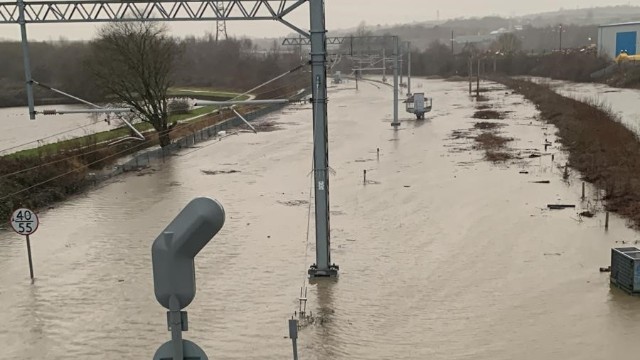
I see the Swindon-Bristol Parkway line is still closed, and reason being is due to water flowing from adjacent fields

Due to heavy rain flooding the railway between Swindon and Bristol Parkway the line is closed. Train services through these stations may be subject to disruption on all routes. Disruption is expected until the end of the day.
Additional Information:
We're sorry for the delay to your journey.
Owing to flooding in the Chipping Sodbury area we are unable to run trains between Swindon and Bristol Parkway. Trains will be diverted via an alternative route, which will add up to 40 minutes to your journey. No station will go without a service.
Network Rail are monitoring the level of the flood water; they have carried out an inspection this morning and water is still flowing on to the railway from the surrounding fields. The line is likely to remain closed for the rest of today.

You do wonder why they don't just build a clay bund /wall along the cutting top to stop someone else's floodwater regularly closing the line.
 

stuu

Established Member
Joined
2 Sep 2011
Messages
3,765
You do wonder why they don't just build a clay bund /wall along the cutting top to stop someone else's floodwater regularly closing the line.
The River Frome crosses over the railway, so when it floods it has one obvious path to use. It would need to be a pretty big flood wall. That said, it would surely be possible to install some hefty drains to a sump with a pump in, and pipe it away downstream somewhere. Perhaps it's cheaper to deal with the disruption?
 

AM9

Veteran Member
Joined
13 May 2014
Messages
16,027
Location
St Albans
Part of the UK's problem with climate change is that it was initially billed as 'global warming'. Many in the UK (including the populist media) have an obsession with the weather, and an irrational desire for eternal sunny days. Note that I said 'weather', which is so often conflated with climate, - a very different matter.
As far back as the late eighties, climate scientists in the UK have been acknowledging that climate change will more likely result in more extreme and unpredictable weather of all kinds. Meanwhile those that deny the change (often as it might ultimately involve some scarifices on their part) cling to the myth that in future, the UK will be transformed by a Mediterranean climate, so any global warming is not a bad thing at all!
If it is percieved that the railway is essential to survival in a zero carbon environment, effective solutions will be needed before the cost of ignoring the warnings removes its viability as a surface transport resource.
 

eldomtom2

On Moderation
Joined
6 Oct 2018
Messages
2,370
Ah, you are forgetting the number one rule of RailForums debate: Britain is ALWAYS a special case due to its history/geography/climate/politics/culture/demographics (delete as appropriate) and therefore never has anything to learn from examples abroad. :lol:
In fairness when it comes to rail, this is an attitude a lot of countries have; bring up through-running at Penn Station and you'll be flooded with people saying New York is a special case where no-one wants a one-seat ride through the city centre.
Equally in fairness, rail networks tend to differ a lot between countries, and what is right for one country is often not right for another.
 

Silenos

Member
Joined
13 Dec 2022
Messages
308
Location
Norfolk
In fairness when it comes to rail, this is an attitude a lot of countries have; bring up through-running at Penn Station and you'll be flooded with people saying New York is a special case where no-one wants a one-seat ride through the city centre.
Equally in fairness, rail networks tend to differ a lot between countries, and what is right for one country is often not right for another.
Exceptionalism is such a big feature of British attitudes that you’ll pardon me, I hope, if I’m a bit sceptical that we truly have the best railway network we can have given our circumstances (which certainly seems to be the view of some railway insiders here), and so genuinely can’t apply any lessons from other systems.

I am not an expert on railways, and thus have no basis to contest this view. However, my experience working for an international regulator in the field I am an expert in, was that while the UK had much to contribute, it also had a great deal to learn. This may bias my judgement.
 

Snow1964

Established Member
Joined
7 Oct 2019
Messages
11,083
Location
West Wiltshire
Seems Network Rail are taking action as part of CP7

£2.8bn to improve protection against bad weather, improve drainage, flooding protection, land slip monitoring, climate change etc

Over the five years to 2029, Network Rail will invest around £2.8bn in activities**and technology that will help it better cope with extreme weather and climate change, which will help deliver a more reliable and better performing railway. Examples include:

  • Increased investment in looking after thousands of miles of drains, cuttings and embankments to make them more weather resilient
  • Recruiting almost 400 extra drainage engineers who will increase the care and maintenance of our drainage assets to be able to better handle increased and intense rainfall
  • Hundreds of key operational staff will attend Network Rail’s new ‘weather academy’ to help make them ‘amateur meteorologists’, better able to interpret forecasts and make better operation decisions such as when and where to slow trains in stormy conditions
  • More than 600,000 metres of drains will be built or rebuilt, redesigned or see increased maintenance to enable our railway to cope with much heavier rainfall and reduce flooding
  • Targeting over 20,000 cuttings or embankments for attention, with over 300 miles being strengthened through renewal and refurbishment and over 900 miles seeing planned maintenance
  • Installing significantly more ‘smart’ movement sensors to cuttings and embankments giving early warning of any changes enabling engineers to react, hopefully before a full landslip
  • Installing CCTV at high-risk flooding sites to enable better and faster response
  • Introducing new technology that will help us keep services running safely in difficult conditions, such as
    • o GUSTO – that uses topography to better predict windspeeds distinguishing valleys, trees and buildings enabling trains to run at higher speeds during stormy weather
    • o Precise ‘real-time’ world leading rainfall forecasting, detailing weather conditions every 500m that will link with asset condition data for even better train service management


Last edited:
Status
Not open for further replies.

Top