
• Our new ticketing site is now live! Using either this or the original site (both powered by TrainSplit) helps support the running of the forum with every ticket purchase! Find out more and ask any questions/give us feedback in this thread!

The Thinking About Light Railways Before 1896. ...

Joined
21 Feb 2018
Messages
917
The Thinking About Light Railways before 1896 (and the 1896 Act of Parliament in the UK).

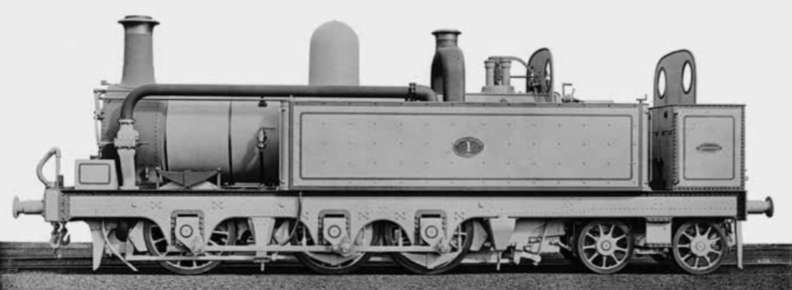
The featured image for this article shows a brand new standard-gauge locomotive – 0-6-4T Mersey Railway No. 1 ‘The Major’. It had not yet received its nameplates when it posed in ‘works grey’ at the Beyer, Peacock works at Manchester in 1885. The locomotive served on the Mersey Railway until that line decided on electrification. Four engines from the line, including ‘The Major’ found employment in Australia, on John Brown’s private light railway – the Richmond Vale Railway in New South Wales. The image comes from “Light Railways – Australia’s Magazine Industrial and Narrow Gauge Railways.” It is included here as an example of a standard gauge locomotive employed on an industrial line recognised as a light railway by ‘The Light Railway Research Society of Australia’. ... Not all ‘Light railways’ were narrow gauge, nor were their locomotives small 0-4-0T or 0-6-0T locomotives. [7]

W.J.K. Davies tells us that in the 1870s, it became apparent both in the UK and other countries that:
“many districts, while they would benefit immensely from the facilities afforded by a railway, just could not maintain a line built and operated to main line standards. And so, gradually, during the 1870’s and 1880’s, the concept of the light railway was formulated; a sub-standard means of bringing the advantages of rail transport into rural districts with the deliberate intention of opening them up and improving them. It must be made clear that this concept was different both from the idea of a standard gauge branch line which, although single track, was built and equipped in such things as signalling, stock and staffing to the same standards as the main lines, and from those narrow gauge lines already in existence which had been constructed in difficult country for a specialized purpose, normally the carriage of minerals; the best example of which was the Ffestiniog Railway, in Wales. These lines were not light railways in the true sense of the term.”

 
Sponsor Post - registered members do not see these adverts; click here to register, or click here to log in
R

RailUK Forums

oldman

Established Member
Joined
26 Nov 2013
Messages
1,343
As late as the 1920 white paper which led to the grouping, government still believed in light railways to help rural development - one section says that 'it should be the policy of the Ministry to stimulate the development of light railways constructed, equipped and worked on the cheapest possible lines'. It looks like they hadn't realised that road transport was going to take over.
 
Joined
21 Feb 2018
Messages
917
It does. Which seems surprising given the significant use of road vehicles later in WW1 and the number of vehicle available second hand after that war.
 

Rescars

Established Member
Joined
25 May 2021
Messages
2,533
Location
Surrey
Certain aspects of the White Paper must have made cheerful reading for Col Stephens!

== Doublepost prevention - post automatically merged: ==

Was the White Paper an encouragement towards the proposals for the Southern Heights Light Railway perhaps?
 
Last edited:
Joined
21 Feb 2018
Messages
917
I think that the Southern Heights Light Railway (SHLR) was authorised in 1928 (unless I have the date wrong) under the Light Railways Act 1896, but ultimately not constructed. If so, the Act had been in place for 32 years by the time that the SHLR was authorised.

No doubt its existence was a great advantage to the Colonel's endeavours but after that length of time it was more a helpful background to plans for the line rather than an influential change in circumstances that made the line more likely.
 

Merle Haggard

Established Member
Joined
20 Oct 2019
Messages
3,897
Location
Northampton
As an aside, J Brown's railway was 'light' only in name - most of the locos were ROD 2-8-0s, bought soon after the end of WW1, and the ore (???) trains were heavy.
 
Joined
1 Jul 2024
Messages
183
Location
Derbyshire Dales
Pre-1896, there seem to have been at least two different sorts of "light railway" - by which I think we mean a railway built for modest speed and loading, as cheaply as possible.

One sort was the local branch or tramway from a mainline station to a small town or industrial facility such as a quarry. Examples would be the Southwold Railway and the Ravenglass and Eskdale in narrow gauge, and the Brill Tramway, the Wisbech and Upwell, the Edenham Railway (which was originally a private road, with trains of road carts pulled by traction engines) and the Wantage Tramway in standard gauge. These were sometimes built on private land and were intended for estate development, the public service being on the basis of noblesse oblige.

The other sort was the "accidental" light railway: conceived with great hopes of heavy traffic and high profits, but which due to unforeseen events such as the Overend and Gurney banking crisis of 1866, ended up as minor dead- end routes, with minimal traffic and little hope of development, utilising ancient second- hand stock to stagger along with a sparse service. Examples would be the Garstang and Knott End (which only got to Knott End decades later, then perhaps wished it hadn't), the Bishop's Castle, the Shrewsbury, Potteries and North Wales (which did get to Shrewsbury at least), the Mawddwy Railway... the list goes on.
 

The Pelican

Member
Joined
3 Oct 2025
Messages
398
Location
London
The Southern Heights Light Railway, electrified and with no level crossings, resembles a relative of some of the Southern's post-grouping suburban lines, like the level crossing free but twisty and steep Wimbledon to Sutton line, and the Chessington South branch. I think this made it a substantial departure from most other light railways principles, which tried to minise both infrastructure and, in many cases, rolling stock costs as far as possible- the electrified tramlines which were electrified and sometimes called light railways seem like a third thing.
 

Belperpete

Established Member
Joined
17 Aug 2018
Messages
3,611
Prior to 1896, there would surely have been a legal requirement for any passenger railway to have been inspected by the HMRI prior to opening, to ensure it met the HMRI and legal requirements in force at the time. Were the HMRI prepared to accept lower standards prior to 1896?

Even if HMRI were prepared to do so, they surely wouldn't have the authority to waive the legal requirements of the Regulation of Railways Act, for continuous brakes, facing point locks and interlocking.
 

Rescars

Established Member
Joined
25 May 2021
Messages
2,533
Location
Surrey
As an aside, J Brown's railway was 'light' only in name - most of the locos were ROD 2-8-0s, bought soon after the end of WW1, and the ore (???) trains were heavy.
What was the largest/most powerful loco used on a UK standard gauge light railway? Was it KESR's 0-8-0T Hecate? I wonder why Col Stephens chose to name his loco after the goddess of magic and crossroads.
 
Joined
1 Jul 2024
Messages
183
Location
Derbyshire Dales
Even if HMRI were prepared to do so, they surely wouldn't have the authority to waive the legal requirements of the Regulation of Railways Act, for continuous brakes, facing point locks and interlocking.

True; but railways sanctioned under earlier standards were given time to comply, and given the pressures elsewhere, re- inspection could be a very low priority. For example, continuous automatic brakes of approved type were legally compulsory after the 1889 act following the Armagh disaster, but the Bishop's Castle continued to use the deprecated Webb chain brake until 1924 - 35 years later. As long as they didn't disgrace themselves enough to be noticed, minor lines could operate "below the radar", and did.

The basic standards were enforced. The Edenham Railway was converted from a road in 1855, but it took two inspections before it was allowed to carry passengers from the end of 1857. The modifications required involved rebuilding the track with transverse sleepers in place of spiking the rail to wooden blocks, and replacement of the pointwork, which may have been very second hand manually- operated stub points. Sadly it didn't last long after that; Lord Willoughby, the estate owner, died in 1860 and the estate trustees perhaps weren't noblesse, and therefore not oblige'd. The locomotives and stock were allowed to run down until no longer operable, and the line closed in 1871.
 

Belperpete

Established Member
Joined
17 Aug 2018
Messages
3,611
True; but railways sanctioned under earlier standards were given time to comply, and given the pressures elsewhere, re- inspection could be a very low priority.
Did the HMRI carry out inspections to ensure that railways had complied with the act? Did they even have the authority to do so? I doubt that the HMRI would have had anything remotely near the manpower that would have been needed to inspect every passenger carriage in the country to ensure that it had continuous brakes.

I have seen the correspondence between the BoT and the NWNGR who tried for a long time to get an exemption from fitting continuous brakes, unsuccessfully. I don't recall any mention of an inspection. As far as I am aware, railways were required to submit annual returns detailing their compliance. If they said they had fitted them, that was good enough for the BoT.
The basic standards were enforced.
They were only enforced when a line first opened. Once a line had been given formal authority to open, the railway inspectors were powerless. They had no authority to carry out inspections to ensure that standards were being maintained, let alone any powers to shut a line down if they weren't. And they couldn't insist that railways update to the latest standards. So the Ffestiniog Railway continued to use its antiquated disc signals and point indicators right up until the line effectively closed in the 1940s.

They might sometimes find out that standards had slipped, such as when carrying out an inspection for an extension. I recall a letter from the HMRI asking for an explanation of how come the NWNGR had published a timetable showing a two train service, when the company had given a signed and sealed undertaking that the line would be worked "one engine in steam"! They often found that standards had slipped when carrying out accident investigations. However, even then they could only report the matter, they had no authority to shut a line down.

The inspectors complained several times about the Ffestiniog Railway's practice of putting the passenger carriages behind the unfitted goods stock, effectively making the continuous brakes on the carriages useless. But they were powerless to act.

The Edenham Railway was converted from a road in 1855, but it took two inspections before it was allowed to carry passengers from the end of 1857. The modifications required involved rebuilding the track with transverse sleepers in place of spiking the rail to wooden blocks, and replacement of the pointwork
It was not unusual for more than one inspection to be required before the HMRI would agree to commencement of passenger services. Some railways seemed to have very vague ideas about the standards required. Probably not helped by the standards being continually improved - what might have been acceptable to the inspectors when one line opened may no longer have been acceptable a number of years later. So you could copy an existing, approved railway, but fail your inspection as expectations had moved on.

It was also not unusual for railways to fail the second inspection. In such cases, the HMRI might give approval for the line to open without a further inspection, once they had been given an undertaking that the deficiencies had been rectified.

An awful lot was taken on trust in those days.
 

Bodiam

Member
Joined
8 Jul 2025
Messages
109
Location
Kent, UK
There was a good deal of debate during the run-up to 1896 about what a light railway was and what it might be expected to achieve, which never reached any consensus. On the one hand, there were enthusiasts for roadside steam tramways, on the Belgian Vicinal model where the low construction costs and the possibility of putting sidings into farms and factories offset the need to tranship goods and the very low speed possible. Alternatively there were standard gauge lines built to a lower standard that would allow through working by at least goods wagons of the main line companies. There was general agreement that French secondary railways, metre gauge but relatively heavily engineered and with proper signalling gave the worst of both worlds - and were rarely able to keep going without subsidies.
 

Top