How much of our third rail can supply 5000hp? I remember seeing references to dual-voltage EMUs de-rated for when they are on the third rail...so thinking about it with feedback from this thread refined the idea quite a bit
2 classes of short single cab / full-cab with a blunt cab locomotives with a shared design of body shell and sub-systems than can be coupled together to share power
class 94: 25Kv AC OHLE that can supply 6500hp each to the shared drive-train - basicly akin to the class 91
class 75: 5000hp 750v DC Third rail / 4000hp Electro-diesel - basically a beefed up class 73
could each be used on there own to replace like for like other locomotives but as a singled shared fleet to reduce maintenance costs
could be used in same class pairs for high power jobs or mixed pairs for Bi mode operations

-
Our new ticketing site is now live! Using either this or the original site (both powered by TrainSplit) helps support the running of the forum with every ticket purchase! Find out more and ask any questions/give us feedback in this thread!
You are using an out of date browser. It may not display this or other websites correctly.
You should upgrade or use an alternative browser.
You should upgrade or use an alternative browser.
idea for a class 94 articulated locomotive
- Thread starter popeter45
- Start date
- Status
- Not open for further replies.
Sponsor Post - registered members do not see these adverts; click here to register, or click here to log in
R
RailUK Forums

Class 92 locos are fairly limited in output when on DC, as were Eurostars when they ran on classic routes, but extensive strengthening of the supply was necessary on the Channel Tunnel corridors nonetheless. I know I keep banging on about them, but on-board traction batteries could be useful for restricting the load on DC if the local voltage is dwindling at any time due to high demand. Locos could draw on the stored energy to supplement the 3rd rail supply for short peaks during acceleration and hill-climbing without having to start their engines in urban areas. Between towns and cities, diesels could cut in as necessary. The third rail could also trickle charge the batteries as expedient when stationary or only drawing low power for traction purposes.How much of our third rail can supply 5000hp? I remember seeing references to dual-voltage EMUs de-rated for when they are on the third rail...

GRALISTAIR
Established Member
So you would NOT operate them 94+75 in top 'n tail mode?
maybe with special wagons that let them share powerSo you would NOT operate them 94+75 in top 'n tail mode?

JohnMcL7
Member
- Joined
- 18 Apr 2018
- Messages
- 1,056
so thinking about it with feedback from this thread refined the idea quite a bit
2 classes of short single cab / full-cab with a blunt cab locomotives with a shared design of body shell and sub-systems than can be coupled together to share power
class 94: 25Kv AC OHLE that can supply 6500hp each to the shared drive-train - basicly akin to the class 91
class 75: 5000hp 750v DC Third rail / 4000hp Electro-diesel - basicly a beefed up class 73
could each be used on there own to replace like for like other locomotives but as a singled shared fleet to reduce maintenance costs
could be used in same class pairs for high power jobs or mixed pairs for Bi mode operations
I was curious wondering if you had body around the size of a class 20 with a single cab, how much of a diesel engine you could fit in one or an electric engine with the idea they'd be coupled nose to nose and able to provide a useful amount of power on their own whether on electric or diesel power. I guess you'd need to be able to squeeze in a lot more power than the 1000bhp an 88 can produce which may be difficult with the exhaust treatment requirements for IIIb compliance.
Getting it all in a single BoBo bodyshell within the UK structure gauge is a major problem I believe. A double unit could be a good answer, with at least as much diesel power as a 68 in one and a set of electrical equipment with a pantograph in the other for overhead work. As I suggested earlier, I'd also add batteries and a third rail pickup in each for the ultimate go-anywhere loco, and eight 25t powered axles should give awesome starting tractive effort and acceleration. While they would normally run around coupled for line haul, a simplified low-speed driving position at each of the inner ends could be incorporated to permit them to be separated and used individually for shunting and similar work. Whether the loco would have a narrow long hood, class 20/58 style, or a full-width car body could be down to the space available and manufacturer's preference.I was curious wondering if you had body around the size of a class 20 with a single cab, how much of a diesel engine you could fit in one or an electric engine with the idea they'd be coupled nose to nose and able to provide a useful amount of power on their own whether on electric or diesel power. I guess you'd need to be able to squeeze in a lot more power than the 1000bhp an 88 can produce which may be difficult with the exhaust treatment requirements for IIIb compliance.
Month later and a new idea popped to my head
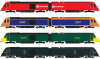
Take a few of the off lease 43's, add buffers like the 43/4's, remove rear luggage space, regeared for fright work and split into two versions
class 64: replace MTU engine with 6-8 16L Deutz V8 engines like the 755's and possibly batteries
class 94: replace MTU engine with OHEL kit with possibility of third rail kit as well as a 94/2
Mocked up a few in DB,GBRf and Freight liner Liveries as well as CS as could work well for Lowlander inverness portion as same loco could pull full rake up to Edinburgh then pull Inverness portion
Take a few of the off lease 43's, add buffers like the 43/4's, remove rear luggage space, regeared for fright work and split into two versions
class 64: replace MTU engine with 6-8 16L Deutz V8 engines like the 755's and possibly batteries
class 94: replace MTU engine with OHEL kit with possibility of third rail kit as well as a 94/2
Mocked up a few in DB,GBRf and Freight liner Liveries as well as CS as could work well for Lowlander inverness portion as same loco could pull full rake up to Edinburgh then pull Inverness portion
Attachments
Last edited:
randyrippley
Established Member
- Joined
- 21 Feb 2016
- Messages
- 5,382
you may have problems with the class 43 being seriously underweight for hauling freight, and the bodyshell may not be strong enough to take the extra ballast needed. The class 60 / 92 bodyshell / frame is a massive structure compared with an HST powercarMonth later and a new idea popped to my head
Take a few of the off lease 43's, add buffers like the 43/4's, remove rear luggage space, regeared for fright work and split into two versions
class 64: replace MTU engine with 6-8 16L Deutz V8 engines like the 755's and possibly batteries
class 94: replace MTU engine with OHEL kit with possibility of third rail kit as well as a 94/2
Mocked up a few in DB,GBRf and Freight liner Liveries as well as CS as could work well for Lowlander inverness portion as same loco could pull full rake up to Edinburgh then pull Inverness portion
apk55
Member
The HST power cars have hardly any pulling power. A single HST power car has a maximum tractive effort of 80KN and 46KN continuous, compared to 313KN max and 250KN continuous for a class 68. The limitation is the traction motors.
Therefore even a pair would struggle with a load of more than 400tons. You would need to seriously re gear or replace the motors in order to get decent haulage caperbility.
Therefore even a pair would struggle with a load of more than 400tons. You would need to seriously re gear or replace the motors in order to get decent haulage caperbility.

E100
Member
- Joined
- 29 Apr 2018
- Messages
- 188
Month later and a new idea popped to my head
Take a few of the off lease 43's, add buffers like the 43/4's, remove rear luggage space, regeared for fright work and split into two versions
class 64: replace MTU engine with 6-8 16L Deutz V8 engines like the 755's and possibly batteries
class 94: replace MTU engine with OHEL kit with possibility of third rail kit as well as a 94/2
Mocked up a few in DB,GBRf and Freight liner Liveries as well as CS as could work well for Lowlander inverness portion as same loco could pull full rake up to Edinburgh then pull Inverness portion
Problems with tractive effort notwithstanding, those look great!

Wonder if Stadler could stick a cab on one end of a Flirt power module over a standard bogie? Take a pair of these, one with 4 Deutz V8 engines, 2 in the other along with a transformer, pantograph, a long range fuel tank and maybe some batteries and you'd have a decent mover. Depends on whether Stadler can power up the centre Jacobs bogie. Siemens have done so I don't see why Stadler can't. Might be issues with the weight though. It could be made narrow enough as a corridor for through passengers isn't needed.
DC capability would allow such a loco to trundle through urban areas like Southampton on blended 3rd rail/battery power alone without having to fire up the diesel. It could also allow batteries to be trickle charged when loco was idle, parked over existing 3rd rail and fast charged on special new short switched sections in depots and yards anywhere in the county where there's no overhead. DC capability should be fairly easy and cheap to add to an electric loco. There have been disappointingly little Continental freight traffic since the Channel Tunnel opened, which is the main reason class 92s traverse Kent infrequently, even though the power supplies were heavily upgraded for them and Eurostars.Nice idea, but why would third-rail capacity be needed? The class 92's barely used theirs and the amount of freight on third rail lines is small to say the least?
Last edited:
......even though the power supplies were heavily upgraded for them and Eurostars.
Slightly OT but have there been any tangential improvements in passenger services due to beefing up of power supplies for freight and ES? (e.g. Redhill to Tonbridge seeing new electric services.)

43096
On Moderation
- Joined
- 23 Nov 2015
- Messages
- 18,879
Month later and a new idea popped to my head
Take a few of the off lease 43's, add buffers like the 43/4's, remove rear luggage space, regeared for fright work and split into two versions
class 64: replace MTU engine with 6-8 16L Deutz V8 engines like the 755's and possibly batteries
class 94: replace MTU engine with OHEL kit with possibility of third rail kit as well as a 94/2
Mocked up a few in DB,GBRf and Freight liner Liveries as well as CS as could work well for Lowlander inverness portion as same loco could pull full rake up to Edinburgh then pull Inverness portion
you may have problems with the class 43 being seriously underweight for hauling freight, and the bodyshell may not be strong enough to take the extra ballast needed. The class 60 / 92 bodyshell / frame is a massive structure compared with an HST powercar
Rather the messing around with re-purposing 40+ year-old power cars with all the risk, cost and complexity that goes with it, or otherwise adopting random solutions from passenger trains, we ought to be looking at something rather more practical. My solution would be to see if Stadler could come up with a UK gauge version of its EuroDual loco. It's exactly what you want from an electro-diesel freight loco:Wonder if Stadler could stick a cab on one end of a Flirt power module over a standard bogie? Take a pair of these, one with 4 Deutz V8 engines, 2 in the other along with a transformer, pantograph, a long range fuel tank and maybe some batteries and you'd have a decent mover. Depends on whether Stadler can power up the centre Jacobs bogie. Siemens have done so I don't see why Stadler can't. Might be issues with the weight though. It could be made narrow enough as a corridor for through passengers isn't needed.
- Co-Co wheel arrangement for adhesion
- CAT C175-16 engine (same as Class 68) for some serious diesel grunt (it will blow a 66 away)
- 500kN starting tractive effort (equivalent of Class 60)
- European version is also a 6MW+ electric loco. If they could get 5MW into a UK gauge machine it would be equivalent to a Class 92
That is proper freight traction.
would a loco with co-co wheel arrangement be permitted to do 125mph? If there's enough weight to spare why not use the Cat 175-20 engine?Rather the messing around with re-purposing 40+ year-old power cars with all the risk, cost and complexity that goes with it, or otherwise adopting random solutions from passenger trains, we ought to be looking at something rather more practical. My solution would be to see if Stadler could come up with a UK gauge version of its EuroDual loco. It's exactly what you want from an electro-diesel freight loco:
- Co-Co wheel arrangement for adhesion
- CAT C175-16 engine (same as Class 68) for some serious diesel grunt (it will blow a 66 away)
- 500kN starting tractive effort (equivalent of Class 60)
- European version is also a 6MW+ electric loco. If they could get 5MW into a UK gauge machine it would be equivalent to a Class 92
That is proper freight traction.

would a loco with co-co wheel arrangement be permitted to do 125mph? If there's enough weight to spare why not use the Cat 175-20 engine?
Why do you need a loco that can do 125mph. Similarly, why do you need the larger engine? The key advantage of not just adding weight "because it's spare" is that you aren't then getting hammered on track access costs, so long as you've got enough to put the power down there's no point adding more if you can help it
Well, Eurostars have moved away and freight has never approached predictions, while classic line services east of Tonbridge have been thinned out. I expect substations and their HV feeders down there are well within capacity today. The irony with Redhill - Tonbridge is that, although primarily electrified for freight, class 92s have never been allowed that way due to track circuit incompatibility on the Brighton line, which with the level of traffic involved, has never been cost-effective to resolve. Hence all continental freights running that way must be diesel-hauled. Signalling renewals and infrastructure enhancements will eventually solve that problem no doubt, but there may not be any 92s remaining in service by then!Slightly OT but have there been any tangential improvements in passenger services due to beefing up of power supplies for freight and ES? (e.g. Redhill to Tonbridge seeing new electric services.)
is there some reason why you don't want 125mph travel?Why do you need a loco that can do 125mph. Similarly, why do you need the larger engine? The key advantage of not just adding weight "because it's spare" is that you aren't then getting hammered on track access costs, so long as you've got enough to put the power down there's no point adding more if you can help it
I've always been thinking about a go anywhere heavy freight hauler in this conversation, so 125mph isn't an issue. The HST, with its twin lightweight power cars, was a response to growing civil and PW engineers' concerns about ever heavier large locomotives of the 6-axle format. The big HS4000 Brush /Sulzer prototype, 'Kestral' was designed for mixed traffic operation up to 110mph with a Co-Co wheel arrangement but was too heavy and the last higher-speed passenger capable diesel loco developed for the UK with that wheel arrangement. The later 125mph capable class 89 was lighter, being an electric, so was able to limit its axle weight to around the same as that of an HST power car, but the 89 was also a prototype of course and never made it to series production.Why do you need a loco that can do 125mph. Similarly, why do you need the larger engine? The key advantage of not just adding weight "because it's spare" is that you aren't then getting hammered on track access costs, so long as you've got enough to put the power down there's no point adding more if you can help it
43096
On Moderation
- Joined
- 23 Nov 2015
- Messages
- 18,879
What's it hauling?is there some reason why you don't want 125mph travel?
with that amount of power it could haul anything from express passenger stock (MK5?) or heavy freight.What's it hauling?
Purple Orange
On Moderation
Month later and a new idea popped to my head
Take a few of the off lease 43's, add buffers like the 43/4's, remove rear luggage space, regeared for fright work and split into two versions
class 64: replace MTU engine with 6-8 16L Deutz V8 engines like the 755's and possibly batteries
class 94: replace MTU engine with OHEL kit with possibility of third rail kit as well as a 94/2
Mocked up a few in DB,GBRf and Freight liner Liveries as well as CS as could work well for Lowlander inverness portion as same loco could pull full rake up to Edinburgh then pull Inverness portion
Like a cut & shut job!
the goalposts moved after the 89 prototype was rolled out. The 125mph capable 3-axle bogie design was also not licensed for others to make use and benefit from so bo-bo it has been ever since.I've always been thinking about a go anywhere heavy freight hauler in this conversation, so 125mph isn't an issue. The HST, with its twin lightweight power cars, was a response to growing civil and PW engineers' concerns about ever heavier large locomotives of the 6-axle format. The big HS4000 Brush /Sulzer prototype, 'Kestral' was designed for mixed traffic operation up to 110mph with a Co-Co wheel arrangement but was too heavy and the last higher-speed passenger capable diesel loco developed for the UK with that wheel arrangement. The later 125mph capable class 89 was lighter, being an electric, so was able to limit its axle weight to around the same as that of an HST power car, but the 89 was also a prototype of course and never made it to series production.
is there some reason why you don't want 125mph travel?
I fully welcome 125mph(+) travel, but there's nothing that this loco should be doing that would merit 125mph. Anything 125mph should really be electrified and in the hands of EMUs, the fastest thing that they should (and would) be working are container trains for which 75mph is the limit.
- Status
- Not open for further replies.