
-
Our new ticketing site is now live! Using either this or the original site (both powered by TrainSplit) helps support the running of the forum with every ticket purchase! Find out more and ask any questions/give us feedback in this thread!
You are using an out of date browser. It may not display this or other websites correctly.
You should upgrade or use an alternative browser.
You should upgrade or use an alternative browser.
Hertford East Branch Platform Extension Updates
- Thread starter TheHSRailFan
- Start date
- Status
- Not open for further replies.
Sponsor Post - registered members do not see these adverts; click here to register, or click here to log in
R
RailUK Forums

BS56
Member
- Joined
- 6 Jan 2019
- Messages
- 124
Do not forget there was a centre run round loop at Hertford at one time so the kink is needed to maintain the six foot at the London end .
It may be gone now, but a few years ago, the centre buffer stop was still there, on a tiny length of track.Do not forget there was a centre run round loop at Hertford at one time so the kink is needed to maintain the six foot at the London end .
http://www.chiark.greenend.org.uk/~owend/I/R/stnpages/hertfordeast.html (about 2/3 down the page).
swt_passenger
Veteran Member
- Joined
- 7 Apr 2010
- Messages
- 34,259
It does look as if the buffer beam is still there, if you zoom in on the picture in post #59It may be gone now, but a few years ago, the centre buffer stop was still there, on a tiny length of track.
http://www.chiark.greenend.org.uk/~owend/I/R/stnpages/hertfordeast.html (about 2/3 down the page).
I was at Ware last night and noticed that the overhead wire from both tracks extends over the single track of the station, with special double masts to hold up the two wires. I suppose this is cheaper than the tensioning equipment they would need if one of the wires terminated and restarted. I couldn't tell if the pantographs were touching both wires simultaneously.
mr_moo
Member
Hi everyone,
I know I said I'd help with a bit more info then dissapeared as the works happened, and I'm sorry about that, but life had other plans for me and I stopped posting for a while. Back now though.
Allow me to assist with a few details about Hertford East, albeit a bit late!
They are indeed expanded polystyrene from Megatech. They all have a form of cladding around the EPS blocks, sit on a base of sand/cement and prepared ground under that to ensure suitable bearing capacity, and are supplied alomst entirely pre-fabbed.
Note that they are discrete blocks with gaps wheras often the platform support would be continuous - the gaps are to allow water to flow though in the event of flooding, which was a potential risk for here.
There's also a new drain behind the walls on both new platforms.
There were good reasons for that choice:
Essentially, you have three options when extending platforms here:
Build new platforms at existing width
Kink
== Doublepost prevention - post automatically merged: ==
Yep, it wasn't removed as part of the extension works. No need.
Yes, this is correct.
I know I said I'd help with a bit more info then dissapeared as the works happened, and I'm sorry about that, but life had other plans for me and I stopped posting for a while. Back now though.
Allow me to assist with a few details about Hertford East, albeit a bit late!
I believe they’re expanded polystyrene. Only the eventual surface panels incorporating the copings and tactiles etc are hard wearing.
The manufacturer’s website includes some photo case studies: https://www.megatechprojects.co.uk/
They are indeed expanded polystyrene from Megatech. They all have a form of cladding around the EPS blocks, sit on a base of sand/cement and prepared ground under that to ensure suitable bearing capacity, and are supplied alomst entirely pre-fabbed.
Note that they are discrete blocks with gaps wheras often the platform support would be continuous - the gaps are to allow water to flow though in the event of flooding, which was a potential risk for here.
There's also a new drain behind the walls on both new platforms.
What triggered my OCD was this image

Given the work involved you would have thought that they could have taking the kink out of the line and made the platform straight
They could have removed the kink in Ware platform but they chose not to.
There were good reasons for that choice:
Essentially, you have three options when extending platforms here:
- Keep the existing width of the platforms all the way and have nice straight platfoms to the new extended end.
- Move the existing tracks closer together now the loco release line is gone, and build the platforms out to meet it.
- Have that kink.
Build new platforms at existing width
- This would require land take from railway street.
- The tracks convege to a standard 6ft track interval (1.970m) shortly after the end of the new platforms, then the new crossover joins the tracks together. If the platforms were kept at the wider width, either the crossover would need to be non-standard (and thus more complex and more expensive) or that convergence would need to happen after the end of the platform and before the crossover, so it would have had to move further away from the station. This would extend the renewals, extend the works area, possibly requiring further land take, and would also cost a few seconds extra in running time betwen a train entering and the next being able to leave or vice versa.
- This would require the existing central buffer to be removed, the existing, er, 'end stop' arrangements to be removed, and the tracks relayed completely (The track at the buffer stop ends was not renewed).
- Extensive works to demolish the existing platform edges and build out would be costly and time consuming.
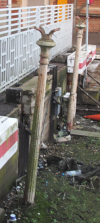
- Interestingly, listed building consent would be required as some things in the station are listed, most notably, the old gas lamp holders of all things:
- With the track being wholly relaid and the alignment changed, two new buffer stops would be required, which would mean the current end/buffer stop standards would be applied, which means the platform extensions would grow in length by anything from 10 to 25m (a risk assessment would be done which would determine whether fixed or retarding buffers would be needed, and how much safety space would be added behind them). This, naturally, adds extra cost and time. (Note, however, that the new signals have been positioned to allow this to happen without moving them again, if, at some point in the future, it is deemed needed by future risk assessments).
- If the tracks move at the buffer end new OLE anchors are needed and further OLE changes - more cost and complexity.
Kink
- This offers the best compromise - the tracks are gently curved, so there's no major gaps created between platform and train, the crossovers are standard, the signalling block distance is minimised, the existing station has only the required works, and the project gets to completion in the best and most cost-efficient way.
== Doublepost prevention - post automatically merged: ==
It does look as if the buffer beam is still there, if you zoom in on the picture in post #59
Yep, it wasn't removed as part of the extension works. No need.
Good spot!I was at Ware last night and noticed that the overhead wire from both tracks extends over the single track of the station, with special double masts to hold up the two wires. I suppose this is cheaper than the tensioning equipment they would need if one of the wires terminated and restarted. I couldn't tell if the pantographs were touching both wires simultaneously.
Yes, this is correct.
- This replicates the previous arrangement so was easier and avoided the need to install new anchor structures and terminations.
- They are not both touching the pantograph - one lifts up out of the way for the majority of the platform.
- They do both come back together as they go through the bridge though - they are both in contact with the pantograph there.
Last edited:
- Status
- Not open for further replies.