Harlequinuk
On Moderation
If diesel prices stay this high, would we see a return of the stored electric locos for freight? Could they work out cheaper?


I suppose in the short term rail operators are less bothered about using diesel as prices are fixed and locked in.Do you know if increased electricity charges will feed in to the price freight users pay fairly quickly, or is it hedged on long-term contracts too? I’m curious if we’ll see less diesel haulage under the wires, which was something that increased last time there was an energy crisis. The impact on electricity prices is likely to be greater since gas supplies are more affected by the conflict and are already constrained by Russia being on the naughty step, but might not kick is as soon.
The impact of higher fuel prices on the railfreight industry is rather more than on the road freight industry.
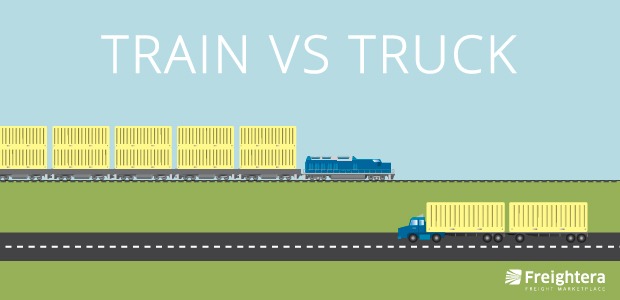
The Pros and Cons of Train VS Truck Freight Shipping [Infographic]
Which mode of transport is more efficient for shipping and what are the advantages and disadvantages of train vs. truck transportation?www.freightera.com
Freight trains can reach as much as over 15000 feet in length (roughly 4500 meters) and, when fully loaded, can weigh over 3.5 million pounds (around 1600 metric tons).
In the USA Rail freight transport accounts for a third of all intercity freight volume. Yet it accounts for only about 2% of all transport-related emissions.
A single gallon of diesel fuel is enough for a freight train to transport a ton of freight for 470 miles as opposed to roughly 134 miles that a truck could do with the same amount of fuel and the same cargo weight.
As we move to renewable energy sources, electric trains will become even more efficient and clean compared to other modes of freight transport.
As per the Association of American Railroads, freight railroads account for only 0.5% of all of the USA’s greenhouse gas emissions. Heavy-duty and medium-sized rucks, on the other hand, are second only to passenger cars making up around 25% of the USA’s emissions in 2020.
Tiny passenger numbers in that service is unlikely to impact rail services given the massive difference in capacityI saw the latest airline on the publicly subsidised Newquay to Gatwick air route has thrown in the towel.
Probably correct for the London centric viewpoint, a lot different for the rest of the country where the car tends to be king most of the time.That was mentioned on the Jeremy Vine R2 show this week and shot down by one of the guests who said that very few drive into London so that would be a lame excuse not to attend the office.
Depends where they expect to run them. If its replacing diesel on routes where NR have declared congested infrastructure due to power constraints, then NR will say no.If diesel prices stay this high, would we see a return of the stored electric locos for freight? Could they work out cheaper?
Ah I see, you're talking about the percentage increase. But if the price per container goes from (completely making up numbers here) £1 to £1.80 for rail, compared to going from say £7 to £9 per container for road, that's still a bigger absolute increase than for rail
Do you know if increased electricity charges will feed in to the price freight users pay fairly quickly, or is it hedged on long-term contracts too? I’m curious if we’ll see less diesel haulage under the wires, which was something that increased last time there was an energy crisis. The impact on electricity prices is likely to be greater since gas supplies are more affected by the conflict and are already constrained by Russia being on the naughty step, but might not kick is as soon.
London specifically was mentioned when relating to that comment on the show.Probably correct for the London centric viewpoint, a lot different for the rest of the country where the car tends to be king most of the time.
If rail is 3-4 times more fuel-efficient, and road haulage has to pay higher duty, then surely road haulage would pay much more than 2x the fuel price per container?With those calculations, yes. But - also completely making numbers up (but more realsitically), if the cost of fuel per container for a trip from Felixstowe to Wakefield rises from £50 to £90 for rail, and £100 to £130 for road, the absolute increase is more for rail.
If I want to go from, say, Devizes to Beverston it won't make the slightest impact on rail usage! With only 2% of all pax trips made by rail the effects will be marginal at best.
Except for the Chiltern line which was absolutely rammed on Saturday and not much better this morning, Easter Sunday.Pedant alert.
Today is actually Holy Saturday.
Easter Saturday is next week.
But you are correct. Today is a relatively quiet day for long distance travel.
And EMR. A consequence of Euston closure.Except for the Chiltern line which was absolutely rammed on Saturday and not much better this morning, Easter Sunday.
This is rail's big problem, it is inflexible. For a lot of people, they need to drive to get to a station. Even in urban areas often it is a long walk or a bus ride to a station, including a lot of Greater London. Taking the bus or driving to a station becomes riskier with the proliferation of Advance tickets.Rail is only a viable option if one lives in a fairly urban area and wishes to travel to a similar area
The UK is too small for rail freight to be attractive in a lot of cases. Freight almost always needs transferring to road for the last mile. This works in the USA because of the large distances.Where rail really excels is heavy long-distance freight which should be utilised far more where possible.

A day return rail ticket ftom Lancashire to/from Glasgow, (or Edinburgh) is almost always more economical than driving and the travel time is likely just as quick. It's certainly more relaxing!The only way the train ever wins on cost is if you either get a lucky advance ticket, or if parking is costly at the other end.
er, the bicycle says "Hello!" Have you ever seen a Dutch (Netherlands) rail station - or even one of their rural bus stops with a shelter incorporating a bike rack!This is rail's big problem, it is inflexible. For a lot of people, they need to drive to get to a station. Even in urban areas often it is a long walk or a bus ride to a station, including a lot of Greater London. Taking the bus or driving to a station becomes riskier with the proliferation of Advance tickets.
Don't forget that taxis need to be remembered as an integral part of public transport. It's a pity they are (were in my childhood) seen as elite or expensive...The "last mile" issue cancels out any time advantage taking the train has. There's no quicker way to get from e.g. London to Bath than taking GWR, helicopter excepted. But when your "London to Bath" journey is actually Selsdon to Box, the train becomes inconvenient and (even more) expensive, or passengers are reliant on family and friends to drop off/pick up at stations.
This is rail's big problem, it is inflexible. For a lot of people, they need to drive to get to a station. Even in urban areas often it is a long walk or a bus ride to a station, including a lot of Greater London. Taking the bus or driving to a station becomes riskier with the proliferation of Advance tickets.
The "last mile" issue cancels out any time advantage taking the train has. There's no quicker way to get from e.g. London to Bath than taking GWR, helicopter excepted. But when your "London to Bath" journey is actually Selsdon to Box, the train becomes inconvenient and (even more) expensive, or passengers are reliant on family and friends to drop off/pick up at stations.
The UK is too small for rail freight to be attractive in a lot of cases. Freight almost always needs transferring to road for the last mile. This works in the USA because of the large distances.
Indeed, my original post should have maybe been more specific, because people are discussing two different questions here:Yet many, many people still take the train.
If you think back to the 1940's when rail was basically the only long distance option (unless you wanted your banger to give up half way there), we've had internal passenger flight, motorways, cars that can last a journey to Scotland, coaches etc - yet our main lines are fuller than they were when they were the only choice.
The rail product has an allure all of its own.
Yet many, many people still take the train.
If you think back to the 1940's when rail was basically the only long distance option (unless you wanted your banger to give up half way there), we've had internal passenger flight, motorways, cars that can last a journey to Scotland, coaches etc - yet our main lines are fuller than they were when they were the only choice.
The rail product has an allure all of its own.
Indeed, my original post should have maybe been more specific, because people are discussing two different questions here:
1. Is there going to be a huge shift from road to rail, e.g. rail numbers increasing by 20%? Answer: almost certainly not
2. Could there be a small but significant shift, more like 3-5% on top of existing growth? I think the jury's still out on that one! Especially because (as The Ham pointed out) it only takes a small proportion of road users to shift to rail to have quite a significant impact on rail numbers, e.g. if 1% of road journey miles moved to rail, that would mean a 9% increase in rail miles.
Indeed, one of the advantages of rail for trips like South East to Scotland is that it avoids the need for either a day of little more than just driving or paying for overnight accommodation to make the journey more tolerable.
Flying can beat the train, however it depends on how easy it is to access the airport (not too bad from Slough but not great from Sevenoaks) and the parking charges can be significant.
However with higher fuel costs flying could get quite a bit more pricey and likely to have fewer fights to pick from.
Obviously, like everything, rail has it's strengths and weaknesses and works better for some travel over others.
For a lot of people, the easiest way for them to reduce their fuel costs would be too walk and cycle a little more and if suitable WFH (again this isn't always an option for everyone).
Up to 15 miles on an ebike (especially if it's not to a public location, such as a train station, so reduces the risk of theft) is easily doable.
If you're paying 15p a mile in fuel, someone commuting 12 miles each way a day could save £800 a year just in fuel which would mean over time it would pay for the bike.
Don't fancy getting rid of the car, that's fine you can keep it, however lots of other costs reduce (less wear on the tyres and brakes, less depression on the value, etc), and that could mean that is the weather is terrible you could still drive.
Whilst the car would likely take 20 minutes whilst the bike an hour each way, however (unless you only use the electric for motion) you're also going to bed getting some exercise and so might not need to spend so much time elsewhere exercising.
The Freight Gateways seems to be springing up all over the place, the recent one at East Midlands Airport seems quite active and lots of lorries driving in/out. Of course it is all containerised so easy to transfer to road for the last mile.The UK is too small for rail freight to be attractive in a lot of cases. Freight almost always needs transferring to road for the last mile. This works in the USA because of the large distances.
We have taken the elasticities directly from PDFH v6 using the PDFH categories specified in this document, these are shown in Table 10. Note that we have assumed that all flows are over 20 miles.

And this isn't an unrealistic prospect:Potentially, although it's unlikely that we'd see anything from the data for ac while.
The impact is likely to be limited unless fuel prices stay high for a prolonged period.
The most likely change could be a shift from air to rail if regional fights see cuts to reduce the fuel burn.
 www.bbc.co.uk
Europe will suffer jet fuel shortages in just three weeks if the the Strait of Hormuz does not reopen, the trade body for the continent's airports has warned.
The Persian Gulf is a major source of aviation fuel, accounting for about 50% of Europe's imports.
Airports Council International (ACI) Europe said its members had "increasing concerns" about the availability of jet fuel, particularly with the approach of the summer tourism season.
It warned smaller airports are particularly vulnerable.
"A supply crunch would severely disrupt airport operations and air connectivity – with the risk of harsh economic impacts for the communities affected, and for Europe," ACI Europe's director-general Olivier Jankovec wrote in a letter to the European commissioners for energy and tourism.
"At this stage, we understand that if the passage through the Strait of Hormuz does not resume in any significant and stable way within the next three weeks, systemic jet fuel shortage is set to become a reality for the EU."
Several airlines worldwide have already cut flights and hiked passenger charges due to concerns about fuel shortages.
Last week, the benchmark European jet fuel price hit an all-time high of $1,838 (£1,387) per tonne, compared with $831 before the war began.
Jankovec urged the EU to intervene, writing that "relying on market forces and adaptation alone is not an option".
He criticised the lack of EU-wide assessment and monitoring of jet fuel production and availability.
ACI Europe wants the EU to engage in collective purchasing of jet fuel. The body has also called for restrictions and regulations on importing jet fuel to be temporarily lifted.
The letter, which was written on 9 April and first reported by the Financial Times, said: "This crisis should also be the opportunity to reinforce support for SAF [sustainable aviation fuel] production and affordability,
"The price of conventional jet fuel is likely to remain at higher levels in the medium to long-term."
Jankovec added that airports with fewer than a million passengers per year were already struggling with viability "without even accounting for the impact of jet fuel shortages".
He warned the current crisis could make airports even more fragile and threaten local communities, potentially impacting European cohesion.
Air travel contributes €851bn (£741bn) to European economies' GDP every year and supports 14 million jobs.
Worth remembering that the Dutch almost went down the car-centric dead end but the combination of the 1973 oil crisis and some high-profile fatalities caused them to switch to the very pro-active travel outlook they have today.I seem to recall reading once that something like 60% of urban car journeys are of less than 2 miles. Most of those could be done by bicycle, as in more-developed countries such as The Netherlands. Many people choose to drive because that's what everybody else does and cycling is seen as being slightly-odd. But if there were a petrol shortage I would expect fewer local trips by car and only a marginal effect on rail travel.
Worth remembering that the Dutch almost went down the car-centric dead end but the combination of the 1973 oil crisis and some high-profile fatalities caused them to switch to the very pro-active travel outlook they have today.
For example, whilst I can understand why driving when it's raining could be attractive, even on nice spring days (i.e. not cold and not wet) people will still drive. The thing I've noticed is that often on a cold morning I stay warmer when I walk than if I were to drive.
I guess that depends where you are in the country. Since covid the number of people walking into town / events etc around us is noticeably much higher, with a consequent reduction in traffic.

I guess that depends where you are in the country. Since covid the number of people walking into town / events etc around us is noticeably much higher, with a consequent reduction in traffic.
Interesting, as I’ve noticed the exact opposite. The car parks in my town are nowadays about 80-90% full throughout the daytime on Mondays to Thursdays, and overflowing on Fridays and at the weekend. A decade ago during the week they would be half empty.
