
That's what I meant. I understand they use PTFE-coated non-conducting contact rods in neutral sections to provide the sliding characteristics needed.
In many cases a low over-bridge will not have clearance to allow sufficient gap between the pantograph and the structure, and between the pantograph and the vehicle. But a non-conducting contact wire or rod that could push the pan down enough to achieve mechanical clearance would be enough not to have to rebuild the bridge.
Provided that all electric stock on the line had a traction battery with sufficient range to self-rescue a stranded train, I still don't see why neutral sections longer than two train lengths cannot be used to save the cost of rebuilding low bridges when appropriate to do so.
In the case where mechanical clearances are achievable then the use of surge diverters and insulating coating should get the wire through the bridge whilst keeping it energised.
Rail engineer have an article on the technology I'm talking about.
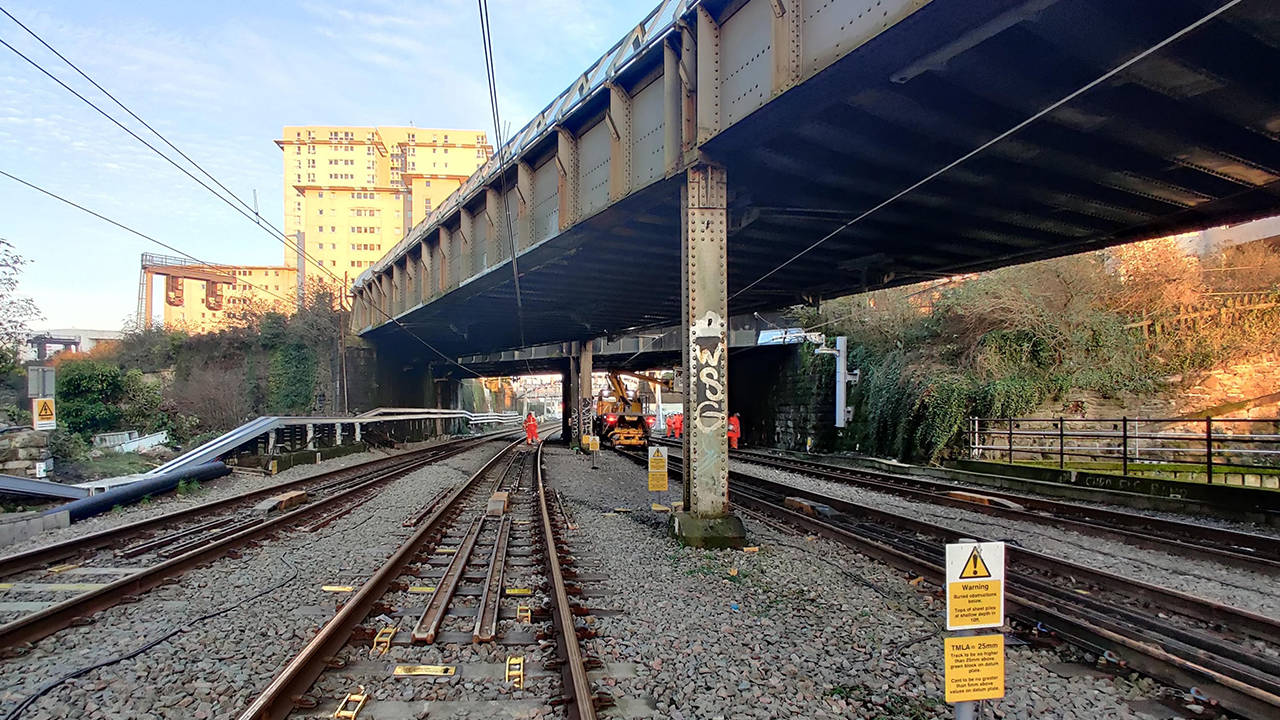
Overcoming the clearance issue - Rail Engineer
Listen to this article Whilst third rail and other low-level current collection systems add a lot of equipment to a railway at ground level, the general approach to electrification across the world has involved the adoption of overhead contact systems. In the UK, the early schemes tended to...
 www.railengineer.co.uk
As I have already said, I've worked in the industry for years with a lot of that in electrification. It's not reasonable to just say somethings wrong or saying you disagree without any expansion or evidence. Why Walmsley didn't mention the valleys I don't know but it isn't immune to the issues he has raised. I could bring up issues I've heard about the project through conversation but obviously it's better to use publicly available, reliable sources as this is an anonymous forum.There might be a few hints here:-
Signed, an industry source (who has actually done some of this stuff).
Having been responsible and a budget holder for track maintenance in the past, I can confirm that the changes to track maintenance costs from electrification are there on paper…. But not on steel, ballast and concrete. It doesn’t reduce inspection frequencies, nor tamping frequencies or the rate of track faults. The cost changes are essentially negligible in the whole scheme of things,
and an electrification business case (Which I have also been responsible for writing).
Sounds as though Bald Rick has a lot of experience from which to make his statements. As an observer of this particular discussion, I'm wondering if you have anything similar on your CV, or, like me, are just an lay observer?
Oh, and a reminder that IW didn't mention the Cardiff Valleys discontinuous electrification once in the article you cited as evidence. As the only such scheme well under way, I find it curious that he didn't reference it at all, as it would have been the obvious thing to do.
