I travel much of the network south and west of London and am amazed how even on a long journey there is an endless procession of pieces of discarded rail and countless bags of ballast mouldering after long completed work. It's not just the value of these commodities it is the sheer quantity. There cannot be a kilometre of line anywhere in the south that is not blessed with at least some removed rail and a lot of ballast bags. High quality scrap steel as in rails are currently £150- - £300 per tonne - and a metre of rail weighs over 60Kg just imagine the thousands of tonnes abandoned on a journey between London and the Coast. Bags of Limestone ballast may not cost as much but they don't cost nothing, and there are thousands of them. The thing is, Quantity Surveyors working for an MDU are never going to say "We can use those 30 bags left over from the last job just up the line" - they will always specify the needs of the job in hand, and so it goes on. If you watch those Youtube cab ride videos in Europe is is remarkable how clean and clear is the lineside in every Western European country compared to the UK, in fact the UK is a disgrace. This seems to be in part a problem of fragmentation - it's no single MDU's responsibility. Nobody is seeing the big picture. We need the ORR to take a leadership role and launch a programme to sponsor engineers trains to recover materials left over and send trainloads of scrap steel back to Scunthorpe and ballast back to a Depot like Eastleigh or Horsham for rebagging and reuse. If we don't it just goes on and on getting worse and worse.

-
Our new ticketing site is now live! Using either this or the original site (both powered by TrainSplit) helps support the running of the forum with every ticket purchase! Find out more and ask any questions/give us feedback in this thread!
You are using an out of date browser. It may not display this or other websites correctly.
You should upgrade or use an alternative browser.
You should upgrade or use an alternative browser.
Clearing up Waste material after Maintenance and Renewals
- Thread starter Domeyhead
- Start date
Sponsor Post - registered members do not see these adverts; click here to register, or click here to log in
R
RailUK Forums
Hasn't this been discussed before? The problem with a heavily used network like the UK has is that removing surplus material is expensive in infrastructure terms, - providing paths for engineering access can cause major disruption to a busy service. Such a path requires blocking lines for at least hours, - maybe even days with the attendant tasks of offloading heavy lifting plant and of course loading it to return to base. In the event, track components and materials have a generally low theft value with a long environmental life, so using the railway's estate for storage is not an operational problem. Eventually it will be removed at time when there is less disruption to the service overall.I travel much of the network south and west of London and am amazed how even on a long journey there is an endless procession of pieces of discarded rail and countless bags of ballast mouldering after long completed work. It's not just the value of these commodities it is the sheer quantity. There cannot be a kilometre of line anywhere in the south that is not blessed with at least some removed rail and a lot of ballast bags. High quality scrap steel as in rails are currently £150- - £300 per tonne - and a metre of rail weighs over 60Kg just imagine the thousands of tonnes abandoned on a journey between London and the Coast. Bags of Limestone ballast may not cost as much but they don't cost nothing, and there are thousands of them. The thing is, Quantity Surveyors working for an MDU are never going to say "We can use those 30 bags left over from the last job just up the line" - they will always specify the needs of the job in hand, and so it goes on. If you watch those Youtube cab ride videos in Europe is is remarkable how clean and clear is the lineside in every Western European country compared to the UK, in fact the UK is a disgrace. This seems to be in part a problem of fragmentation - it's no single MDU's responsibility. Nobody is seeing the big picture. We need the ORR to take a leadership role and launch a programme to sponsor engineers trains to recover materials left over and send trainloads of scrap steel back to Scunthorpe and ballast back to a Depot like Eastleigh or Horsham for rebagging and reuse. If we don't it just goes on and on getting worse and worse.
There is always time for engineers to perform the maintenance in the first place, and recovery of material could be done in the same manner overnight in short posessions, as are many maintenance tasks. It does not need to conflict with peak hour or daytime services. Secondly saying that we can just keep making the problem worse until some unspecified time in the future is also not an answer, it is just kicking the can down the road. If the material has been placed where it is by rail cranes, then it can be recovered by rail cranes, and ditto HGVs with grabs. This is an issue to be addressed, not obfuscated. Not only is this a matter of ORR taking a leadership Role it is practically self funding beccause of the value of the material recovered.Hasn't this been discussed before? The problem with a heavily used network like the UK has is that removing surplus material is expensive in infrastructure terms, - providing paths for engineering access can cause major disruption to a busy service. Such a path requires blocking lines for at least hours, - maybe even days with the attendant tasks of offloading heavy lifting plant and of course loading it to return to base. In the event, track components and materials have a generally low theft value with a long environmental life, so using the railway's estate for storage is not an operational problem. Eventually it will be removed at time when there is less disruption to the service overall.
I have my doubts that it would be self-funding.There is always time for engineers to perform the maintenance in the first place, and recovery of material could be done in the same manner overnight in short posessions, as are many maintenance tasks. It does not need to conflict with peak hour or daytime services. Secondly saying that we can just keep making the problem worse until some unspecified time in the future is also not an answer, it is just kicking the can down the road. If the material has been placed where it is by rail cranes, then it can be recovered by rail cranes, and ditto HGVs with grabs. This is an issue to be addressed, not obfuscated. Not only is this a matter of ORR taking a leadership Role it is practically self funding beccause of the value of the material recovered.
Same thing happens on our road system (where retrieval is much more straightforward) with signs left in place long after work is completed.
Contact them and you're told "sending a man and a van would cost more than the sign is worth".
Given the hybrid warfare threat to the UK this has to change. Leaving materials that could be used to derail trains, short track circuits or be used in arson is making rail lines less secure.
The higher future risk of extreme weather like droughts is also increasing the fire risk. Again more combustible sources line side increases the risk.
The higher future risk of extreme weather like droughts is also increasing the fire risk. Again more combustible sources line side increases the risk.
Although it was primarily used for spoil during ballast cleaning , time for the skip train to return ?
( link shows ballast cleaning system where spoil loaded into skips moved along train of flat wagons by moveable gantry
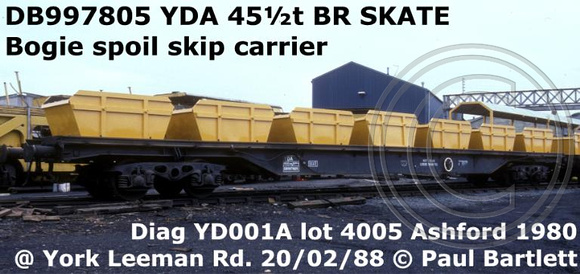
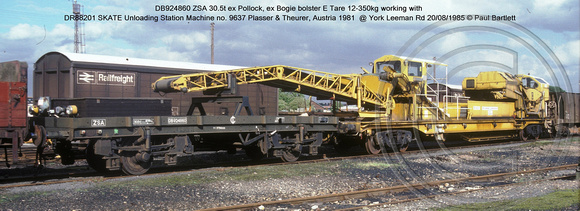
( link shows ballast cleaning system where spoil loaded into skips moved along train of flat wagons by moveable gantry
BR Skate YDA spoil skip storage
23 wagons built at Ashford in 1980. An unconventional concept of carrying 7 waste skips which can be lifted and moved, using a continous rail along the sides of the wagon. 21m over headstocks with bogies at 15.800 centres. An example of the loading station and its runner is at...
paulbartlett.zenfolio.com
DR88201 + DB924860 SKATE Unloading Station ZSA
One of the few machines that worked with Skate skip carrying wagons http://PaulBartlett.zenfolio.com/brskate. It worked behind a ballast cleaner taking the ballast and depositing it in skips, which were moved back along the train - permitting all to be done on a single line. It had its own...
paulbartlett.zenfolio.com
uglymonkey
Member
- Joined
- 10 Aug 2018
- Messages
- 711
They don't care, the railway is used like a rubbish tip ( and fuel for vandals). Presumably every thing is paid for job by job, so anything left at the end is pointless trying to reuse it.
We know that engineering works are typically carried out in very tight timescales, often with the bare minimum of allowances even for the essential work that is scheduled, let along anything else. There have been plenty of instances of trains running over Stop boards or, worse, colliding with things left where they shouldn’t have been, presumably owing to time pressures to hand back the line. There more often than not won’t be time to go ‘tidying up’ beyond what is essential to ensure that the line can be reopened safely, I suspect.

alxndr
Established Member
- Joined
- 3 Apr 2015
- Messages
- 1,695
A lot of what may look like scrap may actually be strategic spares or awaiting install. It's not possible to get stuff on site and installed on the same night, and not cost effective to deliver each piece one by one when it can be more effective to deliver a load at once even if it means it sits around for a while before getting used.
It's also not true that stuff left over from one job never gets used in the future, it just might not be immediate.
It's also not true that stuff left over from one job never gets used in the future, it just might not be immediate.

Western Sunset
Established Member
Somehow I doubt that...Tidy ups to happen, not always at the pace everyone would like.
You can doubt it, but it's still a fact.Somehow I doubt that...
Parham Wood
Member
- Joined
- 13 Jun 2011
- Messages
- 407
Under the New Roads and Streetworks Act 1991 it is an offence to leave signage. materials and equipment on site after works have finished. There is slight buffer period for this. It seems rarely to be implemented. £100 fine for minor offences per day I think.I have my doubts that it would be self-funding.
Same thing happens on our road system (where retrieval is much more straightforward) with signs left in place long after work is completed.
Contact them and you're told "sending a man and a van would cost more than the sign is worth".
Italianauto
Member
Wish it was. 'Not a priority', public complaints closed because they can't be actioned, any de-veg work = rubbish left behind. That's the position on this Route. The best hope is a large project coming along which will move the stuff - if it's on site/in the way.You can doubt it, but it's still a fact.

deltic
Established Member
- Joined
- 8 Feb 2010
- Messages
- 3,722
Every now and then some vandal places a discarded sleeper on the tracks and the railway implements a clean up campaign that soon fizzles out until the next time it happens. Like most of our public realm, the state of the railways leaves a lot to be desired.
Nicholas Lewis
Established Member
On the Brighton Main Line Victoria to Three Bridges its 90% scrap rail, unloaded ballast bags that have largely disintegrated they've been there so long and just loads of general railway waste.Are you sure it’s all scrap / waste, and that some of it isn’t spares?
Below is Cottage Bridge Jcn earlier this year.

The majority of this is light enough to be bagged up and recovered by road but its just accumulating.
Recovery of scrap rail is more challenging as its going to need a RRV (Road Rail Vehicle) but along this section its been accumulating over years so needs a scrap train. Many of the ballast bags with scrap in would probably fail if lifted so thats more work to rebag or handball. Majority of this is from maintenance tasks where access has been at a premia for decades and getting a defective rail changed in a time limited possession is the priority not scrap recovery.
The only way this will be resolved is for a dedicated team to plan, with access to contractors, and organise where they can get in amongst existing possession. That needs funding though which as we know is in short supply so its not going to be recovered anytime soon.
CapabilityB
Member
It's another example of rail projects not costing or planning for whole life costs. In the same way that enhancement projects often fail to cost for ongoing operational or maintenance costs in the business case or plan; renewal or maintenance projects will be forced by the control period cost pressures to do the minimum which is do the job, but not worry about dealing with the waste if it doesn't impact the safety of the railway operation.