• Our new ticketing site is now live! Using either this or the original site (both powered by TrainSplit) helps support the running of the forum with every ticket purchase! Find out more and ask any questions/give us feedback in this thread!

Carlisle shunt neck

saltywalrus

Member
Joined
21 May 2022
Messages
29
Location
Lancaster
I've been sinking far too many hours into SimSig as of late, and there's something that's struck as odd; namely why there's only a single track section from Carlisle South Jn to the Newcastle / S&C lines?

There are two tracks for most of the chord, but one of them stops short less than 100m of the through goods lines and is only used as a shunt neck.

Obviously it's not a major bottleneck, as traffic through there is normally fairly light, but it does seem a puzzling arrangement when it could easily be double-tracked the whole way with a limit of shunt signal to allow one of the lines to be used for shunting moves when required.

Does anyone know why it's laid out this way?
 
Sponsor Post - registered members do not see these adverts; click here to register, or click here to log in
R

RailUK Forums

QueensCurve

Established Member
Joined
22 Dec 2014
Messages
2,196
I've been sinking far too many hours into SimSig as of late, and there's something that's struck as odd; namely why there's only a single track section from Carlisle South Jn to the Newcastle / S&C lines. There are two tracks for most of the chord, but one of them stops short less than 100m of the through goods lines and is only used as a shunt neck. Obviously it's not a major bottleneck, as traffic through there is normally fairly light, but it does seem a puzzling arrangement when it could easily be double-tracked the whole way with a limit of shunt signal to allow one of the lines to be used for shunting moves when required. Does anyone know why it's laid out this way?
I imagine that in the early 1970s BR thought they were providing all the capacity needed.
 

John Webb

Established Member
Joined
5 Jun 2010
Messages
3,750
Location
St Albans
I've been sinking far too many hours into SimSig as of late, and there's something that's struck as odd; namely why there's only a single track section from Carlisle South Jn to the Newcastle / S&C lines. There are two tracks for most of the chord, but one of them stops short less than 100m of the through goods lines and is only used as a shunt neck. Obviously it's not a major bottleneck, as traffic through there is normally fairly light, but it does seem a puzzling arrangement when it could easily be double-tracked the whole way with a limit of shunt signal to allow one of the lines to be used for shunting moves when required. Does anyone know why it's laid out this way?
According to Peter W. Robinson's book "Rail Centres - Carlisle" (Ian Allan Ltd. 1986) that line was singled to a bi-directional line in 1973 when the whole station was resignalled prior to electrification. This included much simplification of the track layout, such as removal of scissors crossovers and slip points replaced by simple crossovers.
 

zwk500

Veteran Member
Joined
20 Jan 2020
Messages
18,458
Location
Northampton
The protection and interlocking requirements for a running line are quite different to those for a siding.
Given the extra cost involved with providing the additional turnout at the junction and signalling the line to passenger standard, it presumably was not worth it for the limited capacity boost to a link that was used for 2 relatively less used line.
 

ac6000cw

Established Member
Joined
10 May 2014
Messages
3,908
Location
Cambridge, UK
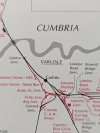
Also there used to be freight avoiding lines to the west of the station, connected to all of the routes to the south, east and west - a snapshot from the 1984 edition of the S K Baker Rail Atlas attached. This meant freight traffic didn't need to use the connecting chord. The avoiding lines were taken out of use after a serious derailment in 1984 that wrecked a bridge over the River Caldew, and BR decided it could handle the freight traffic via the station instead.
 

Attachments

  • PXL_20260527_074036537.jpg
    PXL_20260527_074036537.jpg
    2.3 MB · Views: 213
Last edited:

jfollows

Established Member
Joined
26 Feb 2011
Messages
10,084
Location
Wilmslow
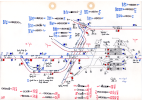
Layout from time of electrification in 1974 attached.

Probably copied from OS Nock, Electric Euston to Glasgow at the time

I think that was probably his last reliable book; after then he really shouldn’t have been allowed to publish without a competent sub-editor.
 

Attachments

  • Carlisle 1974.png
    Carlisle 1974.png
    5.6 MB · Views: 272
Last edited:

takno

Verified Rep - Traksy
Joined
9 Jul 2016
Messages
6,577
Also there used to be freight avoiding lines to the west of the station, connected to all of the routes to the south, east and west - a snapshot from the 1984 edition of the S K Baker Rail Atlas attached. This meant freight traffic didn't need to use the connecting chord. The avoiding lines were taken out of use after a serious derailment in 1984 that wrecked a bridge over the River Caldew, and BR decided it could handle the freight traffic via the station instead.
Ahh, that explains why the lines which appear to be the main avoiding lines just kind peter out into a siding at Rome Street junction. I was filling in some blanks on the Traksy map last night and couldn't figure out what the point of it was
 

zwk500

Veteran Member
Joined
20 Jan 2020
Messages
18,458
Location
Northampton
Ahh, that explains why the lines which appear to be the main avoiding lines just kind peter out into a siding at Rome Street junction. I was filling in some blanks on the Traksy map last night and couldn't figure out what the point of it was
A divided portion of a freight train in 1984 was responsible for the closure of the goods lines round the back of the station.

Early in the morning of 1 May 1984 a freightliner train was descending from Shap on the main line, and became divided. The front portion of the train continued, but the rear portion slowed but then also continued by gravity. Entering the Carlisle complex it was diverted on to the goods avoiding lines. These were sharply curved and the train portion became derailed, causing considerable damage in the process. The route was closed by the damage caused, and in December 1985 the decision was taken not to restore the route, and accordingly it was permanently closed. Signalling changes at Carlisle station were made to facilitate all traffic passing through it.

Nowadays they'd be rather useful for getting long freight trains out of the station, although the number of additional conflicts for Down trains at Upperby Bridge would be awkward and the goods lines could only be very slow linespeed so may cause some trains to miss paths if all were rerouted (similar to how some freight still runs through Crewe station despite the Independent lines).
 

Dr Hoo

Established Member
Joined
10 Nov 2015
Messages
5,616
Location
Hope Valley
Given that Carlisle only has three through platforms any trains that have terminated on one of them need to be moved out of the way promptly. Although I don’t use Carlisle particularly often I’ve seen ‘inter city’ trains dropped in the neck more than once.
 

zwk500

Veteran Member
Joined
20 Jan 2020
Messages
18,458
Location
Northampton
Given that Carlisle only has three through platforms any trains that have terminated on one of them need to be moved out of the way promptly. Although I don’t use Carlisle particularly often I’ve seen ‘inter city’ trains dropped in the neck more than once.
Happens regularly when there's a block on (planned or unplanned) although in the current WTT only 4 trains are using it - all Northern shunts between 5/6 and 1/2, and all early/late so presumably related to stabling or unit rotation.
 

edwin_m

Veteran Member
Joined
21 Apr 2013
Messages
28,613
Location
Nottingham
According to Peter W. Robinson's book "Rail Centres - Carlisle" (Ian Allan Ltd. 1986) that line was singled to a bi-directional line in 1973 when the whole station was resignalled prior to electrification. This included much simplification of the track layout, such as removal of scissors crossovers and slip points replaced by simple crossovers.
From the early 1970s until the late 80s British Rail reduced many junctions to single lead, which I find rather inexplicable to me particularly where there was space to lay a double lead with turnouts and avoid a diamond crossing that way instead. This happened with junctions as important as Euxton and Wigston, both since re-doubled. A double lead also has four turnouts and only a small amount of extra plain line, and creates more capacity where it is needed most (trains on the same route can be timetabled to pass each other on the junction). Fortunately this practice was mostly abandoned after serious head-on collisions at Newton and Bellgrove.
 

Lucy1501

Member
Joined
9 Nov 2021
Messages
241
Location
Cumbria
I've been sinking far too many hours into SimSig as of late, and there's something that's struck as odd; namely why there's only a single track section from Carlisle South Jn to the Newcastle / S&C lines?

As part of the Trilink project (which has been scaled back so much it may as well be scrapped at this point), it is reasonably likely that the shunt neck will be converted back to a through line.

The same proposal also has the middle sidings going at the station - although that one has far less sense behind it!

Ahh, that explains why the lines which appear to be the main avoiding lines just kind peter out into a siding at Rome Street junction. I was filling in some blanks on the Traksy map last night and couldn't figure out what the point of it was
The goods lines were retained as far as the Metal Box Sidings which continued to be in use following the closure of most of the goods lines, hence why there is still a connection.
 

Dave W

Member
Joined
27 Sep 2019
Messages
874
Location
North London
Presumably you've been playing the 1979 timetable - one of the best on any Simsig simulation.

One of the consequences of the 1984 accident closing the goods lines was the up rating of the middle sidings - previously non track circuited and accessed/exited by position light signals - to being fully signalled.
 

The Planner

Veteran Member
Joined
15 Apr 2008
Messages
19,652
As part of the Trilink project (which has been scaled back so much it may as well be scrapped at this point), it is reasonably likely that the shunt neck will be converted back to a through line.

The same proposal also has the middle sidings going at the station - although that one has far less sense behind it!


The goods lines were retained as far as the Metal Box Sidings which continued to be in use following the closure of most of the goods lines, hence why there is still a connection.
West Coast North Route mod isn't dead.
 

route101

Veteran Member
Joined
16 May 2010
Messages
12,258
Does anything use the connection from the Tyne Valley/S&C to the WCML South?
 

zwk500

Veteran Member
Joined
20 Jan 2020
Messages
18,458
Location
Northampton
Does anything use the connection from the Tyne Valley/S&C to the WCML South?
The odd freight and light loco moves. Also been used by tours occassionally, and to turn Steam Locos for tours that have terminated at Carlisle.

In the sectional appendix, it's officially a siding.
 

Paul AC

Member
Joined
3 Aug 2025
Messages
239
Location
Timperley
Layout from time of electrification in 1974 attached.

Probably copied from OS Nock, Electric Euston to Glasgow at the time

I think that was probably his last reliable book; after then he really shouldn’t have been allowed to publish without a competent sub-editor.
I have that book as an ex-library copy. FYI it has monochrome track diagrams, with a fair bit of signal detail, for all the new boxes on the line including Carlisle, but not as much detail as the coloured diagram you pasted into your post.
 

themiller

Established Member
Joined
4 Dec 2011
Messages
1,380
Location
Cumbria, UK
I've been sinking far too many hours into SimSig as of late, and there's something that's struck as odd; namely why there's only a single track section from Carlisle South Jn to the Newcastle / S&C lines?

There are two tracks for most of the chord, but one of them stops short less than 100m of the through goods lines and is only used as a shunt neck.

Obviously it's not a major bottleneck, as traffic through there is normally fairly light, but it does seem a puzzling arrangement when it could easily be double-tracked the whole way with a limit of shunt signal to allow one of the lines to be used for shunting moves when required.

Does anyone know why it's laid out this way?
The line was converted into a siding for parking a Pendolino. I don’t know whether it was used for this purpose but there was a plan to return it to its original use at the same time as redoubling Gretna junction. I assume it was deferred until Carlisle station area is rebuilt.
 

Dave W

Member
Joined
27 Sep 2019
Messages
874
Location
North London
The odd freight and light loco moves. Also been used by tours occassionally, and to turn Steam Locos for tours that have terminated at Carlisle.

In the sectional appendix, it's officially a siding.
I haven't been in Carlisle for ages, but from Google Maps the entire area around what was Upperby TMD is essentially wasteland now. But even when it was bustling railway land, the curve wasn't hugely in use (as evidenced by the aforementioned 1979 Carlisle SimSig timetable, which is one of the most accurate and detailed SimSig timetables ever created).

The shunt neck was a different story - as it had several uses - mostly to shunt light engines and stock between the middle roads, Collier Lane Sidings, the south facing bays, and the Wapping Sidings / Wall Sidings near the signal box. The reduction in shunting around the station plus growing traffic ought to make considering reinstating it as a running line worth it.
 

saltywalrus

Member
Joined
21 May 2022
Messages
29
Location
Lancaster
A divided portion of a freight train in 1984 was responsible for the closure of the goods lines round the back of the station.


Nowadays they'd be rather useful for getting long freight trains out of the station, although the number of additional conflicts for Down trains at Upperby Bridge would be awkward and the goods lines could only be very slow linespeed so may cause some trains to miss paths if all were rerouted (similar to how some freight still runs through Crewe station despite the Independent lines).
Ah yeah, I'd forgotten that the freights would've still been able to use the avoiding lines in the 70s, so the chord would've seen less usage when the station was remodeled.

Presumably you've been playing the 1979 timetable - one of the best on any Simsig simulation.

One of the consequences of the 1984 accident closing the goods lines was the up rating of the middle sidings - previously non track circuited and accessed/exited by position light signals - to being fully signalled.
Only modern timetables I'm afraid :D

As part of the Trilink project (which has been scaled back so much it may as well be scrapped at this point), it is reasonably likely that the shunt neck will be converted back to a through line.

The same proposal also has the middle sidings going at the station - although that one has far less sense behind it!


The goods lines were retained as far as the Metal Box Sidings which continued to be in use following the closure of most of the goods lines, hence why there is still a connection.
Has re-instatement by trilink been confirmed? I can't seem to find any specific plans Trilink has for junction remodeling, other than the Carnforth north chord proposal.
 

The Planner

Veteran Member
Joined
15 Apr 2008
Messages
19,652
Has re-instatement by trilink been confirmed? I can't seem to find any specific plans Trilink has for junction remodeling, other than the Carnforth north chord proposal.
Not called TriLink anymore. Carnforth won't happen, but Carlisle south has a good chance.
 

Western Sunset

Established Member
Joined
23 Dec 2014
Messages
3,051
Location
Wimborne, Dorset
I wonder if the northern end of platform 3 will ever be straightened out? Every northbound departure (or southbound arrival) has to do a reverse curve over the turnout leading to the middle roads.
 
Last edited:
Joined
3 Mar 2020
Messages
669
Location
Furness
Ahh, that explains why the lines which appear to be the main avoiding lines just kind peter out into a siding at Rome Street junction. I was filling in some blanks on the Traksy map last night and couldn't figure out what the point of it was

What the map from 1984 fails to show ( and the hand drawn one only partly shows) is the complexity of the railway operating round Carlisle prior to the opening of the 'new' Kingmoor Yard and round the Rome Street and Denton Holme part of the City especially - most but not all of which would have been removed by the time of the Resignalling and wiring up of the area around 1973. The Metal Box and the Cowans Sheldon are the only factories i remeber being told about as a child in the 80's which were still rail linked
 

ac6000cw

Established Member
Joined
10 May 2014
Messages
3,908
Location
Cambridge, UK
What the map from 1984 fails to show ( and the hand drawn one only partly shows) is the complexity of the railway operating round Carlisle prior to the opening of the 'new' Kingmoor Yard and round the Rome Street and Denton Holme part of the City especially - most but not all of which would have been removed by the time of the Resignalling and wiring up of the area around 1973. The Metal Box and the Cowans Sheldon are the only factories i remeber being told about as a child in the 80's which were still rail linked
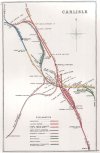
This is a 1912 Railway Clearing House map of the area from Wikimedia commons:
 

Attachments

  • 960px-Carlisle_RJD_001.jpg
    960px-Carlisle_RJD_001.jpg
    335.3 KB · Views: 94

vic-rijrode

Member
Joined
31 Aug 2016
Messages
440
This is a 1912 Railway Clearing House map of the area from Wikimedia commons:
I have a copy of the Ian Allan Pre-Grouping Railway Junctions Diagrams 1914 which has the Carlisle area on page 1 (this is maybe where the Wikipedia diagram comes from). It is worth its weight in gold for showing locations where lines and junctions seem illogical now but are due to subsequent closures.
 

Top