• Our new ticketing site is now live! Using either this or the original site (both powered by TrainSplit) helps support the running of the forum with every ticket purchase! Find out more and ask any questions/give us feedback in this thread!

Glasgow Central, Scotland's rail infrastructure and steam workings in 1965. (long)

70014IronDuke

Established Member
Joined
13 Jun 2015
Messages
4,099
I went on a Scottish shed bash with the South Beds Loco Club (run by the indomitable Brian Lockey) over Easter in 1965, must have been April.
(The next two pars are about the journey north - pl skip if in a hurry.)

We travelled north on the overnight St Pancras – Glasgow Central sleeper on the evening of Maundy Thursday behind a Clss 45. I forget whether we went via Derby or Nottingham or straight up the Erewash. I do remember the climb out of Sheffield though, past white hot molten steel in the works on Brightside at about midnight 30 and sleepy, smouldering, grimy lines of steam on Holbeck 50 minutes later, and over Ais Gill at an hour when even the hardiest of sheep would be huddled in their pens. North of Carlisle, it was impossible to stay awake after Dumfries. Nor was it worthwhile in any case, it seemed an interminable age trundling through grey-green hills enshrouded with mist (little wonder Rabbie Burns preferred the pubs). .

There was the MPD at Hurlford that we had to look out for, of course, then Kilmarnock and the south-west suburbs of Glasgow. We were into Central by about 07.30 – the first time for years apparently the party had arrived on time. Or so said leader Lockey. So we had an hour plus to kill before the bashing bus had been ordered for 09.00-ish, as I remember.

Well, Glasgow Central then was (and still is, I'm sure, to a point) a real Cathedral to rail. In fact, I'd never experienced anything like it. Now don't get me wrong – I'd seen pacifics of all the 'big' railways' at speed – I'd cabbed 'Mallard' in steam, I'd been hauled by a 'Coronation' (OK - it was only from Wolverton to Bletchley). When I first bunked Reading 81D there had been something like 65 locos – the vast majority steam, including Castles - on shed. I'd seen a fair bit.

But what I hadn't experienced was a major terminus with an intensive steam-worked suburban service. From 07.30 to 09.00 that Good Friday morning, it seemed as if there was a train every five minutes arriving behind a Stanier/Fairburn LMS 2-6-4T or the Standard equivalent – and working out again.

Now, I'm sure my impressions even at the time were exaggerated: that is to say, it was probably more like every 15 minutes between most of the arrivals. (Obviously, many of the suburban workings were Blue Train electrics by then. But even so, the steam activity was exhilarating, especially around 08.30 or so).

We departed around 09.00 to 'do' Cowlairs and St Rollox works, and then sheds on the SW side outside Glasgow, such as Greenock, Ayr and Hurlford, before heading over to Edinburgh for the night. (What the Scots were doing working on Good Friday, I don't know. I thought they were more churchgoing?)

Questions

Specifically at Glasgow Central – which lines at that time were steam-worked? I'm sure one was the Greenock line, but I'm not sure where all these trains came from! Can't have been Greenock alone.

I'm also a bit confused by all the Glasgow sheds and stations – who were the original owning railways?

I know St Enoch, which was already closed, was the G&SW station, and the 67 sheds, starting with Corkerhill, were on that division.

Central, and 66 sheds, starting with Polmadie, were presumably the Caledonian Railway's contribution to things. (Or was Central a joint station with another company?)

But it's the Buchanan Street, Queen Str and the 65 sheds which have me lost.

Queen Street was, presumably, the North British terminus, or whatever went before that, and I suspect Eastfield was the NBR shed?

But which company(ies) was/were behind Buchanan Street? It seems too grand to be the Highland Railway. Did the Caledonian have a hand in here too?

And where does this leave St Rollox shed - I mean, with which railway and what kind of workings?

And there was Yoker. Where did that fit in? Maybe there's more I've forgotten.

Finally (if you are still with me), a question on pre-nationalisation locomotives.

At this time, there were still scores, maybe hundreds of North British and LNER 0-6-0s north (in Fife) and east of Edinburgh – including those venerable J36s like 'Byng', 'Joffre' and 'Maude' that had served in France during WW2.

But on the west side, the former Caledonian 0-6-0s (and of course, their earlier 4-4-0 passenger equivalents) had been wiped out by at least 18 months or more. At that point, the score felt like Reid 50 vs Pickersgill 0.

Were the Caledonian machines vastly inferior to their eastern neighbour's machines, or was this just an accident of the modernisation plan? Of course, most of the 0-6-0s on the eastern side were relatively modern Gresley designs, and maybe the LMS had 'done in' much of the Caledonian stock by nationalisation with 4Fs and Crabs? - so maybe I'm making Reid seem a designing genius and doing Pickersgill down.

Thanks for any thoughts (and facts!).
 
Sponsor Post - registered members do not see these adverts; click here to register, or click here to log in
R

RailUK Forums

Falcon1200

Established Member
Joined
14 Jun 2021
Messages
6,637
Location
Neilston, East Renfrewshire
Buchanan Street was an entirely Caledonian Railway (CR) station, along with Central, Queen Street was as you say a North British Railway station, and Eastfield its shed. Therefore, after the Grouping, the LMS had 3 of the 4 Glasgow terminals and the LNER 1! St Rollox was the CR shed serving Buchanan Street.
 

6Gman

Established Member
Joined
1 May 2012
Messages
9,241
And there was Yoker. Where did that fit in? Maybe there's more I've forgotten.
There were plenty! And some less than straightforward:

65C Parkhead (NBR suburban services - mostly)
65D Dawsholm
65E Kipps
65G Yoker
65H Helensburgh
65I Balloch

By now drifting away from inner Glasgow - 65D seems to have been mixed LNER/LMS; 65E was NBR freight depot to the east; 65G largely dock shunting; 65H & 65I suburban work & bits of reight.

And, many miles away, 65F Grangemouth. Grouped within the largely ex-NBR 65 district but was an ex-CR outpost!
 

hexagon789

Veteran Member
Joined
2 Sep 2016
Messages
18,350
Location
Glasgow
Not that many in 1965 - only the Cathcart Circle, Nielston and Newton services out of Central - electrified in 1962. The Gourock/Wemyss Bay lines followed in 1967
10 trains per hour in and out, so quite frequent compared to the other routes and indeed more frequent than today.

I think most of the other local routes were entirely or predominantly dieselised by 1965, though if I recall rightly Wemyss Bay was mainly steam until early (February?) 1966 when some DMUs were transferred from the NER to remove the final steam workings in the Glasgow area; Gourock I think was all or nearly all DMUs by 1965 usually Derby Triples (107s) or MetCamms (101s) or even one of each.
 

Gloster

Veteran Member
Joined
4 Sep 2020
Messages
13,057
Location
Up the creek
The Highland never came south of Perth, with its metals ending a few miles further north at Stanley Junction. The last few miles of the Highland trains’ journeys was over the Caledonian’s main line to Aberdeen.
 

oldman

Established Member
Joined
26 Nov 2013
Messages
1,356
At this time, there were still scores, maybe hundreds of North British and LNER 0-6-0s north (in Fife) and east of Edinburgh – including those venerable J36s like 'Byng', 'Joffre' and 'Maude' that had served in France during WW2.
Not hundreds! According to the RCTS books there were 34 NB 0-6-0s and 25 Gresley J38s in stock as at 31-12-64. Until around 1960 there were still plenty of the Caley equivalents around and I doubt if it was technical merits which decided which went first.

Buchanan Street was the main Caley station with London trains before Central was built.
 

Gloster

Veteran Member
Joined
4 Sep 2020
Messages
13,057
Location
Up the creek
At this time, there were still scores, maybe hundreds of North British and LNER 0-6-0s north (in Fife) and east of Edinburgh – including those venerable J36s like 'Byng', 'Joffre' and 'Maude' that had served in France during WW2.

Wrong war! It was the First World War.
 

70014IronDuke

Established Member
Joined
13 Jun 2015
Messages
4,099
10 trains per hour in and out, so quite frequent compared to the other routes and indeed more frequent than today.

I think most of the other local routes were entirely or predominantly dieselised by 1965, though if I recall rightly Wemyss Bay was mainly steam until early (February?) 1966 when some DMUs were transferred from the NER to remove the final steam workings in the Glasgow area; Gourock I think was all or nearly all DMUs by 1965 usually Derby Triples (107s) or MetCamms (101s) or even one of each.
Thanks for this and all responses - fascinating stuff.

So, hexagon789, are you saying you think all the steam-hauled trains I saw would have been from Wemyss Bay (or stations on that route)? These would have been locos based at Greenock, right? (and maybe some at Corkerhill or Polmadie?)

Wrong war! It was the First World War.
Yes, of course. Brain f**t.
Not hundreds! According to the RCTS books there were 34 NB 0-6-0s and 25 Gresley J38s in stock as at 31-12-64. Until around 1960 there were still plenty of the Caley equivalents around and I doubt if it was technical merits which decided which went first.
Sure, hundreds was hyperbole - but it felt more than 59! They seemed to be all over the place in Fife - Thornton Jcn, Dunfirmline, and at Bathgate. Was it only 38s? No J39s?

Buchanan Street was the main Caley station with London trains before Central was built.
Oh, amazing. I had no idea. Does this mean the first Caley line went north? Presumably BS then got too small as traffic from England increased - and the CR decided it needed a bigger station, so why not cut our the run round from the south into Buchanan Street? Building Central must have been a huge capital outlay at the time.
St Enoch didnt close till 1966
Oh, apologies. I assumed that as we went into Central, St Enoch had already been closed. That's a pity, as I would have liked to visit it - but we didn't get any free time in Glasgow after that first morning.
The Highland never came south of Perth, with its metals ending a few miles further north at Stanley Junction. The last few miles of the Highland trains’ journeys was over the Caledonian’s main line to Aberdeen.
Ah, that answers the question I was going to ask after reading @Falcon1200 's fist reply. So pre Grouping, did Highland Railway engines come off through trains to Glasgow and Edinburgh?

Or did passengers have to change trains?

So, to check - the Caley route to Aberdeen was that through Forfar - closed in the late 60s, I suppose?
Not that many in 1965 - only the Cathcart Circle, Nielston and Newton services out of Central - electrified in 1962. The Gourock/Wemyss Bay lines followed in 1967
OK, thanks. I just didn't want anyone to think I was pretending ALL suburban services were steam.
There were plenty! And some less than straightforward:

65C Parkhead (NBR suburban services - mostly)
65D Dawsholm
65E Kipps
65G Yoker
65H Helensburgh
65I Balloch

By now drifting away from inner Glasgow - 65D seems to have been mixed LNER/LMS; 65E was NBR freight depot to the east; 65G largely dock shunting; 65H & 65I suburban work & bits of reight.
Yeah, quite a list. Maybe we did Parkhead. Is that where the preseved Scottish locos were kept at the time? I seem to remember they were parked in quite a quiet place.
Buchanan Street was an entirely Caledonian Railway (CR) station, along with Central, Queen Street was as you say a North British Railway station, and Eastfield its shed. Therefore, after the Grouping, the LMS had 3 of the 4 Glasgow terminals and the LNER 1! St Rollox was the CR shed serving Buchanan Street.
So, presumably, at that time it was St Rollox that shared the Aberdeen diagrams with Ferryhill - just as it ha been in 1922!

So when Buchanan Street close, did BR need to build new connections, to divert trains into Queen Street, or had that work been done previously? I know the lines were close together, but no idea if it needed land acquisition.

Considering Buchanan Street had been the first (?) major terminus in Glasgow, it was rather a historical loss. Was it much mourned at the time?

And, many miles away, 65F Grangemouth. Grouped within the largely ex-NBR 65 district but was an ex-CR outpost!
Yup, we did Grangemouth. just not sure which day of the trip. Might have been Friday.

Seeing what I never learned until now from this trip illustrates the downside of these super shed bashes versus what you might call 'organic' trainspotting - sitting on the platforms and actually observing workings and chatting to other enthusiasts, steadily acquiring knowledge. Just parachuting into Scotland, and especially Glasgow, with its very complex railway network and history can't make up for that.

Brilliant.
 

hexagon789

Veteran Member
Joined
2 Sep 2016
Messages
18,350
Location
Glasgow
So, hexagon789, are you saying you think all the steam-hauled trains I saw would have been from Wemyss Bay (or stations on that route)?
Not exactly, because the service wasn't that frequent - before electrification it wasn't properly regular interval but roughly hourly with some gaps; Gourock was similar but slightly more trains.

It's just I'm struggling to think which routes still used steam to a significant degree, most of the local routes were at least partly DMUs from around 1959/60, and nothing was really frequent enough to produce multiple steam locos shuttling in and out.
 

Gloster

Veteran Member
Joined
4 Sep 2020
Messages
13,057
Location
Up the creek
Ah, that answers the question I was going to ask after reading @Falcon1200 's fist reply. So pre Grouping, did Highland Railway engines come off through trains to Glasgow and Edinburgh?

Or did passengers have to change trains?

So, to check - the Caley route to Aberdeen was that through Forfar - closed in the late 60s, I suppose?

The usual mixture. Some through trains, including the London ones, although coaches could be attached or detached at Perth. Some through coaches attached tor trains from Aberdeen. Some, including all the locals, terminated at Perth. However, the Highland’s locos went no further south.

It was the former Caledonian line through Coupar Angus, Forfar, and Kinnaber Junction to Aberdeen. It was closed to passengers on 4 September 1967; the last section from Stanley Junction to Forfar closed to goods on 5 June 1982.
 

Rescars

Established Member
Joined
25 May 2021
Messages
2,600
Location
Surrey
What would have been working the Stranraer Road in April 1965 and would those Glasgow trains have run to Central or St Enoch? IIRC the Port Road was steam until the end in 1966.
 

hexagon789

Veteran Member
Joined
2 Sep 2016
Messages
18,350
Location
Glasgow
What would have been working the Stranraer Road in April 1965 and would those Glasgow trains have run to Central or St Enoch? IIRC the Port Road was steam until the end in 1966.
Swindon InterCity DMUs, since 1959.

St Enoch.

They weren't originally intended to work to Stranraer but it was decided just before Ayrshire diesel that they would run to Stranraer as well and so a follow-on order of two buffet cars was made for these workings, though they ended up not seeing much use and were transferred to Leith to work with the other Swindon IC buffet cars on the Edinburgh to Glasgow service.
 

oldman

Established Member
Joined
26 Nov 2013
Messages
1,356
So when Buchanan Street close, did BR need to build new connections, to divert trains into Queen Street, or had that work been done previously? I know the lines were close together, but no idea if it needed land acquisition.
The junction at Greenhill was always there. In the beginning the Edinburgh and Glasgow connected at Greenhill with the Scottish Central Railway to Perth, and for some years Queen Street was the Glasgow station for the north. Even after Buchanan Street took over the long distance services, there were some trains from Glasgow to Alloa, Kinross and Perth from Queen Street.

Looking at Timetable World, I found that in 1963 the Central-Lanarkshire services were marketed as diesel Green Train Services (see image below). The Gourock and Wemyss Bay lines are not shown as diesel, except some on Sundays, and there were five arrivals between 0800 and 0900, plus a couple from Strathaven, and maybe some downstairs, so potentially still a fair number of steam trains.

1790098046381.png
 

Sir Felix Pole

Established Member
Joined
21 Oct 2012
Messages
2,223
Location
Wilmslow
Buchanan St. was a modest affair, with much to be modest about - the main building was timber which had been tarted up a bit by the LMS in the '30s. I don't think many mourned its passing, unlike the glorious St. Enoch. In the immediate post WW2 period there was a plan for a 'Glasgow North' to replace both Buchanan St. and Queen St. but with the economic situation it, of course, came to naught.
 

Falcon1200

Established Member
Joined
14 Jun 2021
Messages
6,637
Location
Neilston, East Renfrewshire
The only services which could not easily use Queen Street instead of Buchanan Street were those coming from the Cumbernauld direction. As a result for some years there was a Cumbernauld/Springburn DMU shuttle, connecting at the latter with EMUs to Queen Street Low Level and beyond. IIRC for a time the DMUs ran though to Queen Street High Level, reversing at Eastfield, until, in 1992, BR built a connecting chord at Cowlairs allowing trains to run direct; As they do today, every half hour and electrified!
 

Taunton

Veteran Member
Joined
1 Aug 2013
Messages
12,345
So pre Grouping, did Highland Railway engines come off through trains to Glasgow and Edinburgh?

Or did passengers have to change trains?

Maybe we did Parkhead. Is that where the preseved Scottish locos were kept at the time? I seem to remember they were parked in quite a quiet place.

So when Buchanan Street close, did BR need to build new connections, to divert trains into Queen Street, or had that work been done previously? I know the lines were close together, but no idea if it needed land acquisition.
The Highland and Caley locos kept to their own systems at Perth, but the trains did considerably work through, and in fact there were substantial through coaches from England, which gave some extremely varied formations over the Highland main line, from multiple English companies (plus the various 'joint stocks' as well), all lashed up together and needing double-heading, and reaching a pinnacle at the start of grouse shooting season. There's a well-known painting, possibly in the National Gallery, of chaotic platform scenes at Perth station from this era.

I think the Scottish preserved locos, now in the Glasgow museum, were kept in the 1960s at Dawsholm, other side of Glasgow.

BR did completely rebuild the connection at Greenhill to allow trains from Stirling and Perth, etc, to gain the Queen Street line, to allow highspeed, 70 mph at the divergence I think, though coming towards Glasgow it's a stiff uphill climb over the connection so I wonder if at first they ever achieved such a speed.
 
Last edited:

WesternLancer

Veteran Member
Joined
12 Apr 2019
Messages
15,420
The Highland and Caley locos kept to their own systems at Perth, but the trains did considerably work through, and in fact there were substantial through coaches from England, which gave some extremely varied formations over the Highland main line, from multiple English companies (plus the various 'joint stocks' as well), all lashed up together and needing double-heading, and reaching a pinnacle at the start of grouse shooting season. There's a well-known painting, possibly in the National Gallery, of chaotic platform scenes at Perth station from this era.
Good observation!

The pair of paintings - Going North and Coming South are on display in the NRM at York - well worth taking a look at and impressive due to its large size. I saw them in June

Going North is of the scene at Kings Cross

Image here is the one showing the scene at Perth but not sure I can identify the differing carriage ownerships in the painting.


caption given:

Painting, oil on canvas, 'Perth Station, Coming South' by George Earl, 1895. Framed and glazed.

Depicts a busy platform with passengers preparing to board a train for London at the close of the shooting season. The scene is set in about 1885, before the station was enlarged. There are crowds of passengers with hunting dogs, including pointers and setters, and among the luggage are grouse, blackcock and stags' antlers. Station porters carry luggage, a boy sells The Scotsman newspaper and passengers bid farewell to their friends and families. There are signs for the Highland and Caledonian Railways, waiting rooms and notices forbidding smoking. Signed and dated by the artist at bottom right.

A companion painting ‘Going North’ depicts the outward journey. The images are full of life and detail, and give a good impression of what it was like to travel by train in style during the latter part of the Victorian era.
 

Bevan Price

Established Member
Joined
22 Apr 2010
Messages
8,354
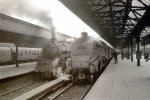
May be of interest - Glasgow Buchanan Street in 1965.

Class A4s took over some Glasgow / Aberdeen services after they became surplus on ECML, allowing 3 hour schedules between Glasgow & Aberdeen. Other services before dieselisation were mostly worked by Class 5 4-6-0s (LMS or BR). However other classes, including occasional ER pacifics, did appear on Glasgow / Dundee services. By 1965, Inverness services were diesel, usually Class 24 or 26 (or one of each)
 

Attachments

  • mbw651904_GlasgowBuchSt_010965.jpg
    mbw651904_GlasgowBuchSt_010965.jpg
    29 KB · Views: 38

Harvester

Established Member
Joined
9 Nov 2020
Messages
1,796
Location
Notts
May be of interest - Glasgow Buchanan Street in 1965.

Class A4s took over some Glasgow / Aberdeen services after they became surplus on ECML, allowing 3 hour schedules between Glasgow & Aberdeen. Other services before dieselisation were mostly worked by Class 5 4-6-0s (LMS or BR). However other classes, including occasional ER pacifics, did appear on Glasgow / Dundee services. By 1965, Inverness services were diesel, usually Class 24 or 26 (or one of each)
I can’t quite make out if the A4 is 60024 or 60034, although the length of the nameplate suggests the latter. This was one of five ex Top Shed A4s transferred to Scotland in late 1963 to work the faster Glasgow/Aberdeen services.
 

matchmaker

Established Member
Joined
8 Mar 2009
Messages
1,890
Location
Central Scotland
The Highland and Caley locos kept to their own systems at Perth, but the trains did considerably work through, and in fact there were substantial through coaches from England, which gave some extremely varied formations over the Highland main line, from multiple English companies (plus the various 'joint stocks' as well), all lashed up together and needing double-heading, and reaching a pinnacle at the start of grouse shooting season. There's a well-known painting, possibly in the National Gallery, of chaotic platform scenes at Perth station from this era.

I think the Scottish preserved locos, now in the Glasgow museum, were kept in the 1960s at Dawsholm, other side of Glasgow.

BR did completely rebuild the connection at Greenhill to allow trains from Stirling and Perth, etc, to gain the Queen Street line, to allow highspeed, 70 mph at the divergence I think, though coming towards Glasgow it's a stiff uphill climb over the connection so I wonder if at first they ever achieved such a speed.
The preserved Scottish locos were indeed stored at Dawsholm. All, apart from GNoSR no.49 "Gordon Highlander", are in the Riverside Museum. No. 49 is currently in the museum at Bo'ness.
 

Bevan Price

Established Member
Joined
22 Apr 2010
Messages
8,354
I can’t quite make out if the A4 is 60024 or 60034, although the length of the nameplate suggests the latter. This was one of five ex Top Shed A4s transferred to Scotland in late 1963 to work the faster Glasgow/Aberdeen services.
60034.
 

Transilien

Member
Joined
10 Mar 2024
Messages
767
Location
Ayrshire
Class A4s took over some Glasgow / Aberdeen services after they became surplus on ECML, allowing 3 hour schedules between Glasgow & Aberdeen. Other services before dieselisation were mostly worked by Class 5 4-6-0s (LMS or BR). However other classes, including occasional ER pacifics, did appear on Glasgow / Dundee services. By 1965, Inverness services were diesel, usually Class 24 or 26 (or one of each)
Why did it take longer for the Aberdeen line to be dieselised? Also, did A4s ever run to Inverness? Was there a loco change at Edinburgh for through services to London from Inverness/Aberdeen?
 

D6130

Established Member
Joined
12 Jan 2021
Messages
9,149
Location
West Yorkshire/Tuscany
The loco on the left looks like 73151, one of St Rollox (Balornock) depot's ten Caprotti valve Gear BR Standard class 5
4-6-0s, which worked a lot of the Glasgow-Buchanan Street - Perth and Dundee services.
Why did it take longer for the Aberdeen line to be dieselised? Also, did A4s ever run to Inverness? Was there a loco change at Edinburgh for through services to London from Inverness/Aberdeen?
The original route via Forfar was planned for closure in 1967, even though it was faster and more direct than the route via Dundee....which may have had a bearing on the situation. Not all the Glssgow-Aberdeen expresses were worked by A4s - or sometimes A2s. Some of them were worked by pairs of NBL class 29s in multiple. I believe that all the Kings Cross-Aberdeen services changed locos at Edinburgh due to limitations on the fuel (coal, water and diesel oil) capacity of the locos.
 

hexagon789

Veteran Member
Joined
2 Sep 2016
Messages
18,350
Location
Glasgow
Why did it take longer for the Aberdeen line to be dieselised? Also, did A4s ever run to Inverness? Was there a loco change at Edinburgh for through services to London from Inverness/Aberdeen?
Diesels appeared on Glasgow to Aberdeen at much the same time as on the Highland Main Line, but the NBL Type 2s were notoriously unreliable, and so the canny Scottish Region sought out replacements in the form of just being withdrawn ex-LNER Pacifics off the East Coast Main Line.

Edinburgh to Aberdeen express services were dieselised in 1960 with accelerated services worked by pairs of BCRW Type 2s.

There were no direct daytime services from London to Aberdeen or Inverness in those days, though there were sleepers. Most of the London to Edinburgh trains did have through carriages for Aberdeen, usually 2 vehicles, which would be detached from the front of an arriving train from King's Cross and attached to an internal Edinburgh to Aberdeen express.

So as D6130 says, locos were changed at Edinburgh on journeys from London to Aberdeen.
 

Harvester

Established Member
Joined
9 Nov 2020
Messages
1,796
Location
Notts
Why did it take longer for the Aberdeen line to be dieselised? Also, did A4s ever run to Inverness?
A4s never ran to Inverness, but on occasions reached Perth on local workings from Edinburgh. The Perth to Inverness Highland route was worked in steam days by Perth and Inverness Stanier Class 5s, often double heading on heavier trains.

Although, as mentioned, diesels started to appear on Edinburgh to Aberdeen trains from 1960, steam substitutes and the occasional steam diagram survived until 1965. Aberdeen Ferryhill (61B) had a return A4 passenger diagram to Edinburgh during he 1965 summer timetable.

25th June to 28th August 1965

19:45 FO Aberdeen - Edinburgh
10:30 SO Edinburgh - Aberdeen

The Railway Observer reported that on Saturday 26th June 1965, A4 60006 was on the 10:30 to Aberdeen while 60027 took out the 10:15 to Inverness (as far as Perth).
 

Taunton

Veteran Member
Joined
1 Aug 2013
Messages
12,345
The Scottish Region had very few large diesels of their own, a situation which lasted a long time. Even in the mid-1970s, by when Glasgow to Aberdeen trains were worked by Class 47, when I used to watch these departing from Queen Street they were a motley bunch, ostensibly allocated to the likes of Tinsley or even Landore, somewhere different every time, purloined from long distance freight. There were two small groups of Class 40 at Haymarket, and a smaller group of Class 47, but these seemed often working down to England, or even on local freight. Double-headed type 2 diesels long held down the Inverness line but were more spasmodic to Aberdeen.

The diversion of expresses via Dundee maybe dismayed Cecil J Allen at the loss of high speed running via Forfar, but commercially sending them via Scotland's fourth-largest city, Dundee, was a great improvement to frequencies all round.
 

Magdalia

Established Member
Joined
1 Jan 2022
Messages
7,440
Location
The Fens
Was there a loco change at Edinburgh for through services to London from Inverness/Aberdeen?
The 1200 noon from Kings Cross first became a through train to Aberdeen in 1966, but the Aberdonian name was only transferred from the sleeper to the daytime train in 1972, when aircon stock was introduced. Haymarket had 1975 (later 47517) to work the up and down Aberdonian north of Edinburgh in the early days of aircon.

There were no through daytime trains between London and Inverness until the Clansman in 1974, when Inverness got its first ETH class 47s to work the Clansman to/from Mossend.
 

hexagon789

Veteran Member
Joined
2 Sep 2016
Messages
18,350
Location
Glasgow
A4s never ran to Inverness, but on occasions reached Perth on local workings from Edinburgh. The Perth to Inverness Highland route was worked in steam days by Perth and Inverness Stanier Class 5s, often double heading on heavier trains.

Although, as mentioned, diesels started to appear on Edinburgh to Aberdeen trains from 1960, steam substitutes and the occasional steam diagram survived until 1965. Aberdeen Ferryhill (61B) had a return A4 passenger diagram to Edinburgh during he 1965 summer timetable.

25th June to 28th August 1965

19:45 FO Aberdeen - Edinburgh
10:30 SO Edinburgh - Aberdeen

The Railway Observer reported that on Saturday 26th June 1965, A4 60006 was on the 10:30 to Aberdeen while 60027 took out the 10:15 to Inverness (as far as Perth).
I've seen a photo of an A4 on the 9.25am Glasgow Buchanan Street to Inverness, though the caption noted the A4 came off at Perth where the Edinburgh portion was attached.

== Doublepost prevention - post automatically merged: ==

The diversion of expresses via Dundee maybe dismayed Cecil J Allen at the loss of high speed running via Forfar, but commercially sending them via Scotland's fourth-largest city, Dundee, was a great improvement to frequencies all round.
Not really, Aberdeen still had only 4 daytime trains from Glasgow and Dundee remained 2-hourly.

At least two of the Aberdeens after the Strathmore shut were formed by extending Dundees within the standard pattern, so it actually probably saved a few sets of coaches.
 

Top