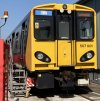
507001 successfully ran under its own power, without a third rail, in tests at Alstom’s Litchurch Lane works in Derby, paving the way for future operation on a heritage railway. This feat has been made possible thanks to the fitment of batteries inside the train’s driving cars. These batteries can power the train’s traction motors and compressor (which supplies air to the brakes), removing the need for a third rail power supply. This modification means the train can run under its own power on unelectrified railways, including the many heritage lines across the country.
On the afternoon of 1st September, the three-car train completed several test runs on the works’ internal railway lines. Over the course of three hours, it travelled a distance of 2.8 miles at speeds of up to 8 mph, all on a single charge.
These low-speed test runs are just the beginning of the battery journey. The next stage will involve designing structural modifications to 507001 to permit higher-capacity batteries to be fitted to the underframe, keeping all three cars available for passenger use. Initial modelling suggests that speeds of up to 25 mph will be possible, suitable for operation on most heritage railways.