
-
Our new ticketing site is now live! Using either this or the original site (both powered by TrainSplit) helps support the running of the forum with every ticket purchase! Find out more and ask any questions/give us feedback in this thread!
You are using an out of date browser. It may not display this or other websites correctly.
You should upgrade or use an alternative browser.
You should upgrade or use an alternative browser.
Track out of Cannon Street towards Charing Cross/Blackfriars
- Thread starter BRNE15004
- Start date
Sponsor Post - registered members do not see these adverts; click here to register, or click here to log in
R
RailUK Forums
It's called Metropolitan Junction or Metropolitan Reversible, and it's now rusty and not in any passenger service. It had a lot of use in the past, including a triangular service between Cannon St, Charing Cross, and London Bridge.
 www.railforums.co.uk
https://traksy.uk/live/L+MYB+@2020-09-11T22:00+LMS/M+37+CANONST It currently says T3
www.railforums.co.uk
www.railforums.co.uk
https://traksy.uk/live/L+MYB+@2020-09-11T22:00+LMS/M+37+CANONST It currently says T3
Search results for query: "metropolitan junction"
www.railforums.co.uk
Search results for query: Metropolitan Reversible
www.railforums.co.uk
norbitonflyer
Established Member
When the South Eastern Railway built its extension west of London Bridge in the 1860s, the original plan was to run all trains into Cannon Street, and reverse there for Charing Cross. This is why, until the Thameslink project fixed the problem 150 years later, the east and west sides of the Borough Market triangle had four tracks and the south side only two. This system was soon recognised as operationally difficult, (this was long before multiple unit opearion, so every train in and out of Cannon Street needed a loco change) and separate Cannon Street and Charing Cross serviecs were soon introduced.
A shuttle service was run for some years, but could not compete with the District Railway which ran more directly between Charing Cross (Embankment) and Cannon Street. (Its short run, central location, and almost certainty of privacy because of its low usage and compartment carriages earned it a reputation as a convenient rendezvous for illicit transactions of various natures)
The shuttle did not last long, and the west side of the triangle subsequently saw very little use, apart from empty stock movements (there used to be a small depot atb Ewer Street alongside the spur to Blackfriars, and this was only accessible from Cannon Street, using the curve) or use as a convenient siding.
I do recall using the curve once, when work in connection with Thameslink (incl;uding - at last - the quadrupling the direct route between London Bridge and Charing Cross/Blackfriars) closed the south side of the triangle and platforms 4-6 at London Bridge. It is still there, but now reduced from four tracks to just one
== Doublepost prevention - post automatically merged: ==
A shuttle service was run for some years, but could not compete with the District Railway which ran more directly between Charing Cross (Embankment) and Cannon Street. (Its short run, central location, and almost certainty of privacy because of its low usage and compartment carriages earned it a reputation as a convenient rendezvous for illicit transactions of various natures)
The shuttle did not last long, and the west side of the triangle subsequently saw very little use, apart from empty stock movements (there used to be a small depot atb Ewer Street alongside the spur to Blackfriars, and this was only accessible from Cannon Street, using the curve) or use as a convenient siding.
I do recall using the curve once, when work in connection with Thameslink (incl;uding - at last - the quadrupling the direct route between London Bridge and Charing Cross/Blackfriars) closed the south side of the triangle and platforms 4-6 at London Bridge. It is still there, but now reduced from four tracks to just one
== Doublepost prevention - post automatically merged: ==
The name actually derives from the other side of the junction, where lines diverge again for Charing Cross and for Blackfriars, because it gave access, via Blackfriars and the Snow Hill link, to the Metropolitan Railway. The South Eastern and Metropolitan Railway were both part of Edward Watkin's empire. The spur to Blackfriars also saw little use until Thameslink.It's called Metropolitan Junction or Metropolitan Reversible,
Last edited:
Tram203
Member
The last time I can remember scheduled passenger services using that spur was a Sunday in April 2014, when I made a trip to London purely to travel over it.
I seem to remember London Bridge's through platforms were closed entirely, and I think probably the District and Circle lines were closed between say Victoria and Aldgate / Aldgate East, hence a South Eastern operated shuttle around that curve maintained a direct connection between Charing Cross and Cannon Street on that day.
I seem to remember London Bridge's through platforms were closed entirely, and I think probably the District and Circle lines were closed between say Victoria and Aldgate / Aldgate East, hence a South Eastern operated shuttle around that curve maintained a direct connection between Charing Cross and Cannon Street on that day.
OliverH68
Member
You're right. 6th April 2014, there was a shuttle service every 15 minutes between Cannon St & Charing X, taking about 7-8 minutes.The last time I can remember scheduled passenger services using that spur was a Sunday in April 2014, when I made a trip to London purely to travel over it.
I seem to remember London Bridge's through platforms were closed entirely, and I think probably the District and Circle lines were closed between say Victoria and Aldgate / Aldgate East, hence a South Eastern operated shuttle around that curve maintained a direct connection between Charing Cross and Cannon Street on that day.
thedbdiboy
Established Member
- Joined
- 10 Sep 2011
- Messages
- 1,213
Until the rebuilding of Blackfriars in the early 2000s, the most regular use of the spur was for ECS movements - it was used regularly Mon-Fri by the ECS movements for the Chatham line peak Cannon St workings which reversed via Blackfriars to access Grove Park sidings. Here's a grainy shot from my office window in 2003 showing two units in the sidings near Blackfriars that will have come from Grove Park and are preparing to enter Cannon St via the eastern spur. Those who are eagle-eyed will notice in the front unit is the Connex VEP that gained a 4TC Driving Trailer as a replacement vehicle in its last years.
I'm not sure what the original plan was: how things developed in the early days - the 1860s and 1870s - seems to have been interesting. Worth noting that Charing Cross opened first, Cannon Street not for another year or two. And initially a shuttle between the two was sensible: the Metropolitan District was still in the future. There were other oddities, such as a Cannon St-Waterloo-Kensington-Willesden SE-LSW-LNW through service for a couple of years. Something I don't know is how frequent services were, even in what we think of as inner suburbs. I don't know how quite the lines developed in the Victorian era - at one stage it was three tracks from Charing Cross towards London Bridge.When the South Eastern Railway built its extension west of London Bridge in the 1860s, the original plan was to run all trains into Cannon Street, and reverse there for Charing Cross. This is why, until the Thameslink project fixed the problem 150 years later, the east and west sides of the Borough Market triangle had four tracks and the south side only two. This system was soon recognised as operationally difficult, (this was long before multiple unit opearion, so every train in and out of Cannon Street needed a loco change) and separate Cannon Street and Charing Cross serviecs were soon introduced.
A shuttle service was run for some years, but could not compete with the District Railway which ran more directly between Charing Cross (Embankment) and Cannon Street. (Its short run, central location, and almost certainty of privacy because of its low usage and compartment carriages earned it a reputation as a convenient rendezvous for illicit transactions of various natures)
The shuttle did not last long, and the west side of the triangle subsequently saw very little use, apart from empty stock movements (there used to be a small depot atb Ewer Street alongside the spur to Blackfriars, and this was only accessible from Cannon Street, using the curve) or use as a convenient siding.
But certainly my understanding is that once things settled down, most - or at least many - services up from London Bridge ran via Cannon Street, then reverse on to Charing Cross, up until the Great War, c 1916. Whether this was equally true for suburban, main line and boat trains I don't know.
Ewer Street was for many years a steam loco servicing point for those running into Charing Cross & Cannon Street (question: how were these turned?), also the SER's Central London goods depot, with 'Grande Vitesse' services to the Continent a speciality - I believe it lasted as such up to the very early 1960s.
Once the connection round to Blackfriars and the LCD City line, for connection on to the Metropolitan, GNR and Midland, there were through passenger services from SER suburban lines to the GNR and Midland, which lasted until about 1908, while is the main connection for goods traffic from the Mid and GN to the SER until the Southern rearrangements of c1930, connecting the former Greenwich Park branch to the SE at Lewisham.
One use made of it in relatively recent times (late 20th Century) was for ECS workings from/to Cannon Street, which worked round via Metropolitan Junction to Blackfriars, then then reverse down the Chatham line to find somewhere to spend the day.I do recall using the curve once, when work in connection with Thameslink (incl;uding - at last - the quadrupling the direct route between London Bridge and Charing Cross/Blackfriars) closed the south side of the triangle and platforms 4-6 at London Bridge. It is still there, but now reduced from four tracks to just one
== Doublepost prevention - post automatically merged: ==
Wondering about the derivation of the name 'Metropolitan Junction', as the junction round to Cannon Street long predated that to Blackfriars (and probably any thought of connecting to the Metropolitan Railway).The name actually derives from the other side of the junction, where lines diverge again for Charing Cross and for Blackfriars, because it gave access, via Blackfriars and the Snow Hill link, to the Metropolitan Railway. The South Eastern and Metropolitan Railway were both part of Edward Watkin's empire. The spur to Blackfriars also saw little use until Thameslink.
Shimbleshanks
Established Member
It's called Metropolitan Junction or Metropolitan Reversible, and it's now rusty and not in any passenger service. It had a lot of use in the past, including a triangular service between Cannon St, Charing Cross, and London Bridge.
It was very rusty until recently but lately I've noticed it has gained a bit of polish again so something must have used it recently?
I can't find a date when the line to Charing Cross was widened from three to four lines......I don't know how quite the lines developed in the Victorian era - at one stage it was three tracks from Charing Cross towards London Bridge.
There was a 55 ft turntable added at some point when the depot was expanded some time after 1873.....Ewer Street was for many years a steam loco servicing point for those running into Charing Cross & Cannon Street (question: how were these turned?)....
The junction with the spur up to Blackfriars was named as such as it was built to link the SER with the Metropolitan Extension of the LCDR in 1878 - the two railways (SER and Metropolitan) had at least one director in common.......Wondering about the derivation of the name 'Metropolitan Junction', as the junction round to Cannon Street long predated that to Blackfriars (and probably any thought of connecting to the Metropolitan Railway)....
norbitonflyer
Established Member
Charing Cross opened in 1964, Cannon Street in 1866. The District reached Mansion House, only about 100 metres away from Cannon Street, in 1871. (It opened a station actually at Cannon Street in 1888)Worth noting that Charing Cross opened first, Cannon Street not for another year or two. And initially a shuttle between the two was sensible: the Metropolitan District was still in the future.
== Doublepost prevention - post automatically merged: ==
There was a turntable at the South Bank end of Hungerford Bridge. It can be seen in this artist's impression of theb Festicval of Britain by Eric Fraser.Ewer Street was for many years a steam loco servicing point for those running into Charing Cross & Cannon Street (question: how were these turned?),
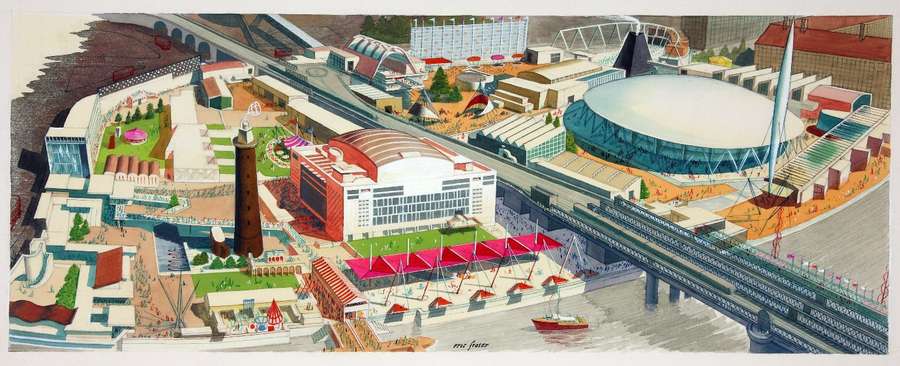
There were others at Ewer Street and Stoney Street (at the south end of the Alexandra (Cannon Street) railway Bridge
== Doublepost prevention - post automatically merged: ==
Cannon Street opned in 1866, the same year as the connection to the Met through the Snow Hill Tunnel. The spur connecting it to the SER opened in 1878, and the name "Metrpolitan Junction" presumably dates from that time.
Wondering about the derivation of the name 'Metropolitan Junction', as the junction round to Cannon Street long predated that to Blackfriars (and probably any thought of connecting to the Metropolitan Railway).
Last edited:
Having been looking further, at vintage large scale OS maps, etc.:
In the mid 1890s, there were two turntables (one each side of the line) at Cannon Street, still on the c1914 edition, and both gone by 1951 revision.
At that time (mid 1890s) lines from Cannon Street to both London Bridge and Charing Cross were just three tracks, with no loco facilities (or anything else) at Ewer Street, nor a turntable by Hungerford Bridge.
By 1914 both Cannon Street to London Bridge and Metropolitan Junction to Charing Cross had been widened to four tracks; with the addition of a turntable by Hungerford Bridge above Sutton Street (now ~ Walk), and the Goods Depot (labelled Grande Vitesse) and loco facilities (including turntable) at Ewer Street: I have found a note that the widening was finished 1901-02, I assume it was all one project.
I have a feeling that at this stage Charing Cross - Metropolitan Junction was worked with up tracks on the outside and down (originally just the one, then both) in the middle, to simplify operations at Canon Street: I think this lasted until the Southern's resignalling of 1925.
In the mid 1890s, there were two turntables (one each side of the line) at Cannon Street, still on the c1914 edition, and both gone by 1951 revision.
At that time (mid 1890s) lines from Cannon Street to both London Bridge and Charing Cross were just three tracks, with no loco facilities (or anything else) at Ewer Street, nor a turntable by Hungerford Bridge.
By 1914 both Cannon Street to London Bridge and Metropolitan Junction to Charing Cross had been widened to four tracks; with the addition of a turntable by Hungerford Bridge above Sutton Street (now ~ Walk), and the Goods Depot (labelled Grande Vitesse) and loco facilities (including turntable) at Ewer Street: I have found a note that the widening was finished 1901-02, I assume it was all one project.
I have a feeling that at this stage Charing Cross - Metropolitan Junction was worked with up tracks on the outside and down (originally just the one, then both) in the middle, to simplify operations at Canon Street: I think this lasted until the Southern's resignalling of 1925.
Gloster
Veteran Member
I can't find a date when the line to Charing Cross was widened from three to four
The London Railway Atlas, 4th Edition (Brown, Ian Allan, 2015) says that London Bridge-Charing Cross was opened with three tracks and had a fourth added circa 1914. However, London’s Termini (Jackson, Pan, 1972) says that fourth track was added on the south side between Belvedere Road and Metropolitan Junctions with effect from 2 June 1901.

NSEWonderer
Established Member
Few videos from movements over metropolitan junction. I remeber aswell in 2014 having to take ot from Waterloo east to cannon street to catch a train back to Greenwich.

GEC465
Member
- Joined
- 10 Mar 2016
- Messages
- 415
Best time is when there's rail tours. There was one recently that over metropolitan curve around a few months ago. Was a 4TC with 2 locos
Thanks - I hadn't thought to look in my copy of "London's Termini" (2nd Ed , David & Charles, 1985).The London Railway Atlas, 4th Edition (Brown, Ian Allan, 2015) says that London Bridge-Charing Cross was opened with three tracks and had a fourth added circa 1914. However, London’s Termini (Jackson, Pan, 1972) says that fourth track was added on the south side between Belvedere Road and Metropolitan Junctions with effect from 2 June 1901.
I note Jackson mentions some changes to track arrangements around WW1 and wonder if that is where Brown got his dates from?
I have always thought it would be useful to have Cannon Street as a terminating point for Thameslink trains if there is line disruption; northbound trains from Rainham or the Brighton Main could use it more easily than the Blackfriars bays, and you could take southbound trains over Metropolitan Junction.
But you probably wouldn't be able to ensure you have enough drivers signed for the route with standard working, and there would be the difficulties inherent with conflicting movements with the normal CST services.
But you probably wouldn't be able to ensure you have enough drivers signed for the route with standard working, and there would be the difficulties inherent with conflicting movements with the normal CST services.
[1] SET drivers no longer know the road; it was deleted from their knowledge years ago, /possibly/ around about the time the new Ewer St / Blackfriars route layout came into use for Thameslink. So today it can not even be planned for SET diversions, in service or ECS, without (re)training or other arrangements.
[2] A potential Thameslink disruption contingency bolt hole is something I thought of in the past. However, apart from the need for TL crew to retain knowledge if it were so used, as mentioned above, the route is not signalled for that.
I am pretty sure, because I have read it elsewhere, and then looked into it, there is no signalled through route to depart FROM Cannon Street over the spur through Metropolitan Jn AND Ewer Street Jn towards BLACKFRIARS, and the track layout does not easily permit such moves without quite a bit of 'bang road' running a track that would have to be made reversible that currently is not.
Take a look e.g. Quail, or on line Traksy, coming from CST into Met Jn is a single line only, and obviously reversible, joins the ("Down Slow" from CHX to be clear) and no connection to "Up Slow" - then out of Ewer St Jn towards BFR there is only one lead only - "Down Slow" to Down Snow Hill which is not (Quail) marked as reversible.
Even if it was reversible, a train FROM Cannon Street for Blackfriars is here in the UP direction and would be opposing up to 10 TPH Down TL trains alone over a short-ish but low-ish speed (and therefore time consuming) route so difficult enough to path, and then add more when opposing Down CHX trains on the "down slow". It is not practical. And almost certainly the reasons such connections were removed and/or not provided under the Thameslink project.
None of this is a total blocking point towards adding switches and signalling for TL trains - anything is possible - but I would doubt there is a business case to do it; it would run into significant 7 digit figures for very little gain, especially with the current TL operators "slash and burn" policy of cancelations at times of disruption, rather than alternatives and contingencies. The whole idea of altered layouts with increased reversibility that came in 10-15 years ago at West Hampstead, Kentish Town, Herne Hill, etc, was exactly for contingency at disruption, but are very seldom used other than to turn one of two otherwise stranded trains, the rest get cancelled.
[2] A potential Thameslink disruption contingency bolt hole is something I thought of in the past. However, apart from the need for TL crew to retain knowledge if it were so used, as mentioned above, the route is not signalled for that.
I am pretty sure, because I have read it elsewhere, and then looked into it, there is no signalled through route to depart FROM Cannon Street over the spur through Metropolitan Jn AND Ewer Street Jn towards BLACKFRIARS, and the track layout does not easily permit such moves without quite a bit of 'bang road' running a track that would have to be made reversible that currently is not.
Take a look e.g. Quail, or on line Traksy, coming from CST into Met Jn is a single line only, and obviously reversible, joins the ("Down Slow" from CHX to be clear) and no connection to "Up Slow" - then out of Ewer St Jn towards BFR there is only one lead only - "Down Slow" to Down Snow Hill which is not (Quail) marked as reversible.
Even if it was reversible, a train FROM Cannon Street for Blackfriars is here in the UP direction and would be opposing up to 10 TPH Down TL trains alone over a short-ish but low-ish speed (and therefore time consuming) route so difficult enough to path, and then add more when opposing Down CHX trains on the "down slow". It is not practical. And almost certainly the reasons such connections were removed and/or not provided under the Thameslink project.
None of this is a total blocking point towards adding switches and signalling for TL trains - anything is possible - but I would doubt there is a business case to do it; it would run into significant 7 digit figures for very little gain, especially with the current TL operators "slash and burn" policy of cancelations at times of disruption, rather than alternatives and contingencies. The whole idea of altered layouts with increased reversibility that came in 10-15 years ago at West Hampstead, Kentish Town, Herne Hill, etc, was exactly for contingency at disruption, but are very seldom used other than to turn one of two otherwise stranded trains, the rest get cancelled.
Last edited:

SE%Traveller
Member
The Metropolitan Extension originally referred to the extension south of the Widened Lines via Elephant & Castle:

So this junction was added to provide access to those lines form the London Bridge
Prior to that the only access was by the London, Chatham & Dover's Greenwich Line via Nunhead:

Timetables are from 1888, prior to Catford Loop opening for those wondering!
So this junction was added to provide access to those lines form the London Bridge
Prior to that the only access was by the London, Chatham & Dover's Greenwich Line via Nunhead:
Timetables are from 1888, prior to Catford Loop opening for those wondering!
Attachments
norbitonflyer
Established Member
No access to the SER that way. That "Greenwich" is the separate LCDR terminus, later known as Greenwich Park. The branch was cut back and diverted into Lewisham to make a connectiin between firmee SER and LCDR lines in the early 20th Century.Prior to that the only access was by the London, Chatham & Dover's Greenwich Line
SE%Traveller
Member
You're right I phrased that badly, should have said "only access to Greenwich area..." but that was the branch I meant, going via the separate Lewisham Road and Blackheath Hill as seen is this map of 2010 (when the Catford Loop had been added)No access to the SER that way. That "Greenwich" is the separate LCDR terminus, later known as Greenwich Park. The branch was cut back and diverted into Lewisham to make a connectiin between firmee SER and LCDR lines in the early 20th Century.

The LCDR's Metropolitan Extension - from Herne Hill - was opened in the mid 1860s; at about the same time as the SER's extensions to Charing Cross and Cannon Street. At that stage there was no connection between the SER and LCDR; that came in the 1870s when the SER thought a connection from its system to Metropolitan Rly (and hence point north) would be a good thing - it took them most of the decade and a lot of money and argument to get the Blackfriars Spur from Metropolitan Junction round to Blackfriars built and opened, in 1878.No access to the SER that way. That "Greenwich" is the separate LCDR terminus, later known as Greenwich Park. The branch was cut back and diverted into Lewisham to make a connectiin between firmee SER and LCDR lines in the early 20th Century.
Until the Southern redid the line from Nunhead and connected it to the ex SER lines at Lewisham, with some other changes, in 1929, the only route from the Metropolitan (etc.) was via the Blackfriars spur and London Bridge.
If you're talking about Cannon Street-Metropolitan Junction, thence Waterloo Junction (later East) then yes - I posted about Cannon Street-Willesden service that ran that way earlier. I believe the LSWR had dreams of using it for access to the City...Am I right in thinking this track would also have been used when the Waterloo-Waterloo East link was still there?
, thence Waterloo Junction (later East) then yes - I posted about Cannon Street-Willesden service that ran that way earlier. I believe the LSWR had dreams of using it for access to the City...
Are you sure about LSWR City intent with that route ?
There is no reference to that in anything authoritative I am aware of, and including none in Dendy-Marshall or other LSWR / SER / SR works.
LSWR did have sights on the City yes, but, via own infrastructure that was never built; they went for the Waterloo & City instead.
The link line never really had any practical function for through services other than "dot to dot" joining up. It is nice to look back on it and cite the limited but short lived service it did have - but has been a source of wonderous speculation ever since. Looking back at many many spurs and links anywhere and everywhere that were proposed and not built, or briefly built and closed, 150-200 years ago now, their original intent or function has been fogged over by years of subsequent discussion, especially since the rise of WWW.
I have read, also in discussion - but never seen any proof of - a suggestion the Waterloo LSWR / SER link /possibly/ came about due to pressure from the military - a means to create a strategic alternative to connect -
(i) army Woolwich Arsenal with Aldershot (established 1854 onwards) and assorted developing artillery establishments on Salisbury Plain and
(ii) navy Chatham dockyard (big expansion 1836-1851 for iron and steam construction) and Portsmouth foundries (1830s-1850s expansion).
IIRC this discussion was on a military orientated forum that I stumbled across through google, not a railway forum per se. And if it were conceived with a strategic function, it may well have been surrounded by secrecy hence hidden from pubic knowledge.
However. it too could be something that has been fogged over with time. For in THE WAR OF THE WORLDS (the HG Wells original version not the trans atlantic movie corruption) set in 1900/1901 -
QUOTE
About five o’clock the gathering crowd in the station was immensely excited by the opening of the line of communication, which is almost invariably closed, between the South-Eastern and the South-Western stations, and the passage of carriage trucks bearing huge guns and carriages crammed with soldiers. These were the guns that were brought up from Woolwich and Chatham to cover Kingston.
UNQUOTE
So it is quite possible someone has interpolated that paragraph into myth.
Anyway, I do think /potential/ strategic use was a possibility in Victorian military planning minds. Especially when you bear in mind rapid (for the day) communication between Admiralty and ports during and post Napoleonic wars led to the optical telegraph lines. That to Portsmouth was only operational 1822 to 1847 when they then moved to railway electric telegraph - but the military mind that needs information links would also have thought about logistical links.
Last edited:

I remember getting the Cannon Street - Waterloo curve on a Charing Cross- Cannon Street shuttle some time during the noughties due to engineering works blocking the normal side of Borough Market junction.
Also got it on one of the EPB railtours in the 90's.
Also got it on one of the EPB railtours in the 90's.
Yes those shuttles were more or less routine tben.I remember getting the Cannon Street - Waterloo curve on a Charing Cross- Cannon Street shuttle some time during the noughties due to engineering works blocking the normal side of Borough Market junction.
it's a bit like Wimbledon / East Putney / Clapham Jn - routine weekends diversion route back then.
Like the most of the railway these days, these things get designed out. GBR of course will fix it all ...... hahahah
Last edited:
Yes those shuttles were more or less routine tben.
it's a bit like Wimbledon / East Putney / Clapham Jn - routine weekends diversion route back then.
Like the most of the railway these days, these things get designed out. GBR of course will fix it all ...... hahahah
Are neither still available then ?