• Our new ticketing site is now live! Using either this or the original site (both powered by TrainSplit) helps support the running of the forum with every ticket purchase! Find out more and ask any questions/give us feedback in this thread!

Trains all at a stand in the Manchester area... (Thursday afternoon 06AUG2026)

QueensCurve

Established Member
Joined
22 Dec 2014
Messages
2,195
It's ironic the Ansaldo stuff is being replaced after only 25 years, while the more-than-a-century-old stuff adjacent soldiers on!
The "Stockport 5" AB boxes have been modernised more than once though, and I think the lineside kit is fully modern.
I also think Manchester South was at one time expected to control the Macclesfield line and the WCML between Crewe and Weaver Jn.
I know the Ansaldo signally had some problems but it came with bidirectional signalling. I hope this facility isn't going to be lost.
 
Sponsor Post - registered members do not see these adverts; click here to register, or click here to log in
R

RailUK Forums

Sir Felix Pole

Established Member
Joined
21 Oct 2012
Messages
2,151
Location
Wilmslow
The Stockport area was due to be the first section controlled by the Ansaldo system. Despite beginning some of the PWay remodeling on the ground, and installing the interlocking equipment, various technical and operational issues combined to convince NR that it wasn't viable. The area that is currently Ansaldo-controlled was to have been the second stage, with the acronym 'SWiM' (Sandbach, Wilmslow including Macclesfield) although in the event Macclesfield itself was not resignalled. That may have been a budgetry issue.
The line was completely closed for months between Cheadle Hulme and Crewe in 2006 - at great personal inconvenience to me - attempting to get the Ansaldo system to work on this relatively straightforward section. Wilmslow only had a token service to Manchester via the Styal line. It has had its 'moments' ever since and the bi-di is rarely used. I hope the replacement system implementation goes rather more smoothly!
 

sharpener

Member
Joined
4 Oct 2018
Messages
370
Not necessarily. A firm I worked for tested them once a month. On one occasion the Facilities Manager thought it would be smart to put the batteries on boost charge afterwards. Then he forgot and they boiled dry.

A few days later there was a real power cut and the genny failed to start leaving entire complex without any power.

The battery chargers for the railway standby generators that I have seen are fully automatic types. Two chargers and batteries for the control system and two chargers and batteries for the starter motor. All four chargers are fed from the load side so that the batteries recharge from both the mains and from the generator supply.

So were the battery chargers at my employers. If the FM had done nothing at all the battery would have been trickle charged and the system would have worked when called on for real.

I recounted this story bc many failures of automatic systems are caused by a misguided intervention or someone switching something to bypass or leaving an interlocked cover open.

It wouldn't surprise me if something like that has happened here. Or some corrective action previously found to be necessary has not in fact been implemented (cf replacing the transformer bushing at Heathrow).
 

muz379

Established Member
Joined
23 Jan 2014
Messages
2,500
Does anybody know why some Avanti trains where able to leave both Piccadilly and Liverpool Lime Street when nearly all TPE and Northern trains couldn't move?
I imagine a few factors would have been at play there. Firstly Crewe displacement, the job was stopped through the castlefield corridor and at Oxford Road for the rest of the day so TPE and Northern would have had traincrew stranded all over the place to the west of Manchester. Also TPE and Northern's west side control reside in the ROC and it sounds like they were also impacted by the telecoms outage for a period of time.

Wheras Avanti operations at Liverpool and Picadilly are much simpler, you have crews starting their duties there and London crews working into and out of both. And Avanti control wouldn't have been trying to get back on its feet after a telecoms/it outage.
 

hwl

Established Member
Joined
5 Feb 2012
Messages
8,233
The control circuitry that is part of the standby generator system includes under voltage detection for each incoming phase. If one phase is lost, it treats it as a complete loss of the DNO supply.

This is another reason why the transfer back to the mains DNO supply is done manually. No point in switching back to a DNO supply that can't support the load. That just causes even more problems. An unstable or intermittent supply will upset both computer based interlocking and signalling systems and relay based interlocking and signalling systems. Drivers and signallers are not keen on signals flashing red, black, red, black etc... And that can cause fuses to blow and MCBs to trip out. Or cause actual signalling equipment to fail.
I didn't say one phase lost, I said 1 phase struggling, there is a big difference! The problems occur when one phase is suffering not lost and just above threshold voltage but with the waveform distorted and appalling power factor, so it passes the simple voltage threshold test with no load. The fun then begins when the load is reconnected...
 

Class 466

Established Member
Joined
5 Mar 2010
Messages
2,128
Location
Atherton, UK
They can specify that the aggregator procures buses that comply with these though.
Based on my experience of a 16 seater Ford Transit on pre-planned Rail Replacements today with Northern - it’s clear they’re not being followed already.
 

sharpener

Member
Joined
4 Oct 2018
Messages
370
I didn't say one phase lost, I said 1 phase struggling, there is a big difference! The problems occur when one phase is suffering not lost and just above threshold voltage but with the waveform distorted and appalling power factor, so it passes the simple voltage threshold test with no load. The fun then begins when the load is reconnected...

Why would that be the case here?

1. if SPENW had cleared the fault in 90 secs that was presumably by switching something e.g. a faulty cable in/out, there was little time to do much else and none to change out any equipment, so why would/could that result in one phase being dodgy?

2. as the fault was on some higher voltage circuit 2 miles away it would have had a big catchment area, what (small) proportion of the total load would Manchester ROC be? Given also that much of the load (domestic/commercial) would have been present as soon as the supply was re-instated, so when the ROC tried later to reconnect the usual status quo would already have been re-established?
 

jfollows

Established Member
Joined
26 Feb 2011
Messages
10,075
Location
Wilmslow
and the bi-di is rarely used.
I would disagree, it seems to be used more regularly, it was used a couple of days ago with down services using the up platform at Cheadle Hulme, and a day or so previously I saw an Alderley Edge terminator using the down line from Wilmslow to Alderley Edge. It gives additional flexibiltity which seems to be used, perhaps not ‘“rarely” but not “frequently” either.
 

Nicholas Lewis

Established Member
Joined
9 Aug 2019
Messages
7,978
Location
Surrey
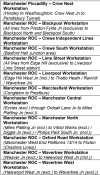
This is from a periodical operating notice from two years ago and is list of workstations and their control areas in Manchester ROC at the time. It may have been added to since then?

Anyhow were services impacted across nine workstation areas?

1786206971251.png
 

HST125Scorton

Member
Joined
4 Jun 2019
Messages
151
Location
Atherton
^ More to add to the above

Manchester ROC also control

Crewe Basford Hall Jn-Betley
Basford Hall Yard Incl South Yard
All lines within Basford Hall
All Independents Lines (Incl to/from Sandbach & Lines to/from Gresty Lane)
 

Attachments

  • Screenshot 2026-08-08 175912.png
    Screenshot 2026-08-08 175912.png
    424.8 KB · Views: 34

AndrewE

Established Member
Joined
9 Nov 2015
Messages
7,300
No. Train s that were physically able to get on the move were moving. The ones that weren't, weren't.

But they do. It has been the case for years that operators instruct compliant vehicles for pre-planned works. This is just part of that.

In any case emergency work doesn't get much oversight compared to anything pre-planned.
and how many compliant vehicles would be on hand for a total regional shutdown with no notice? (compared with planned engineering ops on a limited number of lines.) Almost certainly nowhere near enough.
 

Starmill

Veteran Member
Joined
18 May 2012
Messages
27,143
Location
Bolton
and how many compliant vehicles would be on hand for a total regional shutdown with no notice? (compared with planned engineering ops on a limited number of lines.) Almost certainly nowhere near enough.
So what's your point? Yes, few buses are available at the drop of a hat. That's also always been the case, and won't be likely to change any time soon. The operators who are willing to pay the premium rate for on-the-day orders are always able to secure something, of course. The ones who won't frequently don't. Again nothing has changed.

== Doublepost prevention - post automatically merged: ==

The line was completely closed for months between Cheadle Hulme and Crewe in 2006 - at great personal inconvenience to me - attempting to get the Ansaldo system to work on this relatively straightforward section. Wilmslow only had a token service to Manchester via the Styal line. It has had its 'moments' ever since and the bi-di is rarely used. I hope the replacement system implementation goes rather more smoothly!
The bi di as specified isn't really that much use. It's quite inflexible north of Handforth and south of Sandbach. Being unable to access platform 1/2 at Wilmslow from the north means that it's bi di on a plain two track section with limited crossovers, the only three platforms at Sandbach and loops at Chelford.

The most excitement it is actually useful for is a down express overtaking a down stopping service at Wilmslow, which does happen from time to time.
 
Last edited:

AndrewE

Established Member
Joined
9 Nov 2015
Messages
7,300
So what's your point? Yes, few buses are available at the drop of a hat. That's also always been the case, and won't be likely to change any time soon. The operators who are willing to pay the premium rate for on-the-day orders are always able to secure something, of course. The ones who won't frequently don't. Again nothing has changed.
But people are saying "It's in the contract, so of course there will be enough." I'm saying that the contract doesn't cover providing enough compliant vehicles to cover a whole region's rail services at the drop of a hat - nor would you expect it to. So of course you can't expect them to be magicked up just like that.
see your post 418.
 

jon0844

Veteran Member
Joined
1 Feb 2009
Messages
30,836
Location
UK
You're just playing with semantics. A UPS also switches to providing power from the batteries within milliseconds, when it works.

I'm really not. I know what a UPS is. I used to rely on them.

Times have moved on. Battery power stations now operate as a UPS by simply switching power as quick as a traditional UPS. A UPS is not intended to last a long time, but give time for a computer system to be transferred to another source of power, or safely shut down and save critical data. Okay, you can add more battery packs (many UPS systems still use lead acid batteries) for longer life - but they aren't intended to be another source of power for hours, or even potentially days.

Yes you can still buy a UPS and they still serve a purpose, but I'm talking about batteries that operate like a standard grid mains supply. A smooth 50Hz power supply and near instantaneous switchover.

I have a system at home that is ready to do this, but I opted to save the £500 or so to add the EPS controller because power cuts are rare. But I don't run a control centre with computers that may misbehave if they power down unexpectedly.
 

Starmill

Veteran Member
Joined
18 May 2012
Messages
27,143
Location
Bolton
But people are saying "It's in the contract, so of course there will be enough." I'm saying that the contract doesn't cover providing enough compliant vehicles to cover a whole region's rail services at the drop of a hat - nor would you expect it to. So of course you can't expect them to be magicked up just like that.
see your post 418.
You're confused. That was about pre-planned works, not rail replacement at no notice.

At the end of the day the law is the law for very good reasons, and it isn't having substantial negative effects, so being a sore loser that others are being considered at your own expense is unlikely to be getting you very far.

Accessible loos and auto announcements reading out the next stop are the absolute bare minimum of a 21st century public transport service. It's totally wrong-headed to complain about these being mandatory.
 

LondonExile

Member
Joined
7 Dec 2020
Messages
90
Location
Durham
From RTT it appears that the wheels came off at 13.40, the same time as the power outage. What that tells us I'm not sure. As a layman that looks to me like the ROC lost supply and didn't recover, maybe due to UPS or whatever not taking over. It seems to discount the theory that the UPS took over as it should but was unable to sustain supply.

Where I work (not railway), we have UPS cover plus generators set to auto-start with automatic transfer switches.

Whilst I don't know what has gone wrong at Manchester ROC - it looks quite similar from the outside to a fault we had a couple of years ago. Our DNO lost power for approx. 10m and the generator started. The auto transfer switch commanded a switch to generator supply, and the way that is physically done is via motorised MCCBs (circuit breakers larger than you'll have at home...) To prevent backfeeding the grid, or connecting supples together out of phase, the changeovers are break before make, i.e. it goes Grid -> Nothing -> Generator (or vice-versa)

We had a spindle physically snap in the MCCB whilst it was in the middle "Nothing" position, meaning we had a dead supply from the grid, a generator spun up but doing nothing to actually help the situation and a UPS still counting down its battery life. Cue frantic calls for on-site electricians to see if we could get bypass circuits operated (as by this point the DNO supply was back, but we were no longer connected to it!), but the UPS drained and we lost service before our electricians could physically get to the plant room (which was remote from the offices they were based in.)

If the low-level protection itself breaks, the solution to keeping service going probably sits further up the stack (i.e. second bank of desks on different protective systems from a different feed etc.)
 

Trothy

Member
Joined
22 May 2013
Messages
119
Resignalling is never driven by manpower savings, just asset condition or enhancements. The manpower savings are a very minor clawback.

5 boxes into 1 workstation probably loses about 16 posts (minus 4 boxes net) might save a total of £0.8m a year. Resignalling is approaching £0.5m per signal.
4 of those boxes are double manned, plus the associated relief. So had it been resignalled in 2003 as planned, the costs savings over the last 23 years wouldn't exactly be insignificant.
 

sharpener

Member
Joined
4 Oct 2018
Messages
370
I'm really not. I know what a UPS is. I used to rely on them.

Times have moved on. Battery power stations now operate as a UPS by simply switching power as quick as a traditional UPS. A UPS is not intended to last a long time, but give time for a computer system to be transferred to another source of power, or safely shut down and save critical data.

And? The ROC was specced in 2012 and opened in 2014 or therabouts. With generator backup. The battery power station technology would not have been competitive or mature at that time and there would be no reason to retrofit it, assuming the genny could be maintained in good order. In any case it would seem the load never got as far as being transferred to it.
 

dosxuk

Established Member
Joined
2 Jan 2011
Messages
2,428
A UPS is not intended to last a long time, but give time for a computer system to be transferred to another source of power, or safely shut down and save critical data.
Depends on the UPS. Industrial ones are designed to last indefinitely, switching between sources of power as required to keep their load alive, only triggering a shutdown when there is no other option.

A battery power station is designed to cover short periods when there is no incoming mains supply. That's it. Once it's batteries die it's out of use for the foreseeable, exactly the same as a domestic UPS with a single mains input.
 

jon0844

Veteran Member
Joined
1 Feb 2009
Messages
30,836
Location
UK
A battery power station is designed to cover short periods when there is no incoming mains supply. That's it. Once it's batteries die it's out of use for the foreseeable, exactly the same as a domestic UPS with a single mains input.

I'm not suggesting they buy a Anker Solix power station! I was talking about grid level battery storage that is now economically viable and could power an entire building for some considerable time, doing away with the need for a generator backup for some time (if at all). I think more and more industry will be looking at essentially off-grid solutions in the future, but I think this is going around in circles so let's leave it here.
 

Harpo

Established Member
Joined
21 Aug 2024
Messages
3,731
Location
Newport
4 of those boxes are double manned, plus the associated relief. So had it been resignalled in 2003 as planned, the costs savings over the last 23 years wouldn't exactly be insignificant.
Agreed. 7-8 figure opex savings are not insignificant, but are always a relatively small clawback in 8-9 figure resignalling schemes.
 

The Planner

Veteran Member
Joined
15 Apr 2008
Messages
19,627
I know the Ansaldo signally had some problems but it came with bidirectional signalling. I hope this facility isn't going to be lost.
No

== Doublepost prevention - post automatically merged: ==

The bi di as specified isn't really that much use. It's quite inflexible north of Handforth and south of Sandbach. Being unable to access platform 1/2 at Wilmslow from the north means that it's bi di on a plain two track section with limited crossovers, the only three platforms at Sandbach and loops at Chelford.

The most excitement it is actually useful for is a down express overtaking a down stopping service at Wilmslow, which does happen from time to time.
How were you expecting the get into 1 and 2 from the North at Wilmslow? Handforth to Cheadle Hulme is 2 and a half miles, not exactly a great distance. Its not bi-di south of Sandbach anyway as its a different section and panel. You have the crossovers at Chelfiord, Goostrey, Alderley Edge and Cheadle Hulme South. The longest section between crossovers is about 5 miles between Sandbach and Goostrey.
 
Last edited:

TPO

Member
Joined
7 Jun 2018
Messages
401
"Network Rail's North West route director, Chris Wright………..says engineers have been working hard overnight to build "additional resilience" into Network Rail's signalling systems and ensure this doesn't happen again. "

so, if they could build additional resilience in just by working overnight, why on earth wasn't it built in originally?

Usual words to the press. Not to be taken too literally...... ;)

That hasn't been the case for years, except perhaps for local service disruptions. It simply doesn't have enough staff to handle anything more than that. SBB is centralized and operates four major control centers (West in Lausanne, Central in Olten, South in Pollegio, and East at Zurich Airport). These are structured—both technically and organizationally—in such a way that they can mirror and support one another. The server architecture is designed to be redundant. If, for example, the Central Operations Center in Zürich goes down, parts of the control system can be switched over to the screens at one of the other three centers (e.g. Olten, but who wants to go to Olten...). Staff would then be reassigned to workstations at the other operations center.


And here is the nub of the issue. Centralising to "improve efficiency" will by its nature introduce the ability to have a far wider consequence from failure than is the case in a less centralised system.

I remember the old "through routes" mode on the Western psbs. Basically the show was run in a pre-determined layout by the local interlocking whilst the central brain sorted itself out and then took back control.

Further back, there were many individual signalboxes, experienced staff in and close to each of them and a system that was much easier to fix. So a problem like a power outage of one 'box was much less disruptive.

The cost of efficiency is loss of resilience, twas ever thus. The modern culture also being a slavish follower of the Religion of Progress (I.e. New and Shiny must always be better than old and reliable and computers are always better than people) doesn't help.

Nor am I convinced that the costs of centralising are ever admitted, rather Opex and Capex costs are separated with the latter invisible so that having the latest shiny toy can be justified......


TPO
 

Bevan Price

Established Member
Joined
22 Apr 2010
Messages
8,316
We will have to wait for an official explanation - if one is ever released, but two comments
1. Rechargeable batteries jave finite, and sometimes unpredictable lives. Sometimes they appear to be taking charge, but fail catastrophically without warning.

2. Is it possible that external interference, e.g computer system hacking , created some of the problems ?
 

Harpo

Established Member
Joined
21 Aug 2024
Messages
3,731
Location
Newport
The modern culture also being a slavish follower of the Religion of Progress (I.e. New and Shiny must always be better than old and reliable and computers are always better than people) doesn't help.
Signalling (OK - And the bean counters) has resisted that trend for over a century and people still swing large metal levers to make stuff move.

Luckily every single signal box, however old, has a computer keeping those pesky humans in check. The Victorians made their computers from shaped pieces of metal to follow fixed algorithms. Those mechanical interlockings are still ‘better than people’, a century and a half later.
 

Class 317

Member
Joined
7 Jul 2020
Messages
555
Location
Cotswolds
My colleague has been working on a repower of a signalling site in Germany which is moving to using on site solar and BESS backed up by a grid connection. One requirement of the redesign is to spec the batteries to run the site for 2 hours in the event of grid issues.

A similar upgrade to UK ROC's etc would mean at least no one should end up stranded on trains in a similar situation.to this one.
 

bahnause

Member
Joined
30 Dec 2016
Messages
1,010
Location
bülach (switzerland)
And here is the nub of the issue. Centralising to "improve efficiency" will by its nature introduce the ability to have a far wider consequence from failure than is the case in a less centralised system.
The standard-gauge rail network in Switzerland is probably one of the most centralised. Nevertheless, it is also one of the most reliable and resilient. This is not in spite of centralisation, but largely because of it. Improving efficiency is only a small part of the picture. It is much more about ensuring a continuous flow of information, which simplifies the management of both major and minor disruptions. Whilst normal operations are largely automated, staff can focus on dealing with incidents. As an example, operators can set route
macros to automate bypasses when technical disturbances occur. The same applies to passenger information, which also draws on data from the system. Gone are the days when the information displayed at station X was completely different from that at station Y, because each was managed locally. The same applies to ensuring connections (not only) in the event of delays. These are also managed centrally within the system (often automatically by the system) and are forwarded to the peripheral systems (station displays, online services, apps). No more guesswork on the part of staff or customers.
I remember the old "through routes" mode on the Western psbs. Basically the show was run in a pre-determined layout by the local interlocking whilst the central brain sorted itself out and then took back control.
Even in centralised systems, there is nothing that would make something like this impossible. In fact, it is a technique used almost everywhere in Switzerland to overcome local failures. Signal box technology is, after all, still largely based on a local infrastructure. Thanks to sensible data network planning, there is usually more than one way to (remote) control these local signal boxes, and the core hardware of the control system itself also incorporates built-in (geo-)redundancy.
The cost of efficiency is loss of resilience, twas ever thus. The modern culture also being a slavish follower of the Religion of Progress (I.e. New and Shiny must always be better than old and reliable and computers are always better than people) doesn't help.
The benefits in day-to-day operations far outweigh the potential for large-scale outages. A fundamental feature of the system used in Switzerland is the separation of the functional level and the operational level. The functional level consists of so-called ‘cells’, which are responsible for controlling the signal boxes and for automatic train control. The operator level comprises a small number of ‘operator clusters’, which are used to operate the individual cells. This breaks down the original operational boundaries, as the entire rail network can be accessed from any operator workstation. Should a workstation within an operator cluster fail, any other workstation can take over its function.

 
Last edited:

Paul AC

Member
Joined
3 Aug 2025
Messages
237
Location
Timperley
Out of interest @bahnause , and relevant to the present discussion, how are the signalling systems powered in Switzerland? Does it or can it use the traction 16.7 Hz grid, which must be reliable as you literally 100% rely on it?
 

bahnause

Member
Joined
30 Dec 2016
Messages
1,010
Location
bülach (switzerland)
Out of interest @bahnause , and relevant to the present discussion, how are the signalling systems powered in Switzerland? Does it or can it use the traction 16.7 Hz grid, which must be reliable as you literally 100% rely on it?
It depends on the location... Older relay-based systems were a bit simpler; these were powered by the local mains supply in the event of a failure in the railway power supply. The 16.7 Hz frequency wasn’t a problem for these systems – all the lights just flickered a little. It could give you a bit of a headache after an hour or so.

Modern signal boxes have a UPS which bridges a brief power cut and a second power supply. This can be a different line from another local grid or an inverter connected to the railway power supply.

Larger junctions and the operations centres have a UPS and an emergency power unit with diesel generators.
 

Top