• Our new ticketing site is now live! Using either this or the original site (both powered by TrainSplit) helps support the running of the forum with every ticket purchase! Find out more and ask any questions/give us feedback in this thread!

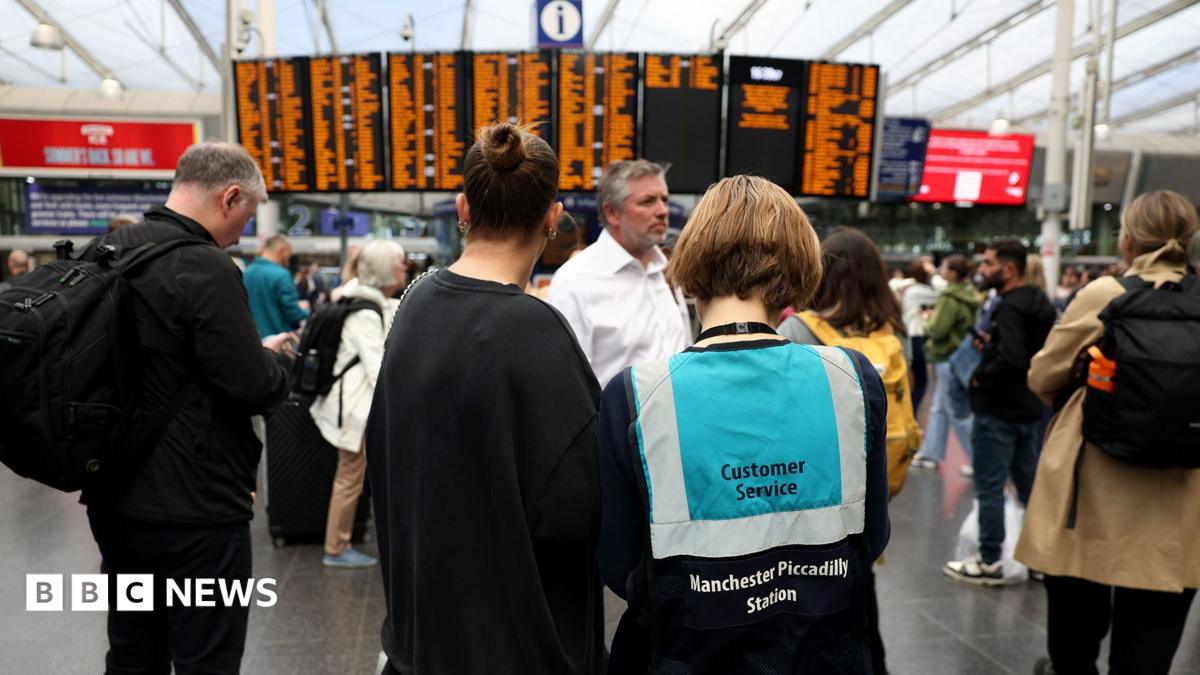
Trains all at a stand in the Manchester area... (Thursday afternoon 06AUG2026)

Starmill

Veteran Member
Joined
18 May 2012
Messages
27,143
Location
Bolton
I am not sure you can make that comment, as it could also affect the decision whether to bother putting toilets in ore not, for trains into the future. any train And how many in the future ? It's basic business / human nature : if stuff becomes more difficult and/or expensive people try to avoid it.
There are very few trains in the UK that don't have toilets.

Nearly all of the ones which lack them, Island Line, Merseyrail, Elizabeth line and London Overground trains for example, will never have them because there is not enough space for them and toilet facilities can be provided at stations (though the latter has been improved, it still needs further work, but regardless, the point stands, they won't be getting onboard loos!).

I can therefore say with great confidence that requiring on train loos to be accessible has not resulted in a overall lack of toilet access for railway passengers. Indeed it's generally had the opposite effect, the benefits of this change vastly outweigh any negatives. Lots of trains without them, such as class 455s and 313s, have rightly been retired, and their duties taken over by trains that have onboard loos.

The only trains where it's questionable are the ones like Southeastern's Metro trains. Some of these have been having them added. Others lack them even though they really should have had them, but unfortunately funding is an issue.
 
Sponsor Post - registered members do not see these adverts; click here to register, or click here to log in
R

RailUK Forums

Paul AC

Member
Joined
3 Aug 2025
Messages
237
Location
Timperley
A UPS is made up of batteries
No, a UPS contains some batteries.

One of the signalling systems people on here will know: are the systems in the ROC powered at (whatever voltage) DC or at 240 V ac? I'd guess that many of the systems run off 240 V ac, in which case you can't just run the ROC straight off any form of battery, there must be some form of inverter (dc to ac convertor) in the circuit.

A typical domestic or industrial UPS will have:
* a battery with a rating to suit a specified hold-up time
* an inverter to create a nice clean ac supply from the battery to feed to the critical systems
* a charger for the battery from the (possibly dirty) mains ac supply
Thus, the UPS cleans up the supply as well as providing backup power when the supply fails.

Many UPSs will also have a bypass mode so that if the inverter fails the output is taken straight from the input. There may also be some form of synchronising circuit so that the changeover from inverter to bypass and back doesn't cause a step change in the output; though the inverter will de-synchronise from the supply if the latter is out of spec in any way.
 

Peter749

Member
Joined
27 Apr 2016
Messages
262
Location
Salford

hwl

Established Member
Joined
5 Feb 2012
Messages
8,233
such as class 455s and 313s, have rightly been retired, and their duties taken over by trains that have onboard loos.
You are aware that the disabled toilets of the 377/6 and /7s are used as standing space on busy peak services so that there isn't actually a toilet available such a sub optimal standing area?
 

Annetts key

Established Member
Joined
13 Feb 2021
Messages
3,787
Location
West is best
I have heard several reports of actual physical damage consequent to the power outage, last on the R4 "Today" programme this morning. Is this actually correct, and if so, what might it be? It was nice to hear some thanks given to the staff who worked to recover the situation too.
I don't know about this specific case, but where I used to work, power blips could cause fuses to blow, equipment that was already likely suffering from degraded components to fail to work when the power comes back (switch mode power supplies are one example of this) or computer based equipment failing to restart with the correct timing and then shutting down (for safety reasons, critical safety systems have to use a majority voting system, at least two processors have to agree, otherwise the outvoted system gets automatically shut down with a requirement that there must be at least two processors still working, otherwise the entire system shuts down).

Going forward, especially now batteries are cheaper than ever (and only continuing to go down in price), wouldn't a sensible future plan be to install battery storage at key locations that means you don't require a UPS to buy time to power up generators, but the batteries can instantly take over - and also step in at any time if the incoming supply fluctuates even for a short period of time.

You could build storage to allow everything to keep going, or just protect key circuits. If the issue is systems messing up if they go offline even for a short time, batteries can ensure this never happens - and obviously the batteries will charge up once the incoming supply is restored (even partly via solar if you have the room).

We are there already. To use batteries effectively you need the means to charge them and also to invert their DC output to usable AC mains. And provide the controls for detecting grid failure and taking over the load mid-cycle.

The combination of all this is what a UPS is.

But it sounds like they use a pretty limited UPS for a short period of time, to allow the switching of power to another source (generator). What I'm talking about is a large battery that can switch instantly to another power source - the battery. It has the inverter and UPS functionality, but is essentially the generator but instantly available at any moment (so is as good as having a second mains power supplier). It can also monitor the power to switch if the incoming supply has issues.

More and more people are buying these for their homes (Anker, Ecoflow, Bluetti, Jackery etc) and I'd certainly do that today than buy a standalone UPS that might run things for only a matter of minutes. Of course, if you're just wanting to keep a computer online to allow you to save (or it saves) data then that's fine, but these days people may want to keep the fridge freezer going, or perhaps even power their gas boiler so they can keep heating their home during a power outage.

Big proper UPSes generally have the ability to add additional battery capacity. But you're still dealing with a different order of magnitude power requirement for a house compared to a ROC with dedicated power feeds. Your domestic breakers are rated at 10s of amps, switchgear on a 6.6kV supply is 1000s of amps. Batteries will also eventually run out, no matter what size of installation you have. Whereas a generator can have its tanks topped up whilst running if you get an extended outage.

But it's still not clear whether the failure was with the UPS kicking in at all. No amount of battery will save you if the switching electronics fail.

The point of my derogatory comment was that nothing gets ‘built’ overnight and alterations are long-lead work.

At best, (for example) it’s possible to hire in a generator set fairly quickly but anything else overnight is just putting things right.
The railway uses proper industrial specification UPS systems. The AC mains supply feeds the UPS. Internally this is converted to a DC supply. This used to both charge the battery (a very large battery) AND supply the inverter (that converts DC to AC). The AC output is then used to supply the load. When the mains into the UPS fails, there is no break in the AC output. That's the whole point of a UPS.

Some of these UPS are the size of a large shipping container... The smaller ones are the size of two washing machines placed side by side. And then there are some that come in-between.

As a standby generator is a requirement (and has been for PSBs from the 1960s), having a UPS with a battery that can last for hours would be using up money for little benefit. As I have said before, the standby generator should auto-start and take the load. The load being the UPS, which in turn then feeds the signalling systems.

The railway has it's own mobile generator sets for use if the fixed installation standby generator has to be taken out of service (for heavy maintenance or due to a fault/problem).

Agreed that with a traditional signalling centre or PSB, it will also supply the external feeders to the lineside equipment, and the generator will backup those supplies. But I haven't seen any cases where the external feeders have been fed from a UPS. You would need a fairly substantial UPS to be capable of driving several point machines simultaneously. The UPSs are only used to power the computer-based kit inside the control centre.
It very much depends on what the requirements are.
Is the requirement just to keep the computer-based systems in the signalling centre running? Then only that would be protected/fed by a UPS.
Is the requirement to have no lost of signalling between the loss of the mains DNO supplies and the standby generator starting up? If so, all the signalling supplies would have to be protected/fed by UPS, including the "remote" (DNO fed) power networks feeding the signalling many miles from where the ROC/signalling centre/PSB is located.

On the area where I used to work, we had both.

The less important lines only had the computer-based systems (an SSI - Solid State Interlocking and PMUX - Panel Multiplexer - both these were made up of a number of computers) fed via a UPS. Nothing else was fed via the UPS. So when the mains (DNO) supply failed, the SSI lost contact with all the TFM (Trackside Functional Modules) and hence the signaller got a "red out" (all track circuits showing occupied, all signals black).

The older, 1970s RRI interlockings and PSB that controlled the main lines had 650V AC UPS retro fitted to feed all of the signalling equipment. Why? Because just the disruption caused by the changes of signal aspects caused by the less than a minute power loss was considered unacceptable. So the money was found to retro fit 650V AC UPS systems.

There's surely no way that they're powering the lights etc 50 miles away from this facility??? The AC losses involved would be absolutely insane.
You seem to have missed the word "local" in Annett's message. Traditional 650v signalling feeders can stretch considerable distances, and I suspect the latest HV 3 phase feeders even further, but I doubt 50 miles. Remote areas will have their own supply points.
On non-electrified lines the railway has DNO feeds that supply power distribution points (which include their own standby generators) every five to ten miles (often located at junctions). This is for the railways own lineside 650V AC distribution network that feeds the vast majority of the signalling equipment.

Surely not? If you kept interlocking but lost the control system itself then at least you havent lost all the positions of the trains (etc) and it's far easier for the control system to boot up again.
That's not how the signalling system works. The indication and control systems are slaves to the interlocking (to be pedantic, a special module that is directly connected to the interlocking rather than the actual interlocking, but all in the same rack). They only do what they are instructed to do. So what they show is the current state from the interlocking.

The interlocking only keeps it's state of the railway information for a very short amount of time (measured in milliseconds). If it cannot communicate with the equipment that is lineside, it updates it's state of the railway information to a "fail safe" state - track circuits are considered to be occupied, signals are marked as being unlit (black) and points are considered to be not detected.

Tbh I'm more familiar with data centres but it is pretty terrifying if this isn't the case. You need building HVAC on it otherwise stuff starts overheating and you get cascading failures (the most common failure type in datacentres isn't power failing, it's HVAC going down and temps rising steadily and causing outages that way).
The aircon systems can safely be fed from the standby generator supply. No need for them to be fed from a UPS.

If the standby generator doesn’t start, you very quickly won't have any operational signalling anyway.

 

hwl

Established Member
Joined
5 Feb 2012
Messages
8,233
No, a UPS contains some batteries.

One of the signalling systems people on here will know: are the systems in the ROC powered at (whatever voltage) DC or at 240 V ac? I'd guess that many of the systems run off 240 V ac, in which case you can't just run the ROC straight off any form of battery, there must be some form of inverter (dc to ac convertor) in the circuit.

A typical domestic or industrial UPS will have:
* a battery with a rating to suit a specified hold-up time
* an inverter to create a nice clean ac supply from the battery to feed to the critical systems
* a charger for the battery from the (possibly dirty) mains ac supply
Thus, the UPS cleans up the supply as well as providing backup power when the supply fails.

Many UPSs will also have a bypass mode so that if the inverter fails the output is taken straight from the input. There may also be some form of synchronising circuit so that the changeover from inverter to bypass and back doesn't cause a step change in the output; though the inverter will de-synchronise from the supply if the latter is out of spec in any way.
Agreed and the logic for deciding what is good enough to synchronise to (and clean up) or desynchronise from isn't always perfect for some of the more unusual fault types. (e.g. what happens if the DNO supply comes back at the exact moment (+/- 3 cycles of 50Hz) that the back up generator is going to take over the from the UPS?)
NR announcements state that some of their equipment (outside of the UPS and generator) got fried.

This could need lots very high resolution telemetry to unpick?
 

PZ 08895

Member
Joined
12 Apr 2022
Messages
54
Location
Horsham
The majority of railway telecoms equipment is DC powered (nominal -48V DC) with at least four hours battery autonomy, but with much more in locations like ROCs. Being DC, there are no invertors. With the AC power on DC rectifiers power the load and charge the batteries, if the power fails, the batteries take over. These systems are made up of a number of strings of batteries and have n+1 rectifiers (at least one more than necessary for the load) so there is no single point of failure. Signalling systems are AC, as stated above.
 

Falcon1200

Established Member
Joined
14 Jun 2021
Messages
6,496
Location
Neilston, East Renfrewshire
Signallers that only sign Sheffield workstations at York, signalling Manchester Victoria or Crewe from York. What could possibly go wrong.

Indeed - Signaller competence outside their normal work area was another, non-addressed issue.

Regarding the whole ROC concept, we (Control staff) had reservations from the start about co-locating Signallers and Controllers, although more in case of events such as an evacuation due to a fire alarm rather than a catastrophic power failure. IMHO, both then (2014 in my case) and still now, Signallers and Controllers absolutely should not be in the same building or location, as was generally the case in the past.
 

Annetts key

Established Member
Joined
13 Feb 2021
Messages
3,787
Location
West is best
No, a UPS contains some batteries.

One of the signalling systems people on here will know: are the systems in the ROC powered at (whatever voltage) DC or at 240 V ac? I'd guess that many of the systems run off 240 V ac, in which case you can't just run the ROC straight off any form of battery, there must be some form of inverter (dc to ac convertor) in the circuit.

A typical domestic or industrial UPS will have:
* a battery with a rating to suit a specified hold-up time
* an inverter to create a nice clean ac supply from the battery to feed to the critical systems
* a charger for the battery from the (possibly dirty) mains ac supply
Thus, the UPS cleans up the supply as well as providing backup power when the supply fails.

Many UPSs will also have a bypass mode so that if the inverter fails the output is taken straight from the input. There may also be some form of synchronising circuit so that the changeover from inverter to bypass and back doesn't cause a step change in the output; though the inverter will de-synchronise from the supply if the latter is out of spec in any way.
Most signalling equipment runs from a 110V AC 50Hz supply. But I don't know what the specification was for equipment in a ROC.
 

sharpener

Member
Joined
4 Oct 2018
Messages
370
A typical domestic or industrial UPS will have:
* a battery with a rating to suit a specified hold-up time
* an inverter to create a nice clean ac supply from the battery to feed to the critical systems
* a charger for the battery from the (possibly dirty) mains ac supply
Thus, the UPS cleans up the supply as well as providing backup power when the supply fails.

Maybe. There is some saving to be had by using a four-quadrant inverter which serves both as the charger and the output inverter depending on what the control circuits are telling the power FETs to do, this is how the Victron marine/domestic battery systems traditionally work. But where the primary intention is the UPS capability, the more expensive DC link is better since as you say it provides cleaner AC to the load as well.

There is also more modern topology which uses high frequency chopping, and so less massive chokes/transformers are required, this is used in wind turbines and is very similar to traction motor drive packages so might also be in industrial UPSs, someone will know...
 

Acathater

Member
Joined
11 Dec 2025
Messages
655
Location
NorthWest
Something that puzzles me in all this is....how were the trains ordered to stop?
Did all signals drop to red following the loss of data input ? If so, where were they powered from? Or was there a GSM alert flashed to all trains?
 

Snow1964

Established Member
Joined
7 Oct 2019
Messages
11,015
Location
West Wiltshire
If the standby generator doesn’t start, you very quickly won't have any operational signalling anyway.
If a standby generator won't start, it's not a standby system.

What no one has said (and apologies if I missed in 330 posts), was when the generator was last fired up successfully (and I mean without someone having to fiddle with it to get it running), not when someone managed to get it to splutter into life.

If the outage was 90 seconds (as suggested) the system should have been able to cope on battery. No one relies on a generator kicking in that fast, they would normally take at least 5 minutes before they are running and can have heavy load. Remember it was started on a warm day, these things are designed to start at something like -10c in middle of winter too. Cold diesels are pretty gutless for first few minutes so expecting full power within a minute and a half is bonkers spec.
 

Annetts key

Established Member
Joined
13 Feb 2021
Messages
3,787
Location
West is best
The majority of railway telecoms equipment is DC powered (nominal -48V DC) with at least four hours battery autonomy, but with much more in locations like ROCs. Being DC, there are no invertors. With the AC power on DC rectifiers power the load and charge the batteries, if the power fails, the batteries take over. These systems are made up of a number of strings of batteries and have n+1 rectifiers (at least one more than necessary for the load) so there is no single point of failure. Signalling systems are AC, as stated above.
Entire railway telephone exchanges were powered from a 48V DC supply. That was fine until the DC rectifiers (otherwise known as a battery charger) failed. I've seen a complete failure. Yes, everything continued running on the battery, well until the battery ran low on charge... Then over the course of an hour, system after system failed...

It took hours for the telecom technicians to get another "DC rectifier" and connect it up. Until the charge level of the battery had recovered, half the equipment had to remain powered off... IIRC, it took over 24 hours for the voltage to recover to the nominal float voltage.

The modern kit either has an internal battery or does not have any battery at all. The separate exchange battery in the main railway telephone exchange where I worked was removed many years ago.
 

mmh

Established Member
Joined
13 Aug 2016
Messages
4,244
Not really. Almost no trains had their toilets permanently removed. Only some class 153s were affected.
Class 456 had their toilets removed (physically, not just locked out of service)
 

hwl

Established Member
Joined
5 Feb 2012
Messages
8,233
Something that puzzles me in all this is....how were the trains ordered to stop?
Did all signals drop to red following the loss of data input ? If so, where were they powered from? Or was there a GSM alert flashed to all trains?
Signal, point motors, track circuits, AWS , TPWS, functional modules and remote interlockings etc are powered from different supplies.
Hence 2 cases:
a) The signal go red (probably most of the affected area yesterday)
b) the the local supply is also lost and the signals go black and you have lots more local issues (It sounds like this might have been the case near Man Vic yesterday)
 

Annetts key

Established Member
Joined
13 Feb 2021
Messages
3,787
Location
West is best
Something that puzzles me in all this is....how were the trains ordered to stop?
Did all signals drop to red following the loss of data input ? If so, where were they powered from? Or was there a GSM alert flashed to all trains?
Depends on if the signalling in the area where the train was still had power.

If no power, the signal goes out - black - no light.

If it is still powered, the loss of control messages from the signalling centre will cause the signal to go back to the most restrictive aspect, so red for a stop signal. This happens in milliseconds.

If a standby generator won't start, it's not a standby system.

What no one has said (and apologies if I missed in 330 posts), was when the generator was last fired up successfully (and I mean without someone having to fiddle with it to get it running), not when someone managed to get it to splutter into life.

If the outage was 90 seconds (as suggested) the system should have been able to cope on battery. No one relies on a generator kicking in that fast, they would normally take at least 5 minutes before they are running and can have heavy load. Remember it was started on a warm day, these things are designed to start at something like -10c in middle of winter too. Cold diesels are pretty gutless for first few minutes so expecting full power within a minute and a half is bonkers spec.
We don't know because no one has reported on what the problem actually was, let alone any further details.
 

sjm77

Member
Joined
8 Jan 2020
Messages
328
Location
Manchester
On the other hand Northern seem to have recovered pretty well, at least around Manchester Victoria and the Calder Valley. I travelled from Todmorden to Leeds this morning, got up much earlier than I needed to and had a bus as a backup plan, but everything was running well first thing. The "do not travel before 10am" warning was not necessary in my case.
Indeed, I was suprised to see the peak extras on the CLC Warrington Central route this morning. Being a Friday there are many working from home so these would have been a low priority to roster (probably) but Northern managed it. Meanwhile TPEx did not provide anything on the same route until the 11:00 arrival into Lime Street and 11:19 departure to Cleethorpes. A stark difference.
 

68000

Member
Joined
27 Jan 2008
Messages
832
Something that puzzles me in all this is....how were the trains ordered to stop?
Did all signals drop to red following the loss of data input ? If so, where were they powered from? Or was there a GSM alert flashed to all trains?
The signalling system is fail safe therefore any interruption to the power or communications between the interlocking and trackside and the interlocking and signaller control system will put the signals to red (which are likely on different power supply to the interlocking or the control system).
 

Starmill

Veteran Member
Joined
18 May 2012
Messages
27,143
Location
Bolton
Class 456 had their toilets removed (physically, not just locked out of service)
Primarily to create space rather than anything else, and not in response to the regulation deadline. Either way, though, the services these units worked on have had toilets now for many years.

== Doublepost prevention - post automatically merged: ==

Something that puzzles me in all this is....how were the trains ordered to stop?
Did all signals drop to red following the loss of data input ? If so, where were they powered from? Or was there a GSM alert flashed to all trains?
Yes some trains had signals revert to red.
 

norbitonflyer

Established Member
Joined
24 Mar 2020
Messages
5,657
Location
SW London
Primarily to create space rather than anything else, and not in response to the regulation deadline. Either way, though, the services these units (456) worked on have had toilets now for many years.
On the contrary, it is only with the introduction of 701s that these services have ever had toilets. (And they seem to be out of order a lot of the time - although more bowsers have been provided at Waterloo that's not much help if a train is stranded out in the wilds.

Other classes still without toilets -
139 (but there would be barely time to use it on the Stourbridge Shuttle!), 345 (Elizabeth Line), 376 and 707 (South Eastern), 378 and 710 (London Overground), 398 (cardiff valleys), 399 (Sheffiekld Tram Trains), 555 (tyne & Wear Metro), 777 (Merseyrail)

== Doublepost prevention - post automatically merged: ==

Quite a few were built without them, replacing trains which did have toilets though.
Can't think of many examples, except the 398s, and a few services in the London area where DMUs (with toilets) were replaced by electric units (without). The North Woolwich- Camden Road service was one, (ist Gen DMUs replaced initially by 416s, and later 313s), the "Goblin" another (172s replaced by 710s), the Abbey Flyer a third (1st gen DMU by 313), and the GW locals (165s) that were replaced by the Elizabeth Line. (on the GE the Elizabeth Line replaced loo-less 315s)

On South eastern the 376s were built without toilets, wheras the older networkrs diod have them, but they were nota replacement as the Networkers remained in service - the 376s were to increase the total size of the fleet. Some inevitably some services that had had networkers now had 376s. for expansion.
 
Last edited:

sharpener

Member
Joined
4 Oct 2018
Messages
370
If the outage was 90 seconds (as suggested) the system should have been able to cope on battery. No one relies on a generator kicking in that fast, they would normally take at least 5 minutes before they are running and can have heavy load. Remember it was started on a warm day, these things are designed to start at something like -10c in middle of winter too. Cold diesels are pretty gutless for first few minutes so expecting full power within a minute and a half is bonkers spec.
Someone upthread said 1 minute to full load. Also it might not be presented with the entire load all at once e.g. the aircon might be staggered.

We don't know because no one has reported on what the problem actually was, let alone any further details.

Highly likely it was problems compounding, which will take some unpicking

Well I think there are some deductions we can make. The UPS battery must surely be sized to last until you can be sure of the genny, so a few minutes, and therefore longer than the 90s of the actual grid outage.

Hence either (a) the UPS didn't take over the load in the first place, or (b) the genny failed and the battery ran out before it could be fixed AND they then didn't revert manually to the mains which had come back in the meantime, which seems less likely. Or (c) the only person who knew what to do was on a break or on holiday.

BBC website says "A 90-second power outage occurred in the area covering Network Rail's Manchester Rail Operating Centre just before 14:00 BST on Thursday."

So if we knew the exact time the ROC went down it might tell us more about the sequence of events.

BTW 48V was standard for civil telecoms too, conveniently it is just about the highest voltage not to be considered a lethal shock risk. I remember a vist to N Malden phone exchange in the '60s, a whole floor of the building was rows of enormous glass 2V cells. The move to VoIP telephony will destroy the resilience provided by having our phones powered from the exchange, as we will no doubt discover.
 

Justin Smith

Established Member
Joined
14 Nov 2009
Messages
1,415
Location
Sheffield
If the epicentre of the problem was in the Ardwick area can anyone tell me how we were able to get this train [from Piccadilly to Sheffield via Romiley] pretty much no problem (apart from it being late) ?
Can I please be cheeky and re-ask this question as my sense of curiosity is positively burning (and, in fact, I have been asked this by two of my friends) ?
 

Freightmaster

Verified Rep
Joined
7 Jul 2009
Messages
4,409
Can I please be cheeky and re-ask this question as my sense of curiosity is positively burning (and, in fact, I have been asked this by two of my friends) ?
Manchester Piccadilly to Ardwick is controlled from the signalling centre in Manchester Piccadilly station
and the line from Ashburys to Marple via Romiley is controlled from the 'Manchester East' signalling centre
at Edgeley Junction, just south of Stockport, as is the route from Ashburys to Greenfield via Guide Bridge
and Stalybridge.

The ROC at Ardwick controls (amongst others) the Oxford Road/Deansgate/Manchester Victoria areas,
which is why there was so much disruption yesterday.
 

Starmill

Veteran Member
Joined
18 May 2012
Messages
27,143
Location
Bolton
Quite a few were built without them, replacing trains which did have toilets though.
Such as...?
Was is SWT who openly admitted the regulations resulted in their new order having no toilets due to the seatspace a wheelchair one would take up was unjustifiable, but had they been allowed a 'traditional' one would have been okay?
You mean the trains that do have toilets? SWR don't use toiletless trains, apart from the Island Line where they never had them anyway.
 

Justin Smith

Established Member
Joined
14 Nov 2009
Messages
1,415
Location
Sheffield
Manchester Piccadilly to Ardwick is controlled from the signalling centre in Manchester Piccadilly station
and the line from Ashburys to Marple Romiley is controlled from the 'Manchester East' signalling centre
at Edgeley Junction, just south of Stockport, as is the route to Greenfield via Stalybridge.

The ROC at Ardwick controls the Oxford Road/Deansgate/Manchester Victoria areas, which is why there
was so much disruption yesterday.
Thanks for that !
I thought huge areas were controlled from a few signalling centres, has that not happened yet in Manchester ?
 

Kite159

Veteran Member
Joined
27 Jan 2014
Messages
22,709
Location
West of Andover
Such as...?

You mean the trains that do have toilets? SWR don't use toiletless trains, apart from the Island Line where they never had them anyway.
Maybe the 707s when they were ordered by Stagecoach without toilets fitted, replacing 450/458s on certain metro services.
 

Freightmaster

Verified Rep
Joined
7 Jul 2009
Messages
4,409
Thanks for that !
I thought huge areas were controlled from a few signalling centres, has that not happened yet in Manchester ?
It's been piecemeal to put it mildly.

For example, Macclesfield box was closed a couple of years ago, but the Stockport area
is still controlled by no less than four lever frame signalboxes! o_O

Piccadilly still controls from Piccadilly to Levenshulme plus the Styal loop including
Manchester airport and Salford Crescent through to Blackrod/Hindley.
 

Top