Our new ticketing site is now live! Using either this or the original site (both powered by TrainSplit) helps support the running of the forum with every ticket purchase! Find out more and ask any questions/give us feedback in this thread!
Gosh you can go back much much further than that. Central Trains was bad enough and EMT never got the allocation they required but right from the inception of the Regional Railways Express network in May 1988 it was commonplace to run single 2-car 156s from East Anglia to the North West. Occasional loco-hauled trains helped out on Summer Saturdays to Skegness & Yarmouth but the powers that be detested running them and it wasn’t long before they were confined to the history books.
The operator may want to hire additional trains in, however it is Dft who control the purse strings and if they say no, there is nothing that EMR can do about it. And no hitachi won't be taken to court. They have a contract between themselves, EMR and the leasing company. They will have...
It could have been worse! On Monday 20th July you would have seen just a 2 car 158 on that train. I travelled on it earlier in the afternoon on its outward journey to Liverpool and passengers were standing from Nottingham and it was absolutely rammed between Sheffield and Manchester.
Gosh you can go back much much further than that. Central Trains was bad enough and EMT never got the allocation they required but right from the inception of the Regional Railways Express network in May 1988 it was commonplace to run single 2-car 156s from East Anglia to the North West. Occasional loco-hauled trains helped out on Summer Saturdays to Skegness & Yarmouth but the powers that be detested running them and it wasn’t long before they were confined to the history books.
That of course is still an option which I suspect won’t make any money.
There are rakes of mk3 stock with charter companies. However let us imagine if EMR hired this and staff to do a Derby - Skegness service every Saturday I doubt they would cover the hire costs.
I remember back then in the day of Central trains, one of the managers said you don’t make any money when you are filling a train with cheap day returns.
That of course is still an option which I suspect won’t make any money.
There are rakes of mk3 stock with charter companies. However let us imagine if EMR hired this and staff to do a Derby - Skegness service every Saturday I doubt they would cover the hire costs.
I remember back then in the day of Central trains, one of the managers said you don’t make any money when you are filling a train with cheap day returns.
In a world where privatisation had not occured and Sprinterisation and the EMU manufacturing series had been allowed to continue, we probably would have ended up in a world where the vast majority of the rolling stock fleet was compliant with only one or two multiple working standards and one or two coupling specs. Probably all EMUs would be on the PEP-through-Networker MU spec with Tightlocks and all DMUs would be using the Sprinter/Networker spec with BSI couplings.
In that world, it would certainly be feasible to build "go-anywhere" multiple units that could be connected in multiple with existing trains and used to boost services wherever desired.
Unfortunately, privatisation did happen, and incompatible train standards have proliferated like mushrooms.
In this environment, short term boosts in capacity seem increasingly unworkable. That leaves heavily seasonal routes like Skegness in a really bad place and I don't think there is much that can be done, except trying to grow off-season traffic so the on-season traffic increase is less drastic.
Liverpool to Sheffield every 20 would be nice but I don't think the paths would be available. Half-hourly Liverpool to Sheffield, with an additional express via New Mills, alongside the existing stopper via New Mills might be possible, or alternatively extending the Hazel Grove service to Sheffield. However, it wouldn't create a nice clock face timetable.
I've been commuting on this line for the last month, and basically; the current frequency is perfectly adequate. The problems arise when either one or the other of EMR or Transpennine are short-formed or cancelled, because this then swamps the other operator. If everything runs as minimum 4 carriages (EMR) or 6 carriages (TP) it's perfectly fine and actually quite a nice commute. Adding an extra train over the Hope Valley would probably cripple reliability, and let's face it- the Castlefield Corridor can't cope as it is without adding another train into the mix. The next growth step for the Hope Valley (which seems hopelessly optimistic at this point), would be for EMR to run consistent 6-carriage formations, after that you're probably looking at Northern running minimum 4 carriages and offering a few cheap advances to alleviate the other two operators.
As a rule, once 2tph is achieved- we need to start running maximum length formations before talking about adding additional services. More services = more things to go wrong.
How long people remain standing is very important. It's one thing if there's people standing from Manchester Oxford Road to Stockport on peak time services. It's another thing if people who board at Manchester are unable to find a seat even when the train is approaching Sheffield.
I've been commuting on this line for the last month, and basically; the current frequency is perfectly adequate. The problems arise when either one or the other of EMR or Transpennine are short-formed or cancelled, because this then swamps the other operator. If everything runs as minimum 4 carriages (EMR) or 6 carriages (TP) it's perfectly fine and actually quite a nice commute. Adding an extra train over the Hope Valley would probably cripple reliability, and let's face it- the Castlefield Corridor can't cope as it is without adding another train into the mix. The next growth step for the Hope Valley (which seems hopelessly optimistic at this point), would be for EMR to run consistent 6-carriage formations, after that you're probably looking at Northern running minimum 4 carriages and offering a few cheap advances to alleviate the other two operators.
As a rule, once 2tph is achieved- we need to start running maximum length formations before talking about adding additional services. More services = more things to go wrong.
A good summary of the Sheffield- Manchester section.
A 3rd fast train an hour to give a 20 minute service interval sounds brilliant - until you realise that when you've pathed them through the Hope Valley you have to squeeze them through Stockport into Piccadilly and from Dore into Sheffield. Then from there to Liverpool, Cleethorpes and Norwich with all the numerous conflicting paths across the country!
Yes to longer EMR trains - increasing numbers already are 5 or 6 car. Detaching half at Nottingham has seemed reasonable on the few journeys I've made towards Norwich, but 3 car is better than 2 from there. 170s are better for loading quickly but 158s are better to spread the load and to allow a catering trolley to work the whole train.
TPE's mix of 3 and 6 car illustrate the difficulty trying to match supply and demand along a long route throughout the day. At most times 3 cars are quite adequate from Cleethorpes up to Doncaster - although sunny summer school holiday days may be exceptions this month.
Northern already run some 4 car trains, and have run 5 and 6. Availability of rolling stock is an issue for all 3 TOCs. That can be serviceable units to be allocated, or units trapped anywhere during the day throwing all into chaos.
That's when the Northern stopper often comes to the rescue. Not needing paths east and south of Sheffield or west of Piccadilly it avoids its own delays - but still picks up delays from other services out to Stockport and Dore.
Extending the hourly stopper to New Mills into Sheffield with limited stops (2 or 3 from Chinley, Edale, Hope, Hathersage, Dore?) has been looked at because it would need no extra paths into Piccadilly and only one extra unit and crew. But it would be tricky to feed it through from Chinley into Sheffield where platform space is restricted. If all other trains run to timetable it's probably doable, but they don't. (Sheffield station comes in at 2419th best for punctuality out of 2649 stations according to On Time Trains; https://www.ontimetrains.co.uk/stations/SHF ) More trains wouldn't make that better.
It's deployable rolling stock that's the big issue. We love to blame Beeching for closing branch lines but he also highlighted how many carriages were held in reserve and said most of them should go - and they did. They were mostly compatible with each other and able to be hauled by steam, diesel or electric traction. Summer specials to coastal resorts every Saturday in August, trains of Mk 1 carriages (and maybe former LMS or LNER) from Sheffield to Skegness possibly hauled by Class 20s.
That of course is still an option which I suspect won’t make any money.
There are rakes of mk3 stock with charter companies. However let us imagine if EMR hired this and staff to do a Derby - Skegness service every Saturday I doubt they would cover the hire costs.
I remember back then in the day of Central trains, one of the managers said you don’t make any money when you are filling a train with cheap day returns.
The problem is that you're bringing in a train that is essentially only needed for one journey out in the morning and one journey back in the late afternoon, but you've still got to have it out all day. It isn't as though you have it running backwards and forwards all day filled with people on cheap day returns, which might be more viable.
Introduce a half hourly service (if Ely North junction can cope) running one between Liverpool Lime Street and Cambridge and one between Liverpool Lime Street and Norwich. All would run as 5-car trains:
Service 1 would run:
Liverpool Lime Street
Liverpool South Parkway
Widnes
Warrington Central
Manchester Oxford Road
Manchester Piccadilly
Stockport
Sheffield
Chesterfield
Derby
East Midlands Parkway
Loughborough
Melton Mowbray
Oakham
Stamford
Peterborough
Ely
Thetford
Norwich
Service 2:
Liverpool Lime Street
Liverpool South Parkway
Widnes
Warrington Central
Manchester Oxford Road
Manchester Piccadilly
Stockport
Sheffield
Chesterfield
Nottingham
Grantham
Peterborough
March
Ely
Cambridge
This would have the benefits:
1) Huge increase in capacity overall especially between the North West and East Midlands
2) half hourly service on the Peterborough to Midland Mainline north of Syston (with Birmingham to Stansted Airport still running) to give Stamford, Oakham, and Melton Mowbray a better service
3) direct link between Derby and East Anglia and the North West avoiding reversal at Nottingham
4) improved service between Cambridge (one of the busiest stations outside London) and the North
5) interchange onto alternative route available at Ely, Peterborough, Cheaterfield, and Sheffield
6) better connectivity to East Midlands Airport
7) elimination of overcrowding on busy stretch between Manchester and Sheffield
8) ability to add peak time stops at stations not served such as Hazel Grove, Dore & Totley, Langley Mill, Ilkeston, Long Eaton, Whittlesea, Cambridge North, Brandon, Attleborough, and Wymondham.
9) new direct link between East Midlands Parkway/Loughborough and East Anglia
Downsides - Norwich loses direct service to Grantham and Nottingham but gains direct services to Stamford, Oakham, Melton Mowbray, Loughborough, East Midlands Parkway, and Derby.
== Doublepost prevention - post automatically merged: ==
Introduce a half hourly service (if Ely North junction can cope) running one between Liverpool Lime Street and Cambridge and one between Liverpool Lime Street and Norwich. All would run as 5-car trains:
Service 1 would run:
Liverpool Lime Street
Liverpool South Parkway
Widnes
Warrington Central
Manchester Oxford Road
Manchester Piccadilly
Stockport
Sheffield
Chesterfield
Derby
East Midlands Parkway
Loughborough
Melton Mowbray
Oakham
Stamford
Peterborough
Ely
Thetford
Norwich
Service 2:
Liverpool Lime Street
Liverpool South Parkway
Widnes
Warrington Central
Manchester Oxford Road
Manchester Piccadilly
Stockport
Sheffield
Chesterfield
Nottingham
Grantham
Peterborough
March
Ely
Cambridge
This would have the benefits:
1) Huge increase in capacity overall especially between the North West and East Midlands
2) half hourly service on the Peterborough to Midland Mainline north of Syston (with Birmingham to Stansted Airport still running) to give Stamford, Oakham, and Melton Mowbray a better service. While this has more stops than currently, it would be no slower between Cheaterfield and Peterborough given the existing route is very slow between Grantham and Nottingham and has a lengthy stop in Nottingham.
3) direct link between Derby and East Anglia and the North West avoiding reversal at Nottingham
4) improved service between Cambridge (one of the busiest stations outside London) and the North
5) interchange onto alternative route available at Ely, Peterborough, Cheaterfield, and Sheffield
6) better connectivity to East Midlands Airport
7) elimination of overcrowding on busy stretch between Manchester and Sheffield
8) ability to add peak time stops at stations not served such as Hazel Grove, Dore & Totley, Langley Mill, Ilkeston, Long Eaton, Whittlesea, Cambridge North, Brandon, Attleborough, and Wymondham.
9) new direct link between East Midlands Parkway/Loughborough and East Anglia
Downsides - Norwich loses direct service to Grantham and Nottingham but gains direct services to Stamford, Oakham, Melton Mowbray, Loughborough, East Midlands Parkway, and Derby.
Introduce a half hourly service (if Ely North junction can cope) running one between Liverpool Lime Street and Cambridge and one between Liverpool Lime Street and Norwich. All would run as 5-car trains:
I have to say, this posting was a fascinating read. I guess there are short term "sticking plaster" fixes, and long term solutions. On the Liverpool to Norwich run, we often see delays, that see the EMR services stuck behind the stoppers to Manchester. That causes delays, certainly round Manchester. The joy of 170s is how quickly they load. The 158s may well hold more passengers. Longer trains have issues at shorter platforms. Maybe in the future, they will run via the new NPR line (if it is ever built) from Liverpool to Manchester. As has been pointed out, Castlefield is the main pinch point. Soon we will see the number of platforms reduced, to cope with longer trains. That will be interesting if a train fails. Then we get to Sheffield. A constraint from Dore to Sheffield (I actually thought the plan was to 4 track that again). Longer trains might solve one problem, but it may stop the use of the south facing bays at Sheffield. I'm not sure what capacity is like at Nottingham. 90mph units have to be carefully timed between Grantham and Peterborough. From there, we have the added constraint of the container trains to Felixstowe. (Last time I was at Peterborough, there were 3 in, at once). Then Ely junction constraints.
Introduce a half hourly service (if Ely North junction can cope) running one between Liverpool Lime Street and Cambridge and one between Liverpool Lime Street and Norwich.
Ely North Junction, and all of Ely-Peterborough, are congested bits of railway with resilience issues. They do not need lots more long distance trains, they need the roughly the same number of trains, but with more carriages, running over shorter distances, and making better use of the available capacity.
Looking from the Anglian perspective what is required is for Anglian services to come under Greater Anglia, not managed from far away by people with other higher priorities (such as the Liverpool-Manchester-Sheffield-Nottingham corridor). As franchises are absorbed into GBR that becomes possible. I would begin by splitting the Liverpool-Norwich route at Nottingham, and handing the eastern part to Greater Anglia.
This would allow Greater Anglia to address the Anglian capacity issues from an Anglian perspective. Regarding Ely-Peterborough, the most important issue is Anglian traffic going to and from Peterborough-Cambridge and Peterborough-Norwich, closely followed by ECML connectivity. The disparate connectivity to the Midlands and North is back in third place, and should not be driving the timetable. The most immediate issue here is peak time between Peterborough and Cambridge, especially the earliest morning arrival at Cambridge from Peterborough being at 0809. This is a direct consequence of the service being managed from far away and not meeting local needs. I'm confident that, given the opportunity, the Greater Anglia management could come up with some "quick win" solutions to the most pressing capacity issues, as they have recently done with Ipswich-Cambridge and Norwich-Cambridge.
Handing the eastern part of the route to Greater Anglia would also allow East Midlands to concentrate on the Liverpool-Manchester-Sheffield-Nottingham corridor, without being encumbered by the different requirements in Anglia.
In the medium term electric battery bimode trains are the way forward in Anglia, possibly using the same design as EWR. To facilitate this it will be desirable to switch the 2 Anglia cross country routes, allowing electric battery bimode trains to run Stansted-Norwich and Stansted-Nottingham, leaving Norwich-Birmingham with diesel traction. This would release trains for strengthening elsewhere.
Back in the old days the summer specials didn’t call at Ely, I don’t know the area but is that to avoid reversal or conflicts?
These were destination Great Yarmouth, normally originating from Birmingham. Any Nottingham (or further west) tended to be sprinter formed using the normal path but extended to Great Yarmouth,
Back in the old days the summer specials didn’t call at Ely, I don’t know the area but is that to avoid reversal or conflicts?
These were destination Great Yarmouth, normally originating from Birmingham. Any Nottingham (or further west) tended to be sprinter formed using the normal path but extended to Great Yarmouth,
Ah, the happy days of a pair of Class 25s on the Derby to Great Yarmouth service and Class 31s on the Birmingham to Norwich.. Certainly wouldn't have wanted them having to run round in Ely station.
If I remember correctly, it was close to 120 days on GWR alone (Cheltenham festival, Bath Christmas markets, Henley regatta, Glastonbury, Rugby matches at Cardiff, air shows, balloon fiesta, Somerset carnivals, and lots more I have forgotten etc. Then add in all the beach weather days school holidays and summer weekends, and nearer 200 days.
I suspect a universal go anywhere stock across whole network, could probably fill 10 trains for 200-250 days a year. Putting that in perspective many commuter trains are only busy for a three hours a day Monday-Thursday 51 weeks a year (not Christmas-New Year) less 5 other bank holidays (so only 199 days a year which is less).
I realise 3 hours a day, 199 days a year seems to out rank the need for event and seasonal capacity, but is that because of the can't do extras attitude
But, of course, commuter trains are operating on a fixed route, fixed time basis, scheduled/rostered in with the other trains on that line. Your 199 days a year are spread over 50 different routes - where would you get the route and traction trained staff from for that, especially as many of the events would require two sets of staff (one in the morning out and one in the evening back) , plus staff to shunt trains from one event area to another. Many of these events are at times when rail staff want time off to attend them as well - there is enough difficulty covering all the normal trains at these periods (particularly weekends). It is not difficult to see why it doesn't make financial sense.
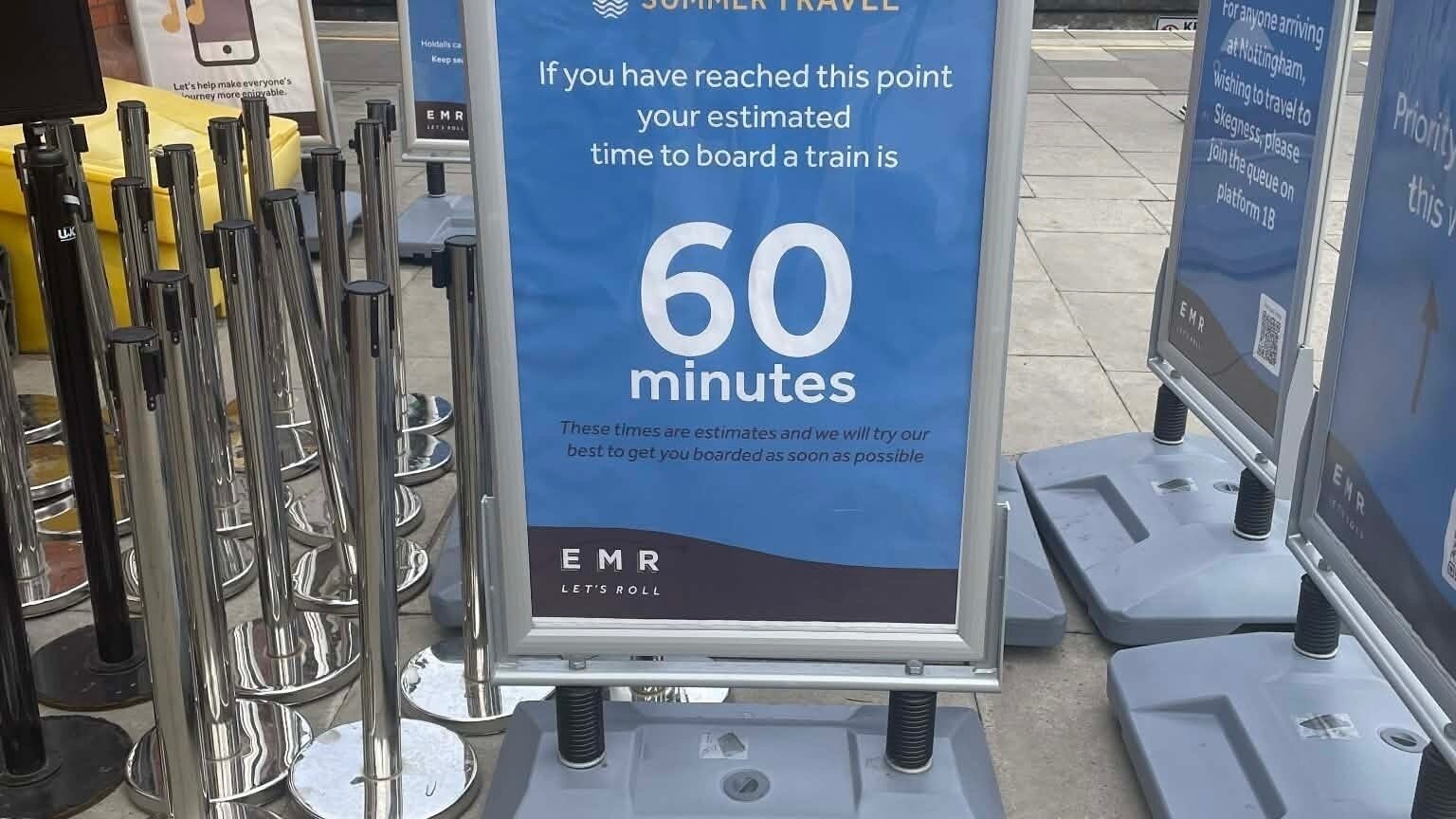
notice a petition has been started regarding the dire overcrowding on the Skegness line and cancellation of this Summer's extra trains or replacement buses..
quote 'Change.org petition'
Back in the old days the summer specials didn’t call at Ely, I don’t know the area but is that to avoid reversal or conflicts?
These were destination Great Yarmouth, normally originating from Birmingham. Any Nottingham (or further west) tended to be sprinter formed using the normal path but extended to Great Yarmouth,
The summer Saturday loco hauled traffic to and from Yarmouth ran via Ely Curve. On summer Saturdays it was the route through Ely North Junction that was nearest to full capacity, and the other services were doing the conflicting.
The summer Saturday traffic was at it peak in the period just after the M&GN closed, starting with summer 1959, and gradually declined from there. In the 1980s it mainly used rolling stock that was borrowed from commuter routes such as Liverpool Street-Cambridge and Kings Cross-Peterborough, which ceased when those routes were electrified.
The weekday service was different. In the 1960s there were only 3 relevant long distance loco hauled cross country trains and they ran via the curve, one each to/from Birmingham, York and Peterborough. However, by the mid 1960s these were running round at Ely. Running via the curve on weekdays was then only done by a few trains until the Norwich-Birmingham loco hauled era 1977-1988, but ended again when the class 156s were introduced.
Shortly after that the track layout was modified to what we have now, including reducing the curve to single track. Following the Newton collision in 1991 there was a long period when the curve could only be used in the westbound direction.
Going via the curve does reduce the number of movements through Ely North Junction from 2 to 1 for each train that does it, but with a loss of connectivity at Ely. The line between Ely and Ely North Junction is bidirectional so some conflicts can be managed: it is possible to have parallel arrivals/departures from/to Peterborough and Kings Lynn or Norwich.
Which brings me to a question about how many mixed traffic lines now accommodate a timetable with trains running on a base 20 minute frequency pattern. There are too many stations between Liverpool and Manchester, and between Chinley and Sheffield to fit in a 20 minute frequency on the faster services.
Just reminiscing slightly, I recall when Liverpool had no direct service to Sheffield at all, and it was only(!) 40 years ago this year that hourly direct trains started. A few of these (all 31 hauled typically 4 coaches) also ran on to Hull, Doncaster, and Norwich. When they first started I often had a bay of 4 seats to myself. Roll on to May 1988 timetable improvements and 156s, standing became commonplace very quickly, and has remained a hallmark of this route ever since.
The route has been a success story from a passenger growth perspective, going from 2 carriages per hour in 1988 to recently ten per hour (in an ideal world) I cant really speak for the route east of Nottingham, but the current 2 trains per hour is adequate for the western half of the route, providing doubled up units run on both the TPE and EMR services. Overcrowding is particularly bad when a 2 car turns up on EMR peak time services.
The construction of the Hazel Grove Chord made it feasible to run from Sheffield into Stockport and get access to platforms 13 and 14 at Manchester Piccadilly. Prior to that the trains from Sheffield ran via New Mills usually into platform 1 at Manchester Piccadilly.
Go back to the early 1960s and there were a few Sheffield Victoria-Liverpool Central services reversing at Manchester Central, including the North Country Continental boat train.
I wonder if another problem is the change in travel patterns into London? It used to be that the London trains were much quieter at the weekends so you could borrow the rolling stock for things like Skegness. Nowadays lesuire travel to the capital and the reduction in weekday commuting means there probably isn't the spare stock at weekends there used to be?
In some ways this pattern probably makes the Liverpool Norwich service "easier" to solve because any extra capacity that can be acquired will likely be well used all week and therfore provide better benefit in any cost benefit analysis.
I wonder if another problem is the change in travel patterns into London? It used to be that the London trains were much quieter at the weekends so you could borrow the rolling stock for things like Skegness. Nowadays lesuire travel to the capital and the reduction in weekday commuting means there probably isn't the spare stock at weekends there used to be?
In some ways this pattern probably makes the Liverpool Norwich service "easier" to solve because any extra capacity that can be acquired will likely be well used all week and therfore provide better benefit in any cost benefit analysis.
Not really as most of the stock is now EMU anyway so would be of little use. As I said earlier, Central trains had Birmingham commuting traffic to take stock from (as it wasn’t needed at the weekend). It was also possible to do some shortening of trains in the holidays. Take the 153 that is strengthening a West Midlands service and send it to Skegness. I haven’t done the route recently but in the week a 3 car (156 + 153) was generally fine. Most services are not booked as 2x 158, so the growth is clearly a nice problem to have.
On that point, Doncaster may not be a must visit destination, but Stockport to Doncaster does provide a way of transferring from the WCML to MML and the ECML.
We are aware of an issue with emails from the Forum to Microsoft-based email accounts (hotmail/outlook/live.com email addresses). This is being looked into currently, thanks for your patience meanwhile.