Except, Sheffield and Rotherham areas are under York ROC, iirc. The middle bit of the Hallam line is, as you say, locally controlled.Outside of the immediate Leeds area, the Harrogate and Hallam lines look they're still under local control.

-
Our new ticketing site is now live! Using either this or the original site (both powered by TrainSplit) helps support the running of the forum with every ticket purchase! Find out more and ask any questions/give us feedback in this thread!
You are using an out of date browser. It may not display this or other websites correctly.
You should upgrade or use an alternative browser.
You should upgrade or use an alternative browser.
Loss of Signalling - Various Across Yorkshire 11/7/26
- Thread starter 43095john
- Start date
- Status
- Not open for further replies.
Sponsor Post - registered members do not see these adverts; click here to register, or click here to log in
R
RailUK Forums
northernchris
Established Member
- Joined
- 24 Jul 2011
- Messages
- 1,558
I only remember one previous occurrence, about 8 years ago when lightning hit York IECC. Has it happened more recently?
There was a similar incident last summer, which also occurred on a hot Saturday afternoon and wiped out most Northern services for the remainder of the day.

GraphitProjekt
Member
Ah thanks! Wasn't aware any of the old PSBs were still working on ECMLAbout 67 miles of the ECML between Stoke Tunnel and north of Shaftholme Jn is still controlled by Doncaster SB.
No doubt this will transfer to York ROC in due course.
Interesting! Did some digging and it also seems the line to Hope is also part of the ROC. I'm rather unsure on the breakdown between panels there, I've seen reference to a Sheffield Outer and Sheffield South in the areaExcept, Sheffield and Rotherham areas are under York ROC, iirc. The middle bit of the Hallam line is, as you say, locally controlled.

Tempest Malice
Member
- Joined
- 12 Dec 2018
- Messages
- 41
Thats a nice diagram of that bit, any chance of a hint for where it came from? (some of the boundaries are a little out of place but it's a good summary of that bit).Interesting! Did some digging and it also seems the line to Hope is also part of the ROC. I'm rather unsure on the breakdown between panels there, I've seen reference to a Sheffield Outer and Sheffield South in the area
View attachment 207590
On the Sheffield south vs. outer question, outer is the name that I belive is current for that workstation, but south may be a name it had earlier in planning when what bits it would split off of sheffield/rotherham may have been less.
Back to the diagram, whilst a reasonable summary of what york roc has in south/west yorkshire, it does miss out other further away workstations:
The south ECML 7 (Kings Cross, Finsbury Park, Wood Green, Langley, Hitchin, Huntingdon, Peterborough) and a few other further out north eastern ones (Hartlepool, Middlesborough, North Lincs (Barnetby - Cleethorpes)).
Back to the topic of this thread; York roc is split into three bits,
- an ECML one covering the 10 workstations across the old york/peterborough/kings cross areas.
- A leeds one containing leed east (which itself might be split in two by now), west, north west, and ardesley.
- And one titled sheffield but containing every other workstation.
GraphitProjekt
Member
Just drawn by myself off of the publicly available sectional appendix and an out of date quail map to help with fringes between boxes. And because of that, the boundaries between panels is rather speculative as SAs (at least the public ones) are not very exact. I did see that the Doncaster/Hambleton fringe seems to be several miles of each track under control of the different boxes so I just had to kind of pick somewhere for the colours to change.Thats a nice diagram of that bit, any chance of a hint for where it came from? (some of the boundaries are a little out of place but it's a good summary of that bit).
I didn't know that about the North East! I never thought to look further than Northallerton. There is also the Brough workstation which I didn't put on either (Howden - Hessle).On the Sheffield south vs. outer question, outer is the name that I belive is current for that workstation, but south may be a name it had earlier in planning when what bits it would split off of sheffield/rotherham may have been less.
Back to the diagram, whilst a reasonable summary of what york roc has in south/west yorkshire, it does miss out other further away workstations:
The south ECML 7 (Kings Cross, Finsbury Park, Wood Green, Langley, Hitchin, Huntingdon, Peterborough) and a few other further out north eastern ones (Hartlepool, Middlesborough, North Lincs (Barnetby - Cleethorpes)).
Yeah I was surprised by the extent of Leeds East, especially considering it's responsible for Leeds platforms whereas Leeds West is just the approaching junctions, negotiation between the two must be quite intense. I vaguely remember people talking about a Leeds Assist panel - not sure what that was about though.Back to the topic of this thread; York roc is split into three bits,
- an ECML one covering the 10 workstations across the old york/peterborough/kings cross areas.
- A leeds one containing leed east (which itself might be split in two by now), west, north west, and ardesley.
- And one titled sheffield but containing every other workstation.
Also it's a bit funny to have Sheffield division responsible for Middlesborough!

26th July - I had a friend get stranded as a resultThere was a similar occurrence, around the same time last year.
I.understand the root cause was a power outage, which affected the Leeds area workstation in the ROC.
How will having the Weaver Network help? Trains will still be the responsibility of a separate body. The problem would be the same as it appears to be now, in that Northern seems to put no effort into seeking to agree ticket acceptance with local bus operator. Why?Northern have the same issues every time there's a major incident, their default response is to issue a do not travel warning as if this absolves them of all responsibility.
Arranging for tickets to be accepted on local buses should be standard (and hopefully will happen once Weaver Network is up and running) as this will enable a significant chunk of passengers to be able to complete their journeys, freeing up staff to assist those where buses aren't viable.
It's evident no-one is holding Northern to account, and it's unacceptable to provide misleading information, although again, Northern have form for this.
MichaelTrains
Member
Update: delay repayment has been accepted with a full refund.I'd contend that it is ethical. The more such events cost the railway real money, perhaps the greater consideration might be given to properly investing so as to minimise or lose altogether the "single point of failure" that is frequently behind such events.
What is required in my opinion is the same sort of thinking applied to keeping things running properly as is applied to trying to achieve 100% safety.
So, despite the near three-hour delay, they have accepted the delay repayment claim.
northernchris
Established Member
- Joined
- 24 Jul 2011
- Messages
- 1,558
How will having the Weaver Network help? Trains will still be the responsibility of a separate body. The problem would be the same as it appears to be now, in that Northern seems to put no effort into seeking to agree ticket acceptance with local bus operator. Why?
Weaver network should join up the transport options, so you would think there would be a better relationship between the bus and train operators which could help during times of disruption. I do think though that Northern's problems come from the senior leadership, so agree that unless the MD is changed there's a risk the problems will continue.
Solent&Wessex
Established Member
- Joined
- 9 Jul 2009
- Messages
- 2,745
At the moment there are multiple bus operators in West Yorkshire alone, sometimes more than one on the same route. Some are large, some are small. Many of the routes are commercial services with no subsidy or control from the combined authority. For these bus operators to accept rail passengers they will want some form of financial reimbursement. This will need a contract of some sorts between Northern and each individual bus operator. Do not underestimate how difficult making a contract or agreement is in the public sector!How will having the Weaver Network help? Trains will still be the responsibility of a separate body. The problem would be the same as it appears to be now, in that Northern seems to put no effort into seeking to agree ticket acceptance with local bus operator. Why?
Once the buses in West Yorkshire are all under the Weaver Network then, in theory, it would only require one contract or agreement to exist, which would make life much simpler. Whilst the publicly owned and controlled rail networks will be different to the publicly owned and controlled bus networks, there is a requirement for GBR to work closely with the combined authorities in the north, and there is likely to be much closer relationships so getting such agreements - which might not even require any financial transactions- will be far easier. It has already happened in Manchester a few times quite easily.
YorkshireBear
Established Member
- Joined
- 23 Jul 2010
- Messages
- 9,662
That's what I was thinking. I'd say this level of outage two summers in the bounce in the same location isn't great. Although no idea if the root cause is the same even if both were power failures.26th July - I had a friend get stranded as a result.
psmith2023
Member
When I was with my sister at blackpool a few months ago there's was a fatal ity near poulton no trains to Leeds from nearly 5 pm till end of service northern refused put on coachs just they just hoped things would be sorted by the last last trains it's it normal for northern to things the cheap way and just hope for the best
Phil Anthtropy
Member
Last Saturday, 11th July, I was trying to travel back to Halifax from Manchester Victoria, I, like many at the time was unaware of any issues until I boarded a very packed 18.57 to Leeds, which was delayed, the crew had no idea what was going on, eventually, the train was cancelled, crew didn't know what for.
It soon became obvious that nothing was moving eastwards beyond Rochdale, leading to mass confusion as the Northern staff on the ground had no idea what was happening, had no information to passengers getting increasingly irate, upset and confused. An hour had passed by until it was leaked that there was a signal failure around Leeds (again).
The Northern staff tried desperately to get information but none was forthcoming, because a "do not travel" had been issued, passengers were, in effect, left stranded, with no trains and no replacement buses forthcoming, passengers became even more angry when the staff on the ground failed to get any managers or supervisors to come and deal with the situation, according to one member of staff, "none of them were answering their phones" given this was less than 1.5 hours before the England game kicked off, suspicions were raised.
I was trying to help a mum and daughter who had just returned from holiday and had 2 big cases with them and were trying to get back to Scarborough, they were very emotional and upset and I think they eventually just went ahead and booked an Uber in the region of £200.
The poor staff on the ground did the best they could but had no help whatsoever from anyone in management, or from the station staff who again, were absent.
Eventually, the 20.57 to Leeds was announced as running, which caused more problems as it was absolutely rammed with people unable to get on or off at stops, the situation made worse by the amount of people trying to get to Leeds, presumably for the football, and also from the thousands swamping Halifax station after the latest concert at the Piece Hall.
Between 18.21 and 21.00, there was only ONE train that left Man Vic to Yorkshire, which of course was absolutely rammed all the way with passengers trapped in the aisles and against the walls etc, there was only another 2 trains that made it out of Manchester to West Yorkshire.
An absolute shambolic state of affairs!
== Doublepost prevention - post automatically merged: ==
And it's not even like these issues are rare, random events, 4 times in the last 12 months alone that I've been stranded due to cancelled or full trains or power/signal/track issues.
Last July, we had to get a taxi from Sheffield to Huddersfield after we had diverted from Hull via Doncaster.
November, had booked seats from Huddersfield to Liverpool return and had to get a taxi back as cancellations meant there was very little chance of getting on trains out of Liverpool as they were all full, there was massive queues just to get anywhere near the platforms.
March and once again, unable to get back from Manchester due to issues on the line.
It's simply not good enough for a supposed developed country.
And would be an outcry across the media, parliament etc if these issues kept happening in and around London!
It soon became obvious that nothing was moving eastwards beyond Rochdale, leading to mass confusion as the Northern staff on the ground had no idea what was happening, had no information to passengers getting increasingly irate, upset and confused. An hour had passed by until it was leaked that there was a signal failure around Leeds (again).
The Northern staff tried desperately to get information but none was forthcoming, because a "do not travel" had been issued, passengers were, in effect, left stranded, with no trains and no replacement buses forthcoming, passengers became even more angry when the staff on the ground failed to get any managers or supervisors to come and deal with the situation, according to one member of staff, "none of them were answering their phones" given this was less than 1.5 hours before the England game kicked off, suspicions were raised.
I was trying to help a mum and daughter who had just returned from holiday and had 2 big cases with them and were trying to get back to Scarborough, they were very emotional and upset and I think they eventually just went ahead and booked an Uber in the region of £200.
The poor staff on the ground did the best they could but had no help whatsoever from anyone in management, or from the station staff who again, were absent.
Eventually, the 20.57 to Leeds was announced as running, which caused more problems as it was absolutely rammed with people unable to get on or off at stops, the situation made worse by the amount of people trying to get to Leeds, presumably for the football, and also from the thousands swamping Halifax station after the latest concert at the Piece Hall.
Between 18.21 and 21.00, there was only ONE train that left Man Vic to Yorkshire, which of course was absolutely rammed all the way with passengers trapped in the aisles and against the walls etc, there was only another 2 trains that made it out of Manchester to West Yorkshire.
An absolute shambolic state of affairs!
== Doublepost prevention - post automatically merged: ==
And it's not even like these issues are rare, random events, 4 times in the last 12 months alone that I've been stranded due to cancelled or full trains or power/signal/track issues.
Last July, we had to get a taxi from Sheffield to Huddersfield after we had diverted from Hull via Doncaster.
November, had booked seats from Huddersfield to Liverpool return and had to get a taxi back as cancellations meant there was very little chance of getting on trains out of Liverpool as they were all full, there was massive queues just to get anywhere near the platforms.
March and once again, unable to get back from Manchester due to issues on the line.
It's simply not good enough for a supposed developed country.
And would be an outcry across the media, parliament etc if these issues kept happening in and around London!
How do you know they refused to buy coaches on?When I was with my sister at blackpool a few months ago there's was a fatal ity near poulton no trains to Leeds from nearly 5 pm till end of service northern refused put on coachs just they just hoped things would be sorted by the last last trains it's it normal for northern to things the cheap way and just hope for the best
They could have attempted to source coaches and all coach companies could have declined to operate any.
MichaelTrains
Member
Apparently, the signalling has gone again.
What a shambles this country is.
What a shambles this country is.
Where?Apparently, the signalling has gone again.
What a shambles this country is.
Leeds and approaches all looks ok?
MichaelTrains
Member
How will having the Weaver Network help? Trains will still be the responsibility of a separate body. The problem would be the same as it appears to be now, in that Northern seems to put no effort into seeking to agree ticket acceptance with local bus operator. Why?
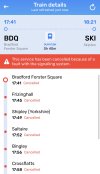
Bradford Forster Square.Where?
Leeds and approaches all looks ok?
Three Skiptons in a row cancelled.
== Doublepost prevention - post automatically merged: ==
I presume the reason is correct.
Why on earth does this happen on a busy Saturday evening?
Attachments
Because the signalling is deliberately designed to fail at the worst possible times. It keeps the engineers in a job.Why on earth does this happen on a busy Saturday evening?
It's a fault, it can't be predicted when it's going to occur.

voyagerdude220
Established Member
- Joined
- 13 Oct 2005
- Messages
- 4,257
How do you know that either Northern refused to or that even coaches were available for short notice hire in the first place? It's by no means uncommon that TOCs have difficulty obtaining replacement road transport when unplanned disruption occurs.When I was with my sister at blackpool a few months ago there's was a fatal ity near poulton no trains to Leeds from nearly 5 pm till end of service northern refused put on coachs just they just hoped things would be sorted by the last last trains it's it normal for northern to things the cheap way and just hope for the best
And just for completeness, this incident was a brief loss of power to a single area which self-restored relatively quickly with the exception of a couple of signals (which trains were being authorised to pass at danger).
A few trains were cancelled to thin out the service to allow repair work to take place. Fully repaired in about 45 minutes. A completely different scale to the incident that started this thread.
A few trains were cancelled to thin out the service to allow repair work to take place. Fully repaired in about 45 minutes. A completely different scale to the incident that started this thread.
GraphitProjekt
Member
A running theme seems to be a brief loss of power, and when things come back on they're broken. But aren't UPSs and such meant to protect against this and allow things to shutdown in a controlled manner?
RichardAsh1981
Member
- Joined
- 28 Oct 2017
- Messages
- 251
You would hope. But then, UPS systems are only as good as their battery maintenance, and you are presuming that the system will start up correctly from cold without human input - which is often harder to ensure than designers realise! Of course all this should be tested, but there are only so many engineering hours, staff and so on.A running theme seems to be a brief loss of power, and when things come back on they're broken. But aren't UPSs and such meant to protect against this and allow things to shutdown in a controlled manner?
matthewjohnson
Member
Another day, another points failure/signal failure on the Leeds to Hull line, around Selby. Been doing this commute for over 12 months now but never known it as bad as the last month or so.
ox_chap
Member
One thing I've never understood is how a system comes back with axle counters, as opposed to track circuits. So, with old track circuits, once everything is restored, presumably it is fail safe, because the train is detected. But if the power goes down, and just at that moment, a train goes past a non-working axle counter, how can the signalman know for sure that the trains are where they are expected when everything is restored? I'm assuming there is a very precise and safe system to deal with this, but I'm curious how it actually works.

Kentish RYS
Member
(Privisio I'm not ops so may have this wro lng) So if you get a complete loss of everything there is effectively a 3rd state as well as occupied and clear. If it is in it a sweep train goes through at caution to check if it is clear. If it has points in the section and the limb not travelled on is beyond a certain length/visibility requirement you need it swept that way as well. If the section is somewhere, for example a track right outside a mechanical box and the signaller can see it all, you can in certain circumstances get an unconditional reset. Also where a section has both axle counters and track circuits you can use the clear track circuit state to reset the axle counters.One thing I've never understood is how a system comes back with axle counters, as opposed to track circuits. So, with old track circuits, once everything is restored, presumably it is fail safe, because the train is detected. But if the power goes down, and just at that moment, a train goes past a non-working axle counter, how can the signalman know for sure that the trains are where they are expected when everything is restored? I'm assuming there is a very precise and safe system to deal with this, but I'm curious how it actually works.
Tempest Malice
Member
- Joined
- 12 Dec 2018
- Messages
- 41
One thing I've never understood is how a system comes back with axle counters, as opposed to track circuits. So, with old track circuits, once everything is restored, presumably it is fail safe, because the train is detected. But if the power goes down, and just at that moment, a train goes past a non-working axle counter, how can the signalman know for sure that the trains are where they are expected when everything is restored? I'm assuming there is a very precise and safe system to deal with this, but I'm curious how it actually works.
Even track circuits don't exactly "detect" a train, but they prove there is no train continuously, effectively in theory cutting the output if it can't prove there is no train (including when it has no input power). And as you have identified, axle counters don't prove continuously so much as well, count only when axle shaped things move in or out.
(Privisio I'm not ops so may have this wro lng) So if you get a complete loss of everything there is effectively a 3rd state as well as occupied and clear. If it is in it a sweep train goes through at caution to check if it is clear. If it has points in the section and the limb not travelled on is beyond a certain length/visibility requirement you need it swept that way as well. If the section is somewhere, for example a track right outside a mechanical box and the signaller can see it all, you can in certain circumstances get an unconditional reset.
I don't think there's much wrong in your summary there, though I can throw in a few more details from a signalling engineering angle. On the whole axle counters handling power outages angle, we first should consider that "the signalling" is not just one system but many of them layered together. So a higher layer can have a problem, and an axle counter can remain powered and working still reporting clear or occupied correctly for when the interlocking and/or control system / panel above it start working again.
Axle counters work using "evaluators", small trackside computers doing the counting for half a dozen or so sections (talking to the actual counters at each end of all the sections it evaluates). These are (usually) on the trackside signalling power supply (so not the same one as the signal box itself, and will typically a failure of it effects a smaller area at a time) which itself should always be redundantly sourced, and often has some amount of generator backup, (and the axle counter kit may have battery/ups backup of it's own too sometimes). But yes as you say as well as storing an internal clear or occupied count, an evaluator can also consider a section in a "disturbed" state (which means it stops updating the count and just reports that section as occupied to the interlocking until that track is reset) for reasons including but not limited to loss of power (the count going negative if more axles appear to leave a section than were in it is another one that springs to mind).
A section that is disturbed (or considered occupied by the evaluator when a signaller has good reason to believe it isn't (previous train through confirmed complete etc.)) can be "reset" (or "restored", one of these words refers to the start of the process and one the completion and I can never remember which way around they go) by the signaller and then as you say each leg of the track (if it has points, or just the whole thing otherwise) need sweeping before the interlocking will clear a signal through that leg again (but the track occupancy count is zeroed as soon as it is reset, just after the restoration protection is set in the interlocking). It is also possible to unconditionally reset an axle counter section if certain reminders are applied to that track in the interlocking first (to cover I.E. engineering work or trains like tampers which may not count correctly), though in these cases there are processes to confirm the track is clear before the signaller should perform the reset.
Also where a section has both axle counters and track circuits you can use the clear track circuit state to reset the axle counters.
There are also some single lines with two sets of axle counters, one for the whole line the others for each track section in turn, and either (so either the counter for the whole single line, or all of the separate ones) showing clear will let you reset the other under a similar principle.

rmHawk765
Member
I am very glad it didn't affect the ECML, given the terrible responses to major disruption we've seen lately...Most interestingly, the whole ECML from Kings Cross to Northallerton is also York ROC and that didn't seem to be affected.
Kentish RYS
Member
Thanks, I am in signalling engineering as well (but worked in some particular sections so not well versed in everything, also typing on here doesn't have quite the same self checking as for something officialI don't think there's much wrong in your summary there, though I can throw in a few more details from a signalling engineering angle.
 ) but you added to my aiming at general folks (and after a day of work, then sorting general life headaches tiredness) explanation.
That I didn't know of, though it rings a vague bell now its mentioned, may have been mentioned by a college or in something I readThere are also some single lines with two sets of axle counters, one for the whole line the others for each track section in turn, and either (so either the counter for the whole single line, or all of the separate ones) showing clear will let you reset the other under a similar principle.
Back to the theme of the thread, I wander if, while there are some large area issue from time time time because of the ROCs, I wander if they suffer from the same issue of 'signalling faults' in the travelling public consciousness in that lots of things are reported as Signalling Faults, and, with ROC covering a large area 'fault' with (insert whichever) ROC controlled signalling appears more than Individual Mechanical 'boxes/Power Signalboxes/Integrated Electronic Control Centers/Area Signalling Centres
- Status
- Not open for further replies.