• Our new ticketing site is now live! Using either this or the original site (both powered by TrainSplit) helps support the running of the forum with every ticket purchase! Find out more and ask any questions/give us feedback in this thread!

AWS fault discussion (relating to 810015 on 1B67 near Bedford)

bengley

Established Member
Joined
18 May 2008
Messages
1,987
Moderator note: Split from

AWS fault as described earlier in the thread

Indeed - the most common of which will be a 'Horn vice bell' which is a right side fault and does not require the driver to stop and report immediately - instead they should report at the first convenient opportunity.

The other types of failures are all 'wrong side' - Bell vice Horn (although the 810 would have likely been running on green signals, so this is unlikely) or no indication received at all - incredibly rare, but possible.

It could have also been a fault with the AWS on the train itself - possibly a TMS (Train Management System) fault indicating an issue or the AWS not cancelling when the driver tried to cancel it.

There are many scenarios but by far the most common one is the one I mentioned above and as I said there is no requirement to stop the train out of course to report that.
 
Last edited by a moderator:
Sponsor Post - registered members do not see these adverts; click here to register, or click here to log in
R

RailUK Forums

Efini92

Established Member
Joined
14 Dec 2016
Messages
2,137
Indeed - the most common of which will be a 'Horn vice bell' which is a right side fault and does not require the driver to stop and report immediately - instead they should report at the first convenient opportunity.

The other types of failures are all 'wrong side' - Bell vice Horn (although the 810 would have likely been running on green signals, so this is unlikely) or no indication received at all - incredibly rare, but possible.
It could have also been a fault with the AWS on the train itself - possibly a TMS (Train Management System) fault indicating an issue or the AWS not cancelling when the driver tried to cancel it.
There are many scenarios but by far the most common one is the one I mentioned above and as I said there is no requirement to stop the train out of course to report that.
It’s also worth noting that the issue could actually be with the tms rather than the actual aws. Hitachi’s seem to be plagued with faults when entering into service.
The Neville hill collision was caused by the driver being distracted whilst trying multiple times to input data into the tms.
The 805’s had a spell of warning of a passenger door being open whilst travelling at speed.
 

D365

Veteran Member
Joined
29 Jun 2012
Messages
13,157
It’s also worth noting that the issue could actually be with the tms rather than the actual aws. Hitachi’s seem to be plagued with faults when entering into service.
AWS/TPWS is always a separate subsystem with its own (electronic) control unit.
 

D365

Veteran Member
Joined
29 Jun 2012
Messages
13,157
On newer trains the AWS/TPWS DMI (TI/F, BRR, etc) "indicator/buttons" are often presented on a TCMS based screen.
Correct, but the control unit (in other words, the brain) is always a standalone item.
 

Fincra5

Established Member
Joined
6 Jun 2009
Messages
2,636
On newer trains the AWS/TPWS DMI (TI/F, BRR, etc) "indicator/buttons" are often presented on a TCMS based screen.
If the 810s follow the 800s (etc), the TWPS & AWS Equipment is separate from the DMI.
 

800301

Member
Joined
29 Dec 2022
Messages
521
Location
Essex
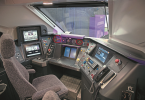
You're right found this image here: https://www.therailwayhub.co.uk/72586/a-look-back-at-810-aurora-units-entering-service/

And circled the button/ indicators and sunflower in red

Quite a few differences from the cab of a GWR 80X.

If there is a fault with the AWS it ‘should’ present it self on the TMS as a fault, the TMS knows if AWS/TPWS has been tripped

If that 810 was operating in ETCS mode the AWS sunflower would be on the DMI not that it would make any difference in how it operates
 

Fincra5

Established Member
Joined
6 Jun 2009
Messages
2,636
Quite a few differences from the cab of a GWR 80X.

If there is a fault with the AWS it ‘should’ present it self on the TMS as a fault, the TMS knows if AWS/TPWS has been tripped

If that 810 was operating in ETCS mode the AWS sunflower would be on the DMI not that it would make any difference in how it operates
Depends on the Fitment. The Hitachi fleet appear to operate with TPWS & AWS separate to the DMI (not STM). So even in Level NTC (AWS/TPWS) you won't necessary get the Sunflower displayed on the DMI.
On the Class 700/717 and 387 (GTR not HX) the TPWS & AWS are built into the DMI display (STM) and have no physical buttons or visuals.
 

D365

Veteran Member
Joined
29 Jun 2012
Messages
13,157
Depends on the Fitment. The Hitachi fleet appear to operate with TPWS & AWS separate to the DMI (not STM). So even in Level NTC (AWS/TPWS) you won't necessary get the Sunflower displayed on the DMI.
On the Class 700/717 and 387 (GTR not HX) the TPWS & AWS are built into the DMI display (STM) and have no physical buttons or visuals.
Correct. Class 66 is the same as Class 810 in that it uses a standalone TPWS DMI and AWS sunflower, despite the onboard ETCS implementation having been originally derived from Class 700.
 

Doubleyellow

Member
Joined
9 Oct 2018
Messages
13
The HEX class 387 uses the right hand side of the ETCS DMI for TPWS button/ indicators and sunflower in SN mode but the retained h/w button/indicators and sunflower during ETCS isolated/ standalone ETCS running.

Crossrail (Elizabeth line CL345) uses a TCMS based DMI for ETCS (including the TPWS indications/ buttons/ sunflower in LNTC TPWS and the CBTC indications in "LNTC" CBTC) [to my memory it doesn't have "standalone" TPWS since they went to full length units and recover in staff responsible or staff accountable (ETCS and CBTC ceiling speed enforced modes respectively)]
 

Top