
YorksLad12
Established Member
"Kids"? I'm 59...It means that kids watching trains don't get in the way of the main people flow.
I'm just impressed there are no food and drink stands on there to help pay for it, as happened at Leeds.

"Kids"? I'm 59...It means that kids watching trains don't get in the way of the main people flow.

Thank god, it'd only be yet another Costa/Starbucks corporate BS."Kids"? I'm 59...
I'm just impressed there are no food and drink stands on there to help pay for it, as happened at Leeds.
Looks good for now, but wait until the dreadful OHLE goes up.A few more photos from the new footbridge at Huddersfield showing the new views that have been opened up which were impossible in the past
[...]
Neil
TfL research shows that at 12 minute frequency (5 services an hour) people perceive a service as truly 'turn up and go'. In other words that don't worry about any timetable and simply rely on the service.
The research was in the context of bus services, but also applies to high frequency train services. Of course some routes don't get that level of frequency because of demand. It's more the human perception of 'turn up and go'.I did say at 20 minutes that people start to, and yes 12 minutes is the standard such should be aimed for.
However, perception of high frequency in London is very different to the rest of the UK (for example there's tube lines with 18tph+ which call at all stations.
Also, I overheard someone complain about how poor their local bus service was one in London and how almost nowhere had such a poor service - it was a service which was 2bph so whilst not great, still better than a lot of people get.
I'd be interested to see how well the bus research held up for trains. At <20 minute frequencies you regularly get buses piling up and weird gaps developing, which would affect perceptions. Could do with being a new thread though!The research was in the context of bus services, but also applies to high frequency train services. Of course some routes don't get that level of frequency because of demand. It's more the human perception of 'turn up and go'.

I am still going to try and be patient and not make a trip until all the June blockades have finished. I am really looking forward to a July trip for the whole route. Really great and pleasing progress.Piles are now in on the new alignment at Neville Hill. Can barely see any piles missing between York and Leeds now.
The compound at Garforth has changed from having piling machines to now all MEWPs (mobile elevated work platforms) so it's clear where the focus is shifting.
Unfortunately I have no choice but to travel Leeds to York four times a week! I do try and wait to do Manchester journeys though.I am still going to try and be patient and not make a trip until all the June blockades have finished. I am really looking forward to a July trip for the whole route. Really great and pleasing progress.

I am still going to try and be patient and not make a trip until all the June blockades have finished. I am really looking forward to a July trip for the whole route. Really great and pleasing progress.


Are you Chris Grayling?Looks good for now, but wait until the dreadful OHLE goes up.
No I'm David Mylchreest. OHLE is not pretty, and the current Network Rail iteration is awful. Designed for a 140mph railway and grossly overspecifieded for any domestic British railwayAre you Chris Grayling?
The routes done after the Great Western are simpler and less cumbersome, not being designed for that speed and taking advantage of lessons learned in that scheme. To my eyes they are still more obtrusive than what was installed by BR.No I'm David Mylchreest. OHLE is not pretty, and the current Network Rail iteration is awful. Designed for a 140mph railway and grossly overspecifieded for any domestic British railway

They probably are more obtrusive as more robust to reduce issues with wires being pulled down?The routes done after the Great Western are simpler and less cumbersome, not being designed for that speed and taking advantage of lessons learned in that scheme. To my eyes they are still more obtrusive than what was installed by BR.
I agree that there are structures which look a lot more intrusive than the rather elegant East Coast electrification, but ultimately we've been paying a maintenance and reliability cost for the lightweight cheap East Coast equipment ever since it was installed. The East Coast electrification nominally supports 140mph, but in practice doesn't quite stay up, and doesn't even come close to supporting the traffic which the Transpennine line has.It might not look too bad around Huddersfield station where I expect it will be mainly hung from the roof structure and in stone cuttings/tunnels.
It's the gargantuan twin-track cantilevers in open country and on embankments which jar, rather than the simpler and lighter single track ones.
No doubt it saves piling for second masts, but they do stand out like sore thumbs, and are already going in on parts of the route.
With speeds no higher than 110mph, you would hope for a more sympathetic design over the hilly sections.
Nothing modern quite matches the light 1960s lattice portal structures on the southern WCML, now handling 125mph.
HS1 OHLE is also quite light and supports 186mph.
To my eyes also!To my eyes they are still more obtrusive than what was installed by BR.
Again, I agree.It might not look too bad around Huddersfield station where I expect it will be mainly hung from the roof structure and in stone cuttings/tunnels.
It's the gargantuan twin-track cantilevers in open country and on embankments which jar, rather than the simpler and lighter single track ones.
No doubt it saves piling for second masts, but they do stand out like sore thumbs, and are already going in on parts of the route..

The East Coast electrification nominally supports 140mph
I agree that there are structures which look a lot more intrusive than the rather elegant East Coast electrification, but ultimately we've been paying a maintenance and reliability cost for the lightweight cheap East Coast equipment ever since it was installed. The East Coast electrification nominally supports 140mph, but in practice doesn't quite stay up, and doesn't even come close to supporting the traffic which the Transpennine line has.
Ultimately we've stepped back a long way from the worst examples on GW. The TTCs mostly seem to be there to help with signal sighting rather than reduce piling, and there's a bit less bulk to them when they are there. They are materials which are designed to become less intrusive with age, and we are seeing them at their newest and most intrusive.
For me though, the biggest thing which makes the newer equipment look bad is that I'm seeing it on cab ride videos, which is almost certainly the worst possible view. You get a close-up of every single piece of equipment as you pass it, and the forward view shows more masts disappearing into the distance than you could see from anywhere else on earth. It's probably worth waiting to judge it in a couple of years, and from a more typical viewpoint.

Indeed. And there is nothing natural about a monocrop field either.Although, people do appear to take a different view when n it comes to 180,000 miles of dry stone walls we have in the UK - and they are very much part of the industrialisation of our countryside.
Crusher run - aka 2 inch fill - followed by weak mix?The video shows work to infill the underpass at Batley -----

Leeds to Manchester has always been painfully slow. I seem to recall that improving it has been claimed many times over the years but without much benefit.To me - these are very key benefits.
Manchester to York journey will be cut by 14 mins down to 63 mins
Leeds to Manchester journey will be cut by 10 mins down to 41 mins
Whilst you might not need the bulky structures for Transpennine Line speeds I would suggest you might went meatier structures up on the exposed areas of the Pennines as it can get pretty rough weather wise up thereWith speeds no higher than 110mph, you would hope for a more sympathetic design over the hilly sections.
Nothing modern quite matches the light 1960s lattice portal structures on the southern WCML, now handling 125mph.
HS1 OHLE is also quite light and supports 186mph.


All our yesterdays - as I was reminded by an old article in the Railway Magazine of 11th August 2023 itself reprinting a long article from their October 1986 edition "Manchester - the Divided City". It reminds that the Hazel Grove chord had just been opened in May 1986 to improve the Sheffield - Manchester - Liverpool service. The year after the double tracks through Dore & Totley station were singled to create a bottleneck that took almost 40 years to remove.Even so, The current Leeds to Manchester time is still faster than Sheffield to Manchester. EMR is 52 minutes, with TPE taking 54 minutes.
From the archive: Manchester – The divided city
by
Alex Bestwick
–
11th October 2023
October 1986: Martin Bairstow describes railway developments in Greater Manchester which have so far fallen short of bridging the gap between north and south.
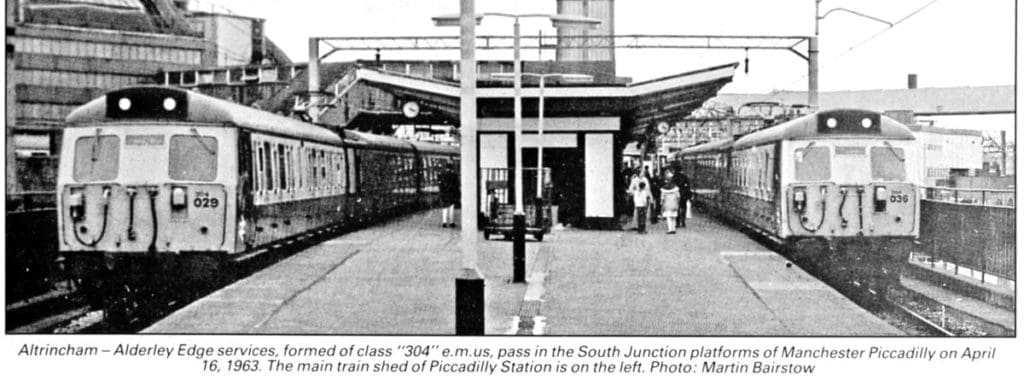
ONE of the legacies left by the early railway builders was the failure in many cities to bring all lines into a common terminus. Often tracks from different directions stopped short of the city centre leaving through passengers to walk from one station to another. When the Manchester & Leeds Railway opened in 1839-41, it started from Oldham Road Station about 11/4 miles to the east of the Liverpool & Manchester Railway terminus at Liverpool Road. Fortunately this east—west barrier was breached as early as 1844 when the two railways were brought together at Victoria Station.
When trains began to arrive in Manchester from the south and from the Woodhead route in the early 1840s they were accommodated at the fore-runner of todays Piccadilly Station. Despite the subsequent construction. mainly for freight. of the South Junction Line (Piccadilly to Ordsall Lane) and the Miles Platting to Ashburys branch. there has never been any effective communication between Piccadilly and Victoria Stations.
Article continues below…
Advert
Enjoy more The Railway Magazine reading every month.
Click here to subscribe & save.
The practical effects of this omission include the virtual exclusion of towns north of Manchester. such as Bolton. Bury, Oldham and Rochdale. from the “InterCity” network. A local train to Victoria. then having to allow at least thirty minutes to cross the city by bus. is a poor start to a journey no matter how attractive the main-line services may be once Piccadilly is reached.
Until recently. the services operating from Victoria appeared to monopolise the most run-down classes of diesel multipleunit. Only the Bury line is electrified on the unique 1,200V d.c. side—contact third rail. In contrast Piccadilly services are largely electrified at 25,000V a.c. and even enjoy better-appointed d.m.us on other routes. The north side has the greater number of run-down unstaffed intermediate stations while Victoria itself has not been fully repaired from bomb damage sustained during the second world war. Although Piccadilly is certainly superior to Victoria in practically every respect, the fundamental problem is that neither of them penetrates the city centre.
Greater Manchester was one of four conurbations chosen to be bestowed with a Passenger Transport Executive under the Transport Act 1968 and the PTE was in existence for some five years before the creation of the Greater Manchester County Council in 1974. With slightly different boundaries and rejoicing in the name of South East Lancashire & North East Cheshire the old PTE was responsible for the “Picc-Vic“ scheme.
Article continues below…
Advert
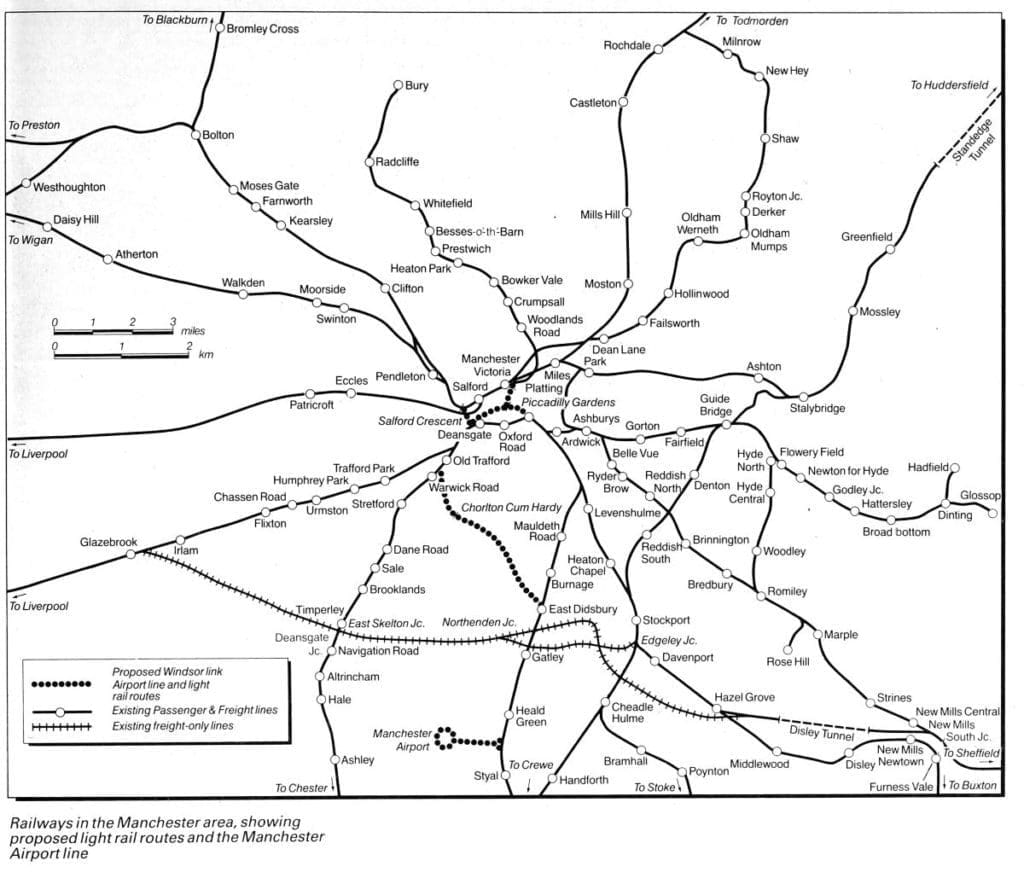
This involved a double—track tunnel electrified at 25,000 Volts leaving the Stockport line near Ardwick and passing through lowlevel platforms at Piccadilly. through three stations in the town centre. then underneath Victoria before surfacing on the Bury line which was to be converted to a.c. electrification. The former route from Radcliffe to Bolton was also to be incorporated into the project. During a period when the Government approved parallel schemes in Liverpool. Newcastle and Glasgow. Manchester was very disappointed to have finance for the “Picc-Vic“ project refused in 1973. It would have been completed in 1978.
Instead. by the late 1970s. the “Picc-Vic“ scheme had been first postponed and then abandoned. leaving BR and the PTE to come up with a cheaper alternative in the form of the Castlefield curve. Linking Deansgate and Salford this would have offered the desired connection between Piccadilly and Victoria but would go round rather than through the city centre and for that reason was opposed by Manchester City Council which wanted rail access into the commercial and shopping centres. BR also had reservations about the Castlefield proposal because of the capacity of the double-track “South Junction“ line between Piccadilly and Deansgate. The idea died.
Having placed “Picc-Vic” as the central feature of its railway development plans Greater Manchester PTE found itself subject to planning blight. There was talk of closures. Oldham-Rochdale. Manchester-Wigan via Atherton. and Guide Bridge-Romiley (lslyde loop) services appeared vulnerable. Only Oldham-Rochdale has gone through the TUCC machinery but that was rescued in 1972 by a “temporary” PTE grant. Despite threats to withdraw this support. particularly after the “Picc-Vic“ fiasco. the line is still in operation and has seen developments.
Article continues below…
Advert
Piecemeal improvements to local rail services have happened throughout the PTE era. In 1971 the off—peak frequency on the Manchester-Altrincham line was increased from three to four trains per hour to coincide with the conversion of this. Manchester‘s busiest suburban line. from d.c. to a.c. electrification. A bus-rail interchange was opened at Altrincham in 1976.
Then 1977 saw a doubling of frequency on the Manchester—Glossop—Hadfield service which was then still d.c. operated as part of the former Woodhead route but which has since been converted to a.c. A station at Hattersley was brought into use in 1978 to serve new housing. This was quite expensive to build being situated in a deep cutting. The previous year a station had opened at Brinnington on the New Mills line.
The year 1979 saw the introduction of a local service between Manchester and Rochdale to supplement the trains running to Leeds via the Calder Valley and also a half-hourly service between Manchester and Shaw.
Article continues below…
Advert
A further bus-rail interchange was opened at Bury in 1980 when the railway was diverted from the former Bolton Street Station to a new island platform beneath the bus station.
In 1981 electrification was extended from Stockport to Hazel Grove giving that town a through service to Oxford Road and Altrincham although a casualty of that investment was a reduction in the diesel service beyond Hazel Grove to Whaley Bridge.
In 1981 Greater Manchester PTE announced proposals to build eight wooden-platform unstaffed stations on existing lines. Those at Humphrey Park. Mills Hill. Derker. Smithy Bridge. Flowery Field and Ryder Brow were opened by the end of 1985. Smithy Bridge is on the site of an earlier station closed in 1960 while Mills Hill had previously booked its last passenger as long ago as 1842. Then, as now. it was the nearest point of the railway to Middleton which lost its own branch line in 1964. Further new stations are planned.
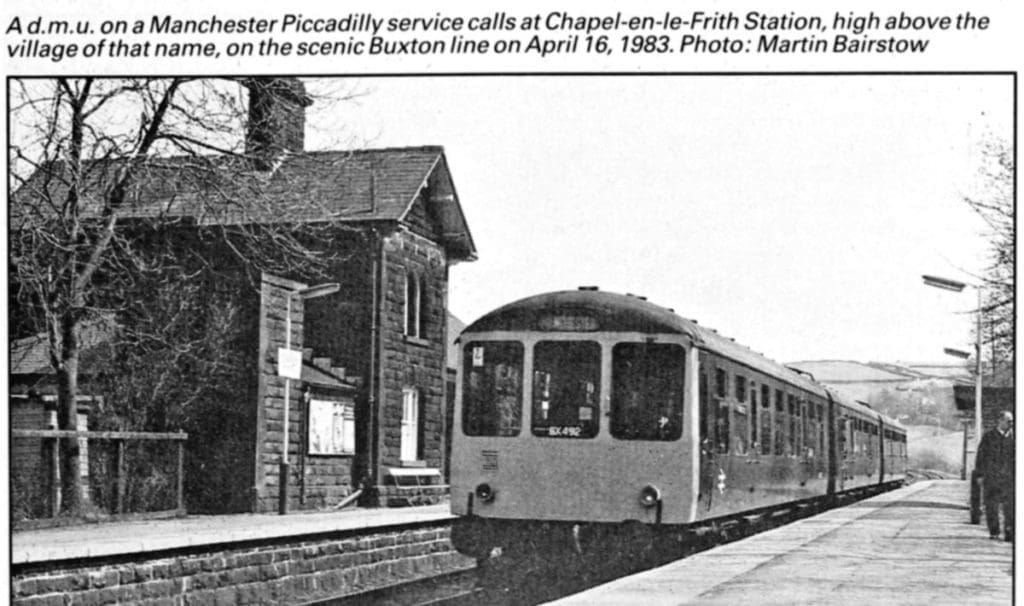
A new generation of diesel multiple-unit entered service on the Manchester- Oldham/Rochdale service in September 1985 in the form of the class “142″ fourwheel sets. These are essentially a widebodied variant of the “141” version introduced in West Yorkshire in 1984. They have 122 seats (against 94 on the class “141″) which is fractionally more than the classic d.m.us which they are replacing. Especially by contrast with their immediate predecessors based at Newton Heath depot. the new trains are cleaner, vibrate less and have better acceleration. They ride well on continuous-welded track but bounce on crossings and rail joints.
Further class “142” units. mostly painted in Greater Manchester orange livery, took over the Manchester—Rose Hill/New Mills operation in March 1986. Within the next two or three years. all “classic” d.m.us are to be replaced by “14X” four-wheelers on local workings or by “15X” class “sprinter” units on medium-distance services. This, together with service improvements and the additional stations. will combine to make the Manchester railway network a brighter affair than previously. However, they will do nothing to connect the two networks to the north and south.
Current thinking on that subject is twofold. Main-line services would be concentrated on Piccadilly Station while some local lines would be converted into a cross-city light railway system.
The Hazel Grove chord. opened in May 1986. is a first stage in the rerouting of a number of main-line trains. Courtesy of a new single-track connection to the east of Hazel Grove Station and to the reopening to passengers of the line through Disley Tunnel. most Sheffield—Manchester expresses have been rerouted via Stockport. a traffic centre in its own right and a useful interchange point. They have also been extended to Liverpool via Warrington and improved to a regular hourly interval.
In 1988. the “Windsor Link”. a new halfmile double-track connection. will open between Deansgate and a new station at Salford Crescent. This will permit trains to Bolton. Blackpool. Blackburn and Wigan to start from Piccadilly rather than Victoria Station. and will probably result in through workings from Buxton to Blackpool using “Sprinter” sets.
It had been hoped that Manchester- Blackpool electrification would be authorised but this had been refused by the Government despite offers of financial assistance from Greater Manchester and Lancashire County Councils and despite a plan to save cost by arranging for trains to coast through the 295—yard twin Farnworth Tunnels where the clearance necessary for 25kV electrification would have involved major expenditure. This refusal will perpetuate locomotive changes at Preston on both London—Blackpool and Manchester- Scotland trains and will prevent the full potential of the “Windsor Link” from being realised. With electrification trains to Blackpool would have run through from Stoke or other points on the electrified network south of Manchester.
To complete the transfer of InterCity traffic from Victoria to Piccadilly. it is envisaged that the “Trans—Pennine” services from the Huddersfield route to Liverpool and North Wales will travel via Stalybridge. Guide Bridge. Piccadilly and Deansgate. This would leave only the Bury electrics. the Oldham and Rochdale services and trains to Bradford via the Calder Valley using Victoria. The latter would run through to Salford Crescent to connect with trains from Piccadilly via the Windsor Link.
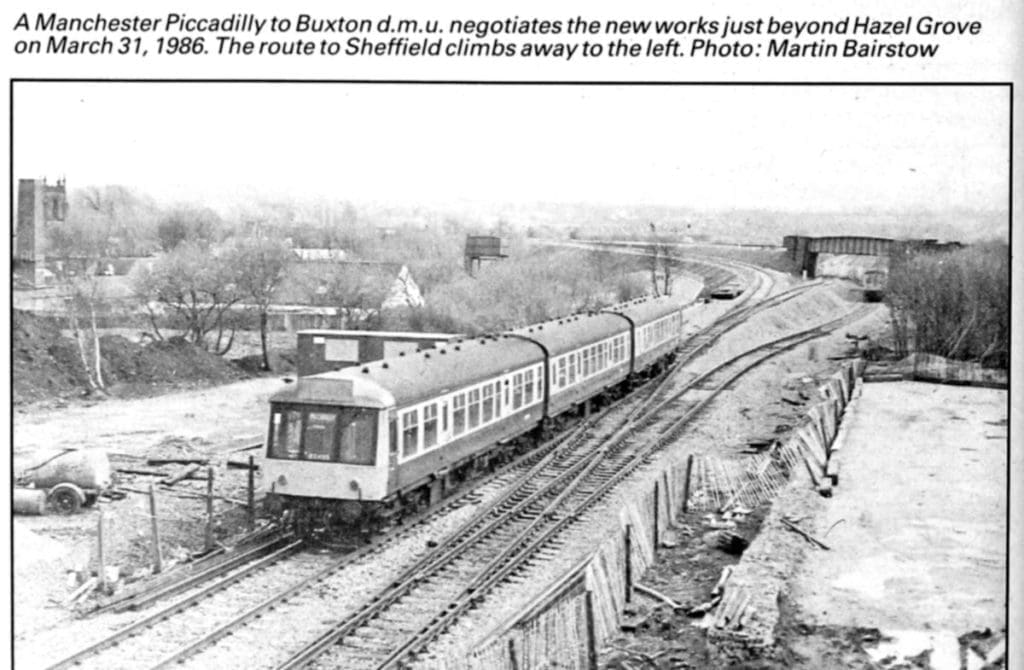
It would. however. impose considerable strain on the “South Junction” line between Piccadilly and Deansgate. To help alleviate this. it has been suggested that the hourly d.m.us from Chester via Altrincham might approach Piccadilly by the present freight only link between Navigation Road and Stockport. increasing the range of services and connectional opportunities at Stockport. Further relief of the South Junction line would have to await transfer of the Altrincham electrics to the proposed light railway system.
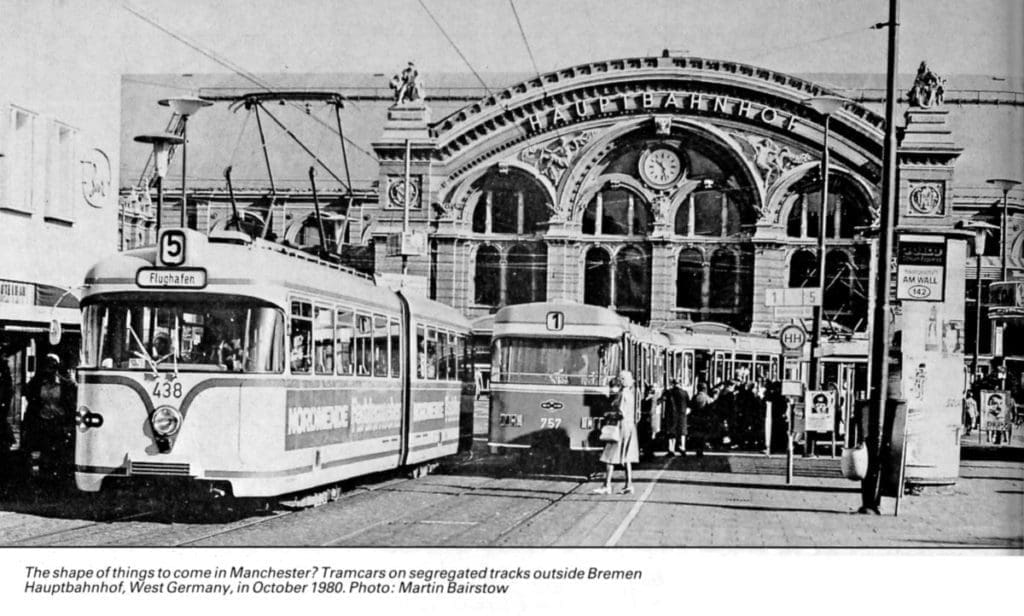
The light railway would cross the city centre at street level largely on segregated tracks through the pedestrian precincts. This is very much a continental solution for bringing the rail service direct into the central area. A basic off-peak timetable would offer a ten-minute frequency on all routes (twenty minutes between Oldham Mumps and Rochdale). enhanced at peak hours. Overhead electric supply would be at 1,500V d.c. (750V in the city centre) and the trains would be able to use either street level or normal railway station platforms.
It is envisaged that two-car articulated trains would operate between Bury and Rose Hill/Marple. between Rochdale. Oldham and East Didsbury using a stretch of the former Midland main line out of Manchester Central closed in 1967. and from Altrincham to Glossop/Hadfield.
Rail links to major international airports are vital because potential railway passengers literally drop out of the sky without cars and. in many cases. wish to travel long distances. Apart from Gatwick. airports tend not to be alongside existing railways and it is (or ought to be) a priority that any railway development plans should include airport links.
Manchester‘s airport. Ringway. is the most important in the North of England and BR is preparing a submission to the Government for funds to construct a loop from the Styal line. electrified at 25kV.
Fares policy in Greater Manchester has been described as “moderate“. Though lower than national BR levels. fares are nothing like as cheap as those in certain other Metropolitan Counties. An annual “Saver“ ticket valid on both trains and buses in Greater Manchester and at one or two stations just beyond costs between £250 and £380 according to the zones. The equivalent in West Yorkshire costs £180). In South Yorkshire abolition of the County Council caused a 2 ‘/2-fold fare increase from April 1 but there was no immediate change in Manchester. There is no Greater Manchester equivalent to the West Yorkshire “Day Rover“ which is issued to children at 50p and which has turned local (and InterCity) trains there into a playground. There is however a “Peak Wayfarer” ticket at £275 with reduction for families giving a days bus and rail travel through Greater Manchester and much of Derbyshirc and Cheshire.
Greater Manchester is one of the PTEs which has favoured investment rather than ultra-cheap fares.
Article Tags:
From the archive, Greater Manchester, The Railway Magazine
About the Author
Contact: alex.bestwick@kelsey.co.uk
Are you Chris Grayling?
OHLE can be Pretty. Weaver to Glasgow and the French high speed lines did it very elegantly.No I'm David Mylchreest. OHLE is not pretty, and the current Network Rail iteration is awful. Designed for a 140mph railway and grossly overspecifieded for any domestic British railway
Though I’m not aware of there being frequent problems with the 1974-vintage equipment over Beattock - which can’t be appreciably less hostile.Whilst you might not need the bulky structures for Transpennine Line speeds I would suggest you might went meatier structures up on the exposed areas of the Pennines as it can get pretty rough weather wise up there
