• Our new ticketing site is now live! Using either this or the original site (both powered by TrainSplit) helps support the running of the forum with every ticket purchase! Find out more and ask any questions/give us feedback in this thread!

What does 6 and 3 stub platforms at Euston mean for hs2?

The Planner

Veteran Member
Joined
15 Apr 2008
Messages
19,634
The London to Chester train will still be one of the eight passenger trains an hour each way passing through Colwich but it will continue to use the West Coast Main Line not HS2. It will continue to terminate at the West Coast Main Line Euston Station not HS2 Euston so the number of HS2 trains an hour North of Birmingham will be six not seven.


At present they keep insisting that HS2 will join the West Coast Main Line at Handsacre Junction which means they will be stuck with the current limits on the number of freight and passenger trains between Stafford and the combined HS2 and Trent Valley Lines. If they want to use the full capacity of HS2 and get all the West Coast Main Line capacity benefits which were the reason to build HS2 they need to connect HS2 to the West Coast Main Line between Norton Junction and Crewe.
This isn't new though, phase 1 was always ending at Handsacre with the proviso of going further soon after.
 
Sponsor Post - registered members do not see these adverts; click here to register, or click here to log in
R

RailUK Forums

Nottingham59

Established Member
Joined
10 Dec 2019
Messages
3,326
Location
Nottingham
It has been stated that 6 platforms at HS2 Euston support up to 10 trains per hour and it was previously stated that 10 platforms at HS2 Euston would support up to 16 trains per hour. It is stated anywhere how many trains per hour could terminate at HS2 Euston with 7, 8 or 9 platforms?
Those numbers generally come from assuming 2tph off each platform plus spare. So 10tph needs 5 platforms + 1 = 6.

The original spec for the full Y HS2 was 18tph, needing 9 platforms plus 2 spare gave the orginal requirement for 11 platforms. This was squeezed down in a later iteration to 1 spare, so 10 platforms overall.
 

HSTEd

Veteran Member
Joined
14 Jul 2011
Messages
20,269
As I said back when the 11 platform variant was replaced by the 10 platform variant, what planners are willing to commit to now in terms of achievable station capacity is not necessarily the same as what will prove possible to timetable in practice.
 

The Ham

Veteran Member
Joined
6 Jul 2012
Messages
12,021
9 platforms gives you 38 minutes to turn a train around on average. Or 30 minutes to turn them round plus 2 spares.

The issue isn't the total number but rather 3 are limited to half length with no certainty that they could ever be altered to be full length platforms.

There's questions about stuff being placed so that they can't (on superseded plans, so may have changed), if that's still the case then that could cause issues in the future when there's a need for more full length trains.

The cost of that passive provision should be fairly limited now but could save billions in the future.

Or they are incompetent and got it wrong.

There’s tonnes of evidence of that throughout the project.

Most of the cost increases aren't linked to engineering poor design, but rather to MP meddling, not having suitable planning reforms (so 60 lorry movements over 12 weeks, so not much more than is seen for bin collection can cause planning permission to be refused) and so on.

Spending resources now for infrastructure that won't be used for decades (if ever) reduces the resources society has to spend on other things.

Although the cost to ensure there's passive provision to facilitate 400m platforms rather than the space be (say) 370m is likely to be limited.

No one is saying the 3 sub platforms have to be built to 400m now, just to ensure that:
a) the split in platform lengths is about right for now - which many have said is right and few have pushed back too much
b) that there's scope to extend them in the future.

This is a bit of a reach. Do we know of any new Birmingham - Wales services planned?

If it had gotten to Crewe, that would be a material time saving for North Walians, even with a change. Current plan, less compelling (nominally a bit quicker but probably not worth getting off a direct service for)

Travel times to Crewe (like Liverpool, Manchester and Scotland) will see journey times to/from London cut by around 20 minutes. The extra to Crewe would be around 32 minutes.

The difference comes when changing trains is that there's currently around 7 trains a day from North Wales to London, soit's those using such a service aren't going to be changing trains.

However, many people will accept a change of train over waiting for the next direct train which could be over 40 minutes away.

250 sounds sensible.

At what cost though, to reopen the negotiations are likely to add at least 5% to the cost with some suggesting up to 20% and for limited benefits.

The number of seats isn't as big as the train length difference suggests (and really mostly only impacts Manchester) and due to the 30 minutes journey time saving there's scope for a trains to arrive to leave Manchester 10 minutes later than the first train on the day currently does, for it to arrive into London 20 minutes earlier than it currently does to then facilitate 1 extra morning train.

That would be on top of the fact that the 7:15 could be arriving at 8:57 vs 9:27 and so would be already +1 train within a core arrival time.

A similar thing can be done at the end of the day to allow later night departures from Euston to Manchester without the arrival time to Manchester being any later (just 20 minutes later from Euston).

And whilst that's shortening the overnight maintenence window, not by much (40 minutes at Euston but 0 minutes at Manchester) and it'll still be longer than pre covid maintenence window.

Even then the overall risk is likely to be low, for example as the track is built to modern standards (and with far fewer junctions) the need to maintain should be reduced, but even if not, it may mean that an extra few nights a year where there'll have to do maintenence to avoid cancelling these services, or they are canceled during the summer holidays when the demand will be lower.

That's probably an easier win than having some 250m long trains which won't fit in the sub platforms (unless we spend more money on infrastructure now as well) but will be far too short to fill the full length ones.

---------------------------------------------

The other point raised by some about ECML having lots of capacity, the London to North East regional travel is already over 25% higher than pre covid and based on HS2's growth models (2.5% growth per year) if 2009 was 100 passengers:
2025 HS2 model 148
2025 actual seen 174

Also:
2024 (calender year) to 2025 (calender year) growth rate seen is 12.6%.

Also even at 2.5% growth to double passenger numbers (so every 5 coach train is 9 or 10 and you'd need every 9 or 10 coach train to also have a second 9 or 10 coach train) would take 28 years.

If 5 coach services made up half of the services (so two trains one of 100 and one of 50) we'd only need to increase passenger numbers by 1/3rd (to be two trains of 100) which would take just 12 years.

Yet at 4% (which if we consider the 12% seen in the latest set of data would be fairly small) that falls to just 8 years.

That also assumes that there's some 5 coach trains already running to those places along the ECML so they can absorb the extra passengers which would otherwise be squeezed off the current 9/10 coach sets.

As such, whilst it may take 40 years to build (although I hope not) passenger numbers aren't going to take that long to get there (even growth of 0.7% pwe year gets us to the plus 1/3rd) and so having low cost passive provision isn't a stupid thing to do.
 

Mgameing123

Member
Joined
29 Apr 2023
Messages
1,031
Location
Denmark
There was always going to be through running to Edinburgh and Glasgow in particular as well as Liverpool and Newcastle - and the train splitting risks reliability as well.

And 18 trains an hour doesn’t exactly leave a lot of slack in case of delays - you’re basically screwed if a train enters the high speed section 90 seconds behind schedule.
Do you really think though that trains won’t have like to wait for 10 minutes before continuing onto HS2?
 
Joined
2 Feb 2019
Messages
1,039
There was always going to be through running to Edinburgh and Glasgow in particular as well as Liverpool and Newcastle - and the train splitting risks reliability as well.

And 18 trains an hour doesn’t exactly leave a lot of slack in case of delays - you’re basically screwed if a train enters the high speed section 90 seconds behind schedule.
True but most services would have run entirely on HS2 infrastructure (including Birmingham to Manchester and Leeds). I wouldn't be surprised if the theoretical maximum capacity of the high speed line was designed to be closer to 24tph, so probably some slack for things being out of sequence.

The splitting for Edinburgh/ Glasgow always seemed like chaos waiting to happen, though.

The final service specification for 2035 on page 133 of the business case was 17tph from London Euston including 3tph to Birmingham, 6tph to Eastern leg destinations and 8tph to Western leg destinations.

Excluding the dropped Eastern leg this was 11tph from London Euston which was 3x400m Birmingham, 3x400m Manchester, 1x200m Liverpool, 1x400m Liverpool+Lancaster dividing at a 400m platform at Crewe, 2x400m Glasgow+Edinburgh calling at a 400m platform at Preston and dividing at a 400m platform at Carlisle plus 1x200m to Stafford, Stoke-on-Trent and Macclesfield. Three dividing 400m trains an hour each way, two at Carlisle and one at Crewe as a result of trying to cram 17tph into HS2 Euston. I agree this always seemed like chaos waiting to happen.

Also planned 3tph from Birmingham Curzon Street including 2x200m to Manchester and 1x200m alternating Edinburgh and Glasgow.

If HS2 is extended to just South of Crewe it would be possible to come close to the capacity delivered by this plan even with six platforms at HS2 Euston.

AIUI they do not want to change the order for the 54 200m sets so they need a plan that would use these and make an additional order for some 250m sets. They could for instance use the 54 200m sets for the 3x400m HS2 Euston to Birmingham, the 2x200m HS2 Euston to Liverpool and run 1x400m HS2 Euston and Old Oak Common non-stop to Preston dividing at Preston into 1x200m each for Edinburgh and Glasgow for a fast hourly London to Scotland service. This would only need one 400m platform at Preston and would be far less operationally risky than the original plan.

Additional 250m sets could then be used for 2tph HS2 Euston to Manchester 1tph HS2 Euston to Edinburgh/Glasgow and 1tph Birmingham Curzon Street to Glasgow/Edinburgh, the latter two alternating between Edinburgh and Glasgow and serving all stations Crewe to Carlisle inclusive to avoid the need for the additional HS2 Euston to Lancaster train and provide stopping London and Birmingham to North West England and Scotland services.

This would be 9tph in total for HS2 Euston supplemented by 1tph Birmingham Curzon Street to Edinburgh/Glasgow. Deliverable with the planned six platforms at HS2 Euston.

2tph could continue to run London Euston to Manchester via Stoke-on-Trent on the West Coast Main Line as now and the two CrossCountry services each hour could run with new rolling stock with at least 600 seats per train Birmingham New Street to Manchester Piccadilly via Stoke-on-Trent.

They need to have a plan like this to get the full operational benefits of the around 100 billion pounds of taxpayers' money being invested building HS2. They can deliver this with six platforms at HS2 Euston but it will have to involve some investment in infrastructure additional to that currently planned and some additional 250m trains.


Attachments

  • HS2W.png
    HS2W.png
    114.2 KB · Views: 17
Last edited:

The Planner

Veteran Member
Joined
15 Apr 2008
Messages
19,634
Ignore what those diagrams for phase 1 say. Its going to have many many iterations yet.
 

Nottingham59

Established Member
Joined
10 Dec 2019
Messages
3,326
Location
Nottingham
If HS2 is extended to just South of Crewe it would be possible to come close to the capacity delivered by this plan even with six platforms at HS2 Euston.
The tragedy is that even with an extension to just south of Crewe, the infrastructure north of Crewe cannot possibly handle that amount of traffic.
 

The Ham

Veteran Member
Joined
6 Jul 2012
Messages
12,021
The tragedy is that even with an extension to just south of Crewe, the infrastructure north of Crewe cannot possibly handle that amount of traffic.

Which is why almost nobody thought cutting phase 2a to Manchester was a good idea.
 
Joined
2 Feb 2019
Messages
1,039
The tragedy is that even with an extension to just south of Crewe, the infrastructure north of Crewe cannot possibly handle that amount of traffic.

There are two long distance trains each way each hour between Crewe to Manchester Piccadilly, the Avanti train to/from London Euston and the Transport for Wales train to/from Cardiff Central. There are two Avanti trains each way each hour between London Euston and Liverpool via Crewe. There are two Avanti trains each way each hour between Crewe and Scotland, one to/from London Euston via the Trent Valley and one via Birmingham. I do not know if a third train each hour could at present run between Crewe and Scotland.
 

HSTEd

Veteran Member
Joined
14 Jul 2011
Messages
20,269
Although the cost to ensure there's passive provision to facilitate 400m platforms rather than the space be (say) 370m is likely to be limited.

No one is saying the 3 sub platforms have to be built to 400m now, just to ensure that:
a) the split in platform lengths is about right for now - which many have said is right and few have pushed back too much
b) that there's scope to extend them in the future.
But the cost of "passive provision" for a 250m platform that can be extended to 400m is likely to be significant.

There is no guarantee that the 250m platforms will be practical to extend at all without substantial spending on "passive provision".

It might not offer traditional "intercity" turnaround times, but I think it highly likely that 18 trains per hour can be timetabled into a station with 6 400m platforms and 3 250m platforms.

Some sets will have to be shorter, obviously, but a 200m TGV M or similar can still fit 740 seats in a single class configuration, suitable for Birmingham shuttles.
 
Last edited:

The Ham

Veteran Member
Joined
6 Jul 2012
Messages
12,021
But the cost of "passive provision" for a 250m platform that can be extended to 400m is likely to be significant.

There is no guarantee that the 250m platforms will be practical to extend at all without substantial spending on "passive provision".

It might not offer traditional "intercity" turnaround times, but I think it highly likely that 18 trains per hour can be timetabled into a station with 6 400m platforms and 3 250m platforms.

Some sets will have to be shorter, obviously, but a 200m TGV M or similar can still fit 740 seats in a single class configuration, suitable for Birmingham shuttles.

According to here:


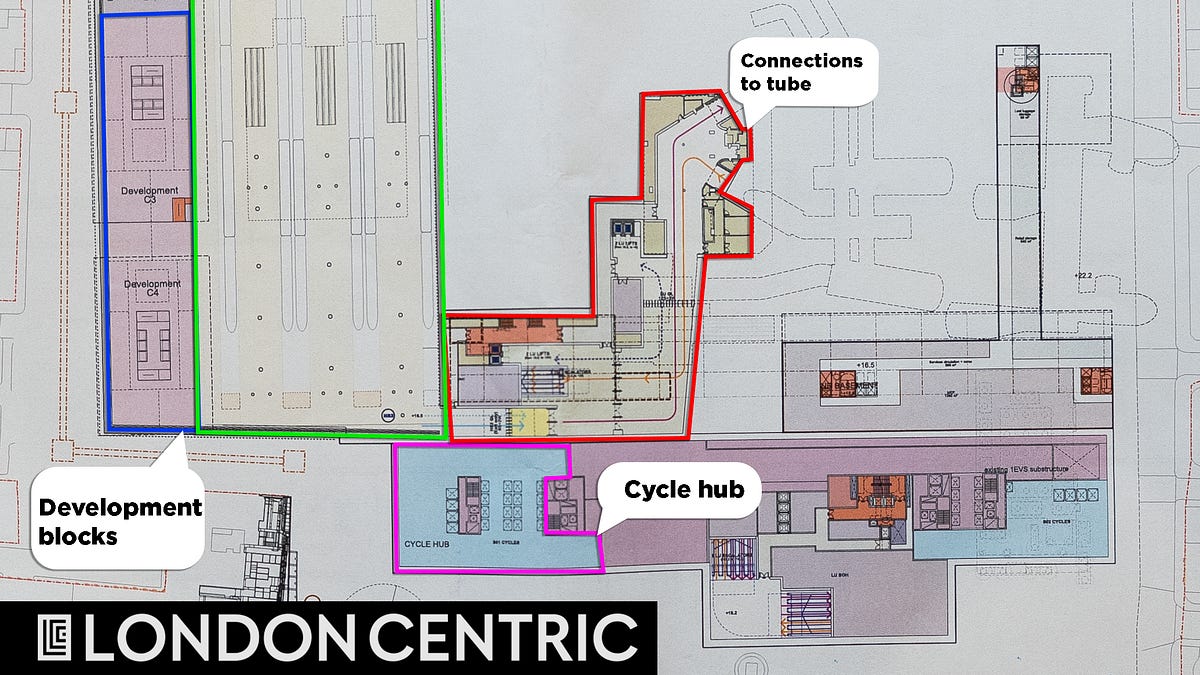
There will also be the option to add three extra half-length platforms in the future, potentially to enable services to Manchester or Scotland. Under the current plans these could never be expanded to full length platforms as the required space would instead be taken up with new commercial buildings, permanently limiting HS2’s capacity.

That sounds more like thru could be have been allowed to have passive provision if the plans (which the article goes on to say are now superseded) were different and instead of having a focus for maximising commercial buildings but rather platform lengths.

The impact of which is unlikely to be significant (arguably the value of commercial space would be higher with the potential of greater footfall from longer platforms vs the extra space which could be leased).

Even if it was were to be better to have commercial space until such time as it was required to have the longer platforms, why not use temporary or semi temporary construction methods which could be removed without causing (presumably) structural issues when the platforms needed extending.

Also within the article it says:

“The station could hit capacity constraints within six years of operation,” warned a confidential internal briefing in late 2025. The document, seen by London Centric, continued: “That would likely mean TfL would have to object to commercial development plans in the local area and would limit the ability of HS2 to run additional services… thus hindering the potential expansion of the network and impacting the Midlands and the North to a greater extent.”

Which could actually mean that the value of the commercial tower blocks (which is talked about as key to the private investment needed to find the station) might be reduced if there's overcrowding within the station as it might not be easy to get to and from.

6 years after opening isn't a timeline which should ever be the case for a new infrastructure project to be hitting capacity issues. It's close enough that things will likely start to be noticeable whilst the buildings are starting to be marketed, even if people haven't seen this article and others linked to it.
 

HSTEd

Veteran Member
Joined
14 Jul 2011
Messages
20,269
That sounds more like thru could be have been allowed to have passive provision if the plans (which the article goes on to say are now superseded) were different and instead of having a focus for maximising commercial buildings but rather platform lengths.
"Passive provision" could have been made if the station plans were redone on a different basis, yes.
But given we are now on... three? failed designs for Euston station, wanting yet another redesign to get 3 150m platform extensions that might never be needed seems like a bad plan to me.

If the redesign is not to result in a bodge with which we will be stuck forever, it could easily add months or years to the timeline - and there is always the risk that any new design will fail just as the older ones did.

6 years after opening isn't a timeline which should ever be the case for a new infrastructure project to be hitting capacity issues. It's close enough that things will likely start to be noticeable whilst the buildings are starting to be marketed, even if people haven't seen this article and others linked to it.
As far as I can tell, these limitations aren't to do with HS2 capacity, it's to do with the lack of any funding for a total reconstruction of Euston tube station. The number of platforms that are built does not directly impact that, although removing commercial floor space may or may not ease footfall requirements.

Of course TfL could just be using these questions about capacity as a lever to get more money out of central government, so we must take them with a big pinch of salt.
 

The Ham

Veteran Member
Joined
6 Jul 2012
Messages
12,021
"Passive provision" could have been made if the station plans were redone on a different basis, yes.
But given we are now on... three? failed designs for Euston station, wanting yet another redesign to get 3 150m platform extensions that might never be needed seems like a bad plan to me.

If the redesign is not to result in a bodge with which we will be stuck forever, it could easily add months or years to the timeline - and there is always the risk that any new design will fail just as the older ones did.

Looking at the images:


Euston-leaked-plan-2(1).jpg

It appears to be the case that it's one of access (as the lift cores appear to go down to ground level).

It should therefore be a fairly easy thing to design a high level podium with primary access via escalators and a few lifts which shuttle a few levels.

These levels could include:
HS2 platform level
Ground (station access) level
Podium level (which could also include retail to offset the loss of office space)
Commercial office access level

On the image shared there's an orange boundary line (top left), within it there's 4 boxes (presumably lifts to HS2 platform level) whilst within the green box these are shown in pairs.

Presumably if there were more sets there wouldn't be the need for them to be a block of 4.

Likewise, if there was another shaft location (at the point where the boundary lines are) you could have 3 lift shafts serving 3 platforms.

Anyway, the point being is that given there's been so many designs (including stations with far more full length platforms) that the designs are still showing a potential significant capacity constraint which if designed well needn't be the case.

To be fair, the main issue is that it impacts all 3 short platforms, even if it only impacted 2 of the 3 that would be better (and obviously if it only impacted one that would be better still).

This shouldn't bebeing designed as an office with a station, it should be a station with an office.

As far as I can tell, these limitations aren't to do with HS2 capacity, it's to do with the lack of any funding for a total reconstruction of Euston tube station. The number of platforms that are built does not directly impact that, although removing commercial floor space may or may not ease footfall requirements.

Of course TfL could just be using these questions about capacity as a lever to get more money out of central government, so we must take them with a big pinch of salt.

I'm not sure that we should necessarily be taking TfL numbers with a big pinch of salt.

HS2 phase 2a to Crewe was due to open in 2027.

From a baseline of 100 HS2 had assumed that long distance passenger numbers would be 156 in 2027.

According to TfL numbers the tube use at Euston has increased from that same baseline of 100 to 163 in 2025 (so not only 2 years earlier but at 2.89% higher effectively sightly more than 3 years, as annual growth was expected to be 2.5% a year).

Now 2025 could be a freak year, given the significant (24%) growth rate, seen, it should also be noted that 2018 to 2019 saw an equally large spike (+30%) and so 2024 had already significantly surpassed the 2018 tube numbers by nearly 1/3.

However TfL (for projects like Crossrail 2) don't use growth rates of 2.5%, they use 1.4% growth.

As such, even comparing the 2009 baseline of 100 to 2040 the expected tube numbers should have been 154.

Which means that even if 2026 sees a fall off 6% and zero growth until 2040 then passenger numbers in the tube are gong to be on target.

Only, by adding commercial floor space (and not just small amounts) that's likely to grow growth beyond just HS2 would be adding and even with lots of people switching at Old Oak Common just an average extra 50 people per train (10tph in each direction, over a 14 hour operational day, over 360 days a year) is an extra 5 million tube passengers a year (+12% vs 2025).

Only, even a fairly lightly loaded 5 coach train, say 30% full, is likely to be carrying 150 passengers and previous expectations were that 85% of passengers would be transferring to the tube, even if that train was 100% full at Old Oak Common (508 passengers) and they all transfer to the tube there, then 15% of that would be 76 (i.e. walking, cycling, taxi or other nice of departure), that's still 74 wishing to join the tube at Euston, which is more than the 50 assumed above.

Happy to discuss where I may be off with the numbers, however I'm not sure we can disregard TfL's concerns by assuming that their numbers can be taken with a big pinch of salt.

Yes, they may well be after more funding, however, they may have a good reason for that. Although, with their own passenger numbers for rail are good (including Elizabeth Line numbers which are at least 5 years ahead of where they were expected to be) they can also be putting in their own money.

Ofcourse, the success of the Elizabeth Line means that on key links (i.e. from it to hub stations like Euston) passenger growth could be significant.

It's why Crossrail 2 (which many have been saying should open at somepoint close to when HS2 does, even if that's one of the later phases) is also key to be delivered (plus 10% capacity to the tube network and directly relieved Euston).

Given TfL aren't asking for that too, that's another reason that I'm not sure that they are overstaying their case for the tube.

 

SynthD

Established Member
Joined
4 Apr 2020
Messages
2,016
Location
UK
Three dividing 400m trains an hour each way, two at Carlisle and one at Crewe as a result of trying to cram 17tph into HS2 Euston. I agree this always seemed like chaos waiting to happen.
Has that been discussed on the forum before? It doesn’t sound chaotic to me because it’s one of the fundamentals that has stuck around.
get 3 150m platform extensions that might never be needed seems like a bad plan to me.
Where does that prediction come from?

If there isn’t room for 9 platforms and ground floor lifts for the development above, what was supposed to happen for 10 or 11 platforms? Or is there a greedy grab for more ground floor space in the development now?
 

HSTEd

Veteran Member
Joined
14 Jul 2011
Messages
20,269
Where does that prediction come from?

If there isn’t room for 9 platforms and ground floor lifts for the development above, what was supposed to happen for 10 or 11 platforms? Or is there a greedy grab for more ground floor space in the development now?
Well, the 10 and 11 platform efforts apparently failed to produce a truly workable design, so I'm not sure we can assume anything about the buildability of such a station.
 

SynthD

Established Member
Joined
4 Apr 2020
Messages
2,016
Location
UK
Well, the 10 and 11 platform efforts apparently failed to produce a truly workable design, so I'm not sure we can assume anything about the buildability of such a station.
That goes to what was said before about an office with a station versus a station with an office. What’s making it unworkable seems to be a wish that a better plan exists, regardless of the costs of trying to discover it. Do we know any of the flaws of the previous efforts? The one I know is insufficient development floor space under the height limit that applies to a portion of the site.
 

HSTEd

Veteran Member
Joined
14 Jul 2011
Messages
20,269
That goes to what was said before about an office with a station versus a station with an office. What’s making it unworkable seems to be a wish that a better plan exists, regardless of the costs of trying to discover it. Do we know any of the flaws of the previous efforts? The one I know is insufficient development floor space under the height limit that applies to a portion of the site.
Well, as I recall, both schemes demonstrated rapid divergent cost growth before they were cancelled.

The first plan has rapid increases in projected cost beyond the planned value and was cancelled and replaced with the second cheaper design. That design then also demonstrated rapid cost growth and was in turn axed, and now here we are.

Such runaway growth in costs is a bad sign regarding the design actually being buildable.
 

AndrewE

Established Member
Joined
9 Nov 2015
Messages
7,302
There are two long distance trains each way each hour between Crewe to Manchester Piccadilly, the Avanti train to/from London Euston and the Transport for Wales train to/from Cardiff Central. There are two Avanti trains each way each hour between London Euston and Liverpool via Crewe. There are two Avanti trains each way each hour between Crewe and Scotland, one to/from London Euston via the Trent Valley and one via Birmingham. I do not know if a third train each hour could at present run between Crewe and Scotland.
Unfortunately not... the only train northbound from Crewe on the WCML each hour for most of the day is the Birmingham to Scotland service. Allegedly the Euston-Glasgows via the Trent valley were so overloaded that "they" dealt with it by withdrawing the stops at Crewe!

A second train north of Crewe has been sought for a long time, something like a Birmingham-Preston is needed at least. Warrington to Wigan is the most congested part of the WCML, so fitting anything extra in is always going to be a challenge.
 
Joined
2 Feb 2019
Messages
1,039
Unfortunately not... the only train northbound from Crewe on the WCML each hour for most of the day is the Birmingham to Scotland service. Allegedly the Euston-Glasgows via the Trent valley were so overloaded that "they" dealt with it by withdrawing the stops at Crewe!

A second train north of Crewe has been sought for a long time, something like a Birmingham-Preston is needed at least. Warrington to Wigan is the most congested part of the WCML, so fitting anything extra in is always going to be a challenge.
I meant there are two Avanti trains each hour each way taking paths on the West Coast Main Line between Crewe and Scotland.
 

Austriantrain

Established Member
Joined
13 Aug 2018
Messages
1,786
It mean trains will have to carefully planned but the full capacity of the (non ATO) route will still likely be achievable.

Without ATO we are looking at seventeen paths per hour.

In Tokyo they manage fifteen with four platforms....

Having platforms of different lengths makes utilising capacity as much as possible significantly harder.
 

Top