"Passive provision" could have been made if the station plans were redone on a different basis, yes.
But given we are now on... three? failed designs for Euston station, wanting yet another redesign to get 3 150m platform extensions that might never be needed seems like a bad plan to me.
If the redesign is not to result in a bodge with which we will be stuck forever, it could easily add months or years to the timeline - and there is always the risk that any new design will fail just as the older ones did.
Looking at the images:

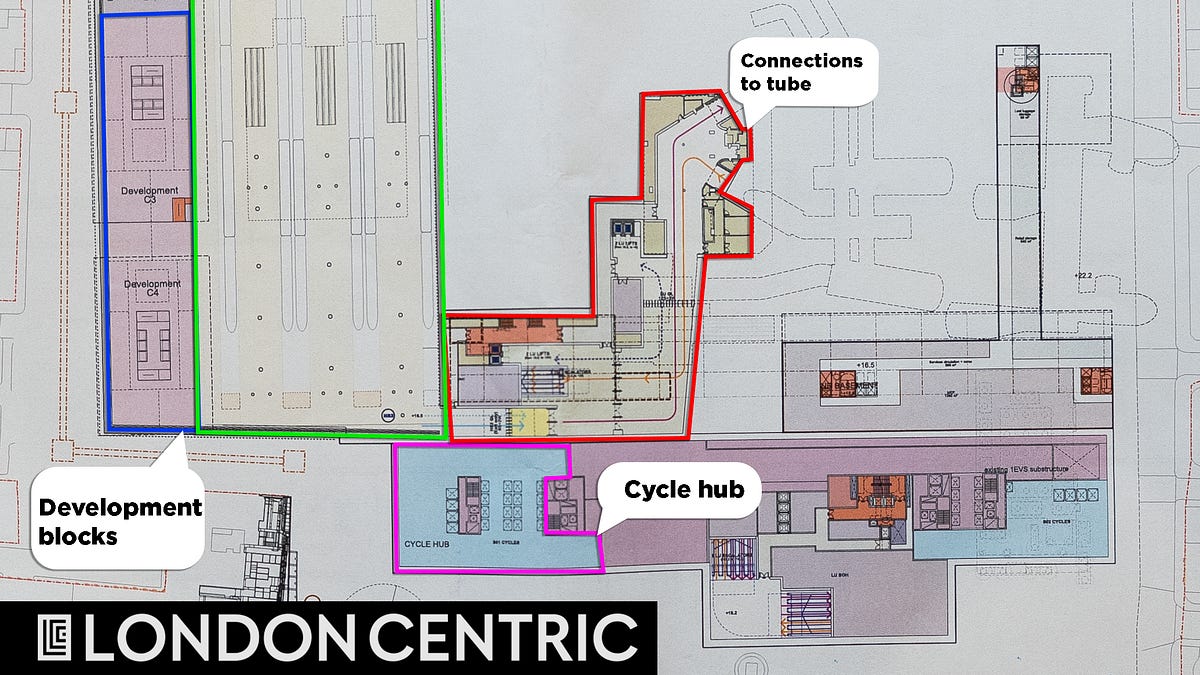
It appears to be the case that it's one of access (as the lift cores appear to go down to ground level).
It should therefore be a fairly easy thing to design a high level podium with primary access via escalators and a few lifts which shuttle a few levels.
These levels could include:
HS2 platform level
Ground (station access) level
Podium level (which could also include retail to offset the loss of office space)
Commercial office access level
On the image shared there's an orange boundary line (top left), within it there's 4 boxes (presumably lifts to HS2 platform level) whilst within the green box these are shown in pairs.
Presumably if there were more sets there wouldn't be the need for them to be a block of 4.
Likewise, if there was another shaft location (at the point where the boundary lines are) you could have 3 lift shafts serving 3 platforms.
Anyway, the point being is that given there's been so many designs (including stations with far more full length platforms) that the designs are still showing a potential significant capacity constraint which if designed well needn't be the case.
To be fair, the main issue is that it impacts all 3 short platforms, even if it only impacted 2 of the 3 that would be better (and obviously if it only impacted one that would be better still).
This shouldn't bebeing designed as an office with a station, it should be a station with an office.
As far as I can tell, these limitations aren't to do with HS2 capacity, it's to do with the lack of any funding for a total reconstruction of Euston tube station. The number of platforms that are built does not directly impact that, although removing commercial floor space may or may not ease footfall requirements.
Of course TfL could just be using these questions about capacity as a lever to get more money out of central government, so we must take them with a big pinch of salt.
I'm not sure that we should necessarily be taking TfL numbers with a big pinch of salt.
HS2 phase 2a to Crewe was due to open in 2027.
From a baseline of 100 HS2 had assumed that long distance passenger numbers would be 156 in 2027.
According to TfL numbers the tube use at Euston has increased from that same baseline of 100 to 163 in 2025 (so not only 2 years earlier but at 2.89% higher effectively sightly more than 3 years, as annual growth was expected to be 2.5% a year).
Now 2025 could be a freak year, given the significant (24%) growth rate, seen, it should also be noted that 2018 to 2019 saw an equally large spike (+30%) and so 2024 had already significantly surpassed the 2018 tube numbers by nearly 1/3.
However TfL (for projects like Crossrail 2) don't use growth rates of 2.5%, they use 1.4% growth.
As such, even comparing the 2009 baseline of 100 to 2040 the expected tube numbers should have been 154.
Which means that even if 2026 sees a fall off 6% and zero growth until 2040 then passenger numbers in the tube are gong to be on target.
Only, by adding commercial floor space (and not just small amounts) that's likely to grow growth beyond just HS2 would be adding and even with lots of people switching at Old Oak Common just an average extra 50 people per train (10tph in each direction, over a 14 hour operational day, over 360 days a year) is an extra 5 million tube passengers a year (+12% vs 2025).
Only, even a fairly lightly loaded 5 coach train, say 30% full, is likely to be carrying 150 passengers and previous expectations were that 85% of passengers would be transferring to the tube, even if that train was 100% full at Old Oak Common (508 passengers) and they all transfer to the tube there, then 15% of that would be 76 (i.e. walking, cycling, taxi or other nice of departure), that's still 74 wishing to join the tube at Euston, which is more than the 50 assumed above.
Happy to discuss where I may be off with the numbers, however I'm not sure we can disregard TfL's concerns by assuming that their numbers can be taken with a big pinch of salt.
Yes, they may well be after more funding, however, they may have a good reason for that. Although, with their own passenger numbers for rail are good (including Elizabeth Line numbers which are at least 5 years ahead of where they were expected to be) they can also be putting in their own money.
Ofcourse, the success of the Elizabeth Line means that on key links (i.e. from it to hub stations like Euston) passenger growth could be significant.
It's why Crossrail 2 (which many have been saying should open at somepoint close to when HS2 does, even if that's one of the later phases) is also key to be delivered (plus 10% capacity to the tube network and directly relieved Euston).
Given TfL aren't asking for that too, that's another reason that I'm not sure that they are overstaying their case for the tube.