
• Our new ticketing site is now live! Using either this or the original site (both powered by TrainSplit) helps support the running of the forum with every ticket purchase! Find out more and ask any questions/give us feedback in this thread!

Spending tax money - good and bad value?

Bletchleyite

Veteran Member
Joined
20 Oct 2014
Messages
112,941
Location
"Marston Vale mafia"
On the Railcard thread I allude to the principle that for the economy rail subsidy may not always be the best value.

My suspicion, though not proven, is along these lines:
  • Capital subsidy for major South East projects like the Elizabeth Line probably is good value in terms of promoting economic growth by enabling movement in parts of the country which contribute very highly to the economy.
  • Capital subsidy for smaller but low cost projects (e.g. reinstating a line that is essentially already there) such as East West Rail or the Ashington line may also be good value.
  • Operating subsidy for the railway as a whole possibly is much worse value, and it may bring more to the economy to put that subsidy into other things like bus travel (as it delivers accessibility of employment to more people than rail per pound spent) and the NHS (to get people out of the workforce through physical or mental illness back into it).
I'm not advocating closing anything so this shouldn't form part of the debate, but it would feed into questions like whether the Scottish "removal" of Anytime fares would be good economic value in England, or whether the proposed 0930 cap on the Senior Railcard is a sensible thing. Obviously dedicated threads should be used for specific discussion of those things, this is more about the general question.

I am deliberately ignoring HS2 here because its mismanagement may result in it being poor value despite the idea of it potentially being good value - it's a bit complex and would cloud the general question, and of course has its own threads.

(Thread on 0930 restriction: https://www.railforums.co.uk/thread...a-fair-solution-be.302899/page-2#post-7810537)

Thoughts?
 
Sponsor Post - registered members do not see these adverts; click here to register, or click here to log in
R

RailUK Forums

Bantamzen

Established Member
Joined
4 Dec 2013
Messages
10,488
Location
Cheshire
On the Railcard thread I allude to the principle that for the economy rail subsidy may not always be the best value.

My suspicion, though not proven, is along these lines:
  • Capital subsidy for major South East projects like the Elizabeth Line probably is good value in terms of promoting economic growth by enabling movement in parts of the country which contribute very highly to the economy.
  • Capital subsidy for smaller but low cost projects (e.g. reinstating a line that is essentially already there) such as East West Rail or the Ashington line may also be good value.
  • Operating subsidy for the railway as a whole possibly is much worse value, and it may bring more to the economy to put that subsidy into other things like bus travel (as it delivers accessibility of employment to more people than rail per pound spent) and the NHS (to get people out of the workforce through physical or mental illness back into it).
I'm not advocating closing anything so this shouldn't form part of the debate, but it would feed into questions like whether the Scottish "removal" of Anytime fares would be good economic value in England, or whether the proposed 0930 cap on the Senior Railcard is a sensible thing. Obviously dedicated threads should be used for specific discussion of those things, this is more about the general question.

I am deliberately ignoring HS2 here because its mismanagement may result in it being poor value despite the idea of it potentially being good value - it's a bit complex and would cloud the general question, and of course has its own threads.

(Thread on 0930 restriction: https://www.railforums.co.uk/thread...a-fair-solution-be.302899/page-2#post-7810537)

Thoughts?
Here's the thing, there is little tangible benefit to people living away from the south east confining subsidies to just that area. It doesn't generate jobs elsewhere, it doesn't help people feed their families, pay for their homes and domestic bills. What it does is further compress the highest earning employment into a small area, that already requires people with substantial incomes to move to where the better employment prospects are. Improving public transport through subsidy around the rest of the country will increase social mobility, widen people's scope for new employment, and maybe even encourage some businesses (albeit not the financial sector which is unwilling to move it seems) to expand into new areas and generate new employment. But this isn't something that's going to give returns in terms of 5, 10 or 15 years. It will need very long term strategies to work, but is increasingly necessary especially as youth unemployment is spiralling out of control.

Whether or not it is considered value in trying to improve employment prospects away from the south east through better mobility can be debated, but in reality it is something that needs tackling. Otherwise the economic gap between the south east and the rest of the country will grow, and that will not benefit the nation as a whole.
 

Harpo

Established Member
Joined
21 Aug 2024
Messages
3,735
Location
Newport
My suspicion, though not proven, is along these lines:
  • Capital subsidy for major South East projects like the Elizabeth Line probably is good value in terms of promoting economic growth by enabling movement in parts of the country which contribute very highly to the economy.
  • Capital subsidy for smaller but low cost projects (e.g. reinstating a line that is essentially already there) such as East West Rail or the Ashington line may also be good value.
  • Operating subsidy for the railway as a whole possibly is much worse value, and it may bring more to the economy to put that subsidy into other things like bus travel (as it delivers accessibility of employment to more people than rail per pound spent) and the NHS (to get people out of the workforce through physical or mental illness back into it).
So, expenditure in the South East=good, elsewhere=not good. Sounds familiar.

For anyone who didn’t see it in Modern Railways I commend John Morris’s excellent detonation of this myth which concludes:

And unless the UK finally confronts the institutional logic that always protects London first, it will keep paying that price again and again.

London will be fine. It always is. It is the rest of the country that will live with the consequences.


35B

Established Member
Joined
19 Dec 2011
Messages
5,362
The thread is meaningless, because there's no meaningful definition of "value for money". If it is on the basis of a return on capital, then your hypothesis may be correct, but there are then significant other factors that need to be considered that are very hard to capture in a business case-style analysis - and which cut to the heart of the principles of benefit/cost analysis.
 

Bletchleyite

Veteran Member
Joined
20 Oct 2014
Messages
112,941
Location
"Marston Vale mafia"
The thread is meaningless, because there's no meaningful definition of "value for money". If it is on the basis of a return on capital, then your hypothesis may be correct, but there are then significant other factors that need to be considered that are very hard to capture in a business case-style analysis - and which cut to the heart of the principles of benefit/cost analysis.

The original premise which resulted in this being created was "promoting economic growth" which allows benefits like increased tax revenue without increasing individual tax burden. However I suppose we can work with multiple premises - take your pick!

As a capitalist country such decisions are usually made financially in some way.
 

35B

Established Member
Joined
19 Dec 2011
Messages
5,362
The original premise which resulted in this being created was "promoting economic growth" which allows benefits like increased tax revenue without increasing individual tax burden. However I suppose we can work with multiple premises - take your pick!

As a capitalist country such decisions are usually made financially in some way.
Communist and socialist countries also did so - just using a different set of weights in the calculations.

Ultimately, the devil here is absolutely in the detail - hence the importance of definitions.

My view is conditioned by two factors:
1. Expenditure on public transport, and especially rail, tends to disproportionately benefit middle and higher income groups
2. The cost/benefit calculations that have done so much since the Victoria Line to help identify value for money are reaching their limits of usefulness as raw affordability becomes more of an issue.

As @Harpo points out, the purely economic analysis biases the conclusion to the scale of large conurbations, meaning that cost/benefit analyses will tend to support the mega projects because of the sheer scale of London. Schemes like Ashington or Ebbw Vale have shown how smaller, cheaper, schemes have delivered significant benefits both in purely economic terms, but also by opening up connectivity to areas whose deprivation is partly due to being detached from economic centres.

To me, the interesting question is how one mega project sits against a larger number of smaller projects, and what impact that has in other ways - economic activity, connectedness, poverty. My hunch is that those smaller projects will rarely justify the attention that the mega projects get, and therefore the sample will be skewed towards favouring the mega projects anchored in London and the SE
 

66701GBRF

Member
Joined
3 Jun 2017
Messages
913
Adding pretty colours, shapes or symbols to roads I would say is a waste of tax payers money.
 

Bletchleyite

Veteran Member
Joined
20 Oct 2014
Messages
112,941
Location
"Marston Vale mafia"
Adding pretty colours, shapes or symbols to roads I would say is a waste of tax payers money.

One could question the value of it however the cost of it is very low so it is really noise level. The cost of doing one zebra crossing would probably cover the cost of filling one pothole, while if the crossing needed repainting anyway the cost may effectively be zero.

It's absolutely noise level compared with funding even a tiny increase in a train service.
 

Farigiraf

Member
Joined
23 Jul 2023
Messages
1,141
Location
Bridge on the River Cam
Operating subsidy for the railway as a whole possibly is much worse value, and it may bring more to the economy to put that subsidy into other things like bus travel (as it delivers accessibility of employment to more people than rail per pound spent) and the NHS (to get people out of the workforce through physical or mental illness back into it).
Railways that are bad value to the taxpayer are only so because they're likely to be in a bad state. A well-used railway will always bring more money to the economy through wider benefits than it costs to run. Closing unprofitable lines and focusing on road/bus travel may provide short-term gain but in the long-term you're likely to lose money as buses aren't as efficient at transporting people, don't contribute as much to urban regeneration and are less effective at driving modal shift. That leads to depopulation of rural areas too, as more people choose to move into the city they work in, as commuting options are poor. Examples: France and Spain, plus Scotland too if Ember & Citylink abstract too many passengers from ScotRail.

There are of course some edge cases such as the Stranraer line, a line that's disproportionately long and high-maintenance for the size of the town it serves, but even there if the train was more frequent and more comfortable than long-distance buses, it would be used much more and would likely turn a profit (not through ticket sales, but for the wider economy through Stranraer increasing in footfall & business).
 
Last edited:

66701GBRF

Member
Joined
3 Jun 2017
Messages
913
One could question the value of it however the cost of it is very low so it is really noise level. The cost of doing one zebra crossing would probably cover the cost of filling one pothole, while if the crossing needed repainting anyway the cost may effectively be zero.

It's absolutely noise level compared with funding even a tiny increase in a train service.
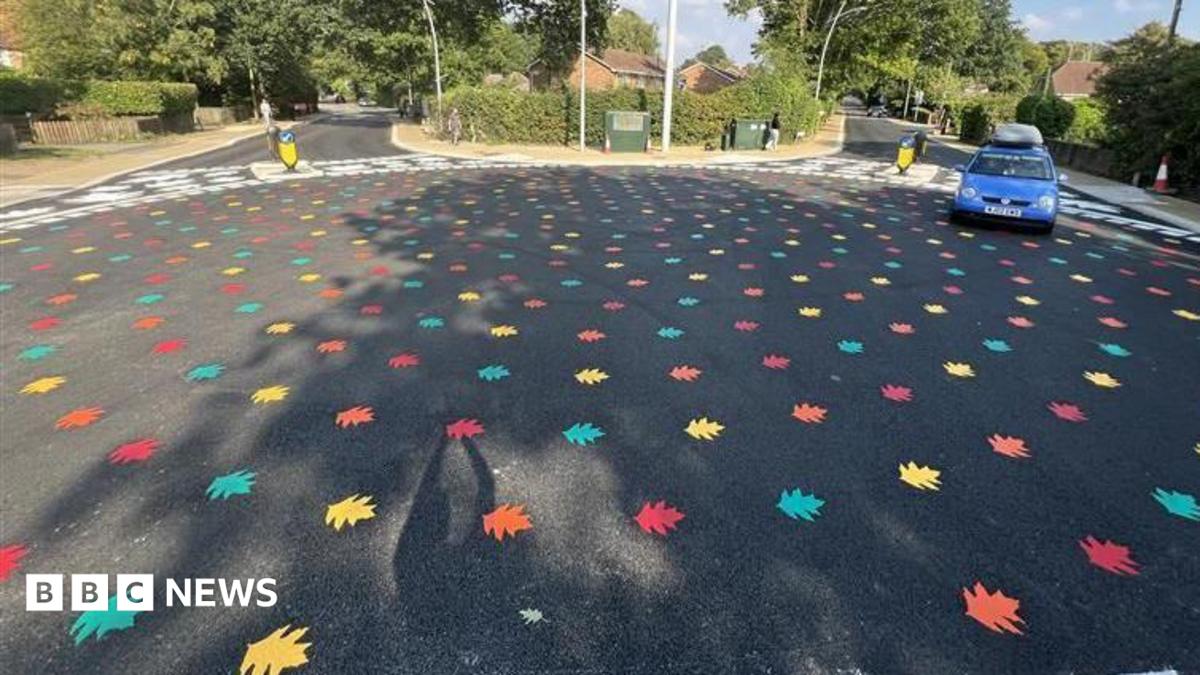
I'm talking about stuff like this.

A petition calling for safety improvements at a road junction that underwent a £5.5m makeover last year will be debated by a council's scrutiny committee next week.

Many residents have complained about the new colourful leaf design of California Crossroads in Finchampstead, Berkshire, calling it an "accident waiting to happen".

Roads and the respective signage are there for a purpose, not to be someones blank canvas.

And a waste of money is a waste of money, regardless if it is £500 or £10000+.
 

Farigiraf

Member
Joined
23 Jul 2023
Messages
1,141
Location
Bridge on the River Cam
I'm talking about stuff like this.


Roads and the respective signage are there for a purpose, not to be someones blank canvas.

And a waste of money is a waste of money, regardless if it is £500 or £10000+.
There is a place for projects that improve how aesthetically pleasing something is too - after all if you halted all council-funded creativity many places would be rather bleak indeed.
But £5.5 million for one junction in one village when the council's already short on funds is indeed a misuse of money.
 

Bletchleyite

Veteran Member
Joined
20 Oct 2014
Messages
112,941
Location
"Marston Vale mafia"
There is a place for projects that improve how aesthetically pleasing something is too - after all if you halted all council-funded creativity many places would be rather bleak indeed.
But £5.5 million for one junction in one village when the council's already short on funds is indeed a misuse of money.

I think I would also say that non standard road markings create misunderstandings on priorities. I'm not there talking about painting a conventional zebra crossing in rainbow colours, say, as it's still obvious what that is, but rather where you create things that don't even vaguely look standard. The setup near Oxford station sees repeated near misses for this reason for example. If these things cost more than the standard then they are definitely bad!

However even so compared to rail it's noise level. You wouldn't even get a couple of inches of platform for the price of painting some random stars on a road.
 

yorkie

Forum Staff
Staff Member
Administrator
Joined
6 Jun 2005
Messages
78,194
Location
Yorkshire
In the original thread, you wrote:
...increased rail subsidy is typically very poor value indeed when compared to other forms of spending, such as on the NHS (to get more people working)...
However, there are quite a few issues with this claim. Here are a few I've quickly cobbled together:

1) It ignores the social and health benefits of increasing public transport usage.
2) The NHS absolutely would not be ringfencing or directing the money to "get more people working"; indeed as a working person I have found that when I needed the NHS, they really didn't want to know, as I was fairly low down their priority list (which is older people and children, not working people).
3) Is this claim actually evidenced by what has happened in any other country, or is it simply made up?
4) If you look at countries with good public transport, e.g. Switzerland, if they diverted money away from public transport and towards healthcare, do you think they would be better off, and is there any evidence to support that?

You do seem to come up with authoritative-sounding sweeping statements, for which the evidence is often lacking.
 

Bantamzen

Established Member
Joined
4 Dec 2013
Messages
10,488
Location
Cheshire
I'm talking about stuff like this.


Roads and the respective signage are there for a purpose, not to be someones blank canvas.

And a waste of money is a waste of money, regardless if it is £500 or £10000+.
What in the name of sanity am I looking at there? Not only is it a confusing mess for both pedestrians and road users, but £5.5m for it? Ye Gods that's crazy!

In the original thread, you wrote:

However, there are quite a few issues with this claim. Here are a few I've quickly cobbled together:

1) It ignores the social and health benefits of increasing public transport usage.
2) The NHS absolutely would not be ringfencing or directing the money to "get more people working"; indeed as a working person I have found that when I needed the NHS, they really didn't want to know, as I was fairly low down their priority list (which is older people and children, not working people).
3) Is this claim actually evidenced by what has happened in any other country, or is it simply made up?
4) If you look at countries with good public transport, e.g. Switzerland, if they diverted money away from public transport and towards healthcare, do you think they would be better off, and is there any evidence to support that?

You do seem to come up with authoritative-sounding sweeping statements, for which the evidence is often lacking.
I'd add economic to point 1 there. When the Airedale & Wharfe lines in West Yorkshire were wired, and subsequently service levels were increased, it didn't just increase social mobility & importantly much better access to the main economic hub Leeds, it helped boost local economies. This was especially true for tourism, places like Ilkley, Saltaire, Skipton, and the Keighley & Worth Valley Railway were much easier to reach for leisure travellers, which brings in much needed cashflows to existing businesses and encourages new ones.
 

yorkie

Forum Staff
Staff Member
Administrator
Joined
6 Jun 2005
Messages
78,194
Location
Yorkshire
I'd add economic to point 1 there. When the Airedale & Wharfe lines in West Yorkshire were wired, and subsequently service levels were increased, it didn't just increase social mobility & importantly much better access to the main economic hub Leeds, it helped boost local economies. This was especially true for tourism, places like Ilkley, Saltaire, Skipton, and the Keighley & Worth Valley Railway were much easier to reach for leisure travellers, which brings in much needed cashflows to existing businesses and encourages new ones.
Agreed. Would @Bletchleyite say the money should have gone to the NHS instead, and if so would we see any long lasting benefits of that money being used more wisely today than the benefits we see on the railway?
 

Bletchleyite

Veteran Member
Joined
20 Oct 2014
Messages
112,941
Location
"Marston Vale mafia"
Agreed. Would @Bletchleyite say the money should have gone to the NHS instead, and if so would we see any long lasting benefits of that money being used more wisely today than the benefits we see on the railway?

I think it is fair to say that capital investment like that is more worthwhile than ongoing subsidy. Thus, wiring these routes to create something akin to an "S-Bahn" which is wildly more desirable than a DMU once an hour might have been worthwhile, but chucking subsidy in to increase a rural route from 1tph to 2tph may not be so. It's likely that that increased desirability will increase revenue, though it clearly has not removed operating subsidy entirely.

This is one reason Metrolink conversion in Manchester is so highly desirable - you chuck in a load of capital but in return you remove or near-remove (I forget the current situation) the need for ongoing operating subsidy.
 

Bantamzen

Established Member
Joined
4 Dec 2013
Messages
10,488
Location
Cheshire
I think it is fair to say that capital investment like that is more worthwhile than ongoing subsidy. Thus, wiring these routes to create something akin to an "S-Bahn" which is wildly more desirable than a DMU once an hour might have been worthwhile, but chucking subsidy in to increase a rural route from 1tph to 2tph may not be so. It's likely that that increased desirability will increase revenue, though it clearly has not removed operating subsidy entirely.

This is one reason Metrolink conversion in Manchester is so highly desirable - you chuck in a load of capital but in return you remove or near-remove (I forget the current situation) the need for ongoing operating subsidy.
That would depend on the route really. With the Airedale / Wharfe lines, it wasn't just about adding an extra service per hour, it was about demonstrating that there was an alternative to the ever more packed main roads for both commuters and leisure travellers. Plus wiring allowed for the ordering of the 333s, which meant quicker journey / acceleration times, which then allowed for more stations to be built & also to really grow the passenger base. That brought a couple of lines from the brink of existence into some of the most popular and important in the area. Of course there was also an environmental issue at stake. At the time before wiring, there was a lot of support for a Airedale by-pass which would have ploughed straight through much of woodland and floodplains along the river and canal. In fact I used to live no more than a couple of hundred metres from where the Shipley - Kirkstall portion of this bypass would have been, and trust me we would have lost some really beautiful areas of woodland & canal walks, and probably killed the Airedale line stone dead in the process, likely meaning that eventually the bypass would have become overwhelmed.

So with that in mind had the proposal been up in 2026 instead of the late 80s / early 90s, would you have considered wiring the lines a worthwhile endeavour or just an expensive way of adding 1tph?
 

Bletchleyite

Veteran Member
Joined
20 Oct 2014
Messages
112,941
Location
"Marston Vale mafia"
So with that in mind had the proposal been up in 2026 instead of the late 80s / early 90s, would you have considered wiring the lines a worthwhile endeavour or just an expensive way of adding 1tph?

I think in 2026 taking into account hindsight on how Metrolink has developed I would be advocating a light rail type solution which would upgrade the service (probably even higher in frequency than you actually got and running on street across Bradford rather than terminating in the utter dive of a station it does) AND reduce or remove operating subsidy. It would require a tram-train type approach but that is entirely possible now.

It does seem in this sort of context that light rail does allow one to have one's cake and eat it, i.e. both improve the service markedly and reduce ongoing subsidy.
 

Bantamzen

Established Member
Joined
4 Dec 2013
Messages
10,488
Location
Cheshire
I think in 2026 taking into account hindsight on how Metrolink has developed I would be advocating a light rail type solution which would upgrade the service (probably even higher in frequency than you actually got and running on street across Bradford rather than terminating in the utter dive of a station it does) AND reduce or remove operating subsidy. It would require a tram-train type approach but that is entirely possible now.

It does seem in this sort of context that light rail does allow one to have one's cake and eat it, i.e. both improve the service markedly and reduce ongoing subsidy.
Or in other words, and given that the WY tram network has been booted into even longer grass, nothing would have happened and the roads would be filling up to the point of rivalling the M25!
 

Bletchleyite

Veteran Member
Joined
20 Oct 2014
Messages
112,941
Location
"Marston Vale mafia"
Or in other words, and given that the WY tram network has been booted into even longer grass, nothing would have happened and the roads would be filling up to the point of rivalling the M25!

Metrolink exists, the Birmingham tram exists, the Tyne and Wear Metro exists, NET does, the Sheffield tram does. I think it's fair to say that overall all of those are far better value than heavy rail solutions in medium sized cities, though one could easily argue that Newcastle and Manchester are backwards, with Newcastle as a small city being more deserving of a tramway and Manchester as a large one more deserving of a full light rail metro as a similar city in Germany would have.
 

Bantamzen

Established Member
Joined
4 Dec 2013
Messages
10,488
Location
Cheshire
Metrolink exists, the Birmingham tram exists, the Tyne and Wear Metro exists, NET does, the Sheffield tram does. I think it's fair to say that overall all of those are far better value than heavy rail solutions in medium sized cities, though one could easily argue that Newcastle and Manchester are backwards, with Newcastle as a small city being more deserving of a tramway and Manchester as a large one more deserving of a full light rail metro as a similar city in Germany would have.
They do, and have for some time. West Yorkshire's tram proposals, which do include the use of tram-train on sections of existing heavy rail, have existed only on paper only for several decades and will for at least another one. I'd say given the option to either a) Create a whole new tram network which incorporates heavy rail, or b) Wire the sections that were done in the early 90s, the latter would be far more likely, could be achieved in a fraction of the time of the former, and deliver significant benefits. Plus it would have benefited from experiences for the teams working on TRU.

Obviously this is an entirely hypothetical scenario given that the lines are wired, but what seems to be the proposal here would be to leave it for another decade and hope someone finds the cash post 2040? This seems to be the case a lot of the time the further north / west we go, lots of grandiose ideas, some of which would genuinely benefit people in the areas, but the bean counters don't like the idea that there isn't an immediate benefit to the generally London-centric economy. So instead taxpayers beyond the sphere of it's influence get to watch their taxes go into projects that they won't benefit from, whilst the ones that would sit on shelves gathering dust. If that sounds like I'm being bitter, well frankly it's because increasingly I am as are many others. Spending public money should benefit everyone, not just those able to live close enough to the GDP epicentre.
 

gswindale

Member
Joined
1 Jun 2010
Messages
1,016
What in the name of sanity am I looking at there? Not only is it a confusing mess for both pedestrians and road users, but £5.5m for it? Ye Gods that's crazy!
It's not that bad to be honest. I've driven across it a few times now, being fully aware of it's existence. It does make you slow down and think, which is a good thing in my opinion. The problem comes with people who think they know how they are driving is correct and are not paying any attention to what is around them.
 

Top