• Our new ticketing site is now live! Using either this or the original site (both powered by TrainSplit) helps support the running of the forum with every ticket purchase! Find out more and ask any questions/give us feedback in this thread!

Royal Train 14 April 1955

Andy873

Established Member
Joined
23 Mar 2017
Messages
1,408
It must have been an impressive sight - she clearly has good memories of it
Yes, she remembers it very well, a once in a lifetime moment.

14 April: left Poulton with 2 x Black 5s via Bolton to Darwen. Royal party alighted, ECS to Accrington. An unidentified Austerity 2-8-0 took over for ECS move to Colne via Rose Grove. Train arrived Colne at 11.30am and was stabled outside the carriage shed.
This point that Stuart Taylor makes about the Royal train had me puzzled. I couldn't understand why, if your going to send the train ECS along the loop line, you would take it to Accrington. Harwood had its own carriage shed... Then I remembered reading that circa 1953, two years before, the shed here was effectively closed down, and unstaffed.

Given the above, it seems going east from Blackburn, Accrington shed was the closest until you get to Colne itself. So why not then straight to Colne? I think that although you would know how long it takes a train to move from point A to B, you don't know how long the cleaning would take. BR's view was probably to get the train cleaned / Royal staff clean it first, then worry about getting it to Colne?

Once cleaned at Accrington, why would send it back 4 miles to Gt. Harwood junction for the loop line? Why not continue on the EL line to Colne? Traffic reasons?

Are there any photos of the Royal train from April 1955?
 
Sponsor Post - registered members do not see these adverts; click here to register, or click here to log in
R

RailUK Forums

Gloster

Veteran Member
Joined
4 Sep 2020
Messages
12,941
Location
Up the creek
I would suspect that internal cleaning and restocking was the responsibility of the Royal Train’s staff, most of whom would be selected British Railways staff from London or Wolverton who regularly worked the train. External cleaning would probably be the job of the local gang, possibly using a carriage washer, under the watchful eye of the train’s regular staff. Once you have cleaned the train, you need to keep it clean until, at least, HM is on board and this will be a factor in the preparation of the diagram.
 

Taunton

Veteran Member
Joined
1 Aug 2013
Messages
12,220
Overnight Royal Train operations commonly had lengthy stops of several hours somewhere, to the extent that the local telephone engineers had to rig up a temporary connection to the train from the nearest telephone pole, and the local phone exchange had to be manned all night. Police stood at both ends, and a loco would be manned for steam heat, which also heated the bath water in the train bathrooms! Furthermore you couldn't really stop in sidings which were not passenger rated, and also didn't want other trains passing at close quarters, so a point on some quiet country branch would be selected, which also meant the signalboxes either side having an unaccustomed night shift. What a palaver!
 
Joined
5 Jun 2022
Messages
34
Location
Hamilton, New Zealand
So noted. Why via Shrewsbury? That seems a roundabout route
Unfortunately the book does not answer that question. The Royal Train also returned from Wigan to Windsor via Shrewsbury as W700

== Doublepost prevention - post automatically merged: ==

Yes, she remembers it very well, a once in a lifetime moment.


This point that Stuart Taylor makes about the Royal train had me puzzled. I couldn't understand why, if your going to send the train ECS along the loop line, you would take it to Accrington. Harwood had its own carriage shed... Then I remembered reading that circa 1953, two years before, the shed here was effectively closed down, and unstaffed.

Given the above, it seems going east from Blackburn, Accrington shed was the closest until you get to Colne itself. So why not then straight to Colne? I think that although you would know how long it takes a train to move from point A to B, you don't know how long the cleaning would take. BR's view was probably to get the train cleaned / Royal staff clean it first, then worry about getting it to Colne?

Once cleaned at Accrington, why would send it back 4 miles to Gt. Harwood junction for the loop line? Why not continue on the EL line to Colne? Traffic reasons?

Are there any photos of the Royal train from April 1955?
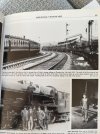
The section in the book is quite long so I did paraphrase it. On the morning of 14th April the Royal train hauled by Black 5s 45020 and 45045 went from Poulton via Bolton to Darwen where the Royals alighted. It then goes on to say:

'The empty stock departed for Accrington at a little after ten in the morning and upon reaching Accrington West, the stock took the angle towards the Bury line, coming to rest at the foot of Baxenden bank. It was here that an unknown Austerity 2-8-0 backed onto the train and proceeded to work it to Colne via Rose Grove where it reached Colne Number One signal box at 11.30am. The train was stabled on the Up Through line in front of the carriage sheds and serviced'

The layout at Colne Number One would allow the train to draw forward over the Up Line crossover and into the Up Through. It would then be possible for the Austerity to draw forward again into the Up Platform which it did (it says here) at 4.25pm. The Jubilees left Accrington at 3pm and having arrived at Colne coupled up at 4.35pm

The unanswered question is how the train got to Rose Grove. It does not say whether or not it went by the Harwood loop line but knowing the area as I do, it makes no sense to me to go via Great Harwood Junction as I reckon it would add an extra 9 miles or so. I can't imagine given the importance of the train there would be any undue delay. The photo attached shows the Austerity facing forward at Colne at the front of the train. Surely the most efficient way to get to Colne is direct from Accrington via Huncoat.
 

Attachments

  • IMG_6997.jpg
    IMG_6997.jpg
    1 MB · Views: 34
Last edited:
Joined
28 Nov 2021
Messages
372
Location
Leith
Although train movements would have been closely guarded, official engagements would be known. In 1955 it would be natural to assume that HM the Queen would travel by train for official engagements in Lancashire.

Unfortunately I can't find the Court Circular for the period because the Times wasn't published because of a strike.
In addition, a lot of people in the place(s) the Queen was visiting would have known something about where should be and when - the cheering crowds weren't there by chance. Most of those could have made an informed guess as to the route and timing of the royal train, at least for its in-service movements if not for ECS.

== Doublepost prevention - post automatically merged: ==

The movements of the Royal Train, even the ecs, came out on special notices that were individually numbered and were distributed only to those who needed them; they were collected in afterwards. This was the situation in my day and I suspect that it was little different then, boyos or not. The most likely explanation of how the family knew was that someone who had to know had discreetly mentioned it to one of them, presumably believing that they might be interested but could be trusted not to spread it further.
But what about instructions regarding the movements (or non-movements) of other trains that were being held/cancelled to create the path for the Royal Train ? Were they in the special notices, or in regular ones ?

Any member of staff reading an instruction "no trains to be allowed between X and Y from 10:00 until advised by Control" who also knew about the royal visit to Y that day would be able to make a good estimate of when the royal train would pass
 
Last edited:

Magdalia

Established Member
Joined
1 Jan 2022
Messages
7,312
Location
The Fens
Overnight Royal Train operations commonly had lengthy stops of several hours somewhere, to the extent that the local telephone engineers had to rig up a temporary connection to the train from the nearest telephone pole, and the local phone exchange had to be manned all night. Police stood at both ends, and a loco would be manned for steam heat, which also heated the bath water in the train bathrooms! Furthermore you couldn't really stop in sidings which were not passenger rated, and also didn't want other trains passing at close quarters, so a point on some quiet country branch would be selected, which also meant the signalboxes either side having an unaccustomed night shift. What a palaver!
We know the overnight stops for this train from the contemporary reports: two nights at Poulton and one at Cholsey. They were usually close to the final destination requiring only short journeys in the morning.

Other key supplies for the overnight stops were ice for the air conditioning and copies of the morning newspapers. The Racing Post was particularly important if HM the Queen or HM the Queen Mother were travelling.

However, it is not correct to say that overnight stabling had to be on a passenger line. The Eastern Region frequently did overnight stops at Barlow CCE Tip near Selby.
 

Andy873

Established Member
Joined
23 Mar 2017
Messages
1,408
knowing the area as I do, it makes no sense to me to go via Great Harwood Junction as I reckon it would add an extra 9 miles or so. I can't imagine given the importance of the train there would be any undue delay.
And I completely agree! Thanks for the expanded explanation and the photos, very helpful as always.

I've asked my friend is she sure it was going in the Padiham direction? and was it a morning or late afternoon / early evening?

In the meantime, I compared part of the route back with an ordinary passenger train and an excursion express. Rose Grove to Gt. Harwood 14 minutes (ordinary), 7 for an express. If we roughly halve the times from Colne to Harwood, I reckon for the Royal train around 10 minutes from Colne (Dep. 5pm) - Rose Grove, then possibly 7 minutes, giving a time at Harwood of 5.17ish - 5.20ish. Now let's say it took 20 minutes to cover the distance (13.5 miles), it gives us an average speed of 40.5 mph. Sounds about right?

Any member of staff reading an instruction "no trains to be allowed between X and Y from 10:00 until advised by Control" who also knew about the royal visit to Y that day would be able to make a good estimate of when the royal train would pass
Two of the three stations on the loop line were, in 1955 fully staffed, as were the signal boxes. I can quite easily see a member of staff saying "there's a special train coming on Thursday" (followed by a grin and a wink) to one of their friends etc, and you'd already know that's the day of the Queen's visit to your area. You could easily work it out from there!
 

Gloster

Veteran Member
Joined
4 Sep 2020
Messages
12,941
Location
Up the creek
In addition, a lot of people in the place(s) the Queen was visiting would have known something about where should be and when - the cheering crowds weren't there by chance. Most of those could have made an informed guess as to the route and timing of the royal train, at least for its in-service movements if not for ECS.

== Doublepost prevention - post automatically merged: ==


But what about instructions regarding the movements (or non-movements) of other trains that were being held/cancelled to create the path for the Royal Train ? Were they in the special notices, or in regular ones ?

Any member of staff reading an instruction "no trains to be allowed between X and Y from 10:00 until advised by Control" who also knew about the royal visit to Y that day would be able to make a good estimate of when the royal train would pass

As said, my experience was thirty years later, but instructions for regulating other trains were often included in the Royal Train notices. For goods this was quite easy, but it needed a little bit more care with passenger trains and the Control telephone line would become red hot if trains or the royal party were delayed. In those days a lot was sorted out between signalmen themselves and they didn‘t bother contacting Control unnecessarily, but just sorted it out, but in cases like this getting it wrong would really be a right royal clanger, so double-checking with Control would be normal.

Two of the three stations on the loop line were, in 1955 fully staffed, as were the signal boxes. I can quite easily see a member of staff saying "there's a special train coming on Thursday" (followed by a grin and a wink) to one of their friends etc, and you'd already know that's the day of the Queen's visit to your area. You could easily work it out from there!

Notices came out fairly late, in my experience the evening before, but sometimes there were people tidying up a bit to make the station look smart which could make some staff wonder. As the Queen’s visits in the area were probably well publicised it might not be difficult to put two and two together to get, where’s my calculator…, four.

One other possibility is that the passage of the train was either publicised or at least allowed to be known so that people got a chance to see their new Queen, or at least the train that she was in, which would be almost as good for many. Remember, she had only come to the throne in 1952 and many still didn’t have a TV or could afford to go to London. Seeing her in the paper or on the cinema screen was one thing, but to see her train or even her in your village, well, that was really something to talk about.
 

Taunton

Veteran Member
Joined
1 Aug 2013
Messages
12,220
Notices came out fairly late, in my experience the evening before, but sometimes there were people tidying up a bit to make the station look smart which could make some staff wonder. As the Queen’s visits in the area were probably well publicised it might not be difficult to put two and two together to get, where’s my calculator…, four.
Some would know well beforehand. The GWR had a standard approach for the Royal loco, not only polished but tender tank cleaned out, and a special wagon of hand-picked coal sent from South Wales. This was done for the two 43xx which took the train from Taunton to Barnstaple in 1957. The rest of the wagonload was tipped into those who followed the Royal locos at the coaling stage. Their drivers said they'd never known anything like it, zero ash.

Gerry Fiennes, in charge at Paddington at the time of the 1964 commemorative run to Plymouth for the 60th anniversary of City of Truro, set this preparation plan in action for the Special. As well known, the immaculate coal and the high steaming rate with two firemen led to the firebars burning through, a loco failure, and Taunton's finest hour in putting out the standby Castle, which had the same preparation.
 

Gloster

Veteran Member
Joined
4 Sep 2020
Messages
12,941
Location
Up the creek
Some would know well beforehand. The GWR had a standard approach for the Royal loco, not only polished but tender tank cleaned out, and a special wagon of hand-picked coal sent from South Wales. This was done for the two 43xx which took the train from Taunton to Barnstaple in 1957. The rest of the wagonload was tipped into those who followed the Royal locos at the coaling stage. Their drivers said they'd never known anything like it, zero ash.

Gerry Fiennes, in charge at Paddington at the time of the 1964 commemorative run to Plymouth for the 60th anniversary of City of Truro, set this preparation plan in action for the Special. As well known, the immaculate coal and the high steaming rate with two firemen led to the firebars burning through, a loco failure, and Taunton's finest hour in putting out the standby Castle, which had the same preparation.

Quite a lot of people would know at the loco depot and carriage sidings concerned, and departure and arrival stations of the party, together with overnight stopping points, but out in the country where the train would merely pass by it would officially mostly be last minute. Station masters and the like would have to know and were expected to only tell those who had to be given notice, but some would want to make a good impression and would start doing things to smarten the station up that would be interpreted as being in connection with a royal visit in the area.
 

Mcr Warrior

Veteran Member
Joined
8 Jan 2009
Messages
17,156
The Royal visit to North, West and East Lancashire in April 1955 was hardly a complete secret. The newspapers were full of the story in the days immediately preceding, listing many of the places that the Queen and the Duke of Edinburgh would be going on the two day trip, together with approximate timings, details of planned local road closures, and stating that the Royal Train was being used to convey the Royal party overnight from Windsor.

Day visitors travelled in by numerous special trains from localities in Lancashire and Yorkshire outside the immediate area to swell the crowds and to try to catch a glimpse of the event. For many places in East Lancashire, it was reportedly the first such Royal visit since July 1913 when King George V and Queen Mary had been the visitors to the area on an eight day tour.
 
Last edited:

Rescars

Established Member
Joined
25 May 2021
Messages
2,517
Location
Surrey
Quite a lot of people would know at the loco depot and carriage sidings concerned, and departure and arrival stations of the party, together with overnight stopping points, but out in the country where the train would merely pass by it would officially mostly be last minute. Station masters and the like would have to know and were expected to only tell those who had to be given notice, but some would want to make a good impression and would start doing things to smarten the station up that would be interpreted as being in connection with a royal visit in the area.
Instructions presumably sent out in sealed envelopes a few days in advance.
 

Taunton

Veteran Member
Joined
1 Aug 2013
Messages
12,220
Day visitors travelled in by numerous special trains from localities in Lancashire and Yorkshire outside the immediate area to swell the crowds and to try to catch a glimpse of the event. For many places in East Lancashire, it was reportedly the first such Royal visit since July 1913 when King George V and Queen Mary had been the visitors to the area on an eight day tour.
Mr Taunton Senior was on an RAF base in Yorkshire in WW2 and King George VI came, but it was very much a military visit, which were of course never publicised. Much done by car, and on the railway just a reserved end compartment.
 

Rail Ranger

Member
Joined
20 Feb 2014
Messages
1,114
The Royal Train was stabled overnight in the goods yard at Plumley before the Duke of Edinburgh opened the Metropolitan Vickers factory in Wythenshawe, Manchester in 1957. The train was heated by a 4F 0-6-0 overnight.
The day the Duke spent the night | Warrington Guardian https://share.google/iz0og31ZHyWTvUmsQ
"The day the Duke spent the night".
 

Andy873

Established Member
Joined
23 Mar 2017
Messages
1,408
Day visitors travelled in by numerous special trains from localities in Lancashire and Yorkshire outside the immediate area to swell the crowds and to try to catch a glimpse of the event. For many places in East Lancashire, it was reportedly the first such Royal visit since July 1913 when King George V and Queen Mary had been the visitors to the area on an eight day tour.
The local papers mention many workers were given the day off as were the school children. Many of the surrounding stations such as Clitheroe saw lots of people waiting to get on trains for Blackburn, Accrington and Burnley.

As for my friend, she's going to ask her sister and any others who saw the train pass Harwood that day...

I think we have to come to the conclusion the Royal train on this occasion only travelled the loop line once, as it took the Queen and the Duke back home and that's what she really saw. As for the blinds being pulled down, if we put ourselves in the Royal's shoes, they have spent two very long days and evenings meeting so many different people, slept on the train (no matter how comfortable it may have been - there's nothing like you own bed!!). By the time I guess you've left Colne and passed Burnley, maybe it's time to shut the world out and close those blinds.

As a side note - This wasn't the only Royal visit that used the loop line. Prince Albert Victor, Queen Victoria's grandson (who, if he had lived would have eventually become King) used it Wednesday, 13 October 1886 on his way to Burnley. He attended a football match (The first Royal to do so, Turf Moor, Burnley v Bolton Wanderers). Wanderers won 4-2 with the Clarets having two goals disallowed... At least they didn't have VAR in those days! ;)
 

Dawg

Member
Joined
28 Jan 2014
Messages
59
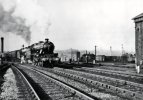
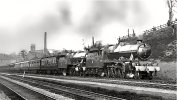
There's a photo of this train being hauled by Jubilees 45571 and 45574 at Cherry Tree, out of Blackburn - interestingly they are taking the branch to Chorley via Brinscal and Wheelton, which means it would have then worked over the Adlington White Bear - Boars Head Junction line to access the WCML into Wigan North Western where there was a crew change. However at the present time, I have only this one taken at Colne Carriage sidings.

== Doublepost prevention - post automatically merged: ==

Found it. Heading up onto the now dismantled Chorley line at Cherry Tree junction.

== Doublepost prevention - post automatically merged: ==

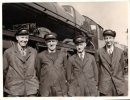
Here's a photo of the two crews probably taken at Accrington.

== Doublepost prevention - post automatically merged: ==

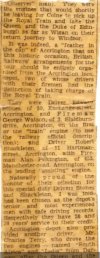
And a newspaper cutting about the Accrington crews.
 

Attachments

  • Royal train 1955 Colne.jpg
    Royal train 1955 Colne.jpg
    6.5 MB · Views: 24
  • Royal train, Cherry Tree 1955.jpg
    Royal train, Cherry Tree 1955.jpg
    4 MB · Views: 21
  • Royal train crews, Accrington 1955.jpg
    Royal train crews, Accrington 1955.jpg
    4.4 MB · Views: 21
  • Newspaper cutting 1955.jpg
    Newspaper cutting 1955.jpg
    2.1 MB · Views: 20
Last edited:

Taunton

Veteran Member
Joined
1 Aug 2013
Messages
12,220
I read a favoured overnight point in Lancashire for the Royal Train was on the East Curve at Parkside, which connects the Liverpool and Manchester with the WCML. Not much in the way, established approach to linking up the train telephone, go in any direction from there, in a cutting out of sight, etc. Jockeying for the honour of providing the overnight steam heat loco were Warrington, Springs Branch and Sutton Oak sheds. They probably took it in turns.

Those Royal Train crew pictured above look a bit ordinary. Certainly on the Western the crew were issued new uniforms and hats for the trip, and inspected by the District Superintendent before departure. Many WR staff of all grades were ex-Royal Navy and knew how to do a good show. The guard was usually the most senior who signed the route, sometimes as a final trip before retirement. Did other regions also make a special payment to the crew, a form of 'tip'?
 

WesternLancer

Veteran Member
Joined
12 Apr 2019
Messages
14,953
There's a photo of this train being hauled by Jubilees 45571 and 45574 at Cherry Tree, out of Blackburn - interestingly they are taking the branch to Chorley via Brinscal and Wheelton, which means it would have then worked over the Adlington White Bear - Boars Head Junction line to access the WCML into Wigan North Western where there was a crew change. However at the present time, I have only this one taken at Colne Carriage sidings.

== Doublepost prevention - post automatically merged: ==

Found it. Heading up onto the now dismantled Chorley line at Cherry Tree junction.

== Doublepost prevention - post automatically merged: ==

Here's a photo of the two crews probably taken at Accrington.

== Doublepost prevention - post automatically merged: ==

And a newspaper cutting about the Accrington crews.
Some nice research there! Good to see all that
 

6Gman

Established Member
Joined
1 May 2012
Messages
9,186
I read a favoured overnight point in Lancashire for the Royal Train was on the East Curve at Parkside, which connects the Liverpool and Manchester with the WCML. Not much in the way, established approach to linking up the train telephone, go in any direction from there, in a cutting out of sight, etc. Jockeying for the honour of providing the overnight steam heat loco were Warrington, Springs Branch and Sutton Oak sheds. They probably took it in turns.

Those Royal Train crew pictured above look a bit ordinary. Certainly on the Western the crew were issued new uniforms and hats for the trip, and inspected by the District Superintendent before departure. Many WR staff of all grades were ex-Royal Navy and knew how to do a good show. The guard was usually the most senior who signed the route, sometimes as a final trip before retirement. Did other regions also make a special payment to the crew, a form of 'tip'?
A certain very high-profile royal train was worked by the senior local union representative.
 

Top