• Our new ticketing site is now live! Using either this or the original site (both powered by TrainSplit) helps support the running of the forum with every ticket purchase! Find out more and ask any questions/give us feedback in this thread!

North Clyde Line Overhead Line Upgrade

TrainViation

Member
Joined
25 Jun 2025
Messages
292
Location
Glenrothes
As per Network Rail’s website, it’s been announced that the North Clyde Line (Airdrie - Helensburgh Central) is due to receive overhead line upgrades. As the current equipment which was installed nearly sixty years ago is at the end of its working life and needs replacing.

I’m now wondering, within the allocated £20m budget, if it will mean the replacement of lineside masts and SPS as well as wires, or just those and switches?

Network Rail Article: https://www.networkrailmediacentre....de-for-scotlands-original-electrified-railway
A £20m project is underway to upgrade the overhead power lines on Scotland’s original electrified railway.

The work will focus on sections of the North Clyde lines, which run from Helensburgh, Balloch and Milngavie through Glasgow’s west end and low‑level stations. It’s the busiest suburban network outside London and one of the most critical parts of Scotland’s railway. ..
 
Last edited by a moderator:
Sponsor Post - registered members do not see these adverts; click here to register, or click here to log in
R

RailUK Forums

Bald Rick

Veteran Member
Joined
28 Sep 2010
Messages
35,620
It won’t be masts for that budget, except perhaps the odd one or two that are at a jaunty angle.
 

OLEngineer

Member
Joined
10 Jun 2026
Messages
16
Location
London
Is this Mark 2 range OLE being replaced? I struggle to tell the difference between Mark 1 and 2. Would be a rare bit of OLE being taken down though if it is
 

Transilien

Member
Joined
10 Mar 2024
Messages
728
Location
Ayrshire
Is this Mark 2 range OLE being replaced? I struggle to tell the difference between Mark 1 and 2. Would be a rare bit of OLE being taken down though if it is
The Mark 2 ones have ‘silver’ masts (I forget which material) and are only used on the Inverclyde Line from before Bishopton (the Mark 2 masts were replaced sometime in the early 2000s by Siemens masts). On the other hand, the Mark 1 masts are used on all other 50s 60s schemes (though many have been replaced now) and have ‘green’ masts made of copper which the Mark 2 design abandoned due to the expense. I’m not sure of any other differences in OHLE designs.
 

The exile

Established Member
Joined
31 Mar 2010
Messages
9,310
Location
Somerset
On the other hand, the Mark 1 masts are used on all other 50s 60s schemes (though many have been replaced now) and have ‘green’ masts made of copper which the Mark 2 design abandoned due to the expense.
Whatever the masts were made of it sure wasn’t copper! Wiring, on the other hand….
 

sh24

Established Member
Joined
28 Sep 2023
Messages
1,471
Location
London
The Mark 2 ones have ‘silver’ masts (I forget which material) and are only used on the Inverclyde Line from before Bishopton (the Mark 2 masts were replaced sometime in the early 2000s by Siemens masts). On the other hand, the Mark 1 masts are used on all other 50s 60s schemes (though many have been replaced now) and have ‘green’ masts made of copper which the Mark 2 design abandoned due to the expense. I’m not sure of any other differences in OHLE designs.

I think the green is just the coating given to the steel. Using copper for masts would have been wildly expensive!
 
Joined
5 Dec 2025
Messages
246
Location
Central Scotland
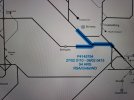
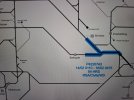
There's plenty of Engineering Possessions Around Late December 26 & January 27.

Looks like most are overnight but there is going to be days where the lines are shut.
There's also engineering works near Bathgate/Newbridge Jn Around The Same Time. Any ideas?

Images Attatched Are From The EAS Document On Gensheet Showing The Possessions Near Newbridge Jn.
 

Attachments

  • 20260610_160230.jpg
    20260610_160230.jpg
    4.4 MB · Views: 101
  • 20260610_160235.jpg
    20260610_160235.jpg
    4.2 MB · Views: 101

AndrewE

Established Member
Joined
9 Nov 2015
Messages
7,306
I think the green is just the coating given to the steel. Using copper for masts would have been wildly expensive!
All the uprights and portals that I know of are (were) galvanised steel, often painted with a pale yellow etch primer ("Clawcoat") and then sparkly grey Micaceous Iron Oxide paint (MIO), but it is possible that stainless has been used in some special locations...

The original BR electrification used tubular steel parts with a thick copper coat, and while it weathers green I don't think I have ever seen one with rust showing, so they got that right (unlike some more recent designs which are rusting already.)
 

Carntyne

Member
Joined
8 Jul 2015
Messages
1,023
There's plenty of Engineering Possessions Around Late December 26 & January 27.

Looks like most are overnight but there is going to be days where the lines are shut.
There's also engineering works near Bathgate/Newbridge Jn Around The Same Time. Any ideas?

Images Attatched Are From The EAS Document On Gensheet Showing The Possessions Near Newbridge Jn.
Those aren't on the North Clyde line.
 

Strathclyder

Established Member
Joined
12 Jun 2013
Messages
3,821
Location
Clydebank
Given that budget, you ain't seeing any en-masse mast replacement programmes here barring sorting the odd one that has gone a bit wonky. Wires and switches at most I can see being attended to here.

Those aren't on the North Clyde line.
Not on the original section the upgrade/replacement work in the OP is concerning itself with anyway.

Some sources - including ScotRail themselves, so it ain't just Wikipedia lol - do assert that the North Clyde Line extends all the way through to Edinburgh thanks to the Airdrie+Bathgate link. Barring requiring DOO stock for normal passenger operations (318s/320s do regularly work to/from Bathgate LMD on ECS workings though), the A+B isn't treated any differently operationally far as I can work out.
 

McRhu

Member
Joined
14 Oct 2015
Messages
666
Location
Lanark
There will be a lot of wiring being replaced I would think. Will the clips on the old MK1 register arms suit current contact wire or is the original wire profile still a standard? If cantilevers are being replaced what will be used, MKIII or Series 2? It appears that Series 2 needs higher masts than MKIII but the old MK1 encumbrance required high masts anyway so that might not be an obstacle.
 

OLEngineer

Member
Joined
10 Jun 2026
Messages
16
Location
London
There will be a lot of wiring being replaced I would think. Will the clips on the old MK1 register arms suit current contact wire or is the original wire profile still a standard? If cantilevers are being replaced what will be used, MKIII or Series 2? It appears that Series 2 needs higher masts than MKIII but the old MK1 encumbrance required high masts anyway so that might not be an obstacle.
If the new contact wire has the same cross sectional area it should still fit the existing clips. If not, I reckon theres probably a clip that can fit the old registration arms and new wire. The old contact is Copper Cadmium and will be replaced with what the RAM team prefer. Same goes for either Mk3 or Series 2 registration equipment. The Series 2 stuff should fit wherever theres 660mm electrical clearance to the stranded catenary wire, but I don't know what kind of arrangement they use for reduced encumbrances, I've only worked with Series 1.
 

AndrewE

Established Member
Joined
9 Nov 2015
Messages
7,306
If the new contact wire has the same cross sectional area it should still fit the existing clips. If not, I reckon there's probably a clip that can fit the old registration arms and new wire.
C/SA and actual cross section profile are not quite the same...
The old contact is Copper Cadmium and will be replaced with what the RAM team prefer. Same goes for either Mk3 or Series 2 registration equipment. The Series 2 stuff should fit wherever theres 660mm electrical clearance to the stranded catenary wire, but I don't know what kind of arrangement they use for reduced encumbrances, I've only worked with Series 1.
I understood that the stranded catenary was the WCML Achilies' heel, especially where it went over the tops of pulleys on portals etc. Something to do with what is effectively wire rope but not moving in the way that rope normally does, just static loading.
Yes new contact wire will be copper-tin or copper-silver.
I thought that the Copper- arsenic or cadmium(?) alloy made it harder and thus longer lasting as a contact wire, whereas pantograph carbons can be replaced nightly if needed (I exaggerate!) Unfortunately the silver content will now make it even more tempting to tea-leaves too!
 

GRALISTAIR

Established Member
Joined
11 Apr 2012
Messages
10,464
Location
Preston Lancs
Cadmium definitely improves the creep resistance. It would not be easy to recover the silver content from a copper silver alloy.
 

OLEngineer

Member
Joined
10 Jun 2026
Messages
16
Location
London
uld not be easy to recover the silver content from a coppe
C/SA and actual cross section profile are not quite the same...

I understood that the stranded catenary was the WCML Achilies' heel, especially where it went over the tops of pulleys on portals etc. Something to do with what is effectively wire rope but not moving in the way that rope normally does, just static loading.

I thought that the Copper- arsenic or cadmium(?) alloy made it harder and thus longer lasting as a contact wire, whereas pantograph carbons can be replaced nightly if needed (I exaggerate!) Unfortunately the silver content will now make it even more tempting to tea-leaves too
I mispoke, all conductors of the same C/SA will have the same cross sectional profile, as far as I know! I've got the drawing in front of me now, B14/M03 in the UKMS R1 catalogue if you have it. Eland Cables also has a bunch of wire drawings publically available but none for cadmium copper. I remember seeing that its carcinogenic?

The WCML had catenary supports on pulley wheels where when the wire would wear down from the expansion and contraction from temperature changes. This was fixed in later equipment ranges by either putting on a line guard over the catenary to protect it, splice in a section of more resistant wire (bridle arrangements as seen on headspans), or install a mechanically independent catenary support.

I'm not exactly sure why cadmium copper is no longer used but the aforementioned drawing does say that said wire is not for new installations, but can be retained if they are in a serviceable condition. Would love to know what specifically drove the choice to CuAg/CuSn or HD Cu contact
 

McRhu

Member
Joined
14 Oct 2015
Messages
666
Location
Lanark
Gralistair, OLEngineer and AndrewE... Many thanks for your insights gents. Looking forward to seeing this upgrade done and whether they graft series 2 equipment in en-masse.
 

hwl

Established Member
Joined
5 Feb 2012
Messages
8,236
I thought that the Copper- arsenic or cadmium(?) alloy made it harder and thus longer lasting as a contact wire, whereas pantograph carbons can be replaced nightly if needed (I exaggerate!) Unfortunately the silver content will now make it even more tempting to tea-leaves too!
I'm not exactly sure why cadmium copper is no longer used but the aforementioned drawing does say that said wire is not for new installations, but can be retained if they are in a serviceable condition. Would love to know what specifically drove the choice to CuAg/CuSn or HD Cu contact
As an alloying element Cadmium was unusual in ticking 4 key boxes:
  • Increasing harness / wear resistance
  • Negligible reduction in conductivity compared to pure copper
  • Significantly increase in resistance to arcing
  • Significantly increases tolerance to arcing damage (not the same as the 3rd bullet)
And needing a lower concentration of (expensive) alloying element than alternatives to tick those boxes.
Unfortunately Cadmium is toxic.

Most of the alternative alloying elements (Sn, Ag, Cr, Zr, Mg) only tick 2 or 3 out of those 4 boxes well and apart from Silver often need much higher concentrations that Cadmium so all are higher overall material cost.

Ag ticks the first 2 boxes well but does nothing for the latter 2 but the other elements do help for the last two but far less well than Cadmium.

Is there a potential assumption that modern train electrical equipment is a bit kinder in terms of reducing arcing issues and graphite strips better monitored (e.g. cameras with ML video analysis for 15+ years in the UK) and maintained, hence the preference for Ag?

The Germans seem to like the Magnesium ( & Phosphorous) copper alloys which despite comparatively poor conductivity tick all the other boxes well. (Is Arcing a much bigger issue for 16 2/3 Hz compared to 50Hz?)
 

59CosG95

Established Member
Joined
18 Aug 2013
Messages
6,853
Location
Beeston (Notts)
If the new contact wire has the same cross sectional area it should still fit the existing clips. If not, I reckon theres probably a clip that can fit the old registration arms and new wire. The old contact is Copper Cadmium and will be replaced with what the RAM team prefer. Same goes for either Mk3 or Series 2 registration equipment. The Series 2 stuff should fit wherever theres 660mm electrical clearance to the stranded catenary wire, but I don't know what kind of arrangement they use for reduced encumbrances, I've only worked with Series 1.
Based on the Tilbury Loop Line works, I'd imagine that UKMS-R1 gets used again up here. This re-used the F&F Cantilevers used on the GEML two-track areas; conventional style, with a horizontal top tube from the mast, an inclined strut tube from the mast, a horizontal registration tube from the strut, an inclined brace tube between the reg tube and the strut tube, and a registration arm supported from a drop bracket beneath the registration tube. See below:
1782288713938.png
As part of the works on the Tilbury Loop, catenaries, contacts and droppers were all replaced, along with *some* structures depending on the conditions of the existing ones. Conductors were also re-tensioned, with Balance Weights giving way to single Tensorex C+ units, uprated to 22kN (IIRC) to cater for both catenary & contact in one fell swoop.

As for the extents of replacement, I'd say the original late 50s-early 60s Mk1 OLE is the one to be replaced:
  • Hyndland to Helensburgh Central (via Anniesland & Singer);
  • Hyndland to Dalmuir (via Yoker);
  • Dalreoch to Balloch;
  • Westerton to Milngavie;
  • Bellgrove to Hyndland (the Queen Street section);
  • Bellgrove to Springburn;
  • Bellgrove to Airdrie.
The Mk2-electrified line south of the Clyde is the Inverclyde Line.
 

TrainViation

Member
Joined
25 Jun 2025
Messages
292
Location
Glenrothes
Here’s a newly replaced dropper at Garscadden station. It seems droppers are being replaced.
 

Attachments

  • IMG_3154.jpeg
    4.3 MB · Views: 156

McRhu

Member
Joined
14 Oct 2015
Messages
666
Location
Lanark
That's interesting... Looks like a mash-up up UK1 and Series 1 with a touch of Siemens thrown in. Is this the official MK1 replacement system?
 

59CosG95

Established Member
Joined
18 Aug 2013
Messages
6,853
Location
Beeston (Notts)
That's interesting... Looks like a mash-up up UK1 and Series 1 with a touch of Siemens thrown in. Is this the official MK1 replacement system?
Yep, that's UKMS-R1. The Tilbury Loop Line's already been done, about 60-70% of it. The two-track parts of the Southend Victoria branch (except for the Southend Vic approaches) and the GEML (between Shenfield & Beaulieu Park) have also got them.

Here’s a newly replaced dropper at Garscadden station. It seems droppers are being replaced.
Almost - it's the cantilever that's been replaced. The droppers are the wee vertical wires between the catenary & contact wires; they'll probably be replaced further down the line.

that looks like it's all new apart from the stanchion...
Pretty much. Some masts might get replaced as well, depending on condition; that was certainly the case on the Tilbury Loop (which, admittedly, had worse ground conditions).
 

McRhu

Member
Joined
14 Oct 2015
Messages
666
Location
Lanark
Yep, that's UKMS-R1. The Tilbury Loop Line's already been done, about 60-70% of it. The two-track parts of the Southend Victoria branch (except for the Southend Vic approaches) and the GEML (between Shenfield & Beaulieu Park) have also got them.


Almost - it's the cantilever that's been replaced. The droppers are the wee vertical wires between the catenary & contact wires; they'll probably be replaced further down the line.


Pretty much. Some masts might get replaced as well, depending on condition; that was certainly the case on the Tilbury Loop (which, admittedly, had worse ground conditions).
Many thanks 59CosG95. I quite like it - not too alien (in the way that Series 2 and Series 1 are) to my eyes at least.
 
Joined
5 Dec 2025
Messages
246
Location
Central Scotland
I was at summerlee museum near coatbridge sunnyside (looking onto the north clyde) and there was two masts. One older one and one newer one. The new one was all connected but the old looked partially connected as well (they were half a metre away maybe?). Any idea??
 

AndrewE

Established Member
Joined
9 Nov 2015
Messages
7,306
I was at summerlee museum near coatbridge sunnyside (looking onto the north clyde) and there was two masts. One older one and one newer one. The new one was all connected but the old looked partially connected as well (they were half a metre away maybe?). Any idea??
new one with OLE supension on it, old one still carrying return conductors/25kV feed to further along the line?
 

Top