Peter Sarf
Established Member
Of course !.Use the remaining 200m sets to replace Pendolinos on classic WCML routes
Lack of tilt on the Southern WCML will not be such an issue once the top expresses are on HS2.

Of course !.Use the remaining 200m sets to replace Pendolinos on classic WCML routes
Having an 11-coach 275m set wouldn't be much longer than an 11-coach Pendolino at 265m. But this is the bare minimum needed for routes such as Manchester simply because the capacity uplift, while good in the short and maybe even medium term, might need extra work in the long-term. An 11-coach Pendolino is 607 seats, so at least 700 should be possible with proper seating density for an 895, even more so if the units don't have first class.I think that if we leave the original 200m order alone then best to order just one longer than 200m version of the same platform. Make the longer version about the same length as an 11car 390/1, no longer. As others have said maintained at Polmadie and Longsight.
The only downside is then perhaps we will have a surplus of 200m sets ?.
SO perhaps just order extra coaches for some of the existing sets ordered - is that too much of a variation ?.
Certainly so, hence why it's a better option than opting for a bespoke 300km/h tilting train that I don't think really exists anywhere in the world at all. Even Japan's tilting Shinkansen trains only do about 1-2 degrees and are limited to 270km/h on curves as far as I'm aware. It's just unfortunate that we've been put into this position by political short-sightedness and awful infrastructure management.I reckon buying more coaches to run 11-car 895s and modifying Polmadie and Longsight will probably cost less than buying bespoke 300kmh, UK loading gauge tilting trains and the associated depot modifications and maintaining TASS balises

Agreed, apparently the units for Virgin Trains Europe are already fairly bespoke, the UK loading gauge adds is another layer of complexityHaving an 11-coach 275m set wouldn't be much longer than an 11-coach Pendolino at 265m. But this is the bare minimum needed for routes such as Manchester simply because the capacity uplift, while good in the short and maybe even medium term, might need extra work in the long-term. An 11-coach Pendolino is 607 seats, so at least 700 should be possible with proper seating density for an 895, even more so if the units don't have first class.
Certainly so, hence why it's a better option than opting for a bespoke 300km/h tilting train that I don't think really exists anywhere in the world at all. Even Japan's tilting Shinkansen trains only do about 1-2 degrees and are limited to 270km/h on curves as far as I'm aware. It's just unfortunate that we've been put into this position by political short-sightedness and awful infrastructure management.
You might just about get away with that on the Manchesters. How small a microfleet would this create though?Having an 11-coach 275m set wouldn't be much longer than an 11-coach Pendolino at 265m.
Will need to run Glasgow and Manchester services, but don't know about stock requirementsYou might just about get away with that on the Manchesters. How small a microfleet would this create though?
Keeping the 3tph frequency, probably about 25-28 trains at a random guess. At an hourly frequency you could probably get the service done with 7/8 units, so with one every twenty minutes you'd have about 21-24 assuming the services are all self-contained and not diagrammed to run elsewhere after arriving at Euston.You might just about get away with that on the Manchesters. How small a microfleet would this create though?

The MU speed profile was funded by Avanti purely for the class 805/807 procurement for Liverpool/North Wales services.On the subject of tilt, are there still plans for faster non-tilt speeds further north than Weaver Junction?
Nobody seems to be addressing the elephant in the room - 8-car HS2 stock versus 390 capacity and journey times on the path-limited WCML north of Handsacre.
I would expect more capacity is required. Other wise HS2 is only justified for freeing up the WCML for freight and maybe non-intercity.Whist an 11 coach 390 is 27% longer than a 200m train, the expected capacity for the HS2 200m trains is 550 vs 607 and so only around 10% fewer seats.
However, that's only when comparing the 11 coach sets.
Yes, that's still an issue on services where they're primarily 11 coaches.
The 9 coach sets have a capacity of 469 seats.
Daily, that means (15 hour of service with 2tph) if it were all 11 coaches vs 200m sets would see a shortfall of 1,700 seats in each direction (out of a daily total of 18,200 seats for the 390's).
However, if 20% (6 services) are 9 coach services that shortfall reduces to 880.
Obviously, the busiest services could be an issue, however, with faster journey times it serious be possible to delay your departure and still arrive at the same time or aim to arrive earlier but not have to leave any earlier.
Assuming that the start of service stays the same, and assuming that only one extra service can run that rather than 6 services getting to London before 9am that becomes 7 under HS2.
Instead of 3,642 seats on all 11 coach sets that's 3,850 seats on the 200m sets.
As such, for the morning peak arrival to London that's an increase of 5.7%.
Clearly, it's not going to be easy to get people to use a train at 5am which will arrive to London at 7am, however, it does highlight that the faster journey times could provide some extra early morning capacity to relieve the shortfall on a per train basis.
I would expect more capacity is required. Other wise HS2 is only justified for freeing up the WCML for freight and maybe non-intercity.
140mph on the classic network would require a lot more than just tilt and ETCS.Imo tilt would be awesome. Blast through HS2 and then 140mph up to Scotland... if they ever upgrade the track to ETCS.
I am sure this is right. But what was planned for the APT (and indeed the 225s, for that matter)?140mph on the classic network would require a lot more than just tilt and ETCS.
225s were planned to have flashing Green aspects for 140mph running before the in-cab signalling requirement above 125mph was brought in, but also I suspect that for both APT and IC225 the requirement for swingnose crossings and restricted platforms above 125mph had probably not been introduced yet.I am sure this is right. But what was planned for the APT (and indeed the 225s, for that matter)?
I agree. HS2 Phase 2 to Manchester would become a more relevant solution if future carryings rose to justify it. If HS2 Phase1 and new stock encourages that then all well and good.The thing is there is only so far you can go without a new line into Manchester.
The point I was getting at is that the impact is no where near as bad as the train length makes out.
Yes, that's not going to help in 20+ years time, however for that growth we (and would be the case almost regardless of if you build 200m, 225m, or 250mm long sets).
It's good enough for now, we don't need to change the contract and we should rather spend our efforts on getting HS2 open and successful.
Taking yesterday as example, the morning services to London from Manchester were:
05:54 - 11 coaches (607 seats)
06:02 - 9 coaches (489 seats)
06:14 - 11 coaches (607 seats)
06:23 - 11 coaches (607 seats)
06:29 - 11 coaches (607 seats) arrives 08:40
06:54 - 11 coaches (607 seats) arrives 09:15
07:00 - 11 coaches (607 seats) arrives 09:02
07:14 arrives 09:31 and was 9 coaches
That's a total of 3,624 seats before 09:05 and 4,820 before 09:35.
Assuming the trains take 30 minutes less time to arrive into London the 07:14 would arrive 09:01 and the 07:34 would arrive 09:16 with services after that arriving after 9:35.
Therefore using the same 09:05 and 09:35 cut off using 200m stock there would be 4,400 (+21% extra) pre 09:05 arrival capacity or 5,500 (+13% extra) pre 09:35 capacity compared to the existing.
It's also worth remembering that pre 2022 the 11 coach trains had 589 seats and so there's already been an uplift in capacity of 3% on those services with 11 coaches.
Yes, thats still going to mean individual services could be very busy, however if that's the case for more than a few services a day then I would argue that it's going to mean that it's worth building phase 2 and the capacity increases that provides.
Only saves a minute every 20 miles run at 140 versus 125. Tilting gear will add to the weight leading to slower acceleration. Hard to see how much would be gained. And you'll just catch up earlier with an intermodal freight which hopefully will be electric-hauledImo tilt would be awesome. Blast through HS2 and then 140mph up to Scotland... if they ever upgrade the track to ETCS.
But until phase 2 is actually constructed and 400m trains in service you can't actually increase passenger numbers.I agree. HS2 Phase 2 to Manchester would become a more relevant solution if future carryings rose to justify it. If HS2 Phase1 and new stock encourages that then all well and good.
This is why if you were looking at improvements north of Preston you would consider things like driving a tunnel between north of Oxenholme and south of Penrith (conveniently with the portals just outside the national park). It allows fast trains to run at a higher line speed on a straighter alignment while overtaking the freight which would take the legacy route over Shap.Only saves a minute every 20 miles run at 140 versus 125. Tilting gear will add to the weight leading to slower acceleration. Hard to see how much would be gained. And you'll just catch up earlier with an intermodal freight which hopefully will be electric-hauled
Oh I agree. Perhaps more capacity because trains are traveling quicker so one more train load of passengers per cycle of paths. But I can see overcrowding eventually being the trigger to justify the obvious to those who deny the need for HS2 Phase2.But until phase 2 is actually constructed and 400m trains in service you can't actually increase passenger numbers.
.....................
But until phase 2 is actually constructed and 400m trains in service you can't actually increase passenger numbers.
The morning peak isn't when the WCML is at its busiest, assuming the present policy of revenue maximisation over bums on seats continues. The problem is Friday evening and Sunday afternoon.
That probably makes it easier in a way though as leisure traffic is more price sensitive so can be priced around more readily.
Again due to the 30 minutes of time saving on a Friday evening there could be a 20:43 service which would arrive at 22:24 (the current arrival to Manchester of the last train of the day).
What timetable are you looking at? The last Euston-Manchester on a weekday is 2203 arriving 0039. There used to be one an hour later before COVID.
You've still got three departures per hour of roughly the same capacity each as the present trains. No improvement there.Oh I agree. Perhaps more capacity because trains are traveling quicker so one more train load of passengers per cycle of paths.
This feels like tinkering around the edges, basically gaining an extra departure or two in each direction late each evening. Not exactly the busiest time of day.Assuming that you are finishing the end of the last service and the start of the first service at the same time as currently you can run at least 2 additional paths between London and Manchester due to the HS2 phase 1 times cutting 30 minutes off the journey time.
This feels like tinkering around the edges, basically gaining an extra departure or two in each direction late each evening. Not exactly the busiest time of day.
The sort of thing that turns public opinion in favour of HS2 is the doubling of capacity that 400m trains would bring and the ability to slash fares to fill it.
Actually that is probably the most realistic benefit of HS2 phase1.You've still got three departures per hour of roughly the same capacity each as the present trains. No improvement there.
The only passenger capacity gain on Manchsster trains after Phase 1 opens I can see is that London to Milton Keynes/Rugby/Nuneaton passengers will no longer occupying capacity on long distance trains.
I think tinkering is inevitably the only think that DfT will allow until it is very obvious that HS2 to Manchester is necessary.This feels like tinkering around the edges, basically gaining an extra departure or two in each direction late each evening. Not exactly the busiest time of day.
The sort of thing that turns public opinion in favour of HS2 is the doubling of capacity that 400m trains would bring and the ability to slash fares to fill it.
As far as Manchester is concerned, yes.Actually that is probably the most realistic benefit of HS2 phase1.
Chris Gibb has been sacked for this.Chris Gibb, who has held senior roles on the passenger railway and is currently a non-exec to DfT's DFTO operation, has proposed that HS2 keeps the current contract for 54x8-car 200m trains, and orders a separate replacement fleet for Pendolinos to maintain capacity and journey times on the WCML post-HS2 starting.
This is his personal contribution and is not any kind of policy, but is a suggestion for a solution to the matching of supply and demand on HS2/WCML, without incurring the high costs of renegotiating the HS2 contract.
He has presented this to DfT/parliamentary bodies, and is reported in today's Guardian:
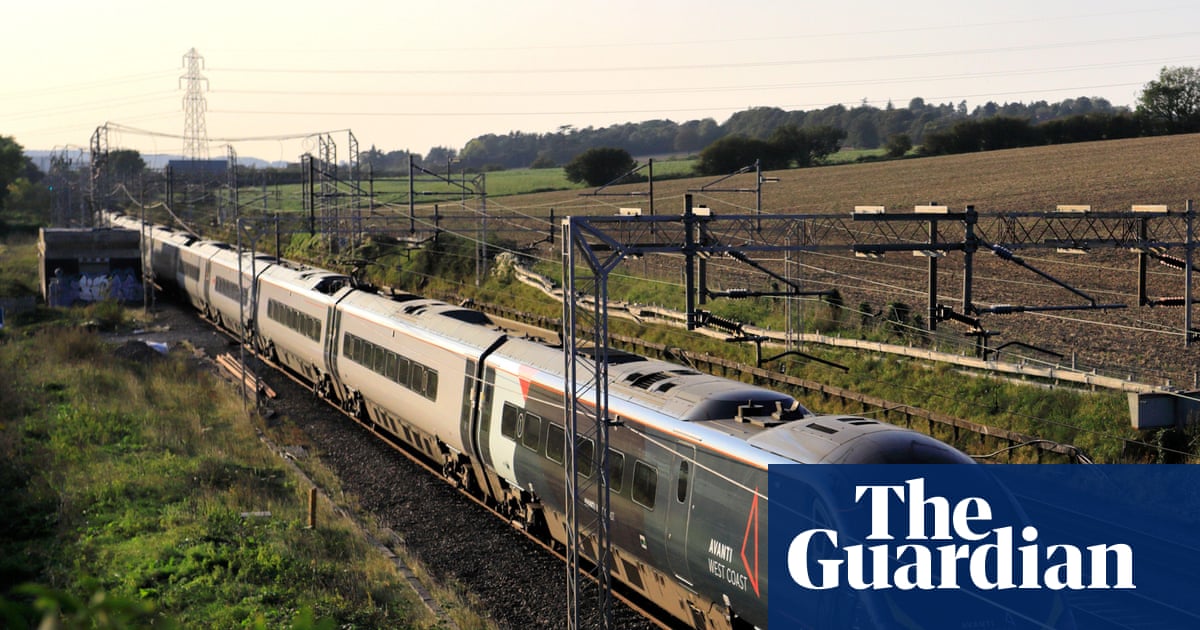
Plans to change HS2 train size could reduce capacity and speed in north, says expert
Review of original train order is meant to prevent service problems north of Birmingham but it may do the oppositewww.theguardian.com
I presume he is talking about a fleet that could tilt on classic lines and also operate on HS2, but that presumes a GB-gauge tilting design can be acquired relatively quickly (eg based on Alstom's Avelia Liberty).
That's an alternative to his previous suggestion of adapting the current Pendolinos to operate on HS2, bearing in mind how old the 390s will be in the mid-2030s.
Ministers sack top rail adviser who spoke out over HS2 train debacle
Chris Gibb, an industry veteran, said plans to shorten HS2 trains would likely inflate costs, slow services beyond Birmingham and result in fewer seats

The plan was to combine Glasgow and Edinburgh portions into a 400m train, splitting at Carlisle into two separate 200m trains to their destinations.What was the original plan for Glasgow? The platforms at central wouldn't be long enough for 400m long trains anytime soon, if ever. So these trains in their current setup would always have been too short
