
Ashley Hill
Established Member
Thanks.Unknown, but this isn't the thread to discuss it - see currently closed thread here https://www.railforums.co.uk/threads/east-west-rail-ewr-countdown-to-entry-into-service.275902/

Thanks.Unknown, but this isn't the thread to discuss it - see currently closed thread here https://www.railforums.co.uk/threads/east-west-rail-ewr-countdown-to-entry-into-service.275902/
Do agree but needs good WCML connections at Bletchley. The existing Birmingham to Cambridge will be redundant as an end to end, could be sent to Norwich instead with a separate Peterborough to Stansted AirportChanging at Bletchley will be simple, straightforward, & in times of disruption and during engineering blockades an excellent alternative to the current direct route.

That wouldn’t be cheap with traincrew learning to Norwich & what about the Liverpool route? Will still need to operate from Leicester eastwards so no real reason to change the route at all.Do agree but needs good WCML connections at Bletchley. The existing Birmingham to Cambridge will be redundant as an end to end, could be sent to Norwich instead with a separate Peterborough to Stansted Airport
An east-north curve at Bletchley is not in the EWR proposals.
I think it makes 100% senseIt makes zero sense to extend Cambridge-MK trains as far as Birmingham New Street.
How long would those trains be? If they are 4 cars, then does the West Coast Mainline have space for them? Would it then propagate delays around the network?I think it makes 100% sense
It makes more sense for some Cambridge trains to go to Milton Keynes Central - possibly extending them to Birmingham New Street via Northampton.
It depends on which direction you look at. Birmingham-Cambridge via Peterborough is 2hr50m.Neither are any plans to stop Avanti services at Bletchley, making the only one-transfer route via Bletchley take at least 2h 45 (minimum connection time at BLY, LNR stopper) which is not 'quicker than Leicester' via as you stated. So the majority of passengers will stick to the direct service unless the via Bletchley route is considerably cheaper.
I agree this is a big unknown, and therefore speculative.all relies on HS2 released capacity.
The one extension beyond Cambridge-Oxford that I think worth considering is to Didcot or Swindon, to give one change connectivity to Cardiff, Bristol and Bath.
Its an option for the future. Network rail previous options for the west coast mainline have included it, with the plan to make MK central a hub.
It makes more sense for some Cambridge trains to go to Milton Keynes Central - possibly extending them to Birmingham New Street via Northampton. The remaining trains could then go through Bletchley and Oxford.
How long would those trains be? If they are 4 cars, then does the West Coast Mainline have space for them? Would it then propagate delays around the network?
I think there will be a substantial number of train journeys Cambridge to Milton Keynes, Northampton, Coventry, Birmingham International and Birmingham New Street when East West Rail is opened in full all the way from Oxford to Cambridge. For Cambridge to Birmingham this would be an attractive alternative to the current CrossCountry route via Peterborough and Leicester and all the modelling shows a substantial demand for journeys such as Cambridge to/from Northampton.Which existing services would these new trains replace north of Bletchley?

By the time they get to build any E-N chord at Bletchley, HS2 will be open to Handsacre and there will be plenty of space on the south WCML.How long would those trains be? If they are 4 cars, then does the West Coast Mainline have space for them? Would it then propagate delays around the network?
The plan for the WCML fasts is to add two "everything stops locations", one on WCML south which will be MK (and WCML North is a big more complex as this will be on different branches). A big benefit is +2tph on the fasts by doing this (which will be more LNWR semi fasts in reality). Hence MK will be the local "intercity" hub. The future service level (TPH) between MK and Bletchley will be pretty good so the main down side would be changes. Anything using the N-E curve would then miss Bletchley would would disadvantage some users. There is no perfect solution.By the time they get to build any E-N chord at Bletchley, HS2 will be open to Handsacre and there will be plenty of space on the south WCML.
For what it's worth, my expectation is that with many fewer passengers on the fasts, the Milton Keynes conurbation will be by far the biggest generator of traffic on the ssouthern WCML, and it would make sense for all trains using the fast lines to call at both Bletchley and MKC. Which makes a E-N chord even less necessary.
I'd wager that Cambridge-Bletchley will be ready long after Oxford is wired. Not that either project is moving at great haste..Until whenever Didcot/Oxford is electrified, I would agree with extending to Didcot, replacing the current GWR local service and therefore having no adverse effect on capacity.
The proposed Eastern entrance at Cambridge is at the eastern end of a new footbridge. Hopefully this copy and paste from you said we did will work!We travel every few weeks from Cambridge to Totnes and it's an awful journey across London. The trains are not well timed so you end up spending ~30 mins on the concourse at Paddington, which is frightfully noisy (what ARE all those hooters going off all the time?).
At Cambridge getting from the bus stops to P7/P8 is a long walk* and the final straw was when they stopped through trains on the Circle Line. The TSRs on the B & H mean that timekeeping has been poor all year.
If all this were fixed the journey from Cambridge to the WoE would be more attractive and ridership might be higher.
* I thought there was a plan for a second footbridge but the recent coverage of the EWR stuff is all about a new exit from the station to the East.
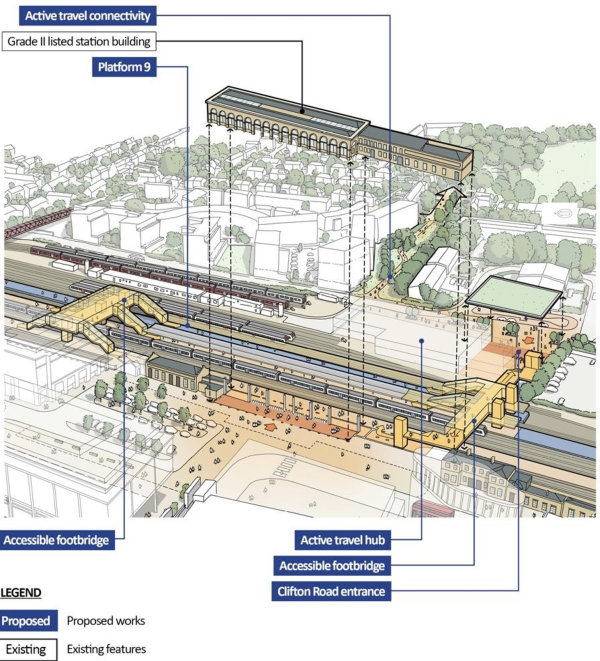
Figure 33: Aerial illustration of proposed Cambridge station works

This feels low. Maybe it is just that low. A few times a year I use Ely to Manchester direct, and direct services are supposed to be so much more desirable to the regular traveller. What are the flows to Sheffield, Manchester and Liverpool from the East?The train service and the data. The one other link is a 1tph 2 car train, and the biggest one way flow beyond the East of England is Nottingham at 15k, less than 50 passengers per day. It also provides links to Central England and the West Midlands via a change at Peterborough. In contrast Norwich-Cambridge is 76k and Norwich-Stansted 42k. Listen to any Norfolk/Suffolk politician or business leader: what they want is better connectivity to Cambridge.
Cambridge to the West Country totals a few thousand passengers a year – compared to nearly 2 million passengers to London. It isn't a journey that will ever be a priority for the railways. There are hundreds of trains arriving into London every hour from all directions and some combinations of those will have good connections and others won't. If the timings were changed to reduce the waiting time for Cambridge to Totnes then they would increase for Cambridge to Swansea, or for Norwich to Totnes, or any number of other combinations.We travel every few weeks from Cambridge to Totnes and it's an awful journey across London. The trains are not well timed so you end up spending ~30 mins on the concourse at Paddington, which is frightfully noisy (what ARE all those hooters going off all the time?).
At Cambridge getting from the bus stops to P7/P8 is a long walk* and the final straw was when they stopped through trains on the Circle Line. The TSRs on the B & H mean that timekeeping has been poor all year.
If all this were fixed the journey from Cambridge to the WoE would be more attractive and ridership might be higher.
* I thought there was a plan for a second footbridge but the recent coverage of the EWR stuff is all about a new exit from the station to the East.
The NR journey planner has it about 10 minutes quicker from Cambridge to Paddington using the fast train to Kings Cross then tube compared to Thameslink to Farringdon and then Crossrail.It is a bit off topic, but you are going the wrong way across London when travelling between the West of England and Cambridge. Use the Elizabeth Line between Paddington and Farringdon then use Thameslink to/from Cambridge.
The plan for the WCML fasts is to add two "everything stops locations", one on WCML south which will be MK (and WCML North is a big more complex as this will be on different branches). A big benefit is +2tph on the fasts by doing this (which will be more LNWR semi fasts in reality). Hence MK will be the local "intercity" hub. The future service level (TPH) between MK and Bletchley will be pretty good so the main down side would be changes. Anything using the N-E curve would then miss Bletchley would would disadvantage some users. There is no perfect solution.
The main beneficiary for an N-E curve is actually freight...
Similarly, East West Rail (EWR) also offers an opportunity to transport more Felixstowe traffic cross-country and releasing cross-London traffic for the benefit of Essex Thameside. Two freight paths a day in each direction are planned to be included as part of the overall timetable solution, which would be of benefit to the limited amount Felixstowe traffic which travels to Wales or the South West. This traffic is currently routed via London, and if, re-routed, additional paths may be possible to and from Essex Thameside.
Although not included in the scope of the EWR project, an east-to-north facing chord from EWR to the West Coast Main Line at Bletchley would provide further routing options for Felixstowe freight trains to/from the West Midlands, North West and Scotland, also potentially offering opportunities to remove some traffic routed via London for the benefit of Essex Thameside freight. This chord could cost in the region of £160m and have the ability to provide around 15 paths a day between Felixstowe and the Midlands and North West. Other improvements, such as greater capacity in the Newmarket area may also be required.
In summary, it is critical that funders recognise that improvements which at first glance may appear to exclusively benefit other freight flows could have a great benefit to the Thames ports and other South Essex freight terminals, if a ‘whole system’ approach of determining complementary investment options and allocating capacity is taken. If a package of cross-London and cross-country freight orientated improvements were prioritised a freight routing situation could emerge whereby the vast majority of Felixstowe traffic is routed cross-country via the existing cross-country corridor and the EWR corridor (being utilised to its full potential), leaving the cross-London corridors largely clear for growing Essex Thameside freight.
Some other minor flows to/from destinations on the GEML, such as the aggregates terminals at Chelmsford, Marks Tey and Ipswich would still require paths via London so it is not possible or practical for all GEML freight to be re-routed away from London. Also, some capacity for Felixstowe services via London would also be desirable from a diversionary perspective for when part of the cross-country route is closed on a planned or unplanned basis, and paths would still fit in the timetable on the ‘Y’ path basis previously described. Figure 12 opposite shows the optimal primary routing solutions for intermodal traffic which forms a majority of freight trains operating on these routes.
It should be noted that gauge enhancements would be required on the Midland Main Line to enable direct intermodal flows between Essex Thameside and the East Midlands. If this is not possible then these flows will still need to travel on the West Coast Main Line via Birmingham.


That doesn't take into account the time (and effort) taken to walk to platform 7 or 8 compared to the time taken to walk to platform 1 at Cambridge!The NR journey planner has it about 10 minutes quicker from Cambridge to Paddington using the fast train to Kings Cross then tube compared to Thameslink to Farringdon and then Crossrail.
It is a bit off topic, but you are going the wrong way across London when travelling between the West of England and Cambridge. Use the Elizabeth Line between Paddington and Farringdon then use Thameslink to/from Cambridge.
Going away from Cambridge, if you choose carefully then you can miss the walk to platforms 7/8 at Cambridge by getting a Thameslink train that starts from platform 1.
The WCML either has space or it doesn’t, however long or short (within reason) the train is. Whether using paths for short trains is the best thing to do is, of course, a different matter.How long would those trains be? If they are 4 cars, then does the West Coast Mainline have space for them? Would it then propagate delays around the network?
The WCML either has space or it doesn’t, however long or short (within reason) the train is. Whether using paths for short trains is the best thing to do is, of course, a different matter.
Not wanting to be pedantic but before 3-car 170s it was the 2-car 170s (270-273) that operated Norwich-Cambridge from it’s reincarnation thanks to Anglia Railways & the SRA in 2002.This feels low. Maybe it is just that low. A few times a year I use Ely to Manchester direct, and direct services are supposed to be so much more desirable to the regular traveller. What are the flows to Sheffield, Manchester and Liverpool from the East?
I do know that the splits I am offered on the Norwich to Liverpool always include a split at Nottingham. Now that Trainline offers splits as well, most passengers are likely to buy them, would that data be skewed by ticket splitting at Nottingham? Or are the flows quoted genuine end to end journeys? Counting tickets won't cut it any more, but journey data exists and DfT seem to be talking about journeys a lot more.
One other point, I tried to act like a regular passenger and went to Trainline to find itineraries from Ely to Manchester, and although it does show the direct options, there are plenty of non direct options for a very small time saving, changing at Peterborough and Doncaster or Leeds, but the orange "Cheapest" blob must be very tempting to an average passenger and they'll end up taking one stop on an Azuma before boarding another DMU for 90 minutes across the Pennines.
In the last few years, Norwich's Cambridge services that were 2 car 156 then 3 car 170 are now almost all 4 car 755 and mostly extended to Stansted. They want half hourly, yes, but should we sacrifice long distance connectivity for everyone else for that? I would say no. And there's not enough 755 stock to run it anyway, as it stands.
The solution here is marketing, pricing, and resourcing. I don't think people know it's there, I don't think LNER should be cheaper (and one can sort that out one way or the other!) and the trains probably aren't big enough (a 3-car 170 being a modest improvement in capacity, much as I prefer a 158).
Thanks for pointing out, you're right, a steady increase in capacity and quality over the years. Although it still saw some 156s until only a few years ago! As I said earlier in the thread, Norwich and Ely have more to gain from EWR than Newmarket and Ipswich, but I don't think Norwich to Liverpool should be sacrificed for that, and EWR could of course provide some of that Norwich to Cambridge capacity to which @Magdalia refersNot wanting to be pedantic but before 3-car 170s it was the 2-car 170s (270-273) that operated Norwich-Cambridge from it’s reincarnation thanks to Anglia Railways & the SRA in 2002.
Oh no me neither. It’s very important we retain this regular direct link to the North West. There’s easily room for a half-hourly Norwich-Cambridge service as every weekend the GEML is dug up proves.Thanks for pointing out, you're right, a steady increase in capacity and quality over the years. Although it still saw some 156s until only a few years ago! As I said earlier in the thread, Norwich and Ely have more to gain from EWR than Newmarket and Ipswich, but I don't think Norwich to Liverpool should be sacrificed for that, and EWR could of course provide some of that Norwich to Cambridge capacity to which @Magdalia refers
Assuming it does fit through Ely and trow bridge (which I assume are the biggest bottlenecks), wouldn't the best/easiest way to provide that be to have the current hourly Norwich-Stansted and an hourly Norwich-Cambridge, rather than trying to connect the latter through to something at Cambridge?Oh no me neither. It’s very important we retain this regular direct link to the North West. There’s easily room for a half-hourly Norwich-Cambridge service as every weekend the GEML is dug up proves.
Trowse Bridge isn’t really that much of a bottleneck to be honest. Ely North Jcn is the main issue Monday-Fridays when freight is at its most prolific. We just need half-hourly Norwich-Cambridge (one continues to Stansted) and then leave the Norwich-Liverpool service as it is but hopefully with 3-car units the norm.Assuming it does fit through Ely and trow bridge (which I assume are the biggest bottlenecks), wouldn't the best/easiest way to provide that be to have the current hourly Norwich-Stansted and an hourly Norwich-Cambridge, rather than trying to connect the latter through to something at Cambridge?
I would imagine 8 cars.How long would those trains be? If they are 4 cars, then does the West Coast Mainline have space for them? Would it then propagate delays around the network?
Out of interest - why is a Norwich to Liverpool Lime Street link considered more important than a Cambridge to Liverpool Lime Street link? Given the Liverpool link requires double the paths. I’ve thought once EWR opens Cambridge to Birmingham New Street should be routed via Milton Keynes Central and Northampton, and the old path used for Birmingham New Street to Norwich. I would divert Liverpool Lime Street to Cambridge. And then have a new additional Leicester to Stansted Airport.Oh no me neither. It’s very important we retain this regular direct link to the North West. There’s easily room for a half-hourly Norwich-Cambridge service as every weekend the GEML is dug up proves.
156s and 150s before them (as well as 150280 on hire from ATW) also saw service on occasions. The 19:28 ex-Norwich & 21:15 (SX) return were even booked for a class 153 in latter days.
It dates back to driver/conductor route learning in the early 1990s. Cambridge crews signed the Birmingham route but Norwich crews only signed to Peterborough. One of the depots needed to sign through to Nottingham and it was deemed economical for Norwich crews to learn this rather than both routes. The alternate hourly services from Norwich to Birmingham/North West became just Liverpool with Cambridge continuing to serve Birmingham and Ipswich dropped from the Express network altogether. Peterborough traincrew depot was closed at the same time. Some changeovers took place at Ely/Leicester for a few years to allow some limited through working from Cambridge to Liverpool (via Nottingham) and Norwich to Birmingham but this all came to an abrupt end when Central Trains was broken up in 2007.I would imagine 8 cars.
== Doublepost prevention - post automatically merged: ==
Out of interest - why is a Norwich to Liverpool Lime Street link considered more important than a Cambridge to Liverpool Lime Street link? Given the Liverpool link requires double the paths. I’ve thought once EWR opens Cambridge to Birmingham New Street should be routed via Milton Keynes Central and Northampton, and the old path used for Birmingham New Street to Norwich. I would divert Liverpool Lime Street to Cambridge. And then have a new additional Leicester to Stansted Airport.
I can't find any estimates for completion of the eastern section, but the much simpler upgrade to the Marston Vale section is projected to not be complete until 2030, so the chances of Class 150s still existing by the time the line is complete through to Cambridge are minuscule. The upgrade will, in any case, replace the stations which have short platforms.There may be two modern EWR parts with modern stock, with the older MV part in between run by 150s, for some time until all are fully integrated?
Agree. If only the Railtrack initiatedI can't find any estimates for completion of the eastern section, but the much simpler upgrade to the Marston Vale section is projected to not be complete until 2030, so the chances of Class 150s still existing by the time the line is complete through to Cambridge are minuscule. The upgrade will, in any case, replace the stations which have short platforms.

