If a minority of people are going to get hysterical, that is their choice and there is nothing anyone can do about that. I don't see this as a good reason for withholding potentially useful information. A derailment sounds operationally serious to anyone not an authority in the rail network but with a reasonable ability to judge a situation, so if they judge the delay to be severe, they may have the option of going home and using their car, or working from home. They can't do that if all that is being announced is some generic statement that could mean anything from a few minutes to an hour or more delay. It comes down to trying to be helpful. As for your analogy, if a road is closed the reason will virtually always be given, usually it is due to roadworks in which case the closure will be advertised in advance, or a collision. Very rarely it is due to severe weather e.g. snow (in the case of roads at altitude in winter), flooding or downed trees.Obviously there's no official line yet, but telling the public a train has derailed will cause some to assume its some sort of mass casualty event and then the inevitable hysteria the media loves.
if it were the case that someone forgot a set of manual points and a train dropped one bogey off the rails but blocked the whole depot by conincidence.. that's very much a "problem at the depot"
People don't always need to know why, but they should be told how to deal with the fallout. Like if the Police close a road you need, you are not entitled to be told what has happened just because it affects your journey.

-
Our new ticketing site is now live! Using either this or the original site (both powered by TrainSplit) helps support the running of the forum with every ticket purchase! Find out more and ask any questions/give us feedback in this thread!
You are using an out of date browser. It may not display this or other websites correctly.
You should upgrade or use an alternative browser.
You should upgrade or use an alternative browser.
Buffer Stop Collision near Brighton (Lovers Walk Depot)
- Thread starter MrJeeves
- Start date
- Status
- Not open for further replies.
Sponsor Post - registered members do not see these adverts; click here to register, or click here to log in
R
RailUK Forums

If a minority of people are going to get hysterical, that is their choice and there is nothing anyone can do about that. I don't see this as a good reason for withholding potentially useful information. A derailment sounds operationally serious to anyone not an authority in the rail network but with a reasonable ability to judge a situation, so if they judge the delay to be severe, they may have the option of going home and using their car, or working from home. They can't do that if all that is being announced is some generic statement that could mean anything from a few minutes to an hour or more delay. It comes down to trying to be helpful. As for your analogy, if a road is closed the reason will virtually always be given, usually it is due to roadworks in which case the closure will be advertised in advance, or a collision. Very rarely it is due to severe weather e.g. snow (in the case of roads at altitude in winter), flooding or downed trees.
I tend to agree giving more information would be better in this instance. I’m sure I’ve seen wording about delays “due to a derailment in a depot”, so I’m surprised they haven’t released something along those lines.

That's not why they're not telling the truth. The reason they're not telling the truth is to try an protect their reputation. GTR are compulsive liars.
No putting out "a derailment" is definitely something other TOCs wouldn't do either. As suggested above, this sends all sort of hysteria and panic especially to media sources who believe a passenger train has derailed and then the press and communications team is having to explain it all day that there's no casulaties, it was in a depot etc. Delay reasoning needs to be very carefully considered, sometimes and for certain incidents.
== Doublepost prevention - post automatically merged: ==
I tend to agree giving more information would be better in this instance. I’m sure I’ve seen wording about delays “due to a derailment in a depot”, so I’m surprised they haven’t released something along those lines.
That option does exist in Darwin ("This train has been delayed by a derailment within the depot"). Interestingly though not every TOC has the complete full list of reasons set up on internal systems, for reasons I am not sure of.

trainmania100
Established Member
Pictures on the argus website.
 www.theargus.co.uk
Morning commute chaos as train hits buffer near Brighton
Rail passengers are in for lengthy delays this morning after a problem at Brighton depot means trains cannot run on the main line to the city.
www.theargus.co.uk

And assess what alternative decisions to make to your travel plans. A derailment is likely to take longer to resolve than a points failure or a power cut etc. If you know what the problem is, you can make an educated guess as to how long it will be before normal service is resumed.Except knowing the actual cause can allow people to be more sympathetic.

DJ_K666
Member
No idea what's going on there. It'd be far easier to wander down from the back of the station to London Road shops and catch the Brighton & Hove 5 or 5A bus to Harrington Road and then it's only a very short walk up to Preston Park station, basically around the corner. I'm fairly sure Compass don't operate at the sort of hour that commuters would be boarding the train. Metrobus has a 273 heading to Crawley at 0726 taking 48 minutes.I think they are trying to terminate them at PRP until Metrobus/Compass Bus properly starts up for the morning to pick up the disrupted passengers.
Other options would include heading to Hove and going round the Cliftonville spur or heading for Lewes and going for a Hastings to Vic train.
CharlieSpotted
Member
- Joined
- 21 May 2014
- Messages
- 976
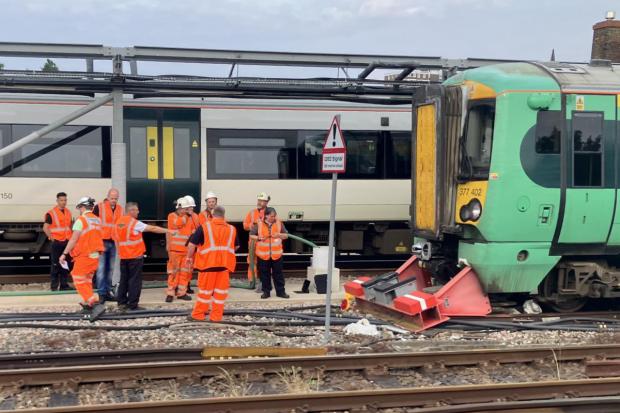
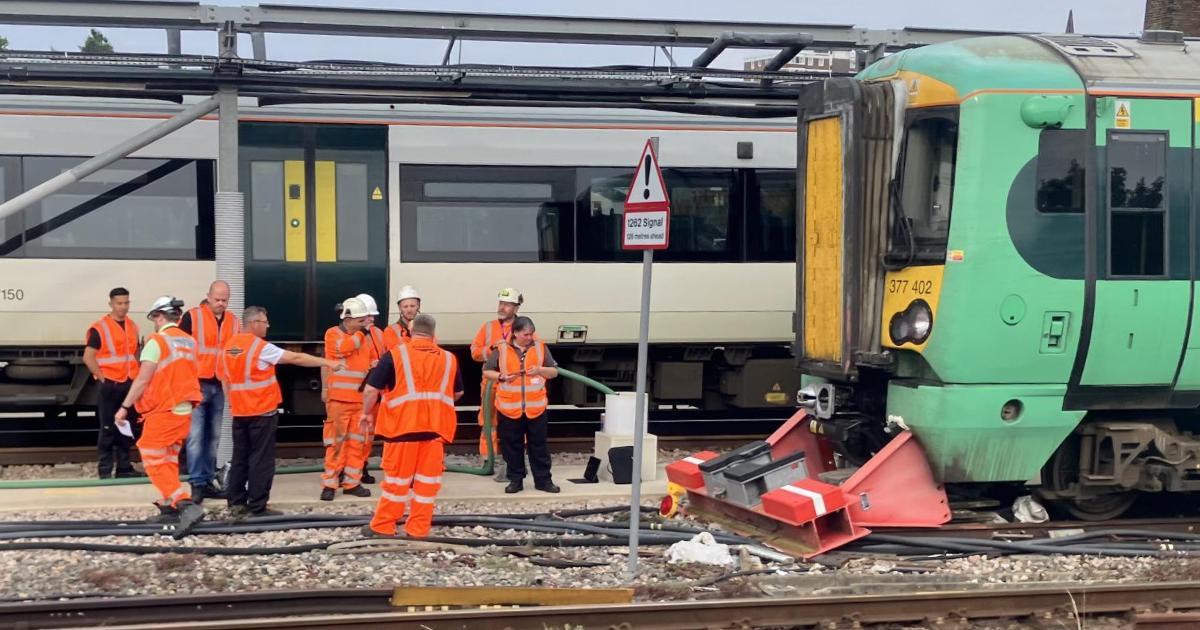
Surely buffers aren't supposed to just fall over like that when hit?
I understand there are many different designs / types of buffer, but is that a normal mode?
Does it suggest it's had, well, quite a whack?
PyrahnaRanger
Member
Yes, but equally “they’ve run out of the good biscuits, all that’s left are the bourbons” could be seen as a problem at the depot, and I’ve watched that well known documentary “Carry on at your convenience” to see how the unions would react to that happeningObviously there's no official line yet, but telling the public a train has derailed will cause some to assume its some sort of mass casualty event and then the inevitable hysteria the media loves.
if it were the case that someone forgot a set of manual points and a train dropped one bogey off the rails but blocked the whole depot by conincidence.. that's very much a "problem at the depot"
People don't always need to know why, but they should be told how to deal with the fallout. Like if the Police close a road you need, you are not entitled to be told what has happened just because it affects your journey.

Slightly less facetiously, imagine there’s a false activation of a depot fire alarm, and the procedure is for the workers to be evacuated, there may be no trains able to leave for a period, but that would probably be less time consuming than a derailment.
If I’ve got the details, I can make an educated guess on what I need to do - go back and get the car, book a hotel room because I can’t get home today, catch a bus, find a taxi… I’ve many options if people can give me an answer.
If you’re civil, the police at a road closure will give you an estimate on how long it’s going to be in place in my experience; this has enabled me to avoid some very long detours in the past by sitting and being patient!
No putting out "a derailment" is definitely something other TOCs wouldn't do either. As suggested above, this sends all sort of hysteria and panic (snip)
I seem to recall that TPE did indeed announce a “derailment within a depot” not too long ago, which was a very useful bit of information as a passenger- you’re able to gauge roughly how long it’s going to take before things are sorted.
Friction stops that have been pushed too far?
Surely buffers aren't supposed to just fall over like that when hit?
I understand there are many different designs / types of buffer, but is that a normal mode?
Does it suggest it's had, well, quite a whack?
uglymonkey
Member
- Joined
- 10 Aug 2018
- Messages
- 708
Looks like the buffers are designed to be pushed ahead of a derailing unit, slowing it down hopefully. Rather than a robust riveted solid immovable buffer, which would surely write off the unit in creating damage ( and more injury potential to staff and customers, due to solid sudden stop) rather than a slow, slow down, dissipating the energy as it goes?
This has been posted and is the quality of comms that would have been much better if sent a few hours earlier.
Normally the NR Sussex/Wessex/Kent "long threads" are pretty good quality and strike the right balance between informative but concise and understandable.
Why would they want the full listNo putting out "a derailment" is definitely something other TOCs wouldn't do either. As suggested above, this sends all sort of hysteria and panic especially to media sources who believe a passenger train has derailed and then the press and communications team is having to explain it all day that there's no casulaties, it was in a depot etc. Delay reasoning needs to be very carefully considered, sometimes and for certain incidents.
== Doublepost prevention - post automatically merged: ==
That option does exist in Darwin ("This train has been delayed by a derailment within the depot"). Interestingly though not every TOC has the complete full list of reasons set up on internal systems, for reasons I am not sure of.
It might be helpful. Sarcasm ends a s its aimed at the people who make the software.
No doubt the list of reasons changed and it was going to cost for it to be updated snd someone didn't wish to buy the cost, which might have been a lot.
== Doublepost prevention - post automatically merged: ==
That is all people seem to be asking for.Normally the NR Sussex/Wessex/Kent "long threads" are pretty good quality and strike the right balance between informative but concise and understandable.
It's made rhe media now so any hysteria, if it happened, will have occurred and be over with.

The fact you believe this made me laugh quite loud!That's not why they're not telling the truth. The reason they're not telling the truth is to try an protect their reputation. GTR are compulsive liars.

trainmania100
Established Member
Guessing Argus got in there first (the article writer is associated with the railway) and I guess NR wanted to get in there quick if people start reading that and there's no comment on it from authoritive sourceswould have been much better if sent a few hours earlier.
Based on how the reasons are provided to consumers of the data, I would suggest any TOC-side system should be importing the data regularly and not relying on a fixed version. Not that the latter with a large cost to update the static data would at all surprise me.No doubt the list of reasons changed and it was going to cost for it to be updated snd someone didn't wish to buy the cost, which might have been a lot.
Especially considering reasons sometimes get removed from the reference list, too! Bet there's no validation on what the CIS inputs into Darwin...Based on how the reasons are provided to consumers of the data, I would suggest any TOC-side system should be importing the data regularly and not relying on a fixed version.


ThameslinkUser
Member
1644 first off Brighton
== Doublepost prevention - post automatically merged: ==
Now the question is why were the power cables in such a position that a buffer impact would cut them? From the image it looks as though there is a significant amount of space for them to continue far enough that a slow speed derailment like this wouldn't cut the cables.
== Doublepost prevention - post automatically merged: ==
Nice presumption about the gender.there is probably one bloke in Control
The post in question was not moaning about knowing the particulars of the issue specifically, but about the fact staff didn't have a clue as to what was going on. No ideas about alterations, no ideas about cancellations, no ideas about ticket acceptance etc. Also, as already mentioned, knowing the details of the issue can allow someone to plan more effectively. 'Problem in the depot' could be anything from a shunter being late to work, to a train being sent out late, to a derailment. It doesn't identify whether all trains will be affected by the issue, like today, or whether just specific depot start ups. Without knowing such details, it is impossible to plan the journey. Not to mention GTR's overly optimistic attitude taking effect once again. Don't forget this was originally supposed to have no disruption whatsoever by 0900. The first train through the affected area is at 1644 and there will still be significant knock on disruption.Indeed, there was another post whining about not knowing the detail of the issue i.e. power / derailment / whatever.
I completely agree with this.Normally the NR Sussex/Wessex/Kent "long threads" are pretty good quality and strike the right balance between informative but concise and understandable.
Now the question is why were the power cables in such a position that a buffer impact would cut them? From the image it looks as though there is a significant amount of space for them to continue far enough that a slow speed derailment like this wouldn't cut the cables.
Last edited:
trainmania100
Established Member
Did anyone get any gen on the loco from Tonbridge that went to assist?
A 1Z99 came from that area and now an 0Z66 from lovers walk is just leaving...
 live.rail-record.co.uk
A 1Z99 came from that area and now an 0Z66 from lovers walk is just leaving...
Train 0Z66 Lovers Walk T&R.S.M.D to Tonbridge West Yard Gbrf Thu 01/08/2024 | Rail Record
Live Train Times for Train 0Z66 Lovers Walk T&R.S.M.D to Tonbridge West Yard Gbrf departing on Thu 01/08/2024 | Rail Record
live.rail-record.co.uk
It seems when there is a railway problem, some people want to know EVERYTHING as soon as it happened.As for your analogy, if a road is closed the reason will virtually always be given, usually it is due to roadworks in which case the closure will be advertised in advance, or a collision. Very rarely it is due to severe weather e.g. snow (in the case of roads at altitude in winter), flooding or downed trees.
On the roads, people seem to accept "The A3 North is closed at Guildford following an accident", and don't demand "The A3 is closed at the hospital junction at Guildford to the A25 junction because a black Peugeot 3008, AB24CDE, hit the OSR quarter of red Nissan Juke, XX70XXX, because the Peugeot driver was sending a text while driving and the Juke driver did not see the problem occuring in their mirror."
Edit to add: "Surrey Police sent these two cars from Guildford, SECAmb sent this DMA based at Chertsey and this SRV based at Guildford, and Westbourne Motors sent this specific recovery vehicle from their depot at... wherever they are based"
The last set of rail disruption I was caught up in was quite large. I got told be staff initially that nothing was going out of the station. Nothing was going to move for a while.
I asked if another specific route would be valid, got told no as that would also be affected as the issue was at XYZ station.
Did I need to know more than that? No.
Once I found out more about what the cause was, did it fundamentally change my travel plan? Also no.
I am not advocating for having no communication, but there is a sensible level.
As others have said, a bogie going on a small adventure is a derailment, but if you ask someone to imagine a derailment, they will say Hatfield, Clapham, Salisbury, Selby, etc and have visions of death, destruction, and days long issues. "A problem in the depot" describes the situation in a balanced way.
On a road example... Picture this: "An incident on the M3 sliproad", and then think about this: "A collision between a coach and a lorry on the M3 motorway".
Now I will say that this hypothetical is a coach doing a 2mph lovetap to the back of an HGV at the lights on a sliproad. Both statements describe the incident, but they are giving different depictions.
The trick is to give as much information as is needed to convey the facts and prevent over speculation, without giving unnecessary or counterproductive information.
ThameslinkUser
Member
It is so people can adequately make alternative plans. Using roads as an example is complete what-about-ism given the extreme differences in flexibility of route selection.It seems when there is a railway problem, some people want to know EVERYTHING as soon as it happened.
Derailment in the depot would describe it more succintly given 'problem in the depot' could be anything from force majure to shunter taking an extended PNB, without the death implications of the listed disasters."A problem in the depot" describes the situation in a balanced way.
Likewise, on the railway I would have accepted "Trains cannot run between Preston Park and Brighton due to a minor derailment at a depot."On the roads, people seem to accept "The A3 North is closed at Guildford following an accident"
I don't see a difference here? The road comparison to the railway information received at stations today would be "Cars cannot drive to Brighton because of an incident in a lay-by."
It is so people can adequately make alternative plans. Using roads as an example is complete what-about-ism given the extreme differences in flexibility of route selection.
Hardly. If you are told "No services between A-B currently due to an ongoing issue. Travel via C to continue your journey. Tickets accepted via operator 1 and bus routes 2,3,4" Disruption expected until 12:00". That is the broad content you'd be getting.
Getting to know the ins and outs is certainly beneficial to an extent (problem / impact / advice), but has no extra bearing on your decision.
Lewisham2221
Established Member
But how does the average passenger - someone who isn't going to be reading or posting on this forum - going to have any idea of the different times it may take to deal with, and clear any of: a problem at the depot; a broken down train; a points failure; a fire next to the track; a trespass incident; a derailment; damage to the overhead wires; a problem with the signalling equipment? I wouldn't be surprised if the average punter doesn't expect a low speed derailment in the depot to be a relatively quick and easy problem to rectify and then expect some of the other issues to take longer to rectify than they actually do.Yes, but equally “they’ve run out of the good biscuits, all that’s left are the bourbons” could be seen as a problem at the depot, and I’ve watched that well known documentary “Carry on at your convenience” to see how the unions would react to that happening
Slightly less facetiously, imagine there’s a false activation of a depot fire alarm, and the procedure is for the workers to be evacuated, there may be no trains able to leave for a period, but that would probably be less time consuming than a derailment.
If I’ve got the details, I can make an educated guess on what I need to do - go back and get the car, book a hotel room because I can’t get home today, catch a bus, find a taxi… I’ve many options if people can give me an answer.
If you’re civil, the police at a road closure will give you an estimate on how long it’s going to be in place in my experience; this has enabled me to avoid some very long detours in the past by sitting and being patient!
I seem to recall that TPE did indeed announce a “derailment within a depot” not too long ago, which was a very useful bit of information as a passenger- you’re able to gauge roughly how long it’s going to take before things are sorted.

Trainguy34
Established Member
That sounds the most accurate without going into extreme detail, couldnt get clearer within reason!Likewise, on the railway I would have accepted "Trains cannot run between Preston Park and Brighton due to a minor derailment at a depot."
ThameslinkUser
Member
"no trains owing to passenger causing a disturbance" vs "no trains owing to a fatality" have very different timings in most commuters heads. Don't forget this incident kicked off at the start of peak time on the busiest commuter line in the country. Whilst Gatwick is en-route, it is in the morning a line used by people who know this stuff and want to know the actual impact. It is so typical of the railway to treat all punters as dunces.Hardly. If you are told "No services between A-B currently due to an ongoing issue. Travel via C to continue your journey. Tickets accepted via operator 1 and bus routes 2,3,4" Disruption expected until 12:00". That is the broad content you'd be getting.
class444 fan
On Moderation
- Joined
- 12 May 2024
- Messages
- 51
Is it a class 377 thats involved in this?
"no trains owing to passenger causing a disturbance" vs "no trains owing to a fatality" have very different timings in most commuters heads. Don't forget this incident kicked off at the start of peak time on the busiest commuter line in the country. Whilst Gatwick is en-route, it is in the morning a line used by people who know this stuff and want to know the actual impact. It is so typical of the railway to treat all punters as dunces.
Sure, but you're not going to be getting War and Peace.
uglymonkey
Member
- Joined
- 10 Aug 2018
- Messages
- 708
Years ago you would have a chalk message on a blackboard, the information haven been gotten to station staff by telephone. Now it's all in real time instantly and if not online speculation fills the vacuum and we all know how that turns out, inaccurately treated as gospel.
theageofthetra
Established Member
Good as useless, particularly as that train shouldn't have been travelling at more than 5mph.
Surely buffers aren't supposed to just fall over like that when hit?
I understand there are many different designs / types of buffer, but is that a normal mode?
Does it suggest it's had, well, quite a whack?
- Status
- Not open for further replies.