HamworthyGoods
Established Member
- Joined
- 15 Jan 2019
- Messages
- 4,476
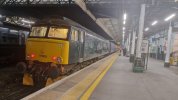
Talking of mk1 LCHS on the mainline, one of the Night Riviera consists currently has a mk1 van running vice mk3 brake.


However, should the distance of the gantry to the train really been that tight ?
Whether or not he should have known better, the safety authorities have taken the view that it was easily preventable and therefore decided to prevent further incidents. There's a whole other thread of 'what level of behaviour should the railways be liable for' but this is not that discussion.I am afraid the enthusiast on the class 442 really should have known better, simply because he knew there was one openable window per side on the unit for the guard to use.
From memory ISTR the gantry was between two tracks and couldn't feasibly be placed anywhere else, but I might have that very wrong.However, should the distance of the gantry to the train really been that tight ?
Flying Scotsman could grind to a halt over modern door demands
Locomotive’s future in doubt as rail watchdog tells its owners to replace old-fashioned locks with up-to-date systems
By Telegraph Reporters
26 May 2023 • 9:49pm
The future of the Flying Scotsman is in doubt over the rail watchdog’s demands that modern door locks are fitted, The Telegraph can reveal.
Carriages hauled by the 100-year-old steam locomotive, run by West Coast Railways, are currently locked and unlocked using an old-fashioned bolt above each door.
However, train bosses are resisting pressure from the Office of Rail and Road (ORR) to modernise the historic carriages with central door locking systems, which the watchdog said would improve safety.
The Telegraph understands that West Coast Railways believes that the modern locking system would cost upwards of £1 million and is unnecessary as stewards man the doors on its charter trains at all times.
The ORR argued that centrally controlled locking systems prevent passengers from opening doors when the platform is too short.
However, safety regulations introduced in 2005 banned hinged door carriages unless they are fitted with central locking.
An exemption for slam-door carriages expired at the end of March and West Coast Railways is seeking a judicial review. But neither West Coast nor the ORR would confirm when it is likely to take place.
The Flying Scotsman is the world’s most famous steam locomotive. Built in 1923, it was officially the first locomotive to reach 100mph, and the first to circumnavigate the globe.
It also holds the world record for a non-stop run by a steam locomotive, set in 1989 with a 422-mile trip, achieved during its visit to Australia in 1989.
However, it has driven a succession of businessmen – Alan Pegler, Sir William McAlpine and Tony Marchington – to financial ruin and was acquired by the National Railway Museum in 2004.
It is able to run at up to 75mph on Network Rail’s tracks, with routes and destinations including its former home, the East Coast Main Line, the Settle-Carlisle line, Great Yarmouth, Aberdeen, Portsmouth and Cardiff.
As well as the Flying Scotsman’s centenary programme of rail tours, other charter trains will be heavily impacted if West Coast Railways is not granted a further exemption.
It also runs the Jacobite service between Fort William and Mallaig in Scotland – made famous by the Harry Potter film series – twice daily, while the Northern Belle dining train’s carriages are currently not compliant with the law either.
Other train companies have been issued with short-term exemptions by the ORR in order to continue operating trains while carriages are being fitted with central locking.
Safety regulations introduced in 2005 banned hinged door carriages unless they are fitted with central locking
Belmond has an exemption until February 2025 for its luxury Twenties and Thirties Pullman carriages, while Vintage Trains’ exemption is set to run out on Nov 29 2024. Unlike West Coast Railways, both companies have pledged to fit the new locking system.
The ORR said it granted an exemption until June 30 2023 to allow West Coast Railways to “honour its bookings and to reflect the interests of its employees whilst its application for judicial review is determined”.
Jeremy Hosking, the chairman of Locomotive Services Limited, which fitted central door locking to its fleet well before the March 31 deadline, expressed his frustration at the current situation.
He said: “We feel a bit silly having complied with regulations that are not being enforced, but we may have to live with it.
“The ORR seems to be in a pickle in the face of what appears to be premeditated non-compliance, so its procrastination-oriented approach is perhaps understandable.”
If the Flying Scotsman is no longer permitted to use the mainline railway, it could still run on Britain’s much smaller network of historical “preserved lines”.
West Coast Railways was unavailable for comment.
That article is being slightly sensationalist as there's nothing stopping 60103 running with another TOC that does have CDL sets.An interesting piece in today's Daily Telegraph about West Coast Railways looking for a judicial review against the requirements for central door locking.
This also explains how West Coast Railways have been able to continue to operate Mark 1s since their exemption expired on 31 March this year.
https://www.telegraph.co.uk/news/2023/05/26/flying-scotsman-future-doubt-trains-modern-doors/
Indeed. It could also be seen as portraying a battle between LSL and WCRC.That article is being slightly sensationalist as there's nothing stopping 60103 running with another TOC that does have CDL sets.
Tbh I think it's portraying a battle between WCRC and WCRC's financial manager more than anything else. But WCRC were certainly not happy about the disruptive new entrant to the market that was happy to actually comply with all the safetly legislation.Indeed. It could also be seen as portraying a battle between LSL and WCRC.
It's always the nature of a safety regulator that people won't like being asked to spend money before serious problems actually happen. However 1. Tornado has run with Mk3s before, Scotsman can as well, 2. If Steam did get banned it'd be better for 99% of ordinary passengers, a fair proportion of whom are unaware that steam actually runs on the mainline at all, as there'd be less trespass incidents, less broken down heritage trains blocking the lines, and less STP amendments to the timetable to get the trains in as well as less cost to NR to do al the gauge clearance and passenger authority work.The ORR is in danger of creating more problems than it solves.
I'm intrigued as to why the Northern Belle isn't apparently compliant - surely, being made up of M2s, it would be? The vehicles are currently having toilet tanks fitted as well so it cant be that.An interesting piece in today's Daily Telegraph about West Coast Railways looking for a judicial review against the requirements for central door locking.
This also explains how West Coast Railways have been able to continue to operate Mark 1s since their exemption expired on 31 March this year.
https://www.telegraph.co.uk/news/2023/05/26/flying-scotsman-future-doubt-trains-modern-doors/
Does it have Central Door Locking or Window protection?I'm intrigued as to why the Northern Belle isn't apparently compliant - surely, being made up of M2s, it would be? The vehicles are currently having toilet tanks fitted as well so it cant be that.
I take it back, surprisingly for a rake predominately made up of Mk2E & Fs, it doesn't appear to have CDL.Does it have Central Door Locking or Window protection?
It wouldn't have needed CDL in service, and heritage operators would always staff it so that it never needed it fitting.I take it back, surprisingly for a rake predominately made up of Mk2E & Fs, it doesn't appear to have CDL.

Talking of mk1 LCHS on the mainline, one of the Night Riviera consists currently has a mk1 van running vice mk3 brake.
It wouldn't have needed CDL in service
The Northern Belle's first charter was in 2000, and the coaches would have spent some time being refurbed into the pullmans before that. When did CDL come into widespread use on the mainline?That would depend on when those vehicles first formed part of the NB rake. Virgin XC Mk2s were certainly fitted with CDL and they bowed out of service in 2002.
Coach 6348Really???

 www.flickr.com
Well that’s… differentCoach 6348
6348 Pressed Steel Mark 1 Barrier Coach, Great Western Railway, St Philip's Marsh, Bristol
Explore Kev Slade Too's 59674 photos on Flickr!

The Northern Belle's first charter was in 2000, and the coaches would have spent some time being refurbed into the pullmans before that. When did CDL come into widespread use on the mainline?
We have seen WCRC’s prioritisation of safety laid bare before but only after serious incidents at Wooton Bassett and Doncaster.Tbh I think it's portraying a battle between WCRC and WCRC's financial manager more than anything else. But WCRC were certainly not happy about the disruptive new entrant to the market that was happy to actually comply with all the safetly legislation.
It's always the nature of a safety regulator that people won't like being asked to spend money before serious problems actually happen.
6348 is a non passenger carrying barrier vehicle and could not even be used as a brakevan for passenger trains as there are no gangways on the ends, nor a guards office.Coach 6348
6348 Pressed Steel Mark 1 Barrier Coach, Great Western Railway, St Philip's Marsh, Bristol
Explore Kev Slade Too's 59674 photos on Flickr!

6348 is a non passenger carrying barrier vehicle and could not even be used as a brakevan for passenger trains as there are no gangways on the ends, nor a guards office.
I agree that the inwards opening guards door and droplight still seem present on this vehicle. But as I said, with no end gangways it could not be used as a brakevan on a passenger carrying train.I think GWRs mk1 barrier vehicles are all ex BG’s (full brakes). The windows and gangways have been removed and internally stripped but still retain the guard’s handbrake,pressure gauge and emergency brake valve.
I agree that the inwards opening guards door and droplight still seem present on this vehicle. But as I said, with no end gangways it could not be used as a brakevan on a passenger carrying train.
Ahhh. Thanks for that. So when it is used 6348 is actually used as linen storage van rather than the traditional brakevan on the train. That is interesting and I suppose does warrant a place in history,m even as a non passenger carrying vehicle. I imagine the sleeping car attendants are non too impressed at having to carry the stuff out onto the platform then load it back into that dark space. I assume it doesn't have internal lighting either.I’m afraid that is incorrect. It is the standby brake for the Night Rivieria. Yes you are correct the usual coaches are the mk3 BFO coaches of which 2 are needed each night and leaving one spare.
The issue arrises when more than one of the BFOs is stopped then to provide a coach with the emergency equipment and van space to store clean/dirty linen being return to Penzance (there’s history from 1978 when linen tried to be stored in the train!). And bicycles are also conveyed in 6348.
You are correct 6348 can only be accessed from the platform, it is a pain for the guards when it is used as a last resort. The guard will work the train from the other mk3s but the van will still be used for emergency equipment etc.
The photo attached shows 6348 in the consist the other night at Exeter vice mk3BFO.
Ahhh. Thanks for that. So when it is used 6348 is actually used as linen storage van rather than the traditional brakevan on the train. That is interesting and I suppose does warrant a place in history,m even as a non passenger carrying vehicle. I imagine the sleeping car attendants are non too impressed at having to carry the stuff out onto the platform then load it back into that dark space. I assume it doesn't have internal lighting either.
Thanks for the correction

Except that it is being used a brake vehicle on a passenger carrying train. The guard's brake facilities were retained deliberately by FGW/GWR so that it could act as an emergency replacement for a missing BFO. There doesn't have to be through access from the rest of the train - it is there as a means to secure the train if/when there is no loco attached.I agree that the inwards opening guards door and droplight still seem present on this vehicle. But as I said, with no end gangways it could not be used as a brakevan on a passenger carrying train.
I concede.Except that it is being used a brake vehicle on a passenger carrying train. The guard's brake facilities were retained deliberately by FGW/GWR so that it could act as an emergency replacement for a missing BFO. There doesn't have to be through access from the rest of the train - it is there as a means to secure the train if/when there is no loco attached.
I don't know why people persist with a certain point of view (and state it as if it was "fact") when there is evidence to the contrary.
The handbrake in the van is only used to secure the train should the loco be shut down or detached when running round. The guard will only access it when stationary so the lack of gangway doesn’t matter.I concede.
I really must desist in having a certain point of view !!!! Especially when a vehicle is allegedly a brake vehicle except the guard cannot perform his full duties from it. I really thought the railway had advanced from non corridor trains but there you go - time to retire I feel.