• Our new ticketing site is now live! Using either this or the original site (both powered by TrainSplit) helps support the running of the forum with every ticket purchase! Find out more and ask any questions/give us feedback in this thread!

Rishi Sunak and the Conservative Party.

Status
Not open for further replies.

Domh245

Established Member
Joined
6 Apr 2013
Messages
8,426
Location
nowhere
Some suppliers claim to be greener than others. This is blatantly not the case.

As far as I know, there is not an entirely separate network of green-coloured pylons crossing the country, which is only connected to green sources of energy such as wind, hydro, solar etc.

So any supplier which claims to be "green" is surely telling porkies, and the energy you receive will still contain energy generated from Coalborough-on-Trent coal-fired power station as much as any other supplier.

Green tariffs are certainly a bit of smoke & mirrors and clever accounting - at any given point you are receiving the grid mix, though this will vary by area (The Scottish Highlands with their abundance of renewables has a much greener mix than London which is much shorter on large scale renewables) - the tariff just ensures that for every kWh of energy you've used, at some point a kWh of green energy has been produced.

As far as I can see there are actually only two meaningful electricity suppliers, the National Grid and the local electricity company, and all else is just smoke and mirrors.

Neither National Grid or your local electricity company (aka DNO) are "suppliers" - but transmitters and distributors. They (usually) don't have any generation capacity and merely provide (& control) the infrastructure to get it from the points of generation to points of consumption. The 'suppliers' if you like are really those who own the actual generation sites, including EDF (UK's active nuclear fleet), Drax, RWE etc. Most of the Big 6 energy firms (and a number of the smaller ones too) have their own generation capacity as well as retail operations
 
Sponsor Post - registered members do not see these adverts; click here to register, or click here to log in
R

RailUK Forums

Typhoon

Established Member
Joined
2 Nov 2017
Messages
3,540
Location
Kent
Maths A level is essential for any STEM degree in any case. So this "initiative", if we can even call it that, is aimed at those who will be doing a non-STEM degree or none at all. Surely more logical to put any maths that is thought to be widely useful into the GCSE, and if necessary push some more specialist stuff out of GCSE and into A level?
I won't be arguing! I don't want to drone on again about this but maths syllabuses were hi-jacked by 'educationalists'. I personally would prefer maths to be split into two - 'Essential maths', the sort of maths of which you speak, and 'Additional maths' containing those elements that would be helpful for those going on further. The former would be compulsory (possibly allow the able to take early), the second optional (like other subjects).

For instance, included in OCR Foundation Level Maths is

Know the exact values of sin i and cos i for i = 0°, 30°, 45°, 60°and 90°. Know the exact value of tan i for i = 0°, 30°, 45° and 60°.​


Factorise quadratic expressions of the form x2 + bx + c e.g. x2 - x - 6 = (x - 3) (x + 2), x2 – 16 = (x + 4) (x – 4), x2 - 3 = (x + √3) (x - √ 3) (sorry can't do 'squared)

Make t the subject of the formulae s = ½ at2 (again, t 'squared')

First one - why? They can look it up.
The last is pointless, if you know the values of 's' and 'a', bung the numbers in and solve it from there, pupils understand numbers much more than they understand letters (and I speak as someone who specialised in algebraic options at university).

To me, most of this is not necessary for the vast majority of pupils. As people have said before, a load of basic arithmetic; using spreadsheets; some stats and probability; some geometry (such as scale drawings); financial stuff - compound interest, mortgages, credit; graphs; estimation.
 

DustyBin

Established Member
Joined
20 Sep 2020
Messages
3,927
Location
First Class
Maths A level is essential for any STEM degree in any case. So this "initiative", if we can even call it that, is aimed at those who will be doing a non-STEM degree or none at all. Surely more logical to put any maths that is thought to be widely useful into the GCSE, and if necessary push some more specialist stuff out of GCSE and into A level?

Not necessarily; I don’t have an A level in maths. It was never my strong point to be honest. I could cope at degree level when dealing with structural calculations for example, but I think this is because point loads, bending moments etc. are “tangible” for want of a better word. Pure maths makes my head hurt!
 

Ediswan

Established Member
Joined
15 Nov 2012
Messages
3,459
Location
Stevenage

Make t the subject of the formulae s = ½ at2 (again, t 'squared')​

The last is pointless, if you know the values of 's' and 'a', bung the numbers in and solve it from there, pupils understand numbers much more than they understand letters (and I speak as someone who specialised in algebraic options at university).
Even with known values of 's' and 'a', you still have to know how to re-arrange the equation to find 't'. That is the skill being tested.
 

Bletchleyite

Veteran Member
Joined
20 Oct 2014
Messages
113,816
Location
"Marston Vale mafia"
I find the whole idea of competition in energy supply a bit strange.

Some suppliers claim to be greener than others. This is, as far as I can tell, blatantly not the case.

There's an element of influence of purchasing possible, and Germany is big on selling that, though the European energy markets are a bit more open than ours.

Most of it is competition between different billing systems and costs, though, which I'd agree is a sham.
 

edwin_m

Veteran Member
Joined
21 Apr 2013
Messages
28,756
Location
Nottingham
Not necessarily; I don’t have an A level in maths. It was never my strong point to be honest. I could cope at degree level when dealing with structural calculations for example, but I think this is because point loads, bending moments etc. are “tangible” for want of a better word. Pure maths makes my head hurt!
OK, there are exceptions, particularly in earlier years when universities, institutions and employers were more willing to give the benefit of the doubt to people who hadn't followed a conventional educational path. Obviously I don't know your exact circumstances but I can't think there are many structural engineers these days without A level or some similar qualification in maths.
 

birchesgreen

Established Member
Joined
18 Aug 2015
Messages
7,685
Location
Solihull
Oh so we are still talking about A Level maths in this thread? No idea why my earlier post was moved then!
 

Typhoon

Established Member
Joined
2 Nov 2017
Messages
3,540
Location
Kent
Even with known values of 's' and 'a', you still have to know how to re-arrange the equation to find 't'. That is the skill being tested.
But they would be rearranging with numbers, not letters. Figure at random - s =123, a = 10 (I think it was) so 123 = 1/2 x 10 x t squared. Then 123 = 5 t squared. Divide by 5, 24.6 = t squared. t is root 24.6. So a tad under 5. Too many at foundation level glaze over when manipulating letters - and it is a skill they will never need! A lot of this stuff just puts students off, they understand '5' and '24.6' but not 'a' or 't' - and if Sunak thinks it will click when they get to 16, he is mistaken.

Oh so we are still talking about A Level maths in this thread? No idea why my earlier post was moved then!
Probably only because the post you quoted was moved. (There is an obvious question to ask at this stage, but I will leave it to you ...)
 

DustyBin

Established Member
Joined
20 Sep 2020
Messages
3,927
Location
First Class
OK, there are exceptions, particularly in earlier years when universities, institutions and employers were more willing to give the benefit of the doubt to people who hadn't followed a conventional educational path. Obviously I don't know your exact circumstances but I can't think there are many structural engineers these days without A level or some similar qualification in maths.

Just to clarify, I wasn’t being pedantic for the sake of it, just pointing out that there are exceptions. Generally speaking I think you’re right.

Amusingly (now at least!) I applied for a job at Network Rail as a new graduate and was rejected as I didn’t have the required A levels, but I did have a first class honours degree… “Computer says no” clearly! :lol:
 

nw1

Established Member
Joined
9 Aug 2013
Messages
9,430
Neither National Grid or your local electricity company (aka DNO) are "suppliers" - but transmitters and distributors. They (usually) don't have any generation capacity and merely provide (& control) the infrastructure to get it from the points of generation to points of consumption. The 'suppliers' if you like are really those who own the actual generation sites, including EDF (UK's active nuclear fleet), Drax, RWE etc.
Yes, I know what you mean there, sorry, poor choice of wording. Essentially the equivalents of what used to be National Power and Powergen (one of which later became Innogy, I forget which) and before that the CEGB.
Most of the Big 6 energy firms (and a number of the smaller ones too) have their own generation capacity as well as retail operations
Fair enough, but my point is that the people that send us the bills are typically neither National Grid nor the local electricity company, but third-parties. I find that whole system a bit strange; what are these third-parties doing besides buying electricity from the local distribution company and re-selling it to you? What is the added value of a third-party company? Is the theory that multiple re-seller companies generate competition and the mere presence of competition is supposed to drive prices down? (One the other hand, a re-seller company is an extra layer between the supplier and you, which might actually drive prices up!)

== Doublepost prevention - post automatically merged: ==

I won't be arguing! I don't want to drone on again about this but maths syllabuses were hi-jacked by 'educationalists'. I personally would prefer maths to be split into two - 'Essential maths', the sort of maths of which you speak, and 'Additional maths' containing those elements that would be helpful for those going on further. The former would be compulsory (possibly allow the able to take early), the second optional (like other subjects).

For instance, included in OCR Foundation Level Maths is

Know the exact values of sin i and cos i for i = 0°, 30°, 45°, 60°and 90°. Know the exact value of tan i for i = 0°, 30°, 45° and 60°.​


Factorise quadratic expressions of the form x2 + bx + c e.g. x2 - x - 6 = (x - 3) (x + 2), x2 – 16 = (x + 4) (x – 4), x2 - 3 = (x + √3) (x - √ 3) (sorry can't do 'squared)

Make t the subject of the formulae s = ½ at2 (again, t 'squared')

First one - why? They can look it up.
The last is pointless, if you know the values of 's' and 'a', bung the numbers in and solve it from there, pupils understand numbers much more than they understand letters (and I speak as someone who specialised in algebraic options at university).

To me, most of this is not necessary for the vast majority of pupils. As people have said before, a load of basic arithmetic; using spreadsheets; some stats and probability; some geometry (such as scale drawings); financial stuff - compound interest, mortgages, credit; graphs; estimation.

I know what you mean, but if you're not learning basic algebra and trigonometry at pre-16, then they have to be learnt at A-level which then impacts upon those who do want to go on and do STEM subjects as it leaves less time for the more advanced stuff. So the "Additional maths" would have to be done pre-16, but I guess that's what you're suggesting.

What would you do if someone didn't take "Additional maths" at 13, then picked up an interest in maths a bit later (say 15), missed the "Additional maths" and didn't know the algebra and trigonometry required to do A-level? In my own case, there was one subject (not maths) I had little interest in aged 12 (so much so that I was struggling to achieve 40%), and then suddenly picked up an interest aged 13, with vastly increased exam scores. I went on to achieve an A at pre-16 and at A-level in this subject.
 
Last edited:

Nicholas Lewis

Established Member
Joined
9 Aug 2019
Messages
8,045
Location
Surrey
Many of those unviable firms went bust, although Bulb was somehow big enough to get a very large taxpayer bailout, so the questions that needs asking the Government are why they got this funding, and whether the privatised model for a strategic industry is feasible.
All the customers were transferred to other companies and the remaining consumers have had to pay a premia to effectively socialise the losses of these companies. The receivers have also picked up nearly 50m so far in fees. Of course teh real culprits are OFGEM and D of BEIS who have utterly failed the consumers and in doing so they have trashed one of the more succesful privatisations. Oh and of course not one of the Tory supporting directors is out of pocket. Its a national scandal but then there are so many competing in that space under the Torys nobody bothers anymore to hold anyone to account.
 

Typhoon

Established Member
Joined
2 Nov 2017
Messages
3,540
Location
Kent
I know what you mean, but if you're not learning basic algebra and trigonometry at pre-16, then they have to be learnt at A-level which then impacts upon those who do want to go on and do STEM subjects as it leaves less time for the more advanced stuff. So the "Additional maths" would have to be done pre-16, but I guess that's what you're suggesting.

What would you do if someone didn't take "Additional maths" at 13, then picked up an interest in maths a bit later (say 15), missed the "Additional maths" and didn't know the algebra and trigonometry required to do A-level? In my own case, there was one subject (not maths) I had little interest in aged 12 (so much so that I was struggling to achieve 40%), and then suddenly picked up an interest aged 13, with vastly increased exam scores. I went on to achieve an A at pre-16 and at A-level in this subject.
I was envisaging Additional Maths being an option to be taken at the start of year 10 (so would be 14) in the same way that subjects like History, Music and RE are. If someone is gifted in Science, they would be strongly 'encouraged' to take Additional Maths as one of their options. I don't see it as being a 'minority' subject

What I would like to avoid are students who struggle to relate to the theoretical aspects of maths spending hours in a classroom being force-fed that, and being put off maths when what they need to survive life is a stripped down version of the subject. This is well over thirty years ago but I can remember invigilating an exam where a pupil started crying because she had come to a question she didn't understand, I cannot remember what it was about but almost certainly some theoretic stuff she would never need in the big wide world. What she needed in life is evidence that she was numerate, not that she could solve simultaneous equations, prove two triangles were congruent, or quote some formula with squares or trig functions in. My concern about Sunak's suggestion is that this is what we will get.
 

takno

Verified Rep - Traksy
Joined
9 Jul 2016
Messages
6,602
What I would like to avoid are students who struggle to relate to the theoretical aspects of maths spending hours in a classroom being force-fed that, and being put off maths when what they need to survive life is a stripped down version of the subject. This is well over thirty years ago but I can remember invigilating an exam where a pupil started crying because she had come to a question she didn't understand, I cannot remember what it was about but almost certainly some theoretic stuff she would never need in the big wide world. What she needed in life is evidence that she was numerate, not that she could solve simultaneous equations, prove two triangles were congruent, or quote some formula with squares or trig functions in. My concern about Sunak's suggestion is that this is what we will get.
Relating to theoretical aspects of maths is a struggle for everybody. You can't offer the opt-out too early otherwise far too few people will bother. More generally, regardless of the exact content being taught, you are training and exercising children in abstract thinking more generally. Complaining that I very rarely use trigonometric functions in my life now is a bit like a trained piano player bemoaning all the time they spent on Chopsticks and Little Donkey when almost nobody ever requests them to be played.

In terms of your anecdote, it really sounds more like a failing in the preparation of the child for the exams, and of exams as a method of testing learning more generally. If you took everything off the curriculum which made the occasional child cry in exams you'd have nothing left.

My concern about Sunak's suggestion is that we don't particularly need to change anything, and it will happen at the expense of other subjects. The more people suggest stuff that they believe should be squeezed into the maths curriculum the more I'm starting to think that Sunak might be onto something.
 

Typhoon

Established Member
Joined
2 Nov 2017
Messages
3,540
Location
Kent
Relating to theoretical aspects of maths is a struggle for everybody. You can't offer the opt-out too early otherwise far too few people will bother. More generally, regardless of the exact content being taught, you are training and exercising children in abstract thinking more generally. Complaining that I very rarely use trigonometric functions in my life now is a bit like a trained piano player bemoaning all the time they spent on Chopsticks and Little Donkey when almost nobody ever requests them to be played.
I'm not certain that I agree with that. As someone said upthread, you reach a ceiling but it might be quite a long way up. There are some people who relish that sort of challenge. Regarding trig functions, I don't disagree, I cannot remember when I last used anything I learnt as part of my degree. I clearly don't know anything about your mathematical skills, but can I presume that you at least coped with trig functions and probably mastered them. Those I am concerned at are those who struggle with mathematics as a whole. You may not agree with this, but I would prefer that they concentrate on the maths that they need for life, rather than being trained in skills that they see no earthly use in. If I may follow you and take a music analogy (although not exact), I cannot play a musical instrument. I was lent a recorder at primary school and tried to learn something basic, it was pathetic, I don't have the co-ordination. My grandmother had an upright piano and she tried to encourage me to learn it. I couldn't get my head around using my fingers to block something like six holes only to find that on a piano there were lots of keys called 'A' I think and seeing notes on a stave when what I had played on the recorder was just letters. I needed to master the basics, which I was struggling with (maybe bang along on a tin box) - give me the Cosine rule everyday of the week.
 

MikeWM

Established Member
Joined
26 Mar 2010
Messages
4,965
Location
Ely
Well, I have a maths degree and strongly enjoyed the abstract nature of it all. If I'd continued to a PhD or further it would almost certainly have been in very pure maths - set theory, logic, that sort of thing. While the specifics of my university course haven't figured into pretty much anything I've done since, the problem-solving skills and tecbniques of approaching problems, and making sure they are solved fully and correctly and understanding how those solutions work, have been most useful in my career as a software engineer.

But it always felt to me that maths fitted well into the way my mind works, and I don't think that applies to everyone. I believe that different people have minds that work in different ways, and it doesn't benefit anyone to be forced to do things that don't fit their strengths. I don't believe absolutely everyone can become a good mathematician, or a good software engineer, any more than everyone can become a good long-distance runner or a good piano player or a good writer or a good painter or a good doctor or a good engineer. People have different strengths and weaknesses, and we should be guiding them towards the things they are good at.

I'm all for improving the pre-16 maths curriculum so that it gives people the basic mathematical and numerical skills they need to get through their life, because it is quite apparent at the moment that many people don't have those skills on leaving school. But it seems silly to make people keep on doing maths until 18 unless they want to. If we can't teach them the basics by the time they are 16, (1) we really ought to be able to, and (2) we're not going to magically manage it in the following two years.
 

The Ham

Veteran Member
Joined
6 Jul 2012
Messages
12,044
Well, I have a maths degree and strongly enjoyed the abstract nature of it all. If I'd continued to a PhD or further it would almost certainly have been in very pure maths - set theory, logic, that sort of thing. While the specifics of my university course haven't figured into pretty much anything I've done since, the problem-solving skills and tecbniques of approaching problems, and making sure they are solved fully and correctly and understanding how those solutions work, have been most useful in my career as a software engineer.

But it always felt to me that maths fitted well into the way my mind works, and I don't think that applies to everyone. I believe that different people have minds that work in different ways, and it doesn't benefit anyone to be forced to do things that don't fit their strengths. I don't believe absolutely everyone can become a good mathematician, or a good software engineer, any more than everyone can become a good long-distance runner or a good piano player or a good writer or a good painter or a good doctor or a good engineer. People have different strengths and weaknesses, and we should be guiding them towards the things they are good at.

I'm all for improving the pre-16 maths curriculum so that it gives people the basic mathematical and numerical skills they need to get through their life, because it is quite apparent at the moment that many people don't have those skills on leaving school. But it seems silly to make people keep on doing maths until 18 unless they want to. If we can't teach them the basics by the time they are 16, (1) we really ought to be able to, and (2) we're not going to magically manage it in the following two years.

Whilst I'm minded to agree, there are things which is not mastered (and most should be able to) before the teacher moves on then hinder people from being able to progress as easily.

In maths one of these things which need to be mastered early on is number bonds, typically to 10 (so 0+10, 1+9, 2+8, 3+7, 4+6 and 5+5), although learning then to 5 is also fairly helpful, with other numbers being able to be built off of that understanding.

That then means that if you're adding 12 to 13 you can say 13 + 7 + 5 (the 7+5 being the 12) so you can say 13 plus 7 is 20 plus 5 is 25, rather than counting up from 13.

Once you master that it makes all maths easier and quicker and so when you face a new theory (say your 2 times table) you can focus on thinking about the new theory rather than the numbers.

Those who struggle the most with maths trends to not have grasped this before the teachers move on (sometimes because the teachers have explained it in one way but the kid would benefit from it being explained in another way). As such more maths when you're 17 and 18 isn't going to help.
 

DynamicSpirit

Established Member
Joined
12 Apr 2012
Messages
9,218
Location
SE London
This is not good for the Tories... Claire Perry, MP for Devizes until the last election, and Minister for Energy and Clean Growth in Theresa May's Government, has quit the Tories and expressed strong support for Keir Starmer. Not reported as having directly joined Labour, but looks like a defection to Labour in all but name. She's no longer an MP, so no change in the Commons, but quite an embarrassment for the Tories.

Link to Guardian story

Guardian said:
A former Conservative minister has quit the party, claiming it is dominated by “ideology and self-obsession”, and has instead thrown her support behind Keir Starmer.

Claire Perry O’Neill, who was part of Theresa May’s cabinet and was briefly retained by Boris Johnson to help run preparations for the Cop26 summit, praised the Labour leader’s “sober, fact-driven, competent political leadership”.

Perry O’Neill, who was a Tory MP from 2010 to 2019, said she liked and admired the prime minister, Rishi Sunak, and the chancellor, Jeremy Hunt. But in an article, she said the pair had become too beholden to inter-party factions to “deliver the big changes we need in a fact-based, competent way”.
 

Gloster

Veteran Member
Joined
4 Sep 2020
Messages
13,044
Location
Up the creek
This is not good for the Tories... Claire Perry, MP for Devizes until the last election, and Minister for Energy and Clean Growth in Theresa May's Government, has quit the Tories and expressed strong support for Keir Starmer. Not reported as having directly joined Labour, but looks like a defection to Labour in all but name. She's no longer an MP, so no change in the Commons, but quite an embarrassment for the Tories.

Link to Guardian story

To be honest, much as I think it is a good thing, most people’s opinion is going to be ‘Who?’ She is no longer an MP and was never a big or notorious name, so it is no more than just another small step on the Conservatives’ downward spiral.
 

brad465

Veteran Member
Joined
11 Aug 2010
Messages
11,561
Location
Taunton or Kent
This is not good for the Tories... Claire Perry, MP for Devizes until the last election, and Minister for Energy and Clean Growth in Theresa May's Government, has quit the Tories and expressed strong support for Keir Starmer. Not reported as having directly joined Labour, but looks like a defection to Labour in all but name. She's no longer an MP, so no change in the Commons, but quite an embarrassment for the Tories.

Link to Guardian story
While it certainly is indicative of the Tories losing support overall, in our increasingly tribal political setup now I suspect those in the Tory party prominently won't give a toss (or claim she was never a Tory in the first place). Bear in mind that John Major is berated in some circles on the right of politics now, and while John Bercow is not exactly in a good place on personal conduct grounds, for many Tories, including James Cleverly, Bercow saying he joined Labour led to certain voices effectively saying this confirmed their suspicions, even though Bercow came into Parliament as a Tory MP and a while back was considered on the right of the party.
 

brad465

Veteran Member
Joined
11 Aug 2010
Messages
11,561
Location
Taunton or Kent
True enough but the Tories don't have a large enough base to lose the 'moderates'
This is also true, they could get away with a lurch to the right in 2019 as Labour had abandoned the centre. But now the Tories have the challenge of fighting on 2 fronts.
 

Typhoon

Established Member
Joined
2 Nov 2017
Messages
3,540
Location
Kent
True enough but the Tories don't have a large enough base to lose the 'moderates'
... especially when it was that wing of the party that was largely affected when Johnson culled/ drove out the 'Remainers' in autumn 2019.
 

brad465

Veteran Member
Joined
11 Aug 2010
Messages
11,561
Location
Taunton or Kent
Johnson must be absolutely livid if this is true:


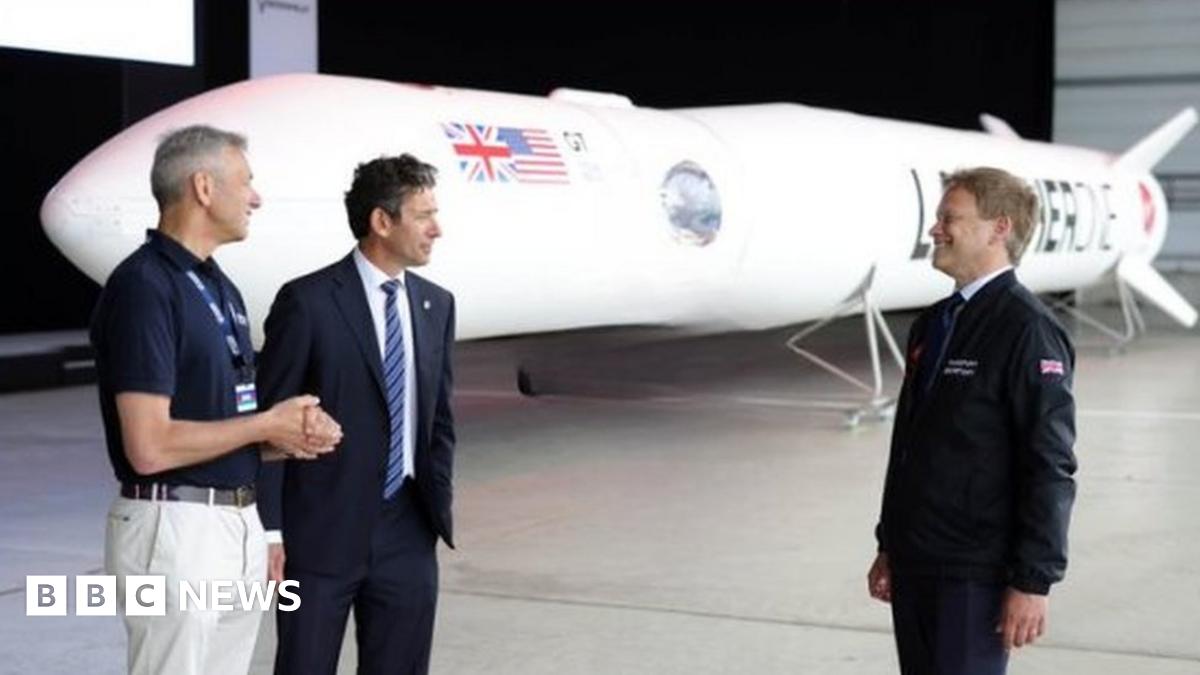
Business Secretary Grant Shapps has denied doctoring a picture on his Twitter feed to remove former Prime Minister Boris Johnson.
Mr Shapps posted a picture of a ministerial visit to Spaceport Cornwall, as he hailed the first rocket launch from UK soil.
But social media users spotted that Mr Johnson, who also went on the trip in 2021, had disappeared from the picture.
Mr Shapps says he wasn't aware it had been edited and has now deleted it.
An identical photo remains on the Number 10 Flickr account, dated 9 June 2021.

It shows Mr Johnson and Mr Shapps side-by-side in Cornwall during a visit to LauncherOne.
The then-Conservative leader is wearing a jacket emblazoned with the words: "Prime Minister".
A source close to Mr Shapps said: "Grant wasn't aware anyone had edited the picture.
"He removed it as soon as it was pointed out. Obviously he wouldn't endorse anyone rewriting history by removing the former PM from a picture."

The first ever satellite mission launched from UK soil ended in failure on Monday, after the rocket suffered an "anomaly".
A jumbo jet operated by the American Virgin Orbit company carried a rocket out of Newquay, Cornwall, to release it over the Atlantic Ocean. The rocket ignited and appeared to be ascending correctly, before the mission failed.
The satellites it was carrying could not be released and were lost.
A Labour Party source said: "The Tories might want to erase their own leaders - but the country is stuck with the consequences of their appalling record: a crashed economy, a broken health service, and an asylum system that doesn't work."
 

Kite159

Veteran Member
Joined
27 Jan 2014
Messages
22,858
Location
West of Andover

najaB

Veteran Member
Joined
28 Aug 2011
Messages
33,734
Location
Scotland
Most likely someone else edited the photo as a joke before sending it to his team to post on twitter without telling them it was photoshopped.
Surely Mr Shapps would have remembered that the then PM was there as well. I can't imagine anyone would every forget Mr Johnson being in the room.
 

nlogax

Established Member
Joined
29 May 2011
Messages
6,044
Location
Mostly Glasgow-ish. Mostly.
Most likely someone else edited the photo as a joke before sending it to his team to post on twitter without telling them it was photoshopped.

It either demonstrates a hilarious lack of competence in the government's socials team or someone is determined to undermine the government from within. Every day with this government is a fresh day of comedy. Unintended or otherwise.
 

brad465

Veteran Member
Joined
11 Aug 2010
Messages
11,561
Location
Taunton or Kent
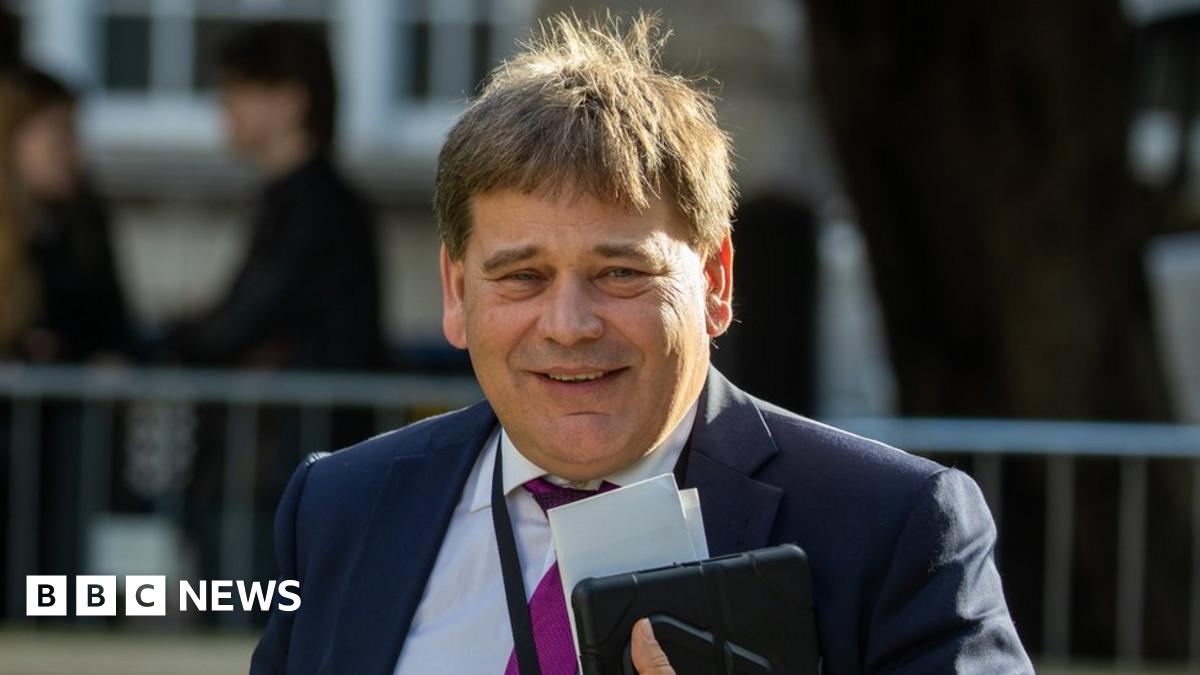
Tory MP Andrew Bridgen has had the whip suspended after invoking Godwin's law in spreading covid vaccine misinformation (he said it was the biggest crime against humanity since the Holocaust):


MP Andrew Bridgen suspended by Conservative party for spreading misinformation about Covid vaccine, chief whip says

== Doublepost prevention - post automatically merged: ==

Sunak has released a party political broadcast:


In my first Party Political Broadcast, I wanted to update you on some of the work we're doing in Government

Video attached
 
Last edited:

Gloster

Veteran Member
Joined
4 Sep 2020
Messages
13,044
Location
Up the creek
Boris Johnson (remember him) is to publish a book about his time at No. 10 which, according to the publisher’s publishing director, will be a “prime ministerial memoir like no other”. Considering that most prime ministerial memoirs, not that there have been that many, tend to be self-justifying uncorroborated versions of selected truths, does that it mean that this one will be the plain and unvarnished truth? Which would be a first for Johnson. A hae ma doots.

I know that this is Johnson, not Sunak, but isn’t the Johnson thread closed, hopefully for ever.
 
Status
Not open for further replies.

Top