The MG4 can take slightly over 140Kwh in tests (despite MG claiming 135 max) so I think people are probably wise not to just expect only premium cars to fast charge, although I guess owners of certain marques are always going to be the same.

-
Our new ticketing site is now live! Using either this or the original site (both powered by TrainSplit) helps support the running of the forum with every ticket purchase! Find out more and ask any questions/give us feedback in this thread!
You are using an out of date browser. It may not display this or other websites correctly.
You should upgrade or use an alternative browser.
You should upgrade or use an alternative browser.
UK switching to electric vehicles discussion
- Thread starter MattA7
- Start date
Sponsor Post - registered members do not see these adverts; click here to register, or click here to log in
R
RailUK Forums

I got some comments of "why are you using a ultra rapid car with your MG5" by some Audi/BMW types in France but when I was pulling over 90kw, much faster than them they sheepishly backed off
That's a surprising number when the 5 is only advertised as 80kW max? My parents have rarely reported more than about 70kW when charging their MG5 at rapid chargers!
Actually the bigger problem is idiots insisting on charging to 100%. It's usually much quicker for your journey to stop at no more than 80%, even if that means charging again later. That last 20% is slooow. I'd actually support chargers automatically stopping at 80% if all chargers on a sit are occupied.
Motorway services are usually very busy. I try to head for MFG petrol stations which tend to have a better provision than most motorway services, or other sites like the Osprey hub at Ipswich P&R which has a dozen or so chargers about 1 minute off the A12/A14 and there are hardly ever many cars there.
Motorway services are usually very busy. I try to head for MFG petrol stations which tend to have a better provision than most motorway services, or other sites like the Osprey hub at Ipswich P&R which has a dozen or so chargers about 1 minute off the A12/A14 and there are hardly ever many cars there.
That's a fair point, there are some who aren't aware though and should probably have been told by the dealer.I suppose you can understand why someone might use a faster charging point if that's the only one available at the time. A bit like those awkward times you enter a car park and badly parked motorists force you to enter a space at an angle or too far over, then when they leave you look like the inconsiderate one!
Osprey seem quite good at giving a reasonable number of chargers, at many services Gridserve only provide 4 spaces (sometimes only 2) which isn't enough and is full quickly. Each car's different charge curve makes it difficult to give an easy rule for all of them other than over 80% usually gets pretty slow and especially over 90%.Actually the bigger problem is idiots insisting on charging to 100%. It's usually much quicker for your journey to stop at no more than 80%, even if that means charging again later. That last 20% is slooow. I'd actually support chargers automatically stopping at 80% if all chargers on a sit are occupied.
Motorway services are usually very busy. I try to head for MFG petrol stations which tend to have a better provision than most motorway services, or other sites like the Osprey hub at Ipswich P&R which has a dozen or so chargers about 1 minute off the A12/A14 and there are hardly ever many cars there.

Interesting one is the Audi e-tron which is only 150kw but manages to maintain it very well while the Porsche Taycan starts to drop of around 50% though still very quick.

reddragon
Established Member
My record is 92.25 kw/h and a friend has had 96 kw/h. MG really under play what their cars can do.That's a surprising number when the 5 is only advertised as 80kW max? My parents have rarely reported more than about 70kW when charging their MG5 at rapid chargers!
My record is 92.25 kw/h and a friend has had 96 kw/h. MG really under play what their cars can do.
Ah interesting, guessing that must have been at a low SOC and a warm day to manage those kind of numbers? (Responding having just hit 70kW a few minutes ago at ~60% battery, which parents are calling as joint record!)
Separately - I have found myself thinking that EV charging would be best served moving away from the current fully 'self service' system of parking at any charging point to a central kiosk/barrier at each charging area where the car model is checked for connectors and draw, drivers can then put it details about how much charge they want to add, how long they're willing to wait, etc, and preauthorise their payment card there. You'd then get issued a ticket saying which charger to use, and when (if there's a queue). Would allow more intelligent utilisation of potentially limited numbers of chargers particular at busier locations and at peak times
(This view may also be shaded by my parents seeming inability to follow the instructions to validate card first and then connect the car, which has resulted in a few visits where the car has locked itself to a 'dud' charger and we've had to wait around in inclement weather for it to release, whilst hoping the rest of the charge points don't fill up, that and a few visits to rugby seeing Teslas sat on the 'regular' chargers whilst the supercharger bank sits empty)
Nah. Just needs a one way in to the charging hub which forms the queue rather than the free for all muddle we see at the moment. That and perhaps if all chargers are occupied the charge stops at 80% and you get charged a punitive idle time fee if you don't shift the car off the charger pronto.Separately - I have found myself thinking that EV charging would be best served moving away from the current fully 'self service' system of parking at any charging point to a central kiosk/barrier at each charging area where the car model is checked for connectors and draw, drivers can then put it details about how much charge they want to add, how long they're willing to wait, etc, and preauthorise their payment card there. You'd then get issued a ticket saying which charger to use, and when (if there's a queue). Would allow more intelligent utilisation of potentially limited numbers of chargers particular at busier locations and at peak times
Nah. Just needs a one way in to the charging hub which forms the queue rather than the free for all muddle we see at the moment. That and perhaps if all chargers are occupied the charge stops at 80% and you get charged a punitive idle time fee if you don't shift the car off the charger pronto.
Having the single entry point does help, but having sat in one such queue at Banbury before for 15 minutes* I still think there's something to be said for a ticket/timeslot system. For example, if you arrive to a hub which hypothetically is entirely full of vehicles at 20% with an (unknown to you at the time) 30 minute wait, sitting in the queue for the entire time would be a worse experience (IMO) than the system saying 'you've a 30 minute wait before you can charge' - armed with that info you could either park up and grab a coffee/toilet break safe in the knowledge your space in the queue is safe, or try your luck at the next station along. You also lose the benefits from being able to manage and optimise the 'fleet' of chargers which I think would be a very useful addition, even if it is only used in anger on a few days each year.
*On which note, chargers need to get better at indicating when they have a fault - in that instance there was a post with a dodgy payment terminal which we'd seen a couple of cars try and then move on from. New cars turning up later once the initial queue had gone, trying it then had to loiter awkwardly in the middle of the parking area for the next charger to come available
The best way of doing it is what Osprey are doing it with their Kempower chargers, there is one central kempower cabinet with the DC rectification equipment in it with kiosks which connect to it. All the kiosks can do 150kw charging but the central cabinet doesn't have the capacity to do it all at the same time, when a car plugs it will only use the maximum it can from the cabinet but remaining capacity can be used by other cars. Much better utilisation instead of having 50kw cars plugged into 150kw chargers with the extra capacity not able to be used.Nah. Just needs a one way in to the charging hub which forms the queue rather than the free for all muddle we see at the moment. That and perhaps if all chargers are occupied the charge stops at 80% and you get charged a punitive idle time fee if you don't shift the car off the charger pronto.
The shared capacity of the kempower chargers also allows Osprey to install a lot of them in each location.
reddragon
Established Member
3rd/4th rapid of the day, close to 40C outside but about 45-48% SOC actually early on a top up charge, probably about 3-5 mins in.Ah interesting, guessing that must have been at a low SOC and a warm day to manage those kind of numbers? (Responding having just hit 70kW a few minutes ago at ~60% battery, which parents are calling as joint record!)
Pulling 75kw'h at 60% and still pulling 50kw/hr at 80%, utterly amazing!
Sounds better than the rubbish they have at Beaconsfield. Charger with two cables that covers two parking spaces. Fair enough it can't handle charging both cables at once. But if there's someone charging from Cable A, it will let you put in all the details (payment etc.) for Cable B. I naively expected this would mean it would start charging Cable B when A stops. But it doesn't. So no wandering off to have a meal, you have to sit there and wait for A to finish, then put your details in and wait for charging.The best way of doing it is what Osprey are doing it with their Kempower chargers, there is one central kempower cabinet with the DC rectification equipment in it with kiosks which connect to it. All the kiosks can do 150kw charging but the central cabinet doesn't have the capacity to do it all at the same time, when a car plugs it will only use the maximum it can from the cabinet but remaining capacity can be used by other cars. Much better utilisation instead of having 50kw cars plugged into 150kw chargers with the extra capacity not able to be used.
The shared capacity of the kempower chargers also allows Osprey to install a lot of them in each location.
Given the contention for chargers, you'd have thought they'd try and set it up so it starts charging as soon as possible to get people on their way.
I don't drive an EV, so this is based on observations only. Would it be better if chargers were arranged like fuel pumps at a petrol station, so that you drive through rather than have to reverse off etc. Would this make queuing more regulated and fairer?Separately - I have found myself thinking that EV charging would be best served moving away from the current fully 'self service' system of parking at any charging point to a central kiosk/barrier at each charging area where the car model is checked for connectors and draw, drivers can then put it details about how much charge they want to add, how long they're willing to wait, etc, and preauthorise their payment card there. You'd then get issued a ticket saying which charger to use, and when (if there's a queue). Would allow more intelligent utilisation of potentially limited numbers of chargers particular at busier locations and at peak times
reddragon
Established Member
Most of the new forecourt charging stations are like this. Expect rapid changeI don't drive an EV, so this is based on observations only. Would it be better if chargers were arranged like fuel pumps at a petrol station, so that you drive through rather than have to reverse off etc. Would this make queuing more regulated and fairer?
I think you're describing the old ecotricity now Gridserve chargers at Beaconsfield, there are no Osprey chargers there. There are 6 Ionity chargers but really there ought to be a dozen at least. Was chaos last time I went there.Sounds better than the rubbish they have at Beaconsfield. Charger with two cables that covers two parking spaces. Fair enough it can't handle charging both cables at once. But if there's someone charging from Cable A, it will let you put in all the details (payment etc.) for Cable B. I naively expected this would mean it would start charging Cable B when A stops. But it doesn't. So no wandering off to have a meal, you have to sit there and wait for A to finish, then put your details in and wait for charging.
Given the contention for chargers, you'd have thought they'd try and set it up so it starts charging as soon as possible to get people on their way.
The old ecotricity chargers are being replaced by better Gridserve chargers, the old ecotricity ones seem to spend most of their time broken.I think you're describing the old ecotricity now Gridserve chargers at Beaconsfield, there are no Osprey chargers there. There are 6 Ionity chargers but really there ought to be a dozen at least. Was chaos last time I went there.
Genuinely interested in what causes chargers to break. I’d have thought that it is fairly simple technology, and it is clearly in the interest of the charger owner to have them functioning.
The few occasions I've seen (at Banbury & Rugby) have both been because of issues with the payment terminals rather than the actual charging equipment itself. Bit weird seeing it happen when contactless card readers are usually pretty reliable, but there you go!
The few occasions I've seen (at Banbury & Rugby) have both been because of issues with the payment terminals rather than the actual charging equipment itself. Bit weird seeing it happen when contactless card readers are usually pretty reliable, but there you go!
Could this be due to 'customer abuse'? Such as card traps or skimmers to defraud card users? Would a 'Charger Card', only suitable for EV charging machines overcome this?
I've had an Ionity charger make lots of clicking noises and then the car rejecting the charge due to a communication error. Seen lots of Gridserve units that immediately go to charge completed. Gridserve do seem to have a particular problem at Rugby, not uncommon to see a significant proportion of the 12 (currently 11 due to one being crashed into and not replaced yet) units out of service, or apparently in service but not working. I also came back front he services to find the charge had stopped randomly once, but fortunately there was enough to get me to Cardiff anyway.The few occasions I've seen (at Banbury & Rugby) have both been because of issues with the payment terminals rather than the actual charging equipment itself. Bit weird seeing it happen when contactless card readers are usually pretty reliable, but there you go!
Last edited:
Could this be due to 'customer abuse'? Such as card traps or skimmers to defraud card users? Would a 'Charger Card', only suitable for EV charging machines overcome this?
I wouldn't think so - Banbury has been "network issues - unable to authenticate" on a couple of occasions, and just a dead terminal at Rugby (no lights and no response when presented a card) - in both cases a dedicated "charge card" would have run into the same issues, whilst simultaneously creating another barrier to using them! I've not seen any chargers that have a 'conventional' card terminal - only ever contactless readers without keypads (or worse, a little sign that says "download our app")
I also came back front he services to find the charge had stopped randomly once, but fortunately there was enough to get me to Cardiff anyway.
I've noticed that some chargers are a lot more susceptible to "tampering" when it comes to stopping a charge. Some require you to re-present the payment card before you're able to stop a charging session, others just need you to press the little "stop" button and leave it at that, including Rugby's!
I assumed that the [bold part above] would be a requirement to stop the more unsavoury local charcters playing pranks on unattended charging cars!I've noticed that some chargers are a lot more susceptible to "tampering" when it comes to stopping a charge. Some require you to re-present the payment card before you're able to stop a charging session, others just need you to press the little "stop" button and leave it at that, including Rugby's!
I wouldn't think so - Banbury has been "network issues - unable to authenticate" on a couple of occasions, and just a dead terminal at Rugby (no lights and no response when presented a card) - in both cases a dedicated "charge card" would have run into the same issues, whilst simultaneously creating another barrier to using them! I've not seen any chargers that have a 'conventional' card terminal - only ever contactless readers without keypads (or worse, a little sign that says "download our app")
I've noticed that some chargers are a lot more susceptible to "tampering" when it comes to stopping a charge. Some require you to re-present the payment card before you're able to stop a charging session, others just need you to press the little "stop" button and leave it at that, including Rugby's!
Regardless of any such requirement, there is always an emergency stop button which reprobates could misuse.I assumed that the [bold part above] would be a requirement to stop the more unsavoury local charcters playing pranks on unattended charging cars!
I'm slowly learning to avoid motorway service areas as they are too busy and one day there will be fisticuffs as no thought has been given to orderly queuing. I bypassed Rugby last time and charged at an MFG petrol station on the edge of Birmingham instead. 8 150kW chargers, only 2 of which were in use and a Greggs on site so was able to sit down inside with a cup of tea. I could see from the apps that Rugby was mega busy so the slight detour was probably quicker than enduring a queue.
Bottles of water etc also much cheaper!
One thing which could hold up the switch to EV's is that the car industry is still about 25% below sales (new cars) pre Covid (with that sort of level should we have a thread entitled "is the car industry sleep walking into oblivion?" - mods see note at end).
Source:
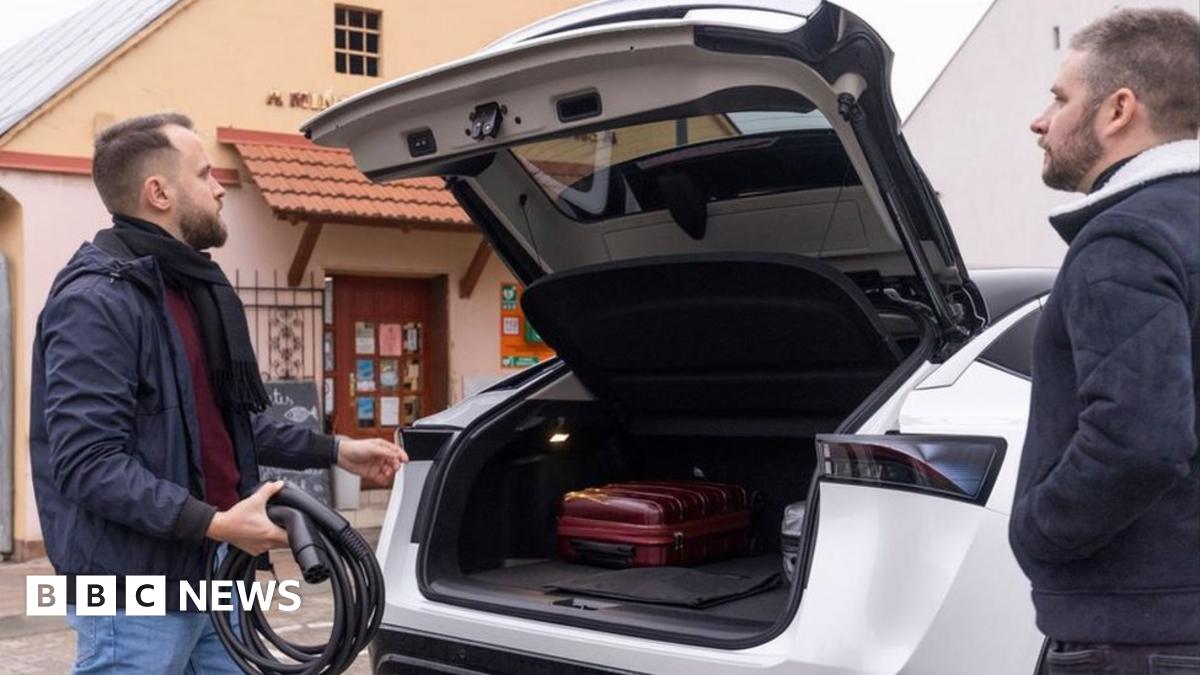
 www.bbc.co.uk
If that continues then cars will need to stay on the road until they are older (not a bad thing, with EV's likely having a longer lifespan). However it's likely to cause a delay in how fast EV's can replace ICE vehicles.
As whilst if 75% reduction lasts for just one year is not even a 2% fall in the number of cars (assuming 100% a year for 15 years), after 4 years this is a 6.7% reduction in the fleet size (assuming cars stay the same average age and no increase in the numbers of cars on the road).
However with an increase of 0.7% on the number of registered vehicles between 2021 and 2022 and 3.1% between 2020 and 2022, that would mean that the fleet must be getting older to accommodate this double whammy of impact this reduction in new cars.
If this 25% reduction continues for 6 years and based on a 1% growth in car numbers year on year (which whilst higher than last year is still lower than 2020 to 2022), without an aging fleet there would be a need for an extra 15% of the fleet to be built to match demand (after four years it would already be 10% of the fleet needed to be built to get us back to the same average age of car we saw pre Covid).
As I said that's not always a bad thing, however currently most of the oldest cars are ICE and so could limit our ability to reduce car based emissions.
As with all things the reasons are wide ranging and complex, however a key factor remains a lack of chips.
---------------------------------------------------------------------------
Note to mods - that's a rhetorical question and for dramatic effect given similar thread titles but for the rail industry. As such, unless it starts to diverge the subject not necessarily an invite to create a new thread.
Source:
UK new car sales hit 30-year low but electric vehicle demand soars
A chip shortage contributed to the drop in car registrations in 2022 - but electric cars boost market share.
www.bbc.co.uk
Across the whole of 2022, 1.61 million new cars were registered in the UK. That was the lowest level since 1992.
The market continued to feel the impact of the Covid pandemic. Sales were slightly lower than in 2021, a period affected by lockdowns and other restrictions - and some 25% down on 2019, the last "normal" year before the outbreak.
If that continues then cars will need to stay on the road until they are older (not a bad thing, with EV's likely having a longer lifespan). However it's likely to cause a delay in how fast EV's can replace ICE vehicles.
As whilst if 75% reduction lasts for just one year is not even a 2% fall in the number of cars (assuming 100% a year for 15 years), after 4 years this is a 6.7% reduction in the fleet size (assuming cars stay the same average age and no increase in the numbers of cars on the road).
However with an increase of 0.7% on the number of registered vehicles between 2021 and 2022 and 3.1% between 2020 and 2022, that would mean that the fleet must be getting older to accommodate this double whammy of impact this reduction in new cars.
If this 25% reduction continues for 6 years and based on a 1% growth in car numbers year on year (which whilst higher than last year is still lower than 2020 to 2022), without an aging fleet there would be a need for an extra 15% of the fleet to be built to match demand (after four years it would already be 10% of the fleet needed to be built to get us back to the same average age of car we saw pre Covid).
As I said that's not always a bad thing, however currently most of the oldest cars are ICE and so could limit our ability to reduce car based emissions.
As with all things the reasons are wide ranging and complex, however a key factor remains a lack of chips.
---------------------------------------------------------------------------
Note to mods - that's a rhetorical question and for dramatic effect given similar thread titles but for the rail industry. As such, unless it starts to diverge the subject not necessarily an invite to create a new thread.
reddragon
Established Member
This is normal.
When tech transitions manufacturers ramp down the production of the old to change production lines over to the new creating a production dip.
Equally consumers stop wanting the old and prefer to hang onto what the have until the new is affordable to them.
There are other factors that come into play. EVs have much less downtime than ICE cars and are suited well to street corner rent by the hour concepts due to the minimal maintenance required, so less cars are needed. Also active travel has grown substantially since Covid struck.
The bigger industry risk is that China have gone full steam ahead on EVs and European manufacturers have dragged their feet. When cameras went digital Kodak delayed & died. When phones went smart Nokia delayed & paid the price. When Japanese cars hit the west, legacy manufactures lost half their sales immediately. Today, China make the best EVs thus some western manufacturers will vanish or have their brand names bought out by China.
When tech transitions manufacturers ramp down the production of the old to change production lines over to the new creating a production dip.
Equally consumers stop wanting the old and prefer to hang onto what the have until the new is affordable to them.
There are other factors that come into play. EVs have much less downtime than ICE cars and are suited well to street corner rent by the hour concepts due to the minimal maintenance required, so less cars are needed. Also active travel has grown substantially since Covid struck.
The bigger industry risk is that China have gone full steam ahead on EVs and European manufacturers have dragged their feet. When cameras went digital Kodak delayed & died. When phones went smart Nokia delayed & paid the price. When Japanese cars hit the west, legacy manufactures lost half their sales immediately. Today, China make the best EVs thus some western manufacturers will vanish or have their brand names bought out by China.
Or consumers cannot decide if the new technology is here to stay and want to jump ship at this stage.When tech transitions manufacturers ramp down the production of the old to change production lines over to the new creating a production dip.
Equally consumers stop wanting the old and prefer to hang onto what the have until the new is affordable to them.
The downturn in sales is probably driven by other factors as well, such as:
- Have ICE cars improved in quality so much that they can comfortably run for well over 100,000 miles, and thus change is not required?
- Miles travelled reduced certainly during the initial stages of Covid - the roads were deserted - so accumulated miles are not so high, thereby delaying next purchases.
- Car sales fell during Covid, and anyone looking for a bargain would have picked the up then.
- The cost of living and energy price rises have reduced the disposable income available to buy new cars.
Interesting in that SMMT data - in December Battery EVs outsold pure petrol cars for the first time ever, and more than 10 times the number of pure diesel cars. Albeit there has evidently been a big delivery of Teslas in December.
== Doublepost prevention - post automatically merged: ==
No doubt these are a factor, but by far the biggest is supply side constraints, certainly in the EV market. I’m hearing from several people that there is simply no availability for delivery of new EVs for months. I have a friend who ordered his in the autumn of ‘21, and it’s not due until this summer!
== Doublepost prevention - post automatically merged: ==
Or consumers cannot decide if the new technology is here to stay and want to jump ship at this stage.
The downturn in sales is probably driven by other factors as well, such as:
- Have ICE cars improved in quality so much that they can comfortably run for well over 100,000 miles, and thus change is not required?
- Miles travelled reduced certainly during the initial stages of Covid - the roads were deserted - so accumulated miles are not so high, thereby delaying next purchases.
- Car sales fell during Covid, and anyone looking for a bargain would have picked the up then.
- The cost of living and energy price rises have reduced the disposable income available to buy new cars.
No doubt these are a factor, but by far the biggest is supply side constraints, certainly in the EV market. I’m hearing from several people that there is simply no availability for delivery of new EVs for months. I have a friend who ordered his in the autumn of ‘21, and it’s not due until this summer!
This is normal.
When tech transitions manufacturers ramp down the production of the old to change production lines over to the new creating a production dip.
Equally consumers stop wanting the old and prefer to hang onto what the have until the new is affordable to them.
There are other factors that come into play. EVs have much less downtime than ICE cars and are suited well to street corner rent by the hour concepts due to the minimal maintenance required, so less cars are needed. Also active travel has grown substantially since Covid struck.
The bigger industry risk is that China have gone full steam ahead on EVs and European manufacturers have dragged their feet. When cameras went digital Kodak delayed & died. When phones went smart Nokia delayed & paid the price. When Japanese cars hit the west, legacy manufactures lost half their sales immediately. Today, China make the best EVs thus some western manufacturers will vanish or have their brand names bought out by China.
I agree with everything but the Nokia bit. They were one of the first with smartphones (Symbian) but made some stupid decisions on the management of its Series 60 version, hindering other manufacturers that wanted to use Series 60 (silly things like making the Facebook app only work on Nokia phones, not Panasonic, Samsung or LG Symbian devices), and later it allowed Stephen Elop to take over and see the demise of the firm with a decision to go with Windows Phone instead of Android.
China is going to shake things up massively. I'm stunned at how well the MG4 has taken off here, and the rave reviews everywhere. Even the new MG5 seems to be getting great reviews, even if this isn't yet a 'true' EV. What comes in the next year or two from MG will be amazing, and then there's BYD that will be coming any moment - although I'm a bit disappointed that all signs point to them being sold at a premium here (going by prices in places like New Zealand and Australia, they're very much MG priced there).
I know MG is meant to be putting prices up this year, if it hasn't already, but as a lot of people will finance or lease - the lease cost for the MG4 SE model is quite exceptional. With the savings on maintenance and fuel, this car alone will make a lot of people switch - but there's obviously a huge level of demand right now.
Other car makers were told to make smaller, more affordable, cars and not just heavy electric SUVs, and it's quite clear which cars are going to see falling sales as the cost of living crisis deepens.
matacaster
On Moderation
Just out of interest, does anyone have a breakdown of electric car sales into
*Private purchases
*PCP deals
*Leased
*Company vehicles?
*Private purchases
*PCP deals
*Leased
*Company vehicles?
My step-mum has a motability car and that skews the total cost of ownership EV argument as she's only paying for the fuel, this makes owning an EV less attractive, especially if like her you cannot charge at home and rely on variable public charger pricing.
Currently they do have an id.3 and have done for about 9 months but not for much longer as it has been agreed that it was mis-sold and it is being replaced with a petrol vehicle (most likely a Corsa Ultimate Auto, as that was the best they could get at the end of the year and they didn't want to hang around and wait for the 1st when the new round of pricing is announced), early starts to get charge and the drop in capacity in the cold are just too problematic for them, plus they hate having to sacrifice range for heat. Switching back to a non-electric vehicle will change their motoring costs minimally but will make life so much easier.
Currently they do have an id.3 and have done for about 9 months but not for much longer as it has been agreed that it was mis-sold and it is being replaced with a petrol vehicle (most likely a Corsa Ultimate Auto, as that was the best they could get at the end of the year and they didn't want to hang around and wait for the 1st when the new round of pricing is announced), early starts to get charge and the drop in capacity in the cold are just too problematic for them, plus they hate having to sacrifice range for heat. Switching back to a non-electric vehicle will change their motoring costs minimally but will make life so much easier.