
RMT's objection is with the very principle of driver only trains. They still object to the closure of ticket offices, but they wouldn't object to the principle of a consultation through the usual Schedule 17 process, as they would then be able to use that to effectively campaign against the changes.It was the content of the DOO that sank the deal, not the timing. If the govt had given the all lines DOO condition at any time, it would have had the same effect.
It's impossible to say for sure if the RMT would have accepted limited DOO or the offer as was without DOO, but it is instructive that the two unions not directly affected by DOO did accept the deal that was proposed.

-
Our new ticketing site is now live! Using either this or the original site (both powered by TrainSplit) helps support the running of the forum with every ticket purchase! Find out more and ask any questions/give us feedback in this thread!
You are using an out of date browser. It may not display this or other websites correctly.
You should upgrade or use an alternative browser.
You should upgrade or use an alternative browser.
Unite Network Rail Strikes Off
- Thread starter MrB
- Start date
- Status
- Not open for further replies.
Sponsor Post - registered members do not see these adverts; click here to register, or click here to log in
R
RailUK Forums
aleandrail
Member
- Joined
- 8 Jun 2013
- Messages
- 137
So, had they not , would things have been resolved by now.They shouldn't have added it at all.

So, had they not , would things have been resolved by now.
They certainly appear to have been resolved in Wales and Scotland, which suggests they would have been had a similar pay offer been tabled, without the DOO string.
It depends how you look at it.So, had they not , would things have been resolved by now.
An offer hasn't been made to the DfT controlled operators that doesn't include the principle (not the actual implementation) of driver only trains. If it were, all other things being equal, a deal may be possible.
DOO has absolutely nothing to do with the NR / RMT negotiations.
RMT were presumably told some time ago that if this action went ahead, there could be no negotiations until they finished, as everyone is busy trying to plan / run the amended service!
Its no surprise that RMT want to talk, given the very clear difference of opinion in the membership, but they also knew that talks would not be possible during the period of action.
RMT were presumably told some time ago that if this action went ahead, there could be no negotiations until they finished, as everyone is busy trying to plan / run the amended service!
Its no surprise that RMT want to talk, given the very clear difference of opinion in the membership, but they also knew that talks would not be possible during the period of action.

brad465
Veteran Member
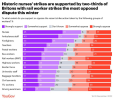
Here's some opinion polling from YouGov on different strike action. The RMT strikes appear to be 43% support vs 49% against, which is the highest against value, although "mid-table" in support. I think though they are being helped (in terms of avoiding further negativity) by nurses and ambulance workers going on strike and overshadowing them, who enjoy much stronger support (nurses are 66% vs 28%):
A majority of Britons support strikes by nurses (66% support to 28% oppose) and ambulance workers (63% support to 31% oppose)
YouGov chart showing different striking sector support levels.
RMT were presumably told some time ago that if this action went ahead, there could be no negotiations until they finished, as everyone is busy trying to plan / run the amended service!
Its no surprise that RMT want to talk, given the very clear difference of opinion in the membership, but they also knew that talks would not be possible during the period of action.
Appreciate DOO is separate to this.
Is it really the case that, in an organisation the size of NR, absolutely nobody is available to undertake high level negotiations because of the replanning?
Andrew*Debbie
Member
Votes cast:15370 (83%)
Voting to Accept:5598 (36%)
Voting to Reject:9772 (64%)
Rejected by 52.7% of RMT members eligible to vote.
Our union (not rail) has never come close to 83% of members voting on anything. That doesn't mean they are infavor or against. They either didn't get a vote in on time, deliberately abstained or the union does not have current contact details.
Our branch is not great about keeping contact details up to date.
Would you apply the same to general elections? 83% is higher then the turnout in the 2019 general election. Here on Anglsey our MP recieved less then 25% of the eligible vote.
yoyothehobo
Member
- Joined
- 21 Aug 2015
- Messages
- 853
Here's some opinion polling from YouGov on different strike action. The RMT strikes appear to be 43% support vs 49% against, which is the highest against value, although "mid-table" in support. I think though they are being helped (in terms of avoiding further negativity) by nurses and ambulance workers going on strike and overshadowing them, who enjoy much stronger support (nurses are 66% vs 28%):
Interesting,
Is there any data from support earlier on in the rail strikes?
Lets be honest as well, a lot more people in the country care when the NHS are striking than the railways. They care more about waiting with a broken hip than whether the trains are running, especially after the last 6 months of particularly rubbish service nationwide with strikes, "short notice changes to the timetable", the Avanti mess etc...
I daresay the public have become mostly apathetic on the issue of rail strikes.
I also think that in that YouGov poll the difference between the against crowds is for NHS workers people considerate a dereliction of duty, whereas the against the rail strikes is most likely "they earn enough anyway"
Just my two cents from observations. Not necessarily reflecting my views in the strikes, just what i gather talking to people.

So, had they not , would things have been resolved by now.
There's a greater chance that they would have been.

High Dyke
Established Member
Senior management decided to roster full shifts on Boxing Day, traditionally most locations would be closed (except for engineering work) and staff 'booked off, not required'. This cynical attempt to break the strike has already backfired from the management point of view.Network Rail will be waiting to see how many return to work instead of striking

Interesting point.
== Doublepost prevention - post automatically merged: ==
Had the government not added the DOO as late as they did, do you think things would have been solved by now.
I doubt it, the RMT would have found another reason to reject it.
Out of the 3 boxes where I work 6 staff out of 13 returned to work last week instead of striking as they couldn't afford to be off, if that's happening elsewhere how long do network Rail need to waitSenior management decided to roster full shifts on Boxing Day, traditionally most locations would be closed (except for engineering work) and staff 'booked off, not required'. This cynical attempt to break the strike has already backfired from the management point of view.
Bishopstone
Established Member
The thing about holding-out in any negotiation, when the other party has stated they’ve made their best and final offer, is that they might not be bluffing.
High Dyke
Established Member
You can't blame, especially at the moment. Many of us have given feedback when asked, but there are those that wonder why.Out of the 3 boxes where I work 6 staff out of 13 returned to work last week instead of striking as they couldn't afford to be off, if that's happening elsewhere how long do network Rail need to wait
Management have done that before.The thing about holding-out in any negotiation, when the other party has stated they’ve made their best and final offer, is that they might not be bluffing.

Kite159
Veteran Member
With both TSSA & Unite accepting that offer why would network rail improve it to suit the RMT as it might upset the other unions.The thing about holding-out in any negotiation, when the other party has stated they’ve made their best and final offer, is that they might not be bluffing.
How many of the RMT members simply voted to reject in the poll without actually reading the deal, because the leaders said to reject it?
To be fair to RMT, the company is obliged to offer the same pay and terms to everyone within each bargaining unit. Therefore if Network Rail were to offer more money everyone in the RMT's bargaining units, including members of TSSA and Unite / any non-RMT members, who are currently working and being paid, would get the benefit. Of course, there is no chance of more money just appearing at this late stage in proceedings.With both TSSA & Unite accepting that offer why would network rail improve it to suit the RMT as it might upset the other unions.
How many of the RMT members simply voted to reject in the poll without actually reading the deal, because the leaders said to reject it?
The ones who've done well out of this are the management grades' bargaining units, as they were allowed to receive their extra money and improved terms in a timely fashion, and haven't lost any pay due to strike action. I really feel for people whose December and January pay has been impacted by the RMT action as it is not going to be fun.
I think that the fact that the offer for Network Rail was recommended against after the negotiators agreed it would be neutral says everything.
In days gone by Management grades in NR had to wait until the pay deal with the non management collective bargaining grades was agreed. Management grades would then get a similar rise but based performance so some managers if they had not achieved their objectives would get nothing.

Annetts key
Established Member
And where/when for the maintenance (including CAPEX and Works Delivery) did “the negotiators agreed it would be neutral”?I think that the fact that the offer for Network Rail was recommended against after the negotiators agreed it would be neutral says everything.
Also it’s the NEC that decided on what is recommended, not the negotiators.
Perhaps the negotiators should have reserved the position then?Also it’s the NEC that decided on what is recommended, not the negotiators.
station_road
Member
The NR management grades had a 2 year pay freeze (will be 1 year for everyone else), following 10 years of percentage increases below other NR grades
Yes, as political campaigns go it is proving very expensive for the union members.It takes the spotlight off the individual disputes, but also feeds into a wider impression that the UK isn’t functioning properly at the moment, which ultimately reflects badly on the government.
It isn't like the Conservatives were already 25% behind anyway. Anyone expecting Labour to be elected promising to spend money reopening ticket offices and bringing back Guards between St Pancras and Bedford (removed 1982) is likely to be disappointed. The nurses, care sector and the NHS are first, second and third for cash.
Days of plenty on the railway are over thanks to nationalisation, the unions are struggling to adjust for the reality of what they campaigned so hard for.
== Doublepost prevention - post automatically merged: ==
Bedford went DOO in 1982. The government should have done the union members and the rest of the economy a favour and just got on with it. When a role is redundant, it is redundant.It wasn't even mentioned as a 'string' to the deal previously and the Government knew full well that guards were never going to vote for a consultation that might see an end to their jobs. Sticking the DOO clause in effectively guaranteed that the current month-long period of industrial action would go ahead.
== Doublepost prevention - post automatically merged: ==
Absolutely right.
No compulsory redundancies is an absurd proposition that cannot exist in the private sector (as they can go bust) and it never existed in BR either. It is a barrier to technology, efficiency and progress and traps employees in low productivity jobs that should have been replaced and automated.
Last edited:

12LDA28C
Established Member
- Joined
- 14 Oct 2022
- Messages
- 5,058
No compulsory redundancies is an absurd proposition that cannot exist in the private sector (as they can go bust) and it never existed in BR either. It is a barrier to technology, efficiency and progress and traps employees in low productivity jobs that should have been replaced and automated.
So you expect Guards to vote for the abolishment of their role yes? Would you?

Wychwood93
Member
You know what is being said - no need to rework an argument that has/does exist in assorted threads. At the start of Railtrack in 1994 an EG grade manager said to me, words to the effect of, 'it is not a job for life anymore'.So you expect Guards to vote for the abolishment of their role yes? Would you?
Guards voted to abolish their role back in 1982. It is the RMT who have gone back on that agreement.
Clearly government are fed up of the RMT striking any time there are proposals for drivers to operate the doors.
Years of strikes on Northern, Merseyrail, Southern and South West Trains. They want to sort the issue once and for all.
And they are not saying all routes will become DOO. They just want to be able to introduce it as appropriate trains are introduced with the required technology and not have endless strike action as a result.
Clearly government are fed up of the RMT striking any time there are proposals for drivers to operate the doors.
Years of strikes on Northern, Merseyrail, Southern and South West Trains. They want to sort the issue once and for all.
And they are not saying all routes will become DOO. They just want to be able to introduce it as appropriate trains are introduced with the required technology and not have endless strike action as a result.
And where/when for the maintenance (including CAPEX and Works Delivery) did “the negotiators agreed it would be neutral”?
I can confirm they did this. Albeit agreed that they would propose to the NEC it would be a neutral recommendation.
Also it’s the NEC that decided on what is recommended, not the negotiators.
Which, to me, seems strange. Why would the NEC overrule the negotiators? Either they think the negotiators are not good enough, or there’s something else afoot.

HSTEd
Veteran Member
- Joined
- 14 Jul 2011
- Messages
- 20,305
This is nothing to do with nationalisation or not.Days of plenty on the railway are over thanks to nationalisation, the unions are struggling to adjust for the reality of what they campaigned so hard for.
Even if the franchise system had survived its own internal contradictions, it would not be able to overcome the Government no longer being willing to drown everyone in a river of money.
If the Franchises had gone over the heads of the government and agreed the pay deals they would inevitably have gone bust when the government refused to increase their subsidy payments accordingly.
Nationalisation didn't destroy the sacred river of money on which the growth of the franchise era was built, the changing socio-economic landscape did.
Robertj21a
On Moderation
- Joined
- 22 Sep 2013
- Messages
- 7,691
Are you suggesting that guards can't ever be made redundant - even if most people expect DOO to become more common ?So you expect Guards to vote for the abolishment of their role yes? Would you?
Yes, as political campaigns go it is proving very expensive for the union members.
It isn't like the Conservatives were already 25% behind anyway. Anyone expecting Labour to be elected promising to spend money reopening ticket offices and bringing back Guards between St Pancras and Bedford (removed 1982) is likely to be disappointed. The nurses, care sector and the NHS are first, second and third for cash.
Maybe not, but a policy of curtailing permanent chaos, disruption and cuts on the railway could appeal to voters.
- Status
- Not open for further replies.