• Our new ticketing site is now live! Using either this or the original site (both powered by TrainSplit) helps support the running of the forum with every ticket purchase! Find out more and ask any questions/give us feedback in this thread!

TfW class 398 Stadler Citylink tram trains

Bletchleyite

Veteran Member
Joined
20 Oct 2014
Messages
113,340
Location
"Marston Vale mafia"
It's not just about Cardiff Bay. It's to allow for potential street running in central Cardiff later in the units' lives, creating something quite a bit more like Metrolink.

It's decent foresight. The mind boggles as to why people are calling for the retention of rotting old DMUs. They're just a type of EMU really, and one with the big bonus of low-floor.
 
Sponsor Post - registered members do not see these adverts; click here to register, or click here to log in
R

RailUK Forums

edwin_m

Veteran Member
Joined
21 Apr 2013
Messages
28,654
Location
Nottingham
Except the wheel profile.
If it runs through pedestrian areas, as is envisaged for the intial tramway section, then it probably needs grooved rail and hence the tram-train wheel profile.
I guess I meant both on-street and line of sight together. To put it another way, which is the best option:

Build a short bridge in Cardiff Bay which would isolate that section from cars and pedestrians, meaning the whole line could be run as heavy rail like the rest of the network – no change to any trains or other infrastructure needed.

Or have that very short on-street/line-of-sight section, which means modifying all the vehicles, changes to all the rest of the network to cope with them, plus knock-on effects on timetables etc.

One big benefit of trams is that they can be threaded between existing buildings. But in this case nearly the whole area is going to demolished and rebuilt anyway, some of it on a very different street pattern. Seems like you might as well make the effort to keep the train line away from the road in that case, if there’s no real need for on-street running.
There could be the following options (terminology may differ and exceptions may be possible with justification, but in my view unlikely to be approved):
  • Railway: fully segregated (perhaps with level crossings) and signalled - no special "tram" features required
  • Segregated line of sight - needs track brakes
  • Unsegregated but not running with traffic (but passes through pedestrian areas and may cross traffic lanes) - also needs wheel profile compatible with grooved rail, shielding of running gear, and better driver field of view
  • Running with traffic - also needs full highway lighting such as brake lights and indicators
Compared with running in pedestrian areas and crossing traffic lanes, the extra features for running in traffic are chickenfeed and might as well be included in the vehicle from new rather than being added later. For significant features to be omitted from the vehicle, it's necessary to remove the interface with other users by full segregation, with the possible exception of level crossings but new ones are unlikely to be allowed. Unless the route is elevated or underground, nobody is then able to cross it and this "community severance" effect means that it would probably be unacceptable to try to insert it into an existing urban area. For an example of what that might look like, see the DLR Lewisham extension.
 

stuu

Established Member
Joined
2 Sep 2011
Messages
3,766
I guess I meant both on-street and line of sight together. To put it another way, which is the best option:

Build a short bridge in Cardiff Bay which would isolate that section from cars and pedestrians, meaning the whole line could be run as heavy rail like the rest of the network – no change to any trains or other infrastructure needed.

Or have that very short on-street/line-of-sight section, which means modifying all the vehicles, changes to all the rest of the network to cope with them, plus knock-on effects on timetables etc.

One big benefit of trams is that they can be threaded between existing buildings. But in this case nearly the whole area is going to demolished and rebuilt anyway, some of it on a very different street pattern. Seems like you might as well make the effort to keep the train line away from the road in that case, if there’s no real need for on-street running.
It makes other extensions easier and cheaper too - Hirwaun has been proposed, if it is built to light rail standards then signalling costs are much reduced, no need to eliminate level crossings, or build expensive footbridges. There are others which could happen within the 30+ year lifespan of the trams
 

Bletchleyite

Veteran Member
Joined
20 Oct 2014
Messages
113,340
Location
"Marston Vale mafia"
It makes other extensions easier and cheaper too - Hirwaun has been proposed, if it is built to light rail standards then signalling costs are much reduced, no need to eliminate level crossings, or build expensive footbridges. There are others which could happen within the 30+ year lifespan of the trams

It's a pity they can't go low-floor, as that'd ease additional stations too. Level boarding, though.

I do think "interurban" style pseudotram operations do have potential for branch lines and extensions, particularly where branch termini are in a bit of an awkward location for historical reasons. St Albans is another potential, where there could be a short extension into town.
 

stuu

Established Member
Joined
2 Sep 2011
Messages
3,766
It's a pity they can't go low-floor, as that'd ease additional stations too. Level boarding, though.

I do think "interurban" style pseudotram operations do have potential for branch lines and extensions, particularly where branch termini are in a bit of an awkward location for historical reasons. St Albans is another potential, where there could be a short extension into town.
Only if they can be fitted with rack and pinion :D (My first proper job was at Ford Credit next to St Albans Abbey station, I know from bitter experience how steep Holywell Hill is)
 

Envoy

Established Member
Joined
29 Aug 2014
Messages
3,133
It's not just about Cardiff Bay. It's to allow for potential street running in central Cardiff later in the units' lives, creating something quite a bit more like Metrolink.

It's decent foresight. The mind boggles as to why people are calling for the retention of rotting old DMUs. They're just a type of EMU really, and one with the big bonus of low-floor.
Why would they have street running in Central Cardiff being as both Queen Street and Central stations are bang in the centre of the city? If they have a secret plan to run on streets in central Cardiff, then that is surely not for the greater good of the whole system and they might just as well have had electric buses - as they now have on the St.Mellons route.
 

eastwestdivide

Established Member
Joined
17 Aug 2009
Messages
3,408
Location
S Yorks, usually
I believe the check rails foul the standard Network Rail lower sector structure gauge, so every type of vehicle that uses the line has to be individually cleared. But the line through Rotherham is used by freight trains as well as Northern DMUs, so presumably this has not proved to be a show stopper in practice.
There's a (quite short) list somewhere of rail vehicles that are prohibited through the Rotherham section. Can't find the definitive list at the moment, but a Modern Railways article from 2017

says (of the Rotherham checkrails):
...After much analysis it was found that the high check rails meant Class 33 lifeguards, snowploughs and wheel skates would hit them...
 

Dai Corner

Established Member
Joined
20 Jul 2015
Messages
6,990
Why would they have street running in Central Cardiff being as both Queen Street and Central stations are bang in the centre of the city? If they have a secret plan to run on streets in central Cardiff, then that is surely not for the greater good of the whole system and they might just as well have had electric buses - as they now have on the St.Mellons route.
Indeed. I'm sure we had this debate before, perhaps on this very thread. It turned out the proponent had never been to Cardiff and was unaware that the railway ran through the city centre on embankments and bridges or that virtually all the main destinations (University, Government Offices, commercial offices, shopping areas, sport and entertainment venues) were within walking distance of Central, Queen Street or Cathays stations.

Street running in Cardiff wouldn't significantly improve access but traffic delays would bring performance risks, particularly around Queen Street station which will have to have very tight timings and the single line sections towards the heads of the Valleys.
 

edwin_m

Veteran Member
Joined
21 Apr 2013
Messages
28,654
Location
Nottingham
Indeed. I'm sure we had this debate before, perhaps on this very thread. It turned out the proponent had never been to Cardiff and was unaware that the railway ran through the city centre on embankments and bridges or that virtually all the main destinations (University, Government Offices, commercial offices, shopping areas, sport and entertainment venues) were within walking distance of Central, Queen Street or Cathays stations.

Street running in Cardiff wouldn't significantly improve access but traffic delays would bring performance risks, particularly around Queen Street station which will have to have very tight timings and the single line sections towards the heads of the Valleys.
In a parallel universe the Taff Vale lines could perhaps have been converted to pure light rail. Trams could leave the existing alignment somewhere in the Cathays area to serve the University then run through the city centre, interchange at Central and continue into the Bay. The City Line could have linked in too, somewhere around Central. This would have been entirely disconnected from National Rail so street delays wouldn't knock on anywhere else, and with cheaper tramway technology more passing loops could have been added to mitigate the effect of the single line sections. It could also have been converted to low floor and platform, with the routes via Caerphilly continuing to be a rail service with FLIRTs or similar.

But we are where we are, and that's not going to happen.
 

geoffk

On Moderation
Joined
4 Aug 2010
Messages
3,931
Location
Exeter
Another difference between railway operation and a tramway running on line of sight on a segregated right of way is facing point locks - legally required on a passenger railway I believe but not on a tramway, hence the slow speed approach to facing points which I experience on Manchester Metrolink.
 

Envoy

Established Member
Joined
29 Aug 2014
Messages
3,133
In a parallel universe the Taff Vale lines could perhaps have been converted to pure light rail. Trams could leave the existing alignment somewhere in the Cathays area to serve the University then run through the city centre, interchange at Central and continue into the Bay. The City Line could have linked in too, somewhere around Central. This would have been entirely disconnected from National Rail so street delays wouldn't knock on anywhere else, and with cheaper tramway technology more passing loops could have been added to mitigate the effect of the single line sections. It could also have been converted to low floor and platform, with the routes via Caerphilly continuing to be a rail service with FLIRTs or similar.

But we are where we are, and that's not going to happen.
The valley lines - as they run through Cardiff are already segregated from the main line. As has already been said, there is no need to go onto the streets in central Cardiff. Even the buses do not use many of the streets as they are pedestrianised. If the National Rail tracks were avoided and the tram-trains took to the streets with all the probability of getting delayed, it is the heads of the valleys that would suffer most as the tram-trains would not make the passing places on time to match those going the other way. The whole system would become an unreliable shambles.

Anyway, I think we digress here from this rolling stock thread and that further discussion on the system should be in the South Wales Metro thread found under infrastructure.
 

Bletchleyite

Veteran Member
Joined
20 Oct 2014
Messages
113,340
Location
"Marston Vale mafia"
Fundamentally even if these things never run on street at all, I don't get what the problem with them is. They look like perfectly decent light rail EMUs, a bit Newcastle Metro-like, perhaps. No toilets, but then Merseyrail, LO etc don't either, they are short journeys mostly to/from stations which do.
 

geoffk

On Moderation
Joined
4 Aug 2010
Messages
3,931
Location
Exeter
No toilets, but then Merseyrail, LO etc don't either, they are short journeys mostly to/from stations which do.
But they are running to Treherbert and Merthyr aren't they, both currently an hour from Queen Street, not short journeys for many.
 

Bletchleyite

Veteran Member
Joined
20 Oct 2014
Messages
113,340
Location
"Marston Vale mafia"
But they are running to Treherbert and Merthyr aren't they, both currently an hour from Queen Street, not short journeys for many.

Liverpool Central to Chester is about 45 minutes, and Hunts Cross to Southport just over an hour, though admittedly I doubt many cross Liverpool on that one.
 

craigybagel

Established Member
Joined
25 Oct 2012
Messages
5,826
But they are running to Treherbert and Merthyr aren't they, both currently an hour from Queen Street, not short journeys for many.
The expectation is that with the acceleration of the 398s, journey times will come down.
 

Bletchleyite

Veteran Member
Joined
20 Oct 2014
Messages
113,340
Location
"Marston Vale mafia"
many will do the journey from merthyr and treherbert to cardiff though

And lots of people go from Liverpool to Chester or vice versa, often connecting from another Merseyrail station, though admittedly you can use the loo while doing so, but I bet most people in fact don't.

45 minutes vs. an hour is in the same magnitude. I think the typical criterion that would be used is "more than an hour = toilets needed".
 

WelshBluebird

Established Member
Joined
14 Jan 2010
Messages
5,595
I will be interested to see what happens on the last trains back up to the heads of the valleys on a Friday or Saturday night, or on the trains back from Cardiff after a Welsh Rugby international given the absence of toilets (lets just say I hope they give the cleaners a big pay rise to deal with it). Especially with the Rugby internationals when you are headed from the queue outside the station right onto the trains, there won't be the time to use the toilets at the station.
 

anthony263

Established Member
Joined
19 Aug 2008
Messages
6,892
Location
South Wales
But they are running to Treherbert and Merthyr aren't they, both currently an hour from Queen Street, not short journeys for many.
Journey times will be reduced to 45-50 minutes from 60-65 minutes I’ve seen stated elsewhere
 

Mitchell Hurd

On Moderation
Joined
28 Oct 2017
Messages
1,759
How will the 398's be able to run on the street from the lines in the Cardiff area? Is this to do with Cardiff Bay being demolished mentioned on here?
 

WelshBluebird

Established Member
Joined
14 Jan 2010
Messages
5,595
It was never ‘every’ Vally Line station - more every few stops, so a significant increase/investment etc.
For the Trerherbert line I think it was just at Treherbert, Tonypandy and Radyr (along side the existing ones at Pontypridd, Cardiff Queen Street and Cardiff Central). No word on opening times and the like though, especially considering the three stations where they say there will be new toilets are unmanned. And of course that assumes they will be open when they should be too (when I regularly used Pontypridd station 14 years ago the toilets were closed more often than they were open).
 

Bob Price

Established Member
Joined
8 Aug 2019
Messages
1,243
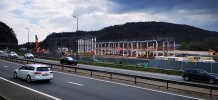
Up at Taffs Well this weekend and the depot is taking shape
 

Attachments

  • IMG_20220403_153046.jpg
    IMG_20220403_153046.jpg
    2 MB · Views: 159
  • IMG_20220403_153359.jpg
    IMG_20220403_153359.jpg
    2.2 MB · Views: 158

Top