• Our new ticketing site is now live! Using either this or the original site (both powered by TrainSplit) helps support the running of the forum with every ticket purchase! Find out more and ask any questions/give us feedback in this thread!

TfGM Bus franchising

Status
Not open for further replies.

Bletchleyite

Veteran Member
Joined
20 Oct 2014
Messages
113,225
Location
"Marston Vale mafia"
Does this mean that comparison with the existing London operations is not allowable. London seems to be mentioned as much as Manchester on this thread recently.

I don't see why it wouldn't be. It's a similar principle.

Incidentally, with reference to past comments about Germanic phraseology being used on this thread, does China or Japan also have particular phrases for transport modes that could be also used in postings?

You've got as much access to Google as I have :)
 
Sponsor Post - registered members do not see these adverts; click here to register, or click here to log in
R

RailUK Forums

Xenophon PCDGS

Veteran Member
Joined
17 Apr 2011
Messages
35,412
Location
A typical commuter-belt part of north-west England
Answer to part one of your posting......

*******************************************************************************************************
Yes, but the point that I sought to make was that comment has been made that Greater Manchester needed to be seen as a trial area, which seemed somewhat hard to comprehend when the London region system is there for all to see.
Don't know what happened computer-wise above
 

Goldfish62

Veteran Member
Joined
14 Feb 2010
Messages
13,163
How many major world cities subsidise their public transport less than London? Can't be that many.
Considering that London has zero subsidy that would be none.

It's no secret and has been pointed out many times over the past few years that London is the only world city to receive no subsidy for its operations.

Just to put the icing on the cake, TfL is the only local authority not to receive a penny from vehicle excise duty. It basically has to maintain its road network for free.
 

ScotGG

Established Member
Joined
3 Apr 2013
Messages
1,585
Yep the UK Govt (well in England) are pretty unique in the world for not supporting public transport. Then they strictly prevent much in the way of local devolution in funding power to offset that.

A rotten system.
 

Stan Drews

Established Member
Joined
5 Jun 2013
Messages
2,152
I guess you probably know - overall, in a typical urban large bus operation like Stagecoach Manchester, what proportion of income comes from BSOG (or rather did pre-COVID)?
BSOG amounts to 14.4p per km, so based on average urban bus speeds, it’s about £2.50/hr. In a profitable operation/route, that will be somewhere around 5-7% of income. Important, but its absence wouldn’t turn every viable route into a loss-maker.
 

Bletchleyite

Veteran Member
Joined
20 Oct 2014
Messages
113,225
Location
"Marston Vale mafia"
BSOG amounts to 14.4p per km, so based on average urban bus speeds, it’s about £2.50/hr. In a profitable operation/route, that will be somewhere around 5-7% of income. Important, but its absence wouldn’t turn every viable route into a loss-maker.

So with a typical urban operation, it's a bit like taking one or two extra cash single fares on each journey, I guess. Interesting, thanks.
 

TheGrandWazoo

Veteran Member
Joined
18 Feb 2013
Messages
22,918
Location
Somerset with international travel (e.g. across th
The congestion charge is only a tiny proportion of TfL's revenue. Despite the congestion charge, buses still get stuck in severe congestion, much worse than that experienced in Manchester. 20 mph limits and cycle path construction contribute to that (I have no problem with either I hasten to add), as well as the huge increase in various kinds of taxis and delivery vehicles. It isn't all plain sailing running buses in London.
London's bus services were getting >£700m in terms of subsidy from either Underground profits but the £85m p.a. from the congestion charge certainly helps (as well as the associated benefit of making car use more problematic). However, Greater Manchester isn't actually bothering with that.
The system is possible without significant increased funding. The funding would only be necessary if you wanted higher frequencies.
So no higher frequencies. Just the ability to travel between modes...
I don't really see why the population is that significant.
You don't think that if the population increases 40% from 6.7m to 9.4m in 30 years that it might have a benefit to bus patronage?

== Doublepost prevention - post automatically merged: ==

Well, the GM share of the £3bn bus levelling up funding, promised by central government over and above the emergency Covid subsidies, will surely be a start.
Well, as you know, setting up the scheme is £135m as a one off. A fair chunk of the £3bn is to fund the capital (buses and infrastructure) for low emission vehicles and when stretched across the UK, it isn't quite the start you believe it is.
What is your proposed alternative to franchising, given that the Bus Strategy effectively states that the DfT will not support a return to the pre-Covid fully deregulated system?
If you care to read back through this thread, you will see.
 
Last edited:

johncrossley

Established Member
Joined
30 Mar 2021
Messages
4,404
Location
London
Partnerships seem to be not very different to the pre-86 situation where the local authority had to negotiate with the local bus company the cost of running the service. A lot of the time the local bus company was part of the same organisation but sometimes it was part of NBC or an independent. There was no incentive to cut costs as the authority only had one choice of bus company, hence franchising in London to introduce competition to cut costs.

Nowadays the company that the authority has to deal with is part of a huge listed company, so will be able to name its own price to maximise profits. I can only see this working if there is a realistic threat of franchising if the operator doesn't offer a good service at a good price. Is there an example of a major bus operation in Europe where the operator is a private monopoly that can't be sacked?
 

domcoop7

Member
Joined
15 Mar 2021
Messages
272
Location
Wigan
Partnerships seem to be not very different to the pre-86 situation where the local authority had to negotiate with the local bus company the cost of running the service. A lot of the time the local bus company was part of the same organisation but sometimes it was part of NBC or an independent. There was no incentive to cut costs as the authority only had one choice of bus company, hence franchising in London to introduce competition to cut costs.

Nowadays the company that the authority has to deal with is part of a huge listed company, so will be able to name its own price to maximise profits. I can only see this working if there is a realistic threat of franchising if the operator doesn't offer a good service at a good price. Is there an example of a major bus operation in Europe where the operator is a private monopoly that can't be sacked?
Under partnership it wouldn't be a private monopoly. The authority could say "you must sell and accept multi modal tickets that cost £10 per week and can be used by tapping a smartphone on a terminal, and the amount you will get reimbursed is £0.x per mile. IN return we promise to spend £x million over x years on bus priority measures". Now Firstbus may then say "we'll lose money doing that so we're withdrawing". But there's nothing to stop any other operator willing to comply from operating those routes instead. And if no operator wants to do it, then either the authority has to rethink as their plans are not profitable enough, or they can put it out to tender as socially necessary.

And if operator ABC decides it is worth a go, runs the route and it's a success, they could then themselves choose, e.g. to extend it to a nearby town or rail station, or extend the hours later into the night, or double bus it during peak hours. If they can increase ridership (and therefor fare income) they can do so, subject to usual Traffic Commissioner notifications.

It's Franchising where the authority will put it out to tender and the operator decides what the cost of running the service is. If only one operator bids, then what they quote is what the authority has to pay. They'll get a fixed amount and it is on the operator to reduce their costs to the maximum extent possible in order to maximise the profit they make. The operator hands over all fare income to the authority and couldn't care less if there's one passenger per day, or it's standing room only, as it makes no odds. If there's an opportunity to increase ridership by extending the service to a nearby town or increase operating hours, the operator simply waits until the authority realises that - if they ever do - and the authority teams of bureaucrats pass it to another team of bureaucrats, and then do an equalities impact assessment, and invite consultations as to how it affects the Climate Emergency and whether or not it is a relic of Colonisation, and so on. Three years later, if the authority still decide it's a good idea, they can then ask the operator to run the extra buses, which the operator will not be bound to do unless they get paid up-front an extra sum. And if it then turns out to be a white elephant, the authority has already spent money on it, so they either fiddle with the rest of the network to force their new decision to turn out to be the right one, or they cut back elsewhere (or blame the Tories in London for not giving Our Buses [TM] the money they deserve).
 

johncrossley

Established Member
Joined
30 Mar 2021
Messages
4,404
Location
London
Under partnership it wouldn't be a private monopoly. The authority could say "you must sell and accept multi modal tickets that cost £10 per week and can be used by tapping a smartphone on a terminal, and the amount you will get reimbursed is £0.x per mile. IN return we promise to spend £x million over x years on bus priority measures". Now Firstbus may then say "we'll lose money doing that so we're withdrawing". But there's nothing to stop any other operator willing to comply from operating those routes instead. And if no operator wants to do it, then either the authority has to rethink as their plans are not profitable enough, or they can put it out to tender as socially necessary.

I don't see how this is very different from franchising if you can effectively force the incumbent out. This is effectively paying a bus company to run a network as in Jersey franchising. TfL franchising is by route but it doesn't have to be and as I understand it TfGM will be franchising in packages of routes, although they want to make some small packages available so that small operators can participate.
 

Greybeard33

Established Member
Joined
18 Feb 2012
Messages
4,335
Location
Greater Manchester
And if operator ABC decides it is worth a go, runs the route and it's a success, they could then themselves choose, e.g. to extend it to a nearby town or rail station, or extend the hours later into the night, or double bus it during peak hours. If they can increase ridership (and therefor fare income) they can do so, subject to usual Traffic Commissioner notifications.
That description does not seem to align with the highly ambitious form of Enhanced Partnership mandated by the Bus Strategy. The DfT wants the partnership to deliver a user experience similar to that of a franchised network:
To achieve our goal, this strategy will make buses more frequent, more reliable, easier to understand and use, better co-ordinated and cheaper: in other words, more like London’s, where these type of improvements dramatically increased passenger numbers, reduced congestion, carbon and pollution, helped the disadvantaged and got motorists out of their cars.
We want the same fully integrated service, the same simple, multi-modal tickets, the same increases in bus priority measures, the same high-quality information for passengers and, in larger places, the same turn-up-and-go frequencies. We want services that keep running into the evenings and at weekends.
Under this sort of partnership, the operators would have to agree routes, timetables, ticketing and fares with the LTA, which would also take over the registration role of the Traffic Commissioners. It seems to me that, particularly with the after-effects of the pandemic, there will be very few routes in GM that would be profitable commercially under this system, so TfGM would have to tender the vast majority. The TfGM bureaucracy needed to manage the partnership would be similar to that needed for franchising, with a similar level of subsidy required.
I don't see how this is very different from franchising if you can effectively force the incumbent out. This is effectively paying a bus company to run a network as in Jersey franchising. TfL franchising is by route but it doesn't have to be and as I understand it TfGM will be franchising in packages of routes, although they want to make some small packages available so that small operators can participate.
Indeed, the Bus Strategy refers approvingly to both the Jersey franchising model and TfGM-type route packaging:
Transport for London determines the network of services which are provided, under contracts for specific routes, by private sector operators. Franchising does not necessarily have to replicate this route-by route tendering. Less onerously, contracts can be let for different parts of a city or to a single operator for a whole network, with significant co-design opportunities for that operator. This is the model of the successful LibertyBus franchise in Jersey.
 

domcoop7

Member
Joined
15 Mar 2021
Messages
272
Location
Wigan
That description does not seem to align with the highly ambitious form of Enhanced Partnership mandated by the Bus Strategy. The DfT wants the partnership to deliver a user experience similar to that of a franchised network:


Under this sort of partnership, the operators would have to agree routes, timetables, ticketing and fares with the LTA, which would also take over the registration role of the Traffic Commissioners. It seems to me that, particularly with the after-effects of the pandemic, there will be very few routes in GM that would be profitable commercially under this system, so TfGM would have to tender the vast majority. The TfGM bureaucracy needed to manage the partnership would be similar to that needed for franchising, with a similar level of subsidy required.

Indeed, the Bus Strategy refers approvingly to both the Jersey franchising model and TfGM-type route packaging:
Yes you're right, there's two types of partnership. "Advanced Quality" partnership and "Enhanced" partnership. However, under both, the legal effect is that the system is still run at will by the operators.

For the Enhanced Parternships, the relevant legislation is section 6D of the Transport Act 1985, which is a new provision inserted by the Bus Services Act 2018. This states that a Traffic Commissioner (or in certain cases the local authority if they've taken responsibility from the Traffic Commissioner) must refuse registration of a new service if it doesn't meet the criteria of the Partnership scheme. However, if a private service does meet the criteria (i.e. it accepts multi-modal tickets, has the right branding, etc.) then it can't be refused - the operator is entitled to run it.

Contrast this with Franchising, where operators are legally banned from operating in a Franchise area unless they are running under a Franchise contract or have a "service permit". The DfT guidance, naively, states at paragraph 3.16 (page 13)
"Commercial services should be able to continue to operate into and out of the franchising area and to spot and fill any gaps in service provision that the authority may have overlooked - providing they do not adversely affect the franchised arrangements."
[DfT Guidance]

But I don't think that's going to happen, save for very well established out of boundary routes which don't impinge on the franchise or routes agreed with neighbouring PTEs.

From what I read on these forums, in London, where non-TfL permits are given, they're treated as if they don't exist so far as TfL is concerned, no timetable info at bus stops, not valid for TfL tickets, Oyster, etc. (And even more weirdly, where TfL services operate outside their area under the Traffic Commissioners, TfL provide some bus stops and include timetable information for non-TfL services, in the likes of Kent and Surrey!). It will be interesting to see what TfGM does.

 

Goldfish62

Veteran Member
Joined
14 Feb 2010
Messages
13,163
From what I read on these forums, in London, where non-TfL permits are given, they're treated as if they don't exist so far as TfL is concerned, no timetable info at bus stops, not valid for TfL tickets, Oyster, etc. (And even more weirdly, where TfL services operate outside their area under the Traffic Commissioners, TfL provide some bus stops and include timetable information for non-TfL services, in the likes of Kent and Surrey!). It will be interesting to see what TfGM does.
Non-TfL services running in London is a whole topic worthy of its own thread, but as it's relevant to service permits in GM I'll try to summarise the position.

Here, I'm just referring to traditional local bus services, not NX, Green line, tour services etc which also fit the legal definition of local services dependent on stopping patterns etc.

There are legally only two ways to operate a local service in London:
- under a London Service Permit (LSP) granted by TfL. Such services run completely independently of the TfL network.
- under a London Local Service Agreement (LLSA). Such services are required to adopt the TfL fares scale and accept all TfL tickets in London, plus accept TfL performance standards, in return for an agreed reimbursement rate on fares. Given that Oyster is a bespoke system and an operator would have to fund provision of the equipment it is not surprising that services under LLSAs have all been withdrawn or converted to LSPs. Arriva's 422 and 477, which converted to LSP did for a while have a commercial arrangement whereby within London they charged a flat rate low fare if a passenger showed a valid Oyster card (validity checked by the driver using a handheld scanner).

In respect of publicity, timetables for LSP services should be posted at TfL bus stops, but TfL's publicity department has been in a state of chaos for a few years. However, they do generally appear on Journey Planner, but this requires manual input into the system.

The aspect whereby local services into London (eg the North Surrey network) are not an integral part of the London bus network is unsatisfactory, but is dictated by primary legislation (GLA Act 1999). I hope Greater Manchester manages better.
 

lincman

Member
Joined
11 Jan 2014
Messages
137
Can someone please explain to me how what is being proposed in Greater Manchester is a franchise? It looks to me that it is just converting all services to minimum cost contracts, or am I missing something?
 
Last edited by a moderator:

johncrossley

Established Member
Joined
30 Mar 2021
Messages
4,404
Location
London
Can someone please explain to me how what is being proposed in Greater Manchester is a franchise, it looks to me that it is just converting all services to minimum cost contracts, or am I missing something.

What would you call TfL bus franchising? Presumably you would call what will happen in GM the same.
 

Bletchleyite

Veteran Member
Joined
20 Oct 2014
Messages
113,225
Location
"Marston Vale mafia"
What would you call TfL bus franchising? Presumably you would call what will happen in GM the same.

Contracting? It isn't classic franchising, which is a business owner buying into a brand and service concept, but then neither is rail franchising.

Personally I call it re-regulation, opposite of deregulation.
 

RT4038

Established Member
Joined
22 Feb 2014
Messages
5,455
Contracting? It isn't classic franchising, which is a business owner buying into a brand and service concept, but then neither is rail franchising.

Personally I call it re-regulation, opposite of deregulation.
Re-regulation, with commercial companies doing vehicle, crew and operation contracting.

Rail franchising (was) more like a fairly tightly prescriptive classic franchising, as there was some freedom of action with pricing and consequent revenue risk. I am not sure how much more (say) a McDonalds franchise has to a rail franchisee? Not ever so much I would guess?
 

Deerfold

Veteran Member
Joined
26 Nov 2009
Messages
13,703
Location
Yorkshire
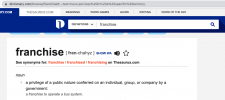
I do not consider TFL bus services franchises, they are by definition minimum cost contracts.,

noun​

a privilege of a public nature conferred on an individual, group, or company by a government:a franchise to operate a bus system.
 

Attachments

  • Screenshot 2021-04-16 at 21.17.19.png
    Screenshot 2021-04-16 at 21.17.19.png
    173.2 KB · Views: 7
Last edited by a moderator:

lincman

Member
Joined
11 Jan 2014
Messages
137
I thank you for the trouble you have gone to provide the definitions, but the point remains TFGM are not conferring a privilege, they are selling the right by tender operate sections of the network. Operators will operate with a reasonable margin and no revenue risk.
 

Cesarcollie

Member
Joined
5 Jun 2016
Messages
829
I thank you for the trouble you have gone to provide the definitions, but the point remains TFGM are not conferring a privilege, they are selling the right by tender operate sections of the network. Operators will operate with a reasonable margin and no revenue risk.

They are actually confiscating existing businesses first, then renting the rights to operate for a defined period. Stagecoach (and others) paid money for a business which included vehicles, premises and goodwill - and ironically it was GMPTE who originally ‘sold’ the North and South businesses and collected the cash! Now they’re taking them back with no compensation......Right, now I’ve lit the blue touch paper, I’ll stand well back.
 

Xenophon PCDGS

Veteran Member
Joined
17 Apr 2011
Messages
35,412
Location
A typical commuter-belt part of north-west England
They are actually confiscating existing businesses first, then renting the rights to operate for a defined period. Stagecoach (and others) paid money for a business which included vehicles, premises and goodwill - and ironically it was GMPTE who originally ‘sold’ the North and South businesses and collected the cash! Now they’re taking them back with no compensation......Right, now I’ve lit the blue touch paper, I’ll stand well back.
Has there previously been such a public sector sell, then take-back without compensation, commercial proposition as you describe above?
 

Deerfold

Veteran Member
Joined
26 Nov 2009
Messages
13,703
Location
Yorkshire
They are actually confiscating existing businesses first, then renting the rights to operate for a defined period. Stagecoach (and others) paid money for a business which included vehicles, premises and goodwill - and ironically it was GMPTE who originally ‘sold’ the North and South businesses and collected the cash! Now they’re taking them back with no compensation......Right, now I’ve lit the blue touch paper, I’ll stand well back.
They're not taking back the vehicles. If they take back the depots, it'll only be by agreement and they'll be paid for.

You can argue about the goodwill, but it sounds like you're suggesting they'll confiscate their assets

== Doublepost prevention - post automatically merged: ==

Has there previously been such a public sector sell, then take-back without compensation, commercial proposition as you describe above?
The public sector sell off included the property and buses. Many people made a lot of money by selling them on.
 

lincman

Member
Joined
11 Jan 2014
Messages
137
They are actually confiscating existing businesses first, then renting the rights to operate for a defined period. Stagecoach (and others) paid money for a business which included vehicles, premises and goodwill - and ironically it was GMPTE who originally ‘sold’ the North and South businesses and collected the cash! Now they’re taking them back with no compensation......Right, now I’ve lit the blue touch paper, I’ll stand well back.
The original sale was to employee owned companies at far less than market value. PTE got nothing from First or Stagecoach
 

Cesarcollie

Member
Joined
5 Jun 2016
Messages
829
The original sale was to employee owned companies at far less than market value. PTE got nothing from First or Stagecoach

I accept property - if purchased - will be paid for. Goodwill will not, and vehicles may or may not be purchased - but if they’re not, they may have to be sold in a fire sale at less than market value (accepting that Groups probably have ability to cascade elsewhere, but not SMEs). PTE got money from the original purchasers - and through a competitive process so a fair value at the time- like most businesses there have been subsequent sales.
 
Status
Not open for further replies.

Top