
"The driver’s actions in checking what had happened to his locomotive before contacting the signaller were consistent with the wording of the Rule Book. RSSB5 has since reported that an amendment to the Rule Book will come into force in December 2020 which will require the driver to inform the signaller of an accident before checking if any other lines are affected."

-
Our new ticketing site is now live! Using either this or the original site (both powered by TrainSplit) helps support the running of the forum with every ticket purchase! Find out more and ask any questions/give us feedback in this thread!
You are using an out of date browser. It may not display this or other websites correctly.
You should upgrade or use an alternative browser.
You should upgrade or use an alternative browser.
Derailment in the Bromsgrove area (24/03/2020)
- Thread starter Murray J
- Start date
- Status
- Not open for further replies.
Sponsor Post - registered members do not see these adverts; click here to register, or click here to log in
R
RailUK Forums
Tom Quinne
On Moderation
- Joined
- 8 Jul 2017
- Messages
- 2,225
His actions post derailment were just as bad. Why didn’t he make an emergency call on the GSMR? 47 seconds would’ve slowed the 170 right down.
47 seconds, enough to “slow the 170 right down” no chance!
66 hits stop block, RAIB say circa 20 seconds for the driver to realise what had gone on.
Thats 27 seconds until impact, it’s a good 15-20 seconds to get a REC out - bare in mind the driver is in shock so probably wouldn’t of got a clear broadcast out anyway.
Best case your looking 17 seconds impact, 5 second process time for the 170 driver to realise he was in danger.
12 seconds to impact - 170 driver sees obstruction anyway.
A REC from the 66 would of made zero difference to the outcome, thankfully the driver was switched on enough go clear the line of himself seconds prior to impact or “we” wouldn’t have him to drag through the coals on here.

Thats 27 seconds until impact, it’s a good 15-20 seconds to get a REC out - bare in mind the driver is in shock so probably wouldn’t of got a clear broadcast out anyway.
I thought the point of the of the big red button is that it was an immediate "all stop" button. Is that 15-20 seconds the time it takes for the driver to push the button and it be received in the other cab, as that does seem quite slow? Or do you have to send a message along with pushing the button

No they weren’t. Only between separated parentsParagraph 50 of the report is incorrect.
Children were permitted to move between different households for childcare reasons during lockdown
Tom Quinne
On Moderation
- Joined
- 8 Jul 2017
- Messages
- 2,225
I thought the point of the of the big red button is that it was an immediate "all stop" button. Is that 15-20 seconds the time it takes for the driver to push the button and it be received in the other cab, as that does seem quite slow? Or do you have to send a message along with pushing the button
Yes as soon as the REC is received in the driving cab it’s a EM brake, but it takes a good 5-10 seconds to broadcast and activate.
Im saying even if the 66 driver had had the presence of mind to put a REC out as soon as he regained his senses the 170 wouldn’t of “slowed right down” as our friend suggested.

I'm not trying to excuse the driver, but his 'family member' repeatedly calling or texting them while clearly knowing they were at work and likely to be driving at the time was also highly irresponsible in my view. Of course, he should have ignored those communications until he was in a position to reply safely but equally having such a major change to all routines suddenly imposed overnight like that against a background of global death and disease probably had him practically bricking it. I know I was not in a normal state of mind the following day and for some time afterwards, but then I don't drive trains for a living. I wonder if there was a spike in other kinds of industrial accidents and injuries on that particular night. I suspect these kinds of unintended consequence are partly the reason subsequent changes to COVID restrictions have been announced a few days ahead of implementation. I note the report does not mention track circuit interrupters, potential mitigation that could be applied at buffer stops to drop a signal aspect for an adjacent line to red. The event unfolded so quickly in this case however that, even if a TCI had been provided, it's not clear that could have mitigated the event as the XC train might already have passed the protecting signal. The thing that amazes me is how a driver can roll continuously towards a brightly lit buffer stop seemingly unaware of the situation. It's almost if the worry had put him in some kind of catatonic state. The modern buffere stop lights are LED tech, very bright today and exrtremely unlikely to fail unexpectedly.

bramling
Veteran Member
yes, but that’s why drivers are classed as professional and get paid the salary they do. These sorts of issues get sorted whilst in the mess room or at home, not whilst sat in the driving seat. He’s lucky he didn't derail the XC and kill someone. This incident is totally inexcusable and I’m sure he is now paying dearly for it.
I can see both sides if it. I bet he wasn’t the only one worrying that night about childcare.
I'm not trying to excuse the driver, but his 'family member' repeatedly calling or texting them while clearly knowing they were at work and likely to be driving at the time was also highly irresponsible in my view. Of course, he should have ignored those communications until he was in a position to reply safely but equally having such a major change to all routines suddenly imposed overnight like that against a background of global death and disease probably had him practically bricking it. I know I was not in a normal state of mind the following day and for some time afterwards, but then I don't drive trains for a living. I wonder if there was a spike in other kinds of industrial accidents and injuries on that particular night. I suspect these kinds of unintended consequence are partly the reason subsequent changes to COVID restrictions have been announced a few days ahead of implementation. I note the report does not mention track circuit interrupters, potential mitigation that could be applied at buffer stops to drop a signal aspect for an adjacent line to red. The event unfolded so quickly in this case however that, even if a TCI had been provided, it's not clear that could have mitigated the event as the XC train might already have passed the protecting signal. The thing that amazes me is how a driver can roll continuously towards a brightly lit buffer stop seemingly unaware of the situation. It's almost if the worry had put him in some kind of catatonic state. The modern buffere stop lights are LED tech, very bright today and exrtremely unlikely to fail unexpectedly.
He certainly won’t have been the only person in a state of near-panic that night. Most people however won’t have had to then go out and do a night shift of safety-critical work straight afterwards.
I have mixed views on this. He should have had his phone off and he certainly shouldn’t have been texting whilst driving a train, however it seems the texting wasn’t happening at the time of the incident, so it was more the stress which caused it. When stressed trying to resolve the situation can actually be one way of dealing with it.
In reality he shouldn’t have been on the train in the first place. On that score he deserves some slack, his 14 years of blemish-free record should count for something, it was perhaps a misguided mark of professionalism that he did turn up for work rather than throw in the towel.
edwin_m
Veteran Member
Changing lights to red wouldn't have had any effect in this accident, because drivers of approaching trains would expect to see a loco there with tail lights lit waiting for the banking duty.It says he complied with the rule book in what he did (apart from not changing his lights to red) - its due to be changed in December though to require drivers to contact the signaler before getting out to see whats happened..

the sniper
Established Member
- Joined
- 4 Sep 2007
- Messages
- 3,498
Given how much time they'd have had at Bromsgrove to do whatever they'd liked, it just makes it worse...
In reality he shouldn’t have been on the train in the first place. On that score he deserves some slack, his 14 years of blemish-free record should count for something, it was perhaps a misguided mark of professionalism that he did turn up for work rather than throw in the towel.
It wasn't picked up in the report and probably not relevant to be fair. But I did idly wonder if he had had to book on with someone face to face rather than remotely via telephone if the person booking him on might have noticed that they were struggling. Even if they had it might not (indeed probably wouldn't) have changed anything. But thought still occured.
bramling
Veteran Member
It wasn't picked up in the report and probably not relevant to be fair. But I did idly wonder if he had had to book on with someone face to face rather than remotely via telephone if the person booking him on might have noticed that they were struggling. Even if they had it might not (indeed probably wouldn't) have changed anything. But thought still occured.
A face-to-face book-on is preferable in so many ways.
Even if he’d continued with his duty, the manager might have given some words of reassurance, either by clarifying the situation, or simply something like “don’t worry lots of people are in the same boat, if you have difficulties we’ll try and be flexible”.
Train cabs are a terrible place when people have worries on their mind, as these worries tend to amplify and circulate. Trying to address the problem wasn’t a bad strategy in itself, just not whilst actually driving the train.
Tom Quinne
On Moderation
- Joined
- 8 Jul 2017
- Messages
- 2,225
I really hope the chap didn’t loose this job, I suspect he did however. ASLEF & RMT policy is no defence against D&A offences or mobile in the cab.
I’m of the view once you mess up, you never do it again. No punishment will take away how lucky both drivers where that night, I fear the driver will loose literally everything following the events of that night.
Those who seem to take delight, and pass judgement should case their minds back to the last time they used their phone or sped. Yes he’s a professional driver at the controls of a 126t locomotive, no he shouldn’t of been using his phone, yes at least two people could of been killed that night.
But, he needs support not punishment - you can bet your life he’ll never use his mobile at work again.
== Doublepost prevention - post automatically merged: ==
Are there many places at crew book on face to face these days?
Last time I booked on face to face (when I was train crew) was 2004!
I’m of the view once you mess up, you never do it again. No punishment will take away how lucky both drivers where that night, I fear the driver will loose literally everything following the events of that night.
Those who seem to take delight, and pass judgement should case their minds back to the last time they used their phone or sped. Yes he’s a professional driver at the controls of a 126t locomotive, no he shouldn’t of been using his phone, yes at least two people could of been killed that night.
But, he needs support not punishment - you can bet your life he’ll never use his mobile at work again.
== Doublepost prevention - post automatically merged: ==
A face-to-face book-on is preferable in so many ways.
Even if he’d continued with his duty, the manager might have given some words of reassurance, either by clarifying the situation, or simply something like “don’t worry lots of people are in the same boat, if you have difficulties we’ll try and be flexible”.
Train cabs are a terrible place when people have worries on their mind, as these worries tend to amplify and circulate. Trying to address the problem wasn’t a bad strategy in itself, just not whilst actually driving the train.
Are there many places at crew book on face to face these days?
Last time I booked on face to face (when I was train crew) was 2004!
Deepgreen
Established Member
In their blind rush to get the story on-line this afternoon the BBC referred to it as a class 65 (and of no class at all in the caption!). It always amazes me that such stories aren't checked before posting - it only takes a few seconds and it's hardly 'breaking' news! It's been corrected now.
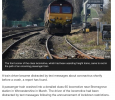
Obviously no excuse for using your phone while doing safety critical work but it should be remembered that he wasn't actually using it in the minutes upto or during the accident. Had he legitimately used his phone before hand then the same result probably would have happened. It's quite amazing the level of sympathy (or lack of) on this incident vs the Neville Hill one.
At least they mentioned it, even if it's wrong. They have a habit of referring to any train as a "locomotive" even when it's a multiple unit, so this is progress of sorts.In their blind rush to get the story on-line this afternoon the BBC referred to it as a class 65 (and of no class at all in the caption!). It always amazes me that such stories aren't checked before posting - it only takes a few seconds and it's hardly 'breaking' news! It's been corrected now.
View attachment 86108
This is quite a shocking and sad story to hear but at least there were no injuries.
I don't work in the rail industry so I'm curious about the mobile policy. I realise that using a phone whilst driving a train is a big no no just as it is when driving a car. However I am curious about comments about a phone in the cab. Are train drivers not even allowed to have a phone with them at all whilst on duty? (For example, only using it on break periods)? They must leave it in a locker at the depot or something like that?
the sniper
Established Member
- Joined
- 4 Sep 2007
- Messages
- 3,498
Obviously no excuse for using your phone while doing safety critical work but it should be remembered that he wasn't actually using it in the minutes upto or during the accident. Had he legitimately used his phone before hand then the same result probably would have happened. It's quite amazing the level of sympathy (or lack of) on this incident vs the Neville Hill one.
Just their thoughts turned to the picture, rather than their eyes, after passing the last signal, according to the report. Though you could only take the Driver's word for that, as there's no way to prove if you're just looking at a phone.
joncombe, our TOC policy says mobile phones must be switched off when in the driving cab that the train is being driven from. Nothing to stop you having it on during a PNB. Some drivers prefer to leave it switched off in their locker so there can be no doubt that they weren’t using it if something goes wrong. I keep mine in my bag out of reach. I also ask any authorised cab pass holders whether their phone is switched off when they get in. Very often they have to switch it off as they have forgotten to do so or don’t know the rules of our TOC. Can’t speak for others.
Tom Quinne
On Moderation
- Joined
- 8 Jul 2017
- Messages
- 2,225
Some FOCs have very different polices to electronic devices in the cab to TOCs.
Robertj21a
On Moderation
- Joined
- 22 Sep 2013
- Messages
- 7,691
Amazing if true.What? In the rulebook having a mooch around takes precedence over making a call to get the job stopped in the area?
Genuine question.

Not sure about on the Mainline, but every LU driver (officially) books on face-to-face.Are there many places at crew book on face to face these days?
Last time I booked on face to face (when I was train crew) was 2004!
Dieseldriver
Member
- Joined
- 9 Apr 2012
- Messages
- 1,020
Agreed. I'm not condoning the fact he was using his phone at all during the trip but the fact is, the evidence suggests he wasn't actually using it at the time of the incident, the incident being caused by distractions in his mind rather than an actual phone. I am of the opinion that this incident could very possibly have still occurred even if he didn't breach the mobile phone policy (if prior to booking on he had had the same conversation and it had continued to play on his mind).Obviously no excuse for using your phone while doing safety critical work but it should be remembered that he wasn't actually using it in the minutes upto or during the accident. Had he legitimately used his phone before hand then the same result probably would have happened. It's quite amazing the level of sympathy (or lack of) on this incident vs the Neville Hill one.
Amazing if true.
If you read the report it goes into the matter in some detail and concludes the driver acted basically appropriately and in accordance with the rules, taking into account the challenges of the particular situation, at least in terms of his actions following the initial collision with the stops.
It also says from the December amendment the requirement to stop the job will take priority over investigating.
Dave W
Member
We almost certainly won't find out, but the outcome of this would be interesting to know - I wonder if the company cut some slack in light of the circumstances that night.
I think the case for the prosecution is rather obvious, but must say this:
... is very pertinent.
I think the case for the prosecution is rather obvious, but must say this:
I can see both sides if it. I bet he wasn’t the only one worrying that night about childcare.
He certainly won’t have been the only person in a state of near-panic that night. Most people however won’t have had to then go out and do a night shift of safety-critical work straight afterwards.
I have mixed views on this. He should have had his phone off and he certainly shouldn’t have been texting whilst driving a train, however it seems the texting wasn’t happening at the time of the incident, so it was more the stress which caused it. When stressed trying to resolve the situation can actually be one way of dealing with it.
In reality he shouldn’t have been on the train in the first place. On that score he deserves some slack, his 14 years of blemish-free record should count for something, it was perhaps a misguided mark of professionalism that he did turn up for work rather than throw in the towel.
... is very pertinent.

Amazing if true.
Well yes, although others have pointed out it changes in December. My question then would be why December and why does it only need to be changed now?
SuspectUsual
Established Member
- Joined
- 11 Jul 2018
- Messages
- 6,854
I'm not trying to excuse the driver, but his 'family member' repeatedly calling or texting them while clearly knowing they were at work and likely to be driving at the time was also highly irresponsible in my view
I don’t think there’s remotely enough background information to make that sort of statement. If he’s separated from the mother of his child, and it’s been acrimonious, her considering his job’s rules is pretty unlikely. I could quite imagine a text along the lines of “you sort it out or you won’t see your child”. I know that because I’ve been on the receiving end of it
the sniper
Established Member
- Joined
- 4 Sep 2007
- Messages
- 3,498
Agreed. I'm not condoning the fact he was using his phone at all during the trip but the fact is, the evidence suggests he wasn't actually using it at the time of the incident, the incident being caused by distractions in his mind rather than an actual phone. I am of the opinion that this incident could very possibly have still occurred even if he didn't breach the mobile phone policy (if prior to booking on he had had the same conversation and it had continued to play on his mind).
Evidence, other than the Driver's own account, would only prove if a message was sent or received during that time though.
Tom Quinne
On Moderation
- Joined
- 8 Jul 2017
- Messages
- 2,225
I don’t think there’s remotely enough background information to make that sort of statement. If he’s separated from the mother of his child, and it’s been acrimonious, her considering his job’s rules is pretty unlikely. I could quite imagine a text along the lines of “you sort it out or you won’t see your child”. I know that because I’ve been on the receiving end of it
Exactly, maybe we could cut him some slack.
Dieseldriver
Member
- Joined
- 9 Apr 2012
- Messages
- 1,020
Yes, but surely that could be true of every incident? The facts are that in the immediate build up and during the incident, he was not actively sending/receiving texts or making/receiving phone calls, yes he was throughout the journey prior to that point but that is not proof that he was using his phone at the time of the incident.Evidence, other than the Drivers own account, would only prove if a message was sent or received during that time though.
the sniper
Established Member
- Joined
- 4 Sep 2007
- Messages
- 3,498
Exactly, maybe we could cut him some slack.
Fate has luckily already cut them quite a lot of slack, in that both they, the Cross Country Driver, the DB Cargo Driver travelling on the Cross Country service, the Cross Country Guard and passengers all lived to tell the tale.
Last edited:
Robertj21a
On Moderation
- Joined
- 22 Sep 2013
- Messages
- 7,691
My query would be how ordinary rail staff, let alone their Unions, could have not raised this as a matter of simple common sense. How long has it been the case - years, decades ?Well yes, although others have pointed out it changes in December. My question then would be why December and why does it only need to be changed now?
- Status
- Not open for further replies.